Article | The Long Pursuit Of Precision A Journey Through Chronometry 1797 1935
The Long Pursuit of Precision: A Journey Through Chronometry, 1797–1935
Offered in the Phillips Geneva Watch Auction: XXIII, this extraordinary group of 11 watches traces the long, intricate history of chronometry from the age of longitude to the flying tourbillon.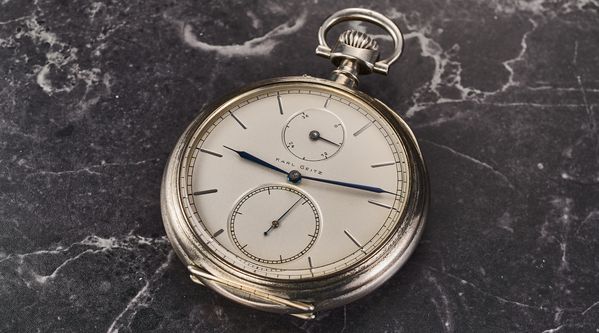
Our first live auction of 2026, the PHILLIPS Geneva Watch Auction: XXIII, takes place on 9 & 10 May, at the Hotel President, at Quai Wilson 47, in central Geneva. The auction includes more than 200 of the world's finest watches – and though we are loath to boast, we truly think it's one of the best catalogues we've ever put together. We'll be highlighting a number of the most interesting lots and stories from the sale over the next month, including the five incredible watches featuring cloisonné enamel dials featured below.
– By Logan Baker
If you want to understand why mechanical watchmaking still matters, you have to go back to a time when it wasn’t a luxury. It was a necessity.
In the 18th century, timekeeping wasn’t about convenience. It was about survival – and power. The ability to determine longitude at sea was one of the great unsolved problems of the age, and whoever solved it would control global navigation. The British government put up a reward. The challenge was simple to state and brutally difficult to solve: build a clock that could keep time accurately enough, over long voyages and changing conditions, to allow a ship to know where it was.
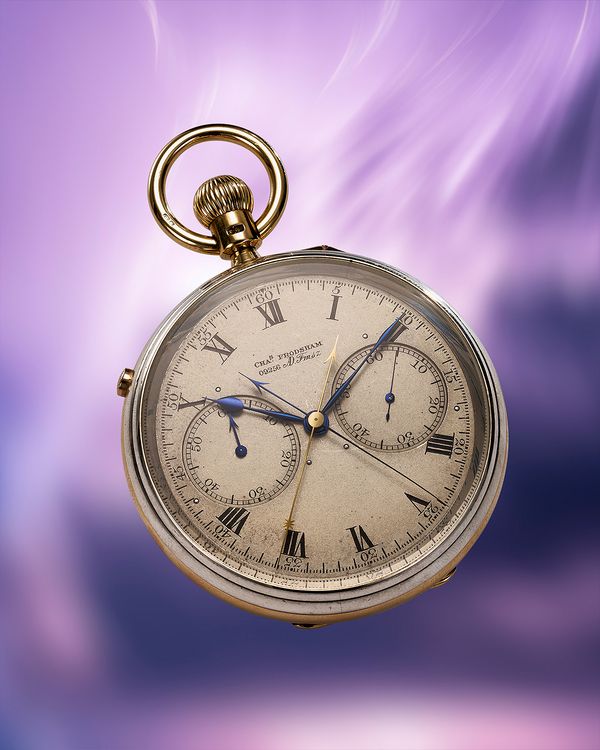
Lot 13: A 1909 Charles Frodsham split-seconds chronograph tourbillon pocket watch in silver and 18k pink gold that's included in the Phillips Geneva Watch Auction: XXIII. Estimate: CHF 30,000 - 60,000
History remembers John Harrison as the winner. But what’s more interesting is that he wasn’t alone.
Across England and Europe, a handful of watchmakers were working toward the same goal, each convinced they had found the right answer. What followed wasn’t a single breakthrough. It was a long, messy, deeply intellectual process – one that played out over more than a century.
The 11 timepieces gathered in the Phillips Geneva Watch Auction: XXIII offer a way to follow that process, not as an abstract idea, but through the watches themselves.
They span the late 18th century to the interwar period and show how different makers in different countries approached the same problem from entirely different directions.
Where It Begins: Mudge and the Problem of Longitude
The story opens, as it should, in England, with a marine chronometer built around the ideas of Thomas Mudge.
Mudge is best known today as the inventor of the detached lever escapement, but in his own lifetime, he was also a serious contender in the race for longitude. His marine timekeepers, completed in the 1770s, were technically ambitious and built around a constant-force principle intended to deliver consistent energy to the regulating organ.
He didn’t win the prize. That distinction went to Harrison. But Mudge never believed he had lost on merit.
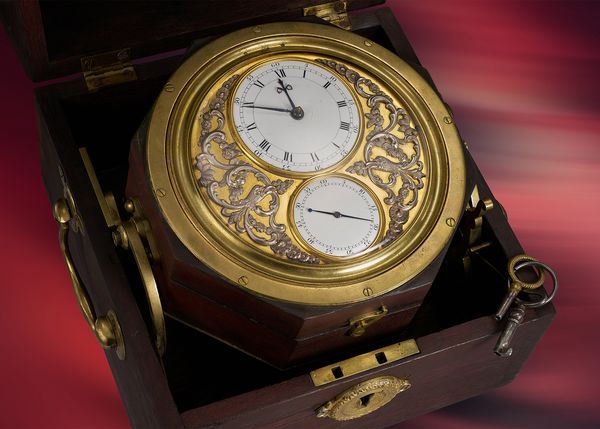
Lot 131: A circa 1797 Robert Pennington and Richard Pendleton gilt and wood one-day marine chronometer, signed No. 25, and based on the work of Thomas Mudge. Included in the Phillips Geneva Watch Auction: XXIII. Estimate: CHF 80,000 - 160,000
After his death, his son – Thomas Mudge Jr., a lawyer by training – set out to prove the point. In 1794, he established a small workshop with Howells, Pennington, and Pendleton to produce faithful copies of his father’s timekeepers.
The project was ambitious and, ultimately, unsustainable. Only 26 examples were completed before the enterprise collapsed under its own cost. One of those is Timekeeper No. 25, a one-day marine chronometer dating to circa 1797. It survives today in remarkably unaltered condition. More than anything, it represents a kind of counterfactual: a different path in the early history of precision timekeeping, preserved in physical form.
It also sets the tone for everything that follows. From the very beginning, chronometry was a debate.
The Idea Spreads: Germany and Switzerland Enter the Conversation
By the early 19th century, the pursuit of precision was no longer confined to England.
In Dresden, Johann Christian Friedrich Gutkaes was developing his own approach. Today, he’s often remembered as the teacher of Ferdinand Adolph Lange (founder of A. Lange & Söhne), but his work stands on its own.
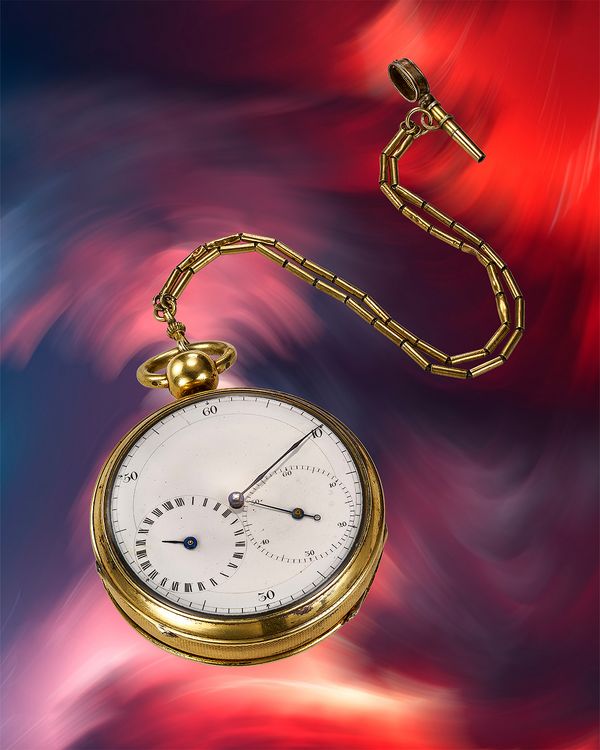
Lot 185: A circa 1840 Johann Christian Friedrich Gutkaes pocket chronometer in silver with an Earnshaw detent escapement utilizing a fusée-and-chain transmission and a helical balance spring. Included in the Phillips Geneva Watch Auction: XXIII. Estimate: CHF 10,000 - 20,000
Among his rarest creations are a small number of pocket chronometers – no more than ten are known – built with detent escapements, fusée-and-chain transmission, and a level of refinement that places them within the highest traditions of chronometry. These were not experimental curiosities. They were serious instruments, built for performance.
At roughly the same time, in Le Locle, Switzerland, Louis Richard was pushing things even further.
Richard is one of those figures who should be better known than he is. He approached watchmaking almost like a scientist, acquiring astronomical instruments, conducting his own observations, and testing his watches under controlled conditions – heat, cold, and everything in between.
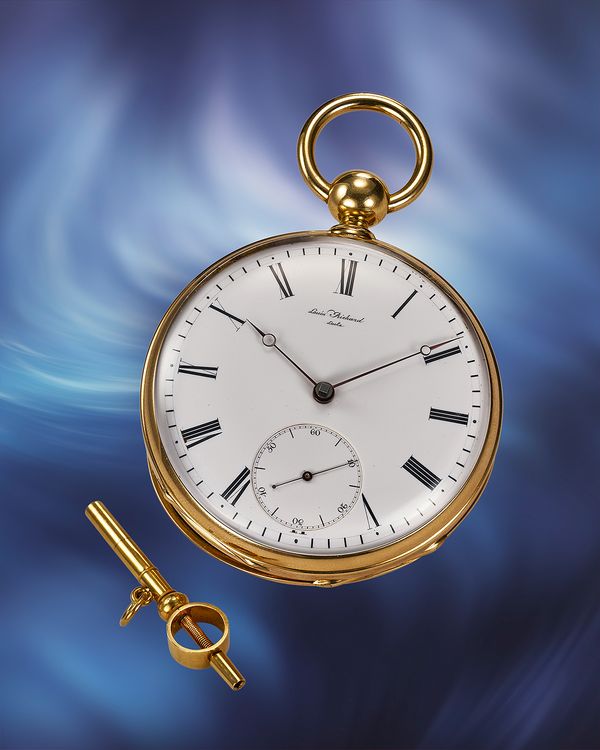
Lot 108: A circa 1860 Louis Richard triple-detent constant force one-minute tourbillon pocket chronometer in 18k yellow gold that's included in the Phillips Geneva Watch Auction: XXIII. Estimate: CHF 100,000 - 200,000
He also played a central role in establishing the Swiss marine chronometer industry, helping lay the groundwork for what would become one of the defining strengths of Swiss watchmaking.
Two watches illustrate the range of his thinking.
The first, from around 1860, is almost hard to comprehend. It combines a constant-force mechanism with a tourbillon regulator and a triple-detent escapement – three systems, each complex in its own right, brought together into a single construction. It’s believed to be unique.
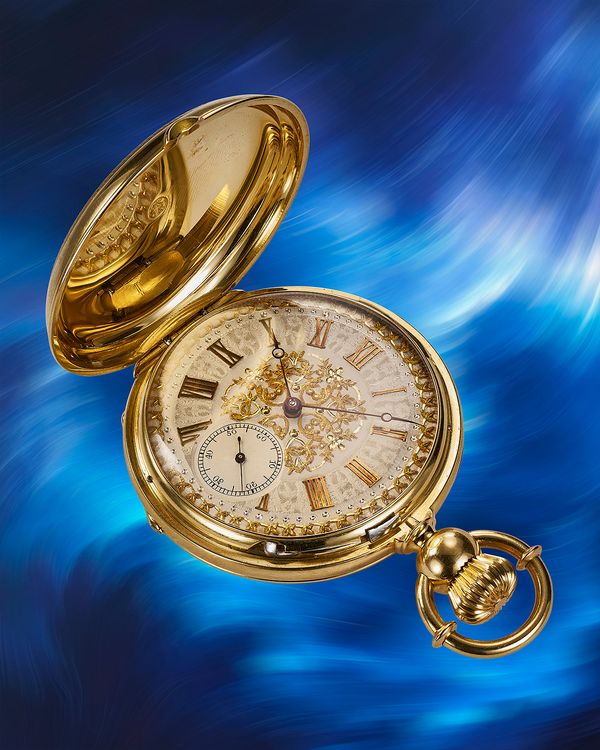
Lot 129: A circa 1870 Louis Richard triple-bridge tourbillon pocket watch in 18k yellow gold that's included in the Phillips Geneva Watch Auction: XXIII. Estimate: CHF 30,000 - 60,000
The second, from circa 1870, shows a different side of Richard’s work. Its three-bridge architecture anticipates the visual language that would later be associated with Girard-Perregaux, with the regulating organ framed beneath a sequence of bridges that are as much about structure as they are about aesthetics.
Pushing the Limits: Late 19th-Century Experimentation
By the late 19th century, the focus shifted. The problem of basic precision had, to a large extent, been solved. What remained was refinement – and competition.
Victor Kullberg represents this moment well.
Born in Sweden and later based in London, Kullberg became one of the leading chronometer makers of his time, supplying marine chronometers to multiple navies and earning recognition through observatory trials. His work sits firmly within the English tradition, but with its own distinctive twists.
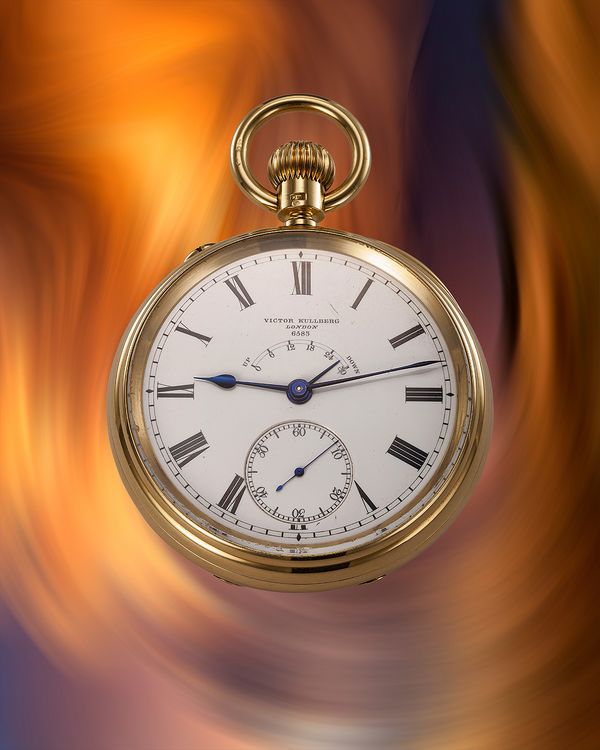
Lot 130: A circa 1890 Victor Kullberg one-minute tourbillon pocket chronometer in 18k yellow gold with Earnshaw spring detent escapement. Included in the Phillips Geneva Watch Auction: XXIII. Estimate: CHF 40,000 - 80,000
Among his rarest creations are three tourbillon pocket chronometers. Only one of them incorporates a detent escapement. That watch stands as a kind of culmination of 19th-century thinking: the tourbillon, designed to average positional errors, combined with the detent escapement, prized for its minimal friction and precision.
By this point, the question is no longer how to achieve precision. It’s how far it can be pushed.
Precision Measured: The Age of Observatory Trials
In the early 20th century, chronometry became more formalized. Precision was tracked and tested, not just claimed.
Observatories in places like Kew, Neuchâtel, and Geneva provided a standardized way to evaluate performance, subjecting watches to controlled conditions and scoring them based on their rate stability.
Paul Ditisheim was one of the great figures of this period.
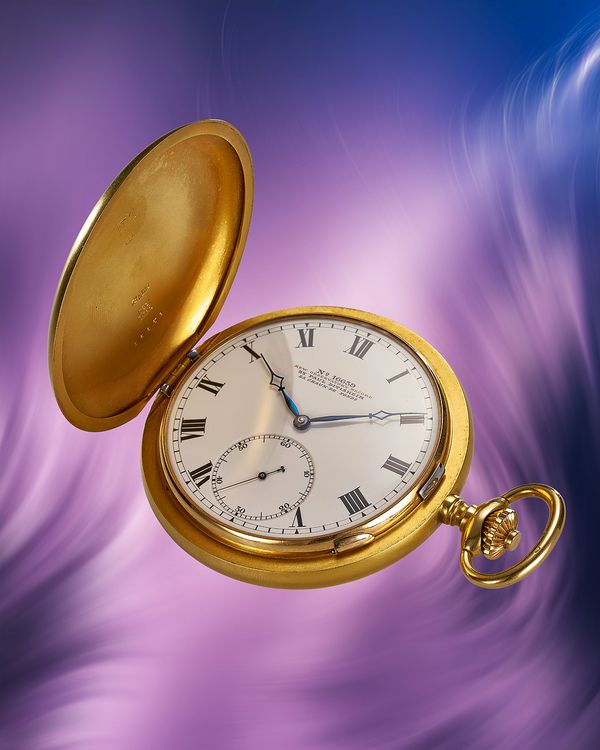
Lot 138: A 1903 Paul Ditisheim one-minute detent escapement tourbillon pocket watch with Guillaume balance in 18k yellow gold. Included in the Phillips Geneva Watch Auction: XXIII. Estimate: CHF 60,000 - 120,000
Working in La Chaux-de-Fonds, he dedicated his career to understanding how temperature, pressure, and magnetism affected timekeeping. His watches were the result of systematic study, and the results speak for themselves.
One of his tourbillon chronometers, made in 1903, achieved a score of 94.9 points at Kew Observatory – a record at the time. Only eight tourbillons are known from Ditisheim. This one sits at the very top of that small group.
At the same time, in England, Charles Frodsham continued the country’s long tradition of precision timekeeping.
One of his watches combines a one-minute tourbillon with a split-seconds chronograph, housed in a rare two-tone case and tested at Kew, where it received a Class A certificate.
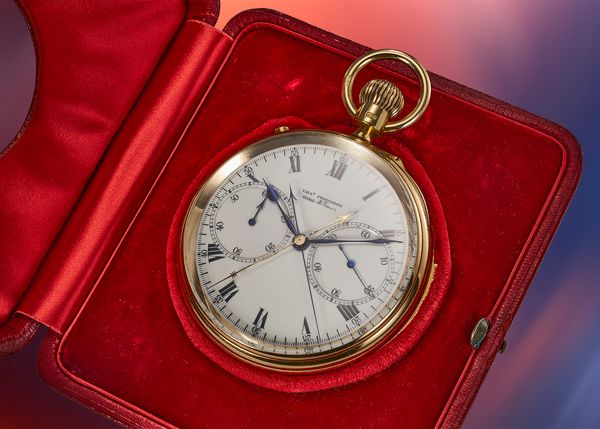
Lot 136: A circa 1928 Charles Frodsham minute repeating, split-seconds chronograph pocket watch in 18k yellow gold with one-minute tourbillon, originally sold to J.P. Morgan Jr. Included in the Phillips Geneva Watch Auction: XXIII. Estimate: CHF 70,000 - 140,000
Another, larger and even more complex, adds a minute repeater to the mix.
Commissioned by J.P. Morgan Jr. as part of a series of gifts, it eventually found its way to Thomas Lamont, one of the most influential financiers of the early 20th century.
The Final Chapter: Precision in the 20th Century
By the 1920s and 1930s, the world was changing.
Electrical timekeeping is beginning to emerge. Navigation is evolving. But mechanical chronometry hasn’t stopped. If anything, it became more refined.
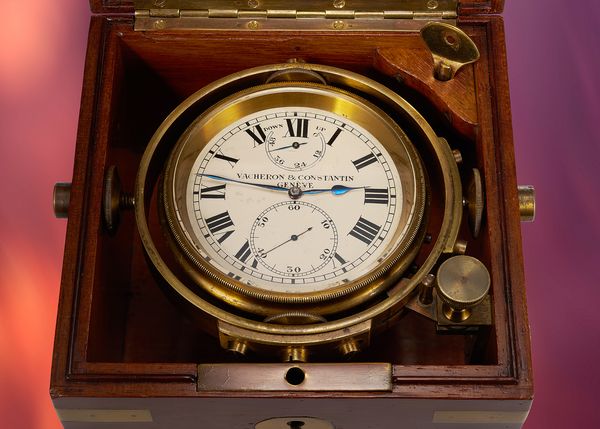
Lot 222: A circa 1926 Vacheron & Constantin gimballed two-day marine chronometer with detent escapement that's included in the Phillips Geneva Watch Auction: XXIII. Estimate: CHF 20,000 - 40,000
A marine chronometer by Vacheron Constantin from 1926 clearly demonstrates this.
It abandons the traditional fusée in favor of a spring barrel with stop-work, resulting in a slimmer, more modern movement, while retaining a detent escapement.
A Breguet tourbillon from around 1930 offers a different perspective. Its movement, built around a tourbillon supplied by James Pellaton, reflects the continued importance of specialized expertise within watchmaking. Its aesthetic choices – an enamel dial, an engraved case – demonstrate that, even at this level of technical sophistication, design still mattered.
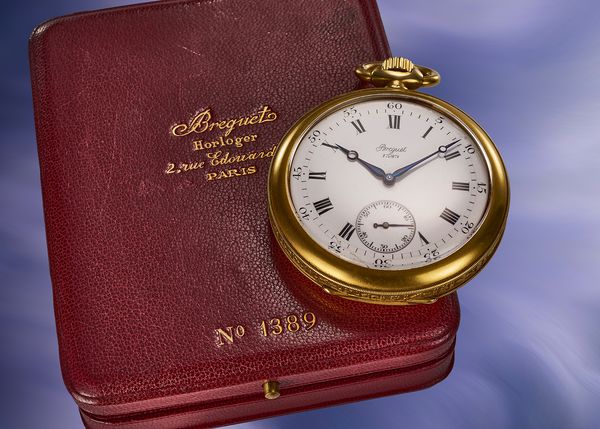
Lot 91: A circa 1930 Breguet one-minute tourbillon pocket watch in 18k yellow gold that's included in the Phillips Geneva Watch Auction: XXIII. Estimate: CHF 70,000 - 140,000
And then there is the watch that brings this story to a close.
In 1935, at the Deutsche Uhrmacherschule (DUS) in Glashütte, a student named Karl Geitz completed a school watch under the guidance of Alfred Helwig. It features a flying tourbillon – Helwig’s own invention – paired with a detent escapement, a power reserve indicator, and a compensating balance.
It is, in every sense, an extreme object. The flying tourbillon removes the upper bridge, making the entire system more vulnerable. The detent escapement is inherently sensitive to shock. Combining the two is not an obvious choice.
And yet it works.
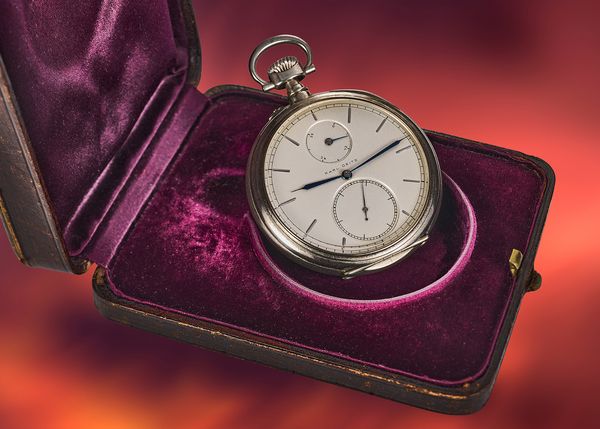
Lot 14: A circa 1935 Karl Geitz flying tourbillon school watch with spring detent escapement that is included in the Phillips Geneva Watch Auction: XXIII. Estimate: CHF 80,000 - 160,000
In 1937, the watch was submitted to the Deutsche Seewarte chronometry trials in Hamburg, where it achieved first prize in the “Special Class.”
No Single Answer
Looking across these 11 watches, what stands out is not a single breakthrough, but a series of them. Different makers, working in different places, arriving at different solutions to the same fundamental problem.
Constant-force mechanisms. Detent escapements. Tourbillons. Observatory trials. Each represents a different way of thinking about precision.
And that’s really the point.
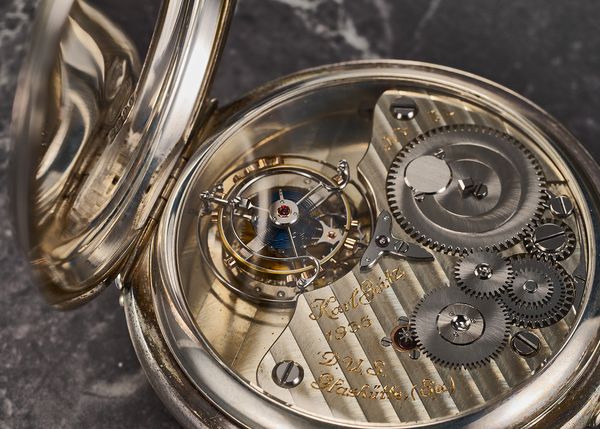
Lot 14: A circa 1935 Karl Geitz flying tourbillon school watch with spring detent escapement that is included in the Phillips Geneva Watch Auction: XXIII. Estimate: CHF 80,000 - 160,000
Chronometry was never solved once. It was pursued, argued over, refined, and reinvented – again and again.
These watches reveal how watchmakers have effectively mastered time over centuries.
You can learn more, place a bid, and view the entire Geneva Watch Auction: XXIII catalogue right here.
About Phillips In Association With Bacs & Russo
The team of specialists at PHILLIPS Watches is dedicated to an uncompromised approach to quality, transparency, and client service. Phillips in Association with Bacs & Russo holds the world record for the most successful watch auction, with its Geneva Watch Auction: XIV having realized $74.5 million in 2021. Over the course of 2021 and 2022, the company sold 100% of the watches offered, a first in the industry, resulting in the highest annual total in history across all the auction houses at $227 million.
About Logan Baker
Logan has spent the past ten years covering the watch industry from every angle. He joined Phillips in Association with Bacs & Russo in early 2023 as Senior Editorial Manager, after previous roles at Hodinkee and WatchTime. Originally from Texas, he spent a decade in New York and now calls Geneva home.
Recommended Reading