Article | Top Lots Editions And Works On Paper
Top Lots: Editions & Works on Paper
The works to know ahead of our first live auction of the year in New York.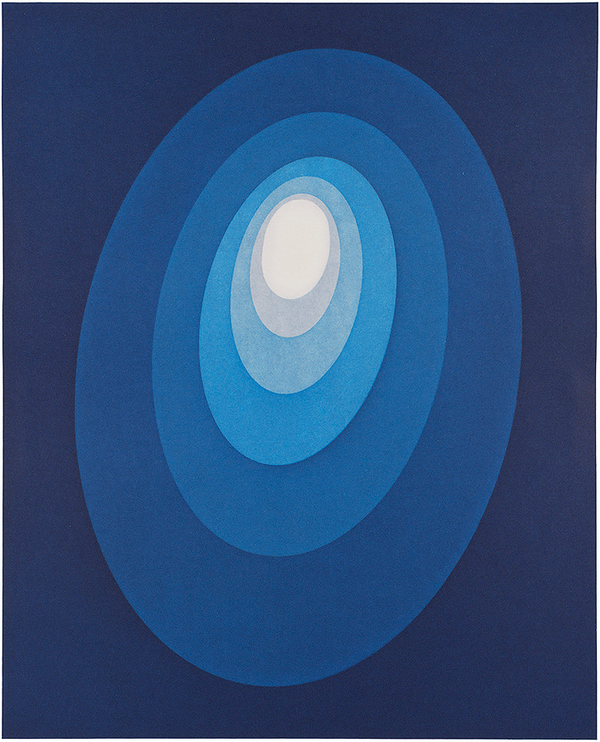
James Turrell, Untitled, 2013. Editions & Works on Paper New York.
James Turrell
American artist James Turrell (b. 1943) is renowned for embracing light as a medium unto itself. In his illuminating works, Turrell shapes perception with environmental, often large-scale works in which space, depth, and color act as companions to our awareness of seeing and experiencing light. This immersive approach resonates across a range of colors in the artist’s palette, and in 2013’s Untitled, blue demonstrates Turrell’s mastery of expanse while holding a stillness that draws the viewer from a depth to an elusive brightness. The gradient shifts give simultaneous feelings of sinking and surfacing, of an enveloping darkness and a way through it, all while maintaining a meditative atmosphere that invites continuous reflection.
Ed Ruscha
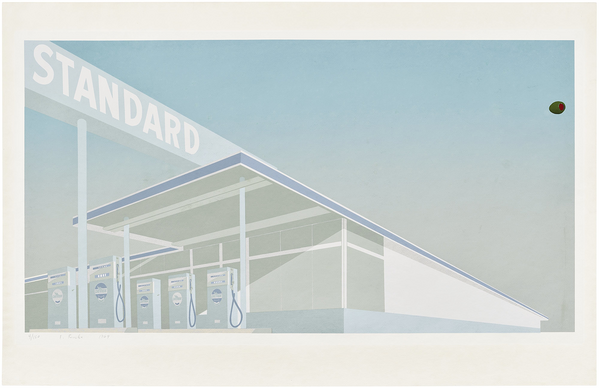
Ed Ruscha, Cheese Mold Standard with Olive, 1969. Editions & Works on Paper New York.
Pop Art pioneer Ed Ruscha (b. 1937) is rooted in the visual culture of the American West, with an exacting eye for the mundane imagery that dots the long drives and cityscapes between Los Angeles and the interstate system as it winds inland. Part of the Standard Station series, Cheese Mold Standard with Olive renders the ubiquitous marker of American highways with crisp screenprint precision, as commercial iconography blends with spatial tension: the diagonal linework and muted colors evoke a sense of dislocation, as if the gas station was built into the environment for minimum impact. It is there out of necessity, but it cannot impose itself. The lone stuffed olive adds a surreal element to the work, almost as if to reorient the viewer to consider its flatness, like a rest-stop placemat under which the olive rolls, its diner long since back on the road.
Julian Schnabel
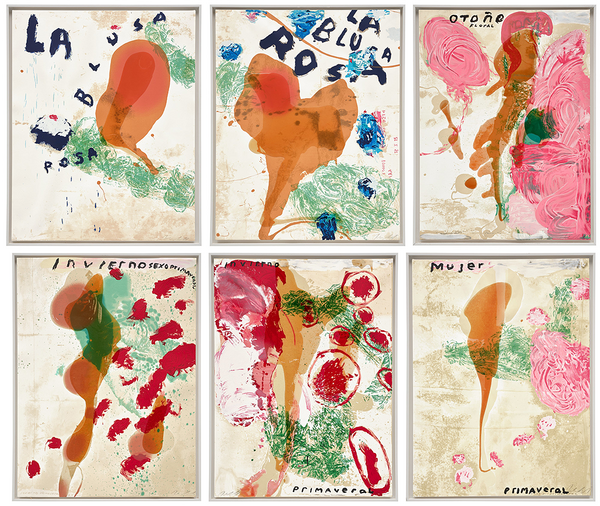
Julian Schnabel, Sexual Spring-Like Winter, 1995. Editions & Works on Paper New York.
Julian Schnabel (b. 1951) asserts a theatrical rawness through his works by combining autobiography, mythology, charged emotions, and the inherent strain of words and images in a practice that spans painting, film, and editions. Known for his unconventional materials and gestural approach, Schnabel collates his themes in the six screenprints that make up Sexual Spring-Like Winter to evoke the transformation of natural forms as they grow and touch, segment and overlap — a nascent sensuality with the blooming season ahead. This dimorphism is further heightened by the Spanish text repeating seasonal names and feminine articles of clothing, creating a sexualized abstraction from cultural signifiers and temporal movements.
Jennifer Bartlett
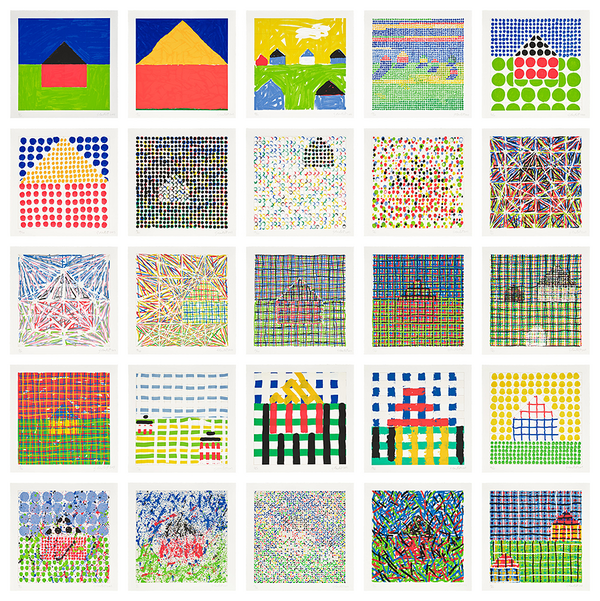
Jennifer Bartlett, House, 2003. Editions & Works on Paper New York.
Houses exemplifies Jennifer Bartlett’s (1941—2022) lifelong engagement with familiar motifs to explore memory and perception as constitutive elements of a given place. The concept of a house, rendered through repetition and changes in color, scale, and composition over 25 plates, becomes less about the specificity of a given dwelling and instead develops into a wayfinding symbol: the domestic becomes the psychological; the abstraction becomes its immutable characteristics. Through this portfolio, Bartlett transforms an everyday form into a site of sustained inquiry, where meaning emerges through the accumulation of images rather than a singular, definitive representation. This wonderfully intuitive series is presented in its original yellow cloth portfolio.
Sam Francis
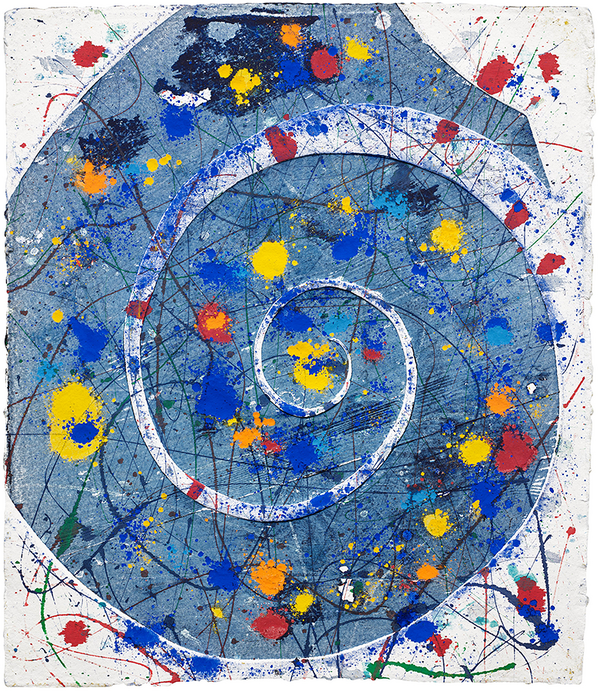
Sam Francis, Untitled, 1982. Editions & Works on Paper New York.
Sam Francis (1923—1994) was most notably associated with the Abstract Expressionist movement and the postwar expansion of gesture as a spatial force in American art. Deeply influenced by East Asian philosophy, Francis’ printmaking showcases an energetic force in which color, emptiness, and movement interact on the same plane. The 1982 Untitled print captures a sense of immediacy and openness unique to monotype, where each impression is singular and unrepeatable. Areas of dense pigment are set against a dispersive spiral and improvisational marks; while the chaos of its individual elements is visceral and intense, the overall balance is one of coexistence.
Robert Motherwell
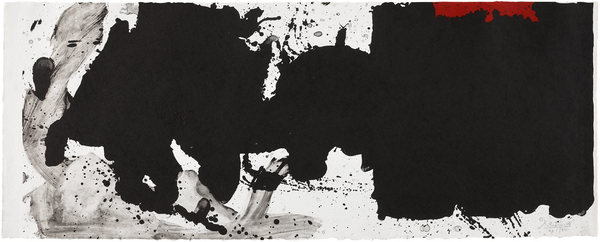
Robert Motherwell, Black with No Way Out, from El Negro, 1983. Editions & Works on Paper New York.
A central figure in Abstract Expressionism and one of its most intellectually driven artists, Robert Motherwell (1915—1991) combined painterly gesture with deep engagement in philosophical inquiry and political action. His work is marked by tensions between instinct and structure, in which bold forms and simplified palettes convey emotional heft and abstraction — rather than escaping meaning, Motherwell confronts history directly with the conditions of modern life. The stark economy of Black with No Way Out suggests enclosure, or an impasse, in the absence of narrative imagery, combining intensity and bold forms with the sharp emotional connotation of its title.
Motherwell’s prints have had much recent attention, from Robert Motherwell: At Home and in the Studio at the New York Public Library in 2025, which showcased his prints and annotated books, to group shows at Jerald Melberg Gallery and a museum exhibition focused on his prints at the Bruce Museum, Greenwich, Connecticut, in 2023.
Jonas Wood
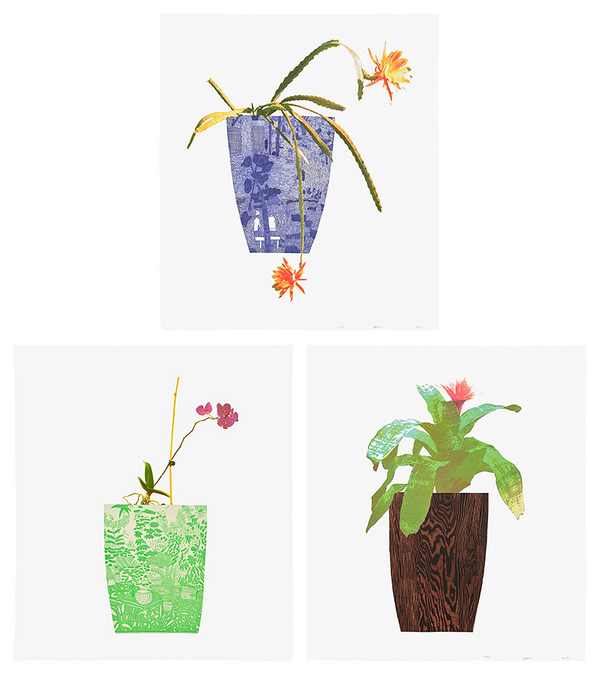
Jonas Wood, Three Landscape Pots, 2019. Editions & Works on Paper New York.
For Jonas Wood (b. 1977), experimentation is at the heart of printmaking: "I was curious to see if printing the plant elements with photolithography would make the etched portions, the pots, feel more realistic and like three-dimensional objects," notes the artist. The resulting work, Three Landscape Pots, balances his signature flattened style with the organic forms of each decorative vessel to wonderful effect. The layered textures and rich coloration give dimension to the compressed images, creating a graphic surface that emphasizes their forms, almost as if they've emerged from the pots organically rather than decoratively.
Following a 2024 solo exhibition with Gagosian in London, Wood was featured in a two-artist show alongside Shio Kusaka at Ryosokuin Temple in Kyoto. From September 2026 through February 2027, the artist's first survey exhibition in Asia will be held at the Amorepacific Museum of Art, Seoul.
Mickalene Thomas
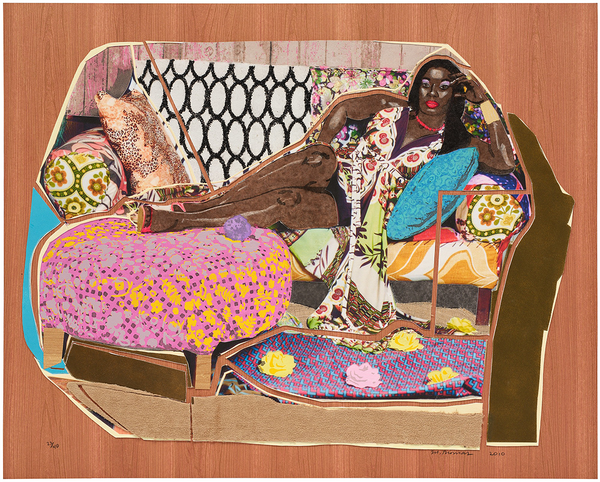
Mickalene Thomas, You're Gonna Give Me the Love I Need, 2010. Editions & Works on Paper New York.
Bringing together screenprinted pigmented paper pulp, pochoir, digital print, glitter, and cloth appliqué, Mickalene Thomas’ (b. 1971) You’re Gonna Give Me the Love I Need incorporates a variety of printmaking techniques and elements to emphasize the discretion of what at first appears to be a relaxed scene. It is in this amalgamation that Thomas uses layers to convey the depth of her subject's presence. Her gaze and posture imbue the work with both ease and intensity; the mixed materials add textures and cultural affection. Rather than evoking a single narrative, the composition embodies the artist’s representation of Black women within popular culture. It is at once stratified and placid, and Thomas’ subject carries her individuality with the weight of art history and the viewer’s gaze.
Thomas’ first major international survey has been touring since 2024, with exhibition stops in Los Angeles, Philadelphia, London, and Toulouse. In addition, Thomas is the focus of a landmark retrospective at the Grand Palais, Paris, through early 2026. In 2025, Thomas showed new print work and site installations at the IFPDA Print Fair in New York.
Discover More from Editions & Works on Paper >
Recommended Reading