Article | The Sound Of Editions New York Auction February 2026
The Sound of Editions
Works that imply sound or even create it.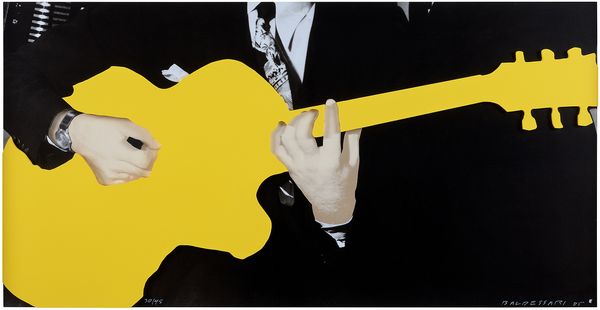
John Baldessari, Person with Guitar (Yellow), 2005. Editions & Works on Paper New York.
For those of us equally in love with sound and sight, here’s a bit of impractical but fun napkin math. Any audio engineer will tell you we can only hear sounds between 20 and 20 thousand Hertz (Hz), and we know that visible light exists between 430 trillion and 750 trillion Hz. If you take the B-flat below middle C and move it up an octave, you’re doubling the Hertz. So, for argument’s sake, double that B-flat about 40 times, and you get yellow light — the color of John Baldessari’s glowing guitar above. The pesky reality of Physics gets in the way, of course, as the two wave forms are fundamentally different, but hey, what’s a few trillion Hertz between friends?
The point is, for many of us, sight and sound are as linked as scent and taste, and artists often take advantage of this, both in works that depict sound-producing objects or that physically produce sound. (Beyond that, try finding us a visual artist who doesn’t like music — we’ll wait). In the meantime, in a perusal of our upcoming live and online Editions sales, the artworks are simply singing.
Beyond its sonic impression, Baldessari’s work explores a conceptually refreshed take on the art-historical image of the guitar, evoking the iconic works of the Cubists. But by isolating the guitar’s form through color and layering, the artist presents it as a distinct piece of American iconography, reminding us that it is a tool as noteworthy as any person who played it. For Bruce Nauman, on the other hand, his 1985 drypoint is self-referential, recalling the flashing lights of his celebrated neon work, which reminds us there are only a few letters’ difference between violins, violence, and silence. But by presenting the image of the instruments here, he awakens our sonic perception, showing us how similar these two words sound.
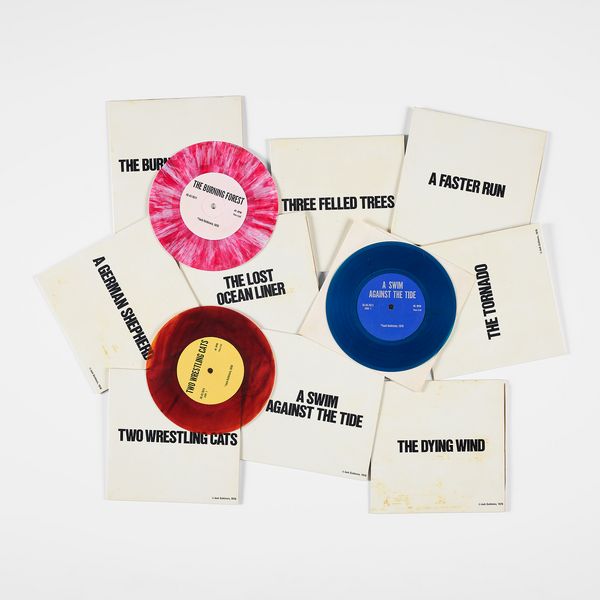
Jack Goldstein, A Suite of Nine 7-Inch Records with Sound Effects, 1976. Editions & Works on Paper: Online Auction.
The most directly connected to sound of all the works in our upcoming Editions sales are the four lots from the artist Jack Goldstein in the online sale. An unfairly under-sung multimedia artist, Goldstein treats sound as a found object, akin to a physical material that could be captured and framed like any other. In each of these works, rendered as vinyl records, he probes the idea that sound media doesn’t achieve a state of objecthood until it is attached to a physical form, but looking back on these works from the ‘70s, we’re struck by how much has changed in audio culture in the streaming age. Not many people collect music in the traditional sense anymore, and it’s a rare pleasure to see these works come to auction.
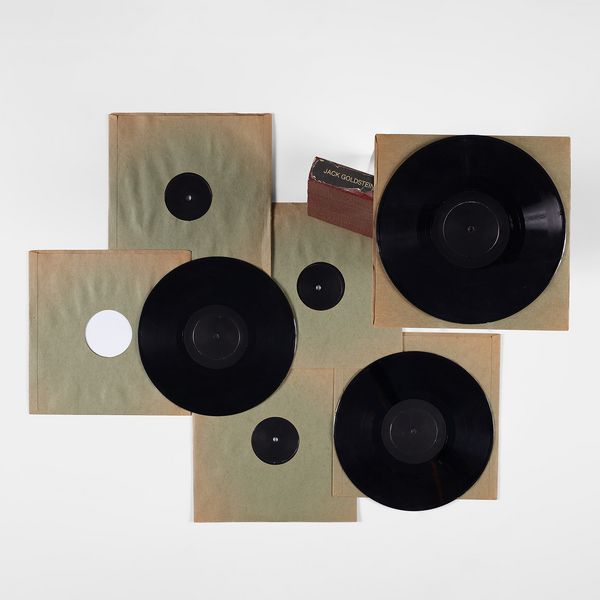
Jack Goldstein, The Planets, 1984. Editions & Works on Paper: Online Auction.
A Suite of Nine 7-Inch Records with Sound Effects from 1976 is perhaps his most lauded sound work, and the 1984 set of six 45s entitled The Planets, seems to directly confront a work from the classical music canon — The Planets by Gustav Holst, a suite of six movements each imagining the atmosphere of the planets in musical form. Regarding the work, Goldstein explained, “The 45s form a large circle on a pointed yellow or red wall, as if they were planets themselves in our galaxy. Each record has to be played in order to locate from our memory what planet each record might suggest. The records are made up of found musical recording, from sci-films that have been remixed to suggest to the viewer what planet he or she might be listening to. Since 90% of the universe is in total blackness, and one needs a telescope to reveal what is out there, through meditation — one has to play the record to locate its identity.”
Luckily for us, in the age of streaming, we don’t even have to take them out of the box:
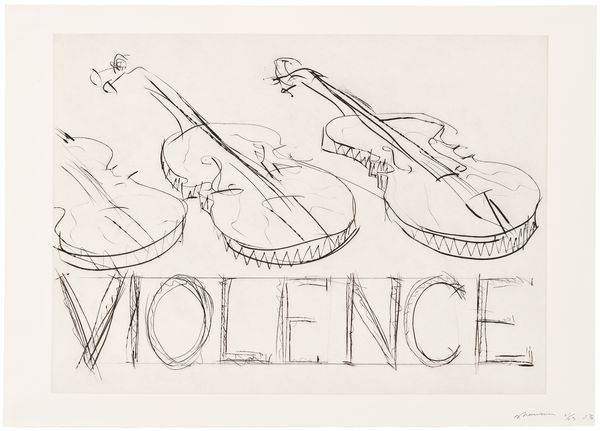
Bruce Nauman, Violins/Violence, 1985. Editions & Works on Paper New York.
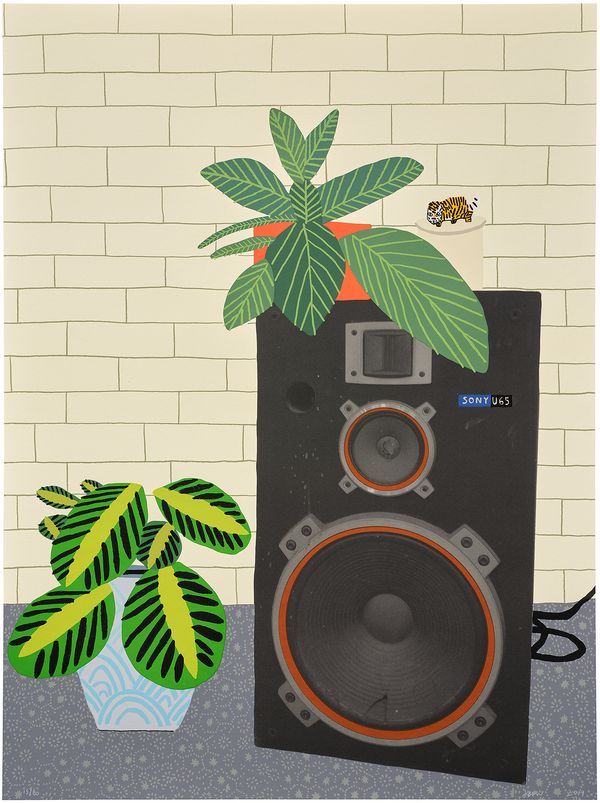
Jonas Wood, Speaker Still Life, 2019. Editions & Works on Paper: Online Auction.
And in pure vibes territory, we encounter Jonas Wood’s inclusion of a speaker in a still life. When compared with the above works, we’re made aware of the transition away from music and sound produced primarily by physical instruments toward the use of electronic equipment to reproduce recorded sounds, which is a delightful connection to make with the nature of printmaking itself. We hear that Wood loves to play reggae tracks from his Los Angeles studio, and it’s easy to imagine walking right into this scene on a studio visit. How chill would that be?

Yoshitomo Nara, Doggy Radio, 2011. Editions & Works on Paper New York.
Speaking of speakers, Yoshitomo Nara — an artist whose love of music is well documented — offers a creation that combines function and concept. His dog imagery can be seen to represent a sense of vulnerability and longing for inclusion — two traits that music opens in us — and in this case, the dog is presented not just as a work of visual art, but as a functional speaker system, replete with FM radio access, Bluetooth, and USB connection. It also makes us think about the frequencies dogs can hear that we can’t, poignantly making us consider all that we can’t perceive.
Recommended Reading