Article | Trend Report Cross Category Curiosity Modern Contemporary Art Auction New York November 2025
TREND REPORT: Cross-Category Curiosity
How today's (and yesterday's) currents show there are as many ways to collect as there are collectors.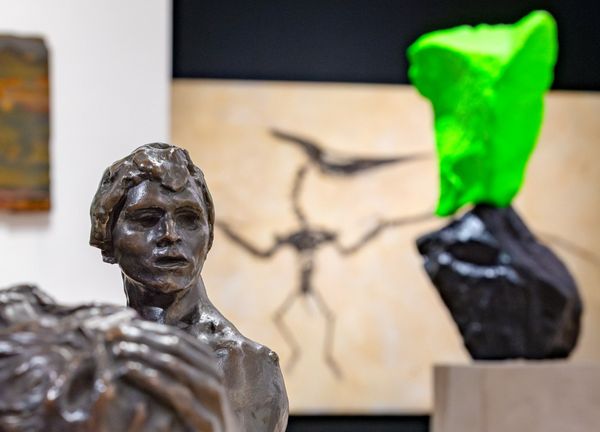
Works by Auguste Rodin and Ugo Rondinone in front of a subadult Pteranodon.
One of the joys of art collecting is the ability to form our own perspectives, to tell our own stories — composing distinct lines of inquiry within a collection and weaving them together with individuality. This is even more interesting today, at a time when algorithms tend to homogenize mainstream taste.
In turn, following an extended period during which art collectors often sought out the freshest, most contemporary works, we’re seeing collectors’ purchases become more considered. Some are exploring more comprehensive approaches to collecting, often delving deeper within the categories they already know, or branching out into related ones.

Front: Manolo Valdés, Reina Mariana, 2016. Modern & Contemporary Art Day Sale, Morning Session, New York.
Back: Fernando Botero, Femme du Monde, 1974. Modern & Contemporary Art Day Sale, Morning Session, New York.
“I’ve definitely noticed an increased interest in cross-category collecting over the past several years,” says Adam Green, founder of Adam Green Art Advisory and host of the ArtTactic podcast. “This trend has accelerated in the past couple of years as the art market has softened. Many of my clients are becoming more selective with their acquisitions and are focusing more on collecting across generations. That often means exploring more established Impressionist, Modern, or Post-War artists, or studying the living artists in their collections and considering the historical figures who influenced them.”
For many collectors, there has been a shift toward refining their own perspective. As Green explains, “I find a well-rounded collection that spans multiple generations often tells the most compelling story, and it’s the kind of collection that living artists are genuinely excited to be part of. It also helps collectors stay focused rather than feeling pressure to chase every new name that comes along.”

Art Advisor Adam Green. An auction world veteran, Green now advises clients on acquisitions of investment-quality Post-War and contemporary art.
“Beyond fine art, several of my clients have also broadened their interests into other collecting categories such as watches, wine, design, and first edition books,” Green tells us, echoing trends we’re also seeing. “These areas similarly combine connoisseurship, history, and a discerning eye for quality.”
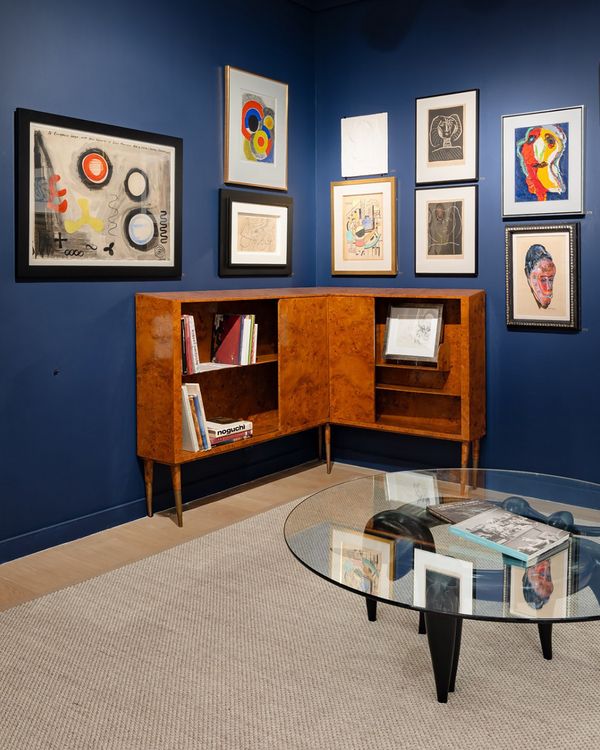
Furniture by Gio Ponti and Judy Kensley McKie in conversation with Modern and Contemporary Art in “The Cabinet of Curiosities” room at Phillips' galleries. Left to right: Works by Alexander Calder, Sonia Delaunay, Joan Miró, Henri Laurens, Fernand Léger, Pablo Picasso, Karel Appel, and Norman Lewis.
But collecting across categories isn’t exactly new. A quick look at the past reveals several intriguing examples of unbridled and eccentric collectors. Although these characters were unique, many shared an interest in collecting across various fields. One thinks of the British Neoclassical Architect Sir John Soane (1753–1837), who collected art, artifacts, and natural history, presenting them in intriguing and unexpected ways in his London home and museum. In an anecdote that may sound familiar to some collectors today, his star acquisition, the Sarcophagus of Seti I — acquired after the British Museum refused to pay the asking price — was too large to fit through the front entrance of his home. Naturally, he had a hole knocked out in the back of the building so the sarcophagus could be lowered into his basement, and then illuminated the room with a plethora of candles and torches and hosted parties for three consecutive evenings.
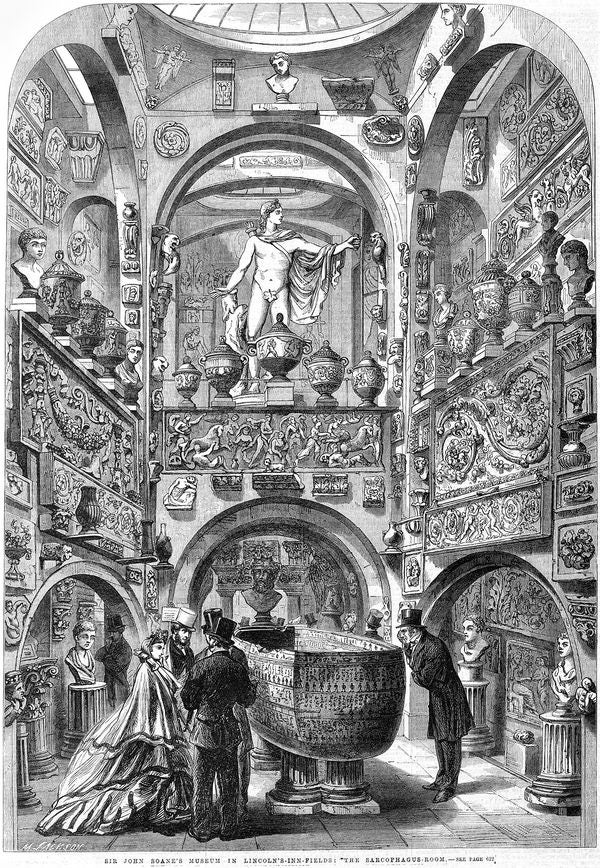
An engraving by Mason Jackson of The Sarcophagus of Seti I in the museum and home of Sir John Soane, depicted in an 1864 publication of the Illustrated London News.
Or take the Holy Roman Emperor Rudolf II (1552–1612), whose eccentricities expanded far beyond his love of art and his lauded Kunstkammer. Among the tales told of the Emperor — who moved his court from Vienna to Prague in order to have more solitude to focus on his passions for art and science — is the story that he had his court alchemist arrested for refusing to produce gold. He also collected exotic animals, natural history specimens, and mystical oddities, ranging from magical stones to unusual horns and automatons. Although his goal was to acquire a specimen of everything in the known world, it’s easy to see he was an art lover above all — he often ignored his official tasks to spend hours gazing at paintings from his collection. Particularly fond of Northern Mannerism, he collected works by artists including Albrecht Dürer and Giuseppe Arcimboldo.
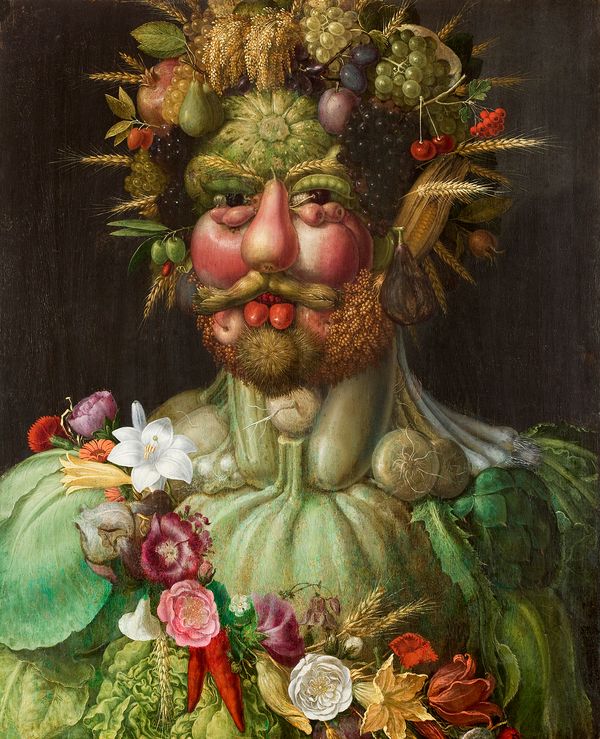
Giuseppe Arcimboldo, Rudolf II of Habsburg as Vertumnus, 1590.
These stories resonate with us partly because they seem unbelievable, and partly because we may see a bit of ourselves in them. In many ways, such historic figures set the stage for contemporary collectors whose interests extend to natural history. Christian Link, founder of Wunderkammer Zurich and Phillips’ Natural History Consultant, tells us his buyers are often well-known contemporary art collectors. “What excites me most is sharing these treasures with collectors, guiding them into corners of history they may never have explored,” he shares.

Left to Right: CERA — Juvenile Triceratops Skeleton, circa 66 million years ago. Modern & Contemporary Art Evening Sale, New York.
Legacy of the Predator King, Complete Tyrannosaurus Rex Jaw Section on a Custom Metal Stand, circa 66 million years ago. Modern & Contemporary Art Presents: Out of This World.
Ugo Rondinone, the great, 2013. Modern & Contemporary Art Day Sale, Afternoon Session, New York.
Upon closer look, art and natural history are a fitting pairing. After all, if art can be a portal to another world, so too can objects from space, or from prehistory. “I see my role as opening new paths for discovery, and I recognize the importance of handling these incredible objects with both scientific accuracy and respect,” Link says. Miety Heiden, Phillips’ Chairman, Private Sales, adds, “It is undeniable that today’s global collectors are increasingly drawn to rare and extraordinary objects that transcend traditional collecting categories. They seek the unexpected.”
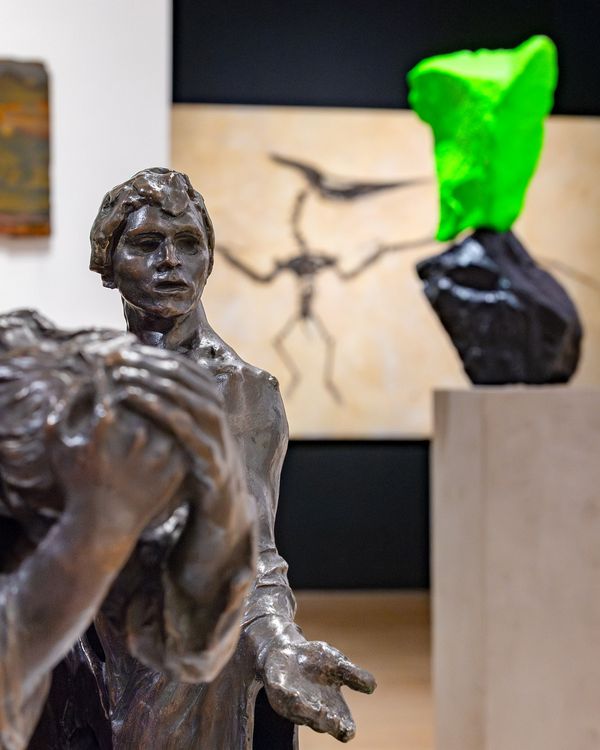
Front to Back: Auguste Rodin, Les bourgeois de Calais, deuxième maquette, 1885. Modern & Contemporary Art Day Sale, Morning Session, New York.
Ugo Rondinone, black green mountain, 2015–2016. Modern & Contemporary Art Day Sale, Afternoon Session, New York.
King Ghidorah, A very fine subadult Pteranodon, circa 87 million years ago. Modern & Contemporary Art Presents: Out of This World.
Of course, no two collectors share the same approach, goals, or ideas, but exposure to new concepts and the experience of ownership can help solidify one’s path. When asked why some collectors focus on a particular area and others explore multiple categories, Green explains: “I think it often comes down to what aspect of collecting feels most meaningful to the individual. For some, that means focusing on living artists and building relationships that extend beyond the artworks themselves. Collecting in this way is about engagement and connection. Many collectors visit studios, get to know the artists personally, and feel a genuine sense of purpose in supporting their growth through acquiring their work, museum donations, exhibition loans, and more.”

Amoako Boafo, Red Dress, 2017. Modern & Contemporary Art Day Sale, Afternoon Session, New York.
Green continues: “Others share that same passion for living artists but also want to build a broader narrative within their collections. They see collecting as a way to reflect ideas, values, and artistic progress over time. As their journey evolves, I often see collectors begin with one area of focus and then gradually expand their interests to include others as their collecting deepens.”
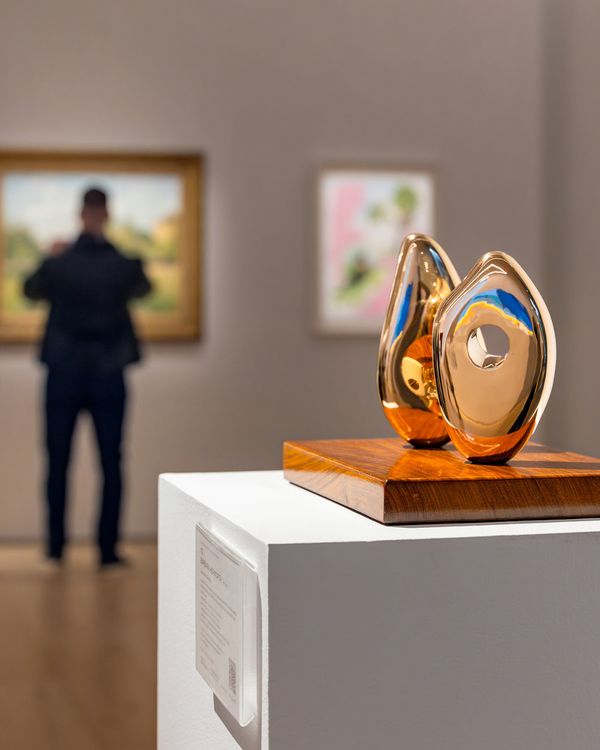
Barbara Hepworth, Two Forms (Orkney), 1967. Modern & Contemporary Art Day Sale, Morning Session, New York.
Asked what cross-category pairing he would personally form among the lots on offer this season in New York, Green suggests two works that, surprisingly, can be seen in conversation with each other — Simone Leigh’s The Village Series #19 and David Smith’s Forging V.
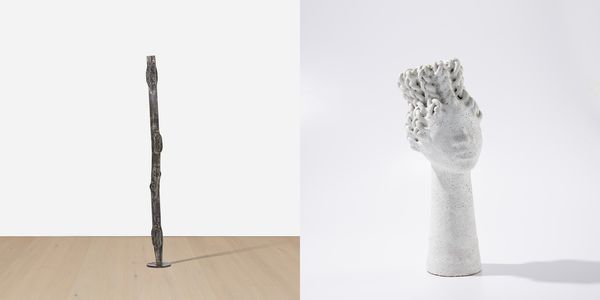
Right: David Smith, Forging V, 1955. Modern & Contemporary Art Evening Sale, New York. Left: Simone Leigh, The Village Series #19, 2020. Modern & Contemporary Art Day Sale, Afternoon Session, New York
“At first glance, they come from very different worlds, yet both artists reveal the expressive potential of raw material. Smith’s Forging V translates the language of drawing into steel and, through its verticality and curvature, subtly evokes the human body. Leigh’s ceramic bust, by contrast, renders the body explicitly, conveying quiet monumentality while honoring the histories and labor of Black women. Seen together, their works trace how two sculptors, generations apart, use material and form to assert presence: one through industrial abstraction and the other through cultural embodiment,” he tells us.
Such combinations of ideas abound throughout our galleries this season. With a look to the left, you’re in Modernist territory; to the right, a painting made just last year; and straight ahead, evidence of life on earth from billions of years ago.
In fact, the closer you look, the more unexpected relationships you might discover. And there’s only one way to find out.
Phillips’ November auctions of Modern & Contemporary Art and Natural History are on view at 432 Park Avenue through 19 November.
Discover more from Modern & Contemporary Art >
Recommended Reading