Article | Alma Thomas Ultimate Gift
Alma Thomas’ Ultimate Gift
Jonathan Frederick Walz — curator and co-editor of the retrospective exhibition catalogue 'Alma W. Thomas: Everything Is Beautiful' — shares his reflections on the remarkable Thomas work coming to auction at Phillips this season.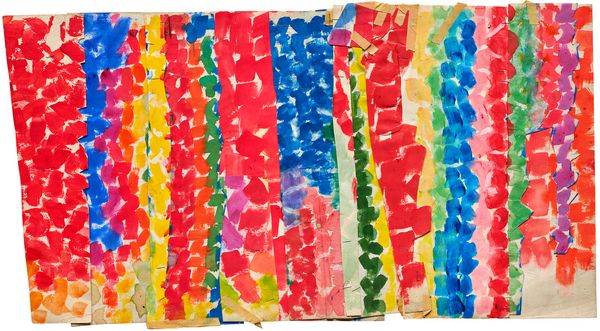
Alma Thomas, Untitled, circa 1968. Modern & Contemporary Art Evening Sale New York.
—By Jonathan Frederick Walz, Ph.D.
Untitled, c. 1968 first came to scholarly attention as part of the exhibition 'Alma Thomas: Thirteen Studies' that the Washington, DC-based gallery Hemphill Fine Arts mounted in late 2014. Thomas’ small chromatic studies on watercolor paper were not unknown, but Thirteen Studies revealed several mockups at full scale, an unfamiliar intermediary step between the intimate, postcard-sized sketches — of which she made hundreds — and the final acrylic paintings on canvas, masterful combinations of careful planning and spur-of-the-moment improvisation. Two works in Thirteen Studies particularly stood out: Untitled, c. 1968, now at the Museum of Modern Art (299.2015), and Untitled, c. 1968, now returning to the market after approximately a decade in private hands. Both mockups are composed of multiple pieces of brightly painted paper that Thomas scissored apart, recombined, and overpainted. These exuberant Frankensteins, held together with masking tape and staples, evidence Thomas’ deep knowledge of color theory and her determination to find the precise, sophisticated combination of hues her exacting eye demanded.
As artist and photojournalist Ida Jervis’s 1968 photographs of Thomas in her studio document, the artist-educator sometimes pinned these self-approved prototypes to the tops of new canvases as aides-mémoire. Then, with her preplanned pigments at hand, Thomas began the thoughtful production of what she called “Alma’s stripes” — multiple paint pats in vertical bands — making adjustments as necessary in real time.
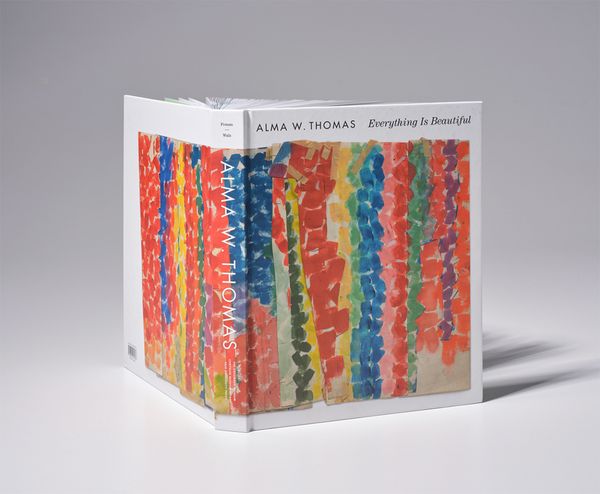
Untitled as it appears on the cover of the 2022 exhibition catalogue Alma W. Thomas: Everything Is Beautiful.
What is so extraordinary about Untitled, and its companion at MoMA, is how both provide such a sustained glimpse into the artist-educator’s mind. It is as if we see over Thomas’ shoulder as she navigates the many decisions that make her canvases impossible to replicate: color against color, negative space versus positive space, intent alongside intuition. There is an exciting rawness here that gets polished away before any public exhibition of the finished canvases. Unlike the Washington Color School painters with their anonymous staining techniques, Thomas never relinquished “the hand.” Indeed, in Untitled (like its MoMA counterpart) there is such a sense of the handmade: cut edges, layered strips, skewed tape, obsessive stapling. It is this heady combination of hand and mind that convinced co-curator Seth Feman and me to advocate for Untitled’s appearance on the front cover of the exhibition catalogue Alma W. Thomas: Everything Is Beautiful. To us, it seemed to plainly exemplify what Dr. Feman has termed Thomas’ “relentless search for beauty.”
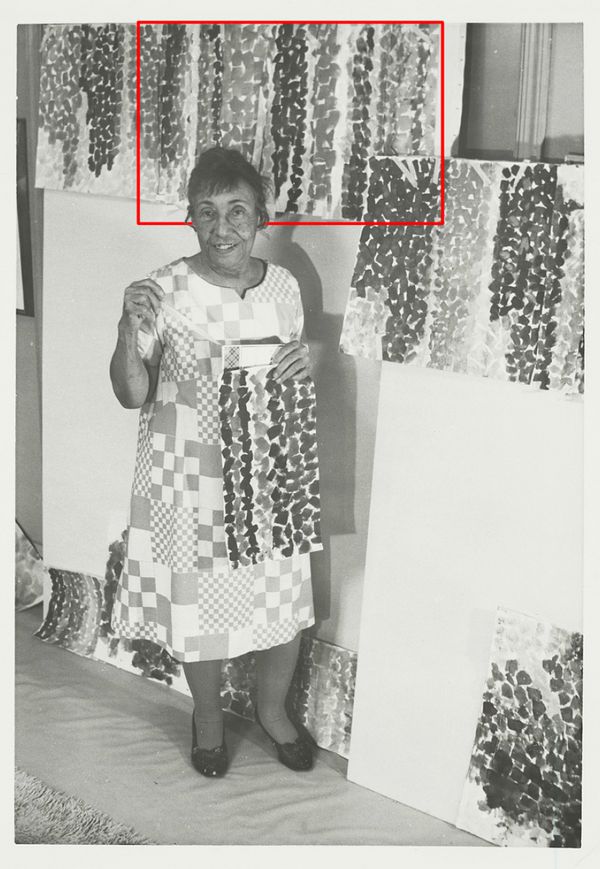
The present work [top center] in progress, as seen in a photograph of Alma Thomas in her studio, circa 1968. Photograph by Ida Jervis. Archives of American Art, Smithsonian Institution, Washington, D.C. Image: Archives of American Art, Smithsonian Institution, Alma Thomas Papers, circa 1894-2001, Artwork: © 2025 Estate of Alma Thomas (Courtesy of the Hart Family) / Artists Rights Society (ARS), New York.
Untitled, c. 1968 is undoubtedly a study for an uncompleted or as yet unidentified acrylic on canvas painting from Thomas’ Earth series. It is appealing for the way it recapitulates, and in such relatable terms, themes and subjects that Thomas explored from her childhood to old age. In Washington, Thomas planned her backyard beds of annuals and perennials using the same color principles that she harnessed for her studio production; in her mind, the two activities — painting and gardening — were deeply interconnected. The large-scale sheets of paper here recall the paper patterns that her mother used as an in-demand dressmaker and that Thomas also used as a costume designer for the Howard Players in the 1920s. Thirty-five years of teaching junior high school art made Thomas quite familiar with the ubiquitous classroom supplies of masking tape and staples. Untitled’s cut edges, color juxtapositions, and multiple layers evoke a rustling curtain, one near a window — or in front of a puppet stage. (Thomas wrote her master's thesis about using marionettes to teach in the classroom.) This implied undulation, as well as the way the assemblage’s hues optically advance and recede, corresponds to Thomas’ own movement in and through parks and gardens. It is on those visits that she collected “impressions,” carefully observing natural phenomena, like the way the wind activates flowers and branches.
Untitled is important not only because it readily telescopes decades of Thomas’ artmaking, including the “lost years” before her breakthrough innovations of 1966, but also because it embodies her abundant generosity of spirit. The artist-educator’s invitation to be curious and to look closely — at the jostling forms, engaging colors, and evident traces of making in Untitled, and, really, Thomas’ entire oeuvre — are undeniably her ultimate gift.
Discover more from Modern & Contemporary Art >
Recommended Reading