Article | Ask A Neurosurgeon
Ask a Neurosurgeon
Beyond her medical achievements, Dr. Sonia Eden is an art collector and advocate for equity. Here, we pick her brain ahead of Phillips’ charitable offering, 'For Tomorrow’s Future.'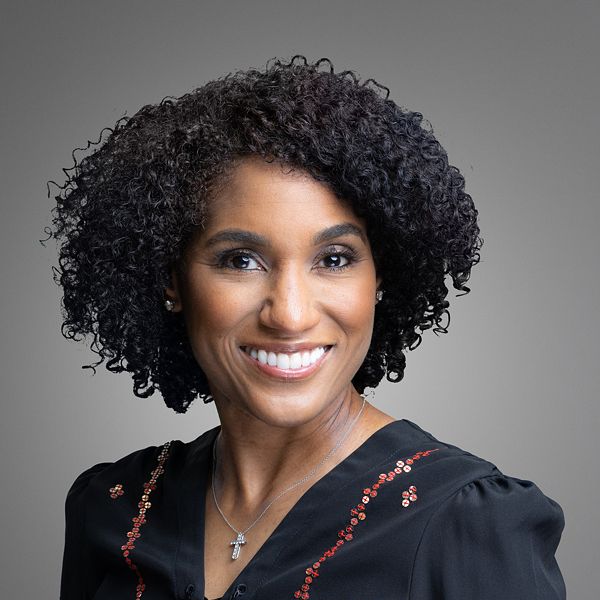
Dr. Sonia Eden, MD. Founding member, American Society of Black Neurosurgeons.
Dr. Sonia Eden can count many accolades. An alumna of Yale and the University of Michigan, her practice as a neurosurgeon and her advocacy for equity in healthcare are deeply inspiring. But beyond that, she’s an art lover with a sharp mind and a curious eye. This passion has led her not just to collecting, but to serving as a Board Member at the Memphis Brooks Museum in Memphis, Tennessee. Her commitment to service is further amplified through mentorship in the Big Brother Big Sister program and membership on boards, currently with the Semmes Murphey Foundation and previously with Borgess Foundation, Friendship Village, and the Ruben. J. Williams Foundation.
What’s more, she is also a founder and board member of the American Society of Black Neurosurgeons (ASBN), which she describes as a passion and a blessing. Ahead of For Tomorrow’s Future, a selection of works on offer in our September New Now and Online auctions with proceeds supporting the ASBN’s mission, Phillips caught up with Dr. Eden to learn more about her background, her approach to collecting, the initiatives of ASBN, and what she’d love to own from the selection on offer.
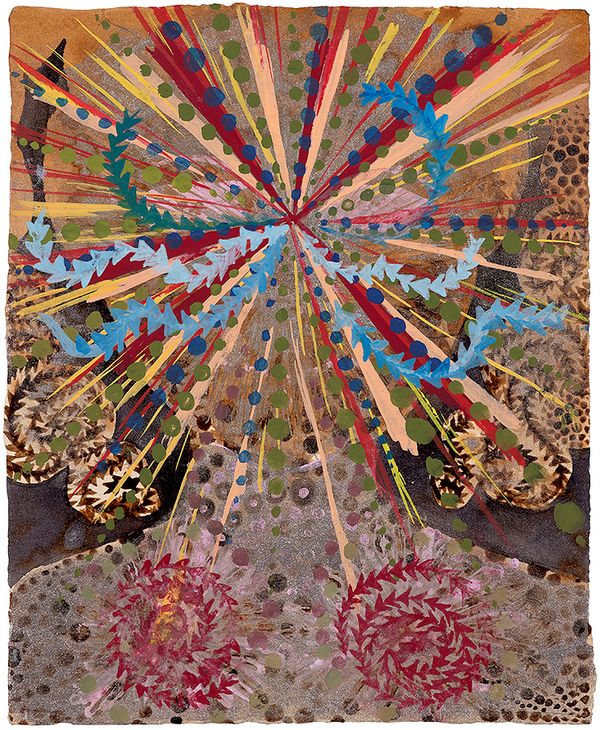
Firelei Báez, Memory Like Fire, 2015. New Now: Modern & Contemporary Art.
Dr. Eden demonstrated interest in neurosurgery at a remarkably young age, owing in part to her mother, an educator, who instilled a natural curiosity in her. She tells us an amusing story her mom used to recount: “When I was three or four years old, my mother used to get migraines. I came in and said, ‘Mommy, what’s wrong?’ She said, ‘Oh, my head hurts.’ So I said, ‘I’m going to cure your headache!’ I went to the kitchen, grabbed some utensils, and role-played doing a surgery on her brain. She closed her eyes and played along and said her headache was gone. (Laughs.) She used to tell me prior to getting dementia that she thinks I was wired to be a brain surgeon a long time ago.”
In her neurosurgery residency at the University of Michigan, she became friends with the ENT plastic surgeon Charles Boyd, an avid art collector. She tells us, “I would stop by his boutique offices to say hi, and he would take me around and be like, ‘Oh, this is Elizabeth Catlett, this is Titus Kaphar,’ and so on. He would name all these artists, and he would say to me, ‘You should start collecting Black art.’”
She was especially drawn to the dimensionality of Kaphar’s works and loved that they share the same home state of Michigan, but it took some time for Dr. Boyd’s influence to spark her imagination: “He was on me to start collecting for ten years. And then he told me how much he paid for his works, how much they’re worth now, and how museums were after them. And I thought, okay, maybe I should learn a little bit more about art.” Eventually, Dr. Boyd introduced her to the advisor Gardy St. Fleur, and she began to build a growing collection.
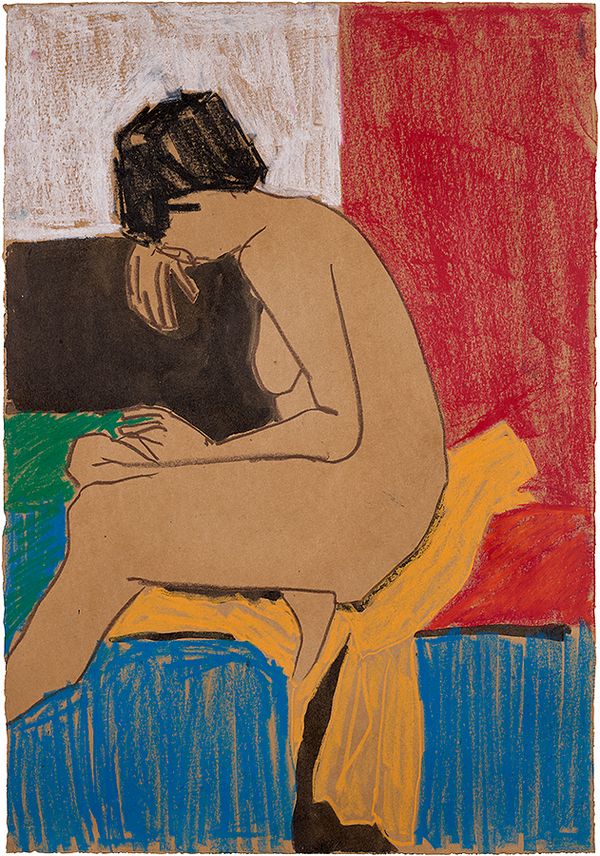
Suzanne Jackson, Class Figure Study, 1962. New Now: Modern & Contemporary Art.
Regarding ASBN, Dr. Eden tells us, “It’s an organization that I founded with four other neurosurgeons across the country back in 2021, a few months after the murder of George Floyd. I think that was a pivotal and crucial turning point here in America and in the world, where the police brutality that is differentially aimed at different individuals is no longer invisible. All of us were impacted by that and needed to do some real internal healing from what we saw.”
A WhatsApp group chat was formed, and members began adding neurosurgeons of color from across the country. “The next thing you know, we had like 100 neurosurgeons on this group chat, and I thought, we should start an organization,” Dr. Eden says. “We got together and started ASBN. We decided on the mission statement and the vision, and received nonprofit status.”
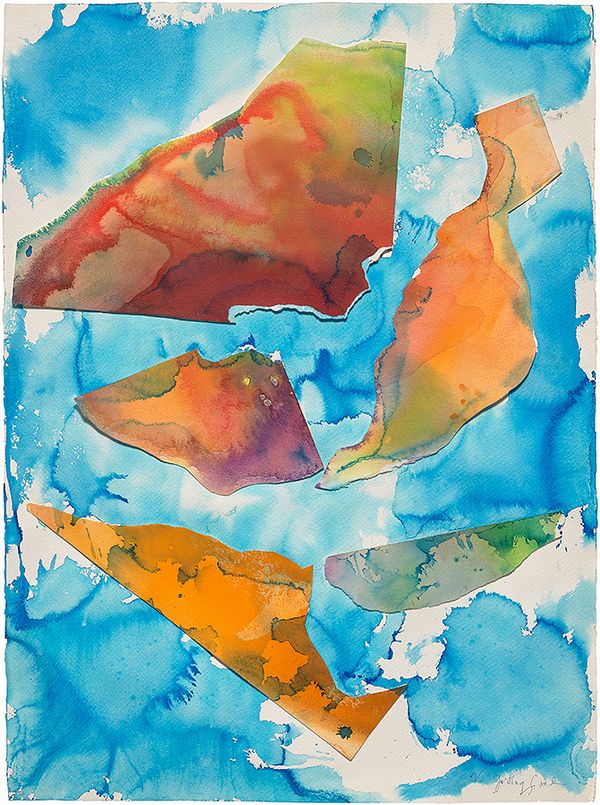
Vivian Springford, Scuba Series, 1976. New Now: Modern & Contemporary Art.
Dr. Eden answers a few questions we’ve always wanted to ask a neurosurgeon art collector.
PHILLIPS: Why do you collect art?
DR. SONIA EDEN: I gravitate towards people who are creating things or doing things they are passionate about. It kind of fills my tank to collect art. I’m looking at a massive picture I have by Harmonia Rosales above my fireplace here. It brings me joy to see this art and to understand what the artist is trying to discern or convey and the stories they’re telling through their artwork.
P: When did you know you wanted to be a neurosurgeon?
SE: I’ve always had this intense interest in the brain. Even back in middle school, when we dissected the little animals, I wanted to get into the skull and see the brain. My teachers wouldn’t let us do that in class; it wasn’t part of the dissection. (Laughs.) But they would always help me to open the skull and dissect out the brain after class.
I consciously knew that I wanted to be a neurosurgeon when I was in high school. I had the opportunity to do some research on brain averaging using computers and MRIs. I wrote a term paper on neurotransmitters and just had this intense desire to learn as much as possible about the nervous system and neural networks. So I did this research project one summer, and they saw my interest in the brain, and set me up to see a brain surgery at Henry Ford Hospital in Detroit, where I’m from. I knew then that that was my calling.
P: How did you start collecting?
SE: Initially, Gardy [St. Fleur] sent me books so I could learn about art. And I was just drawn in magically. I went through those books and highlighted who I liked. I remember I liked Bethany Collins, so then I acquired a Bethany Collins piece. I just started learning so much about art and about the parallels of being Black in neurosurgery and being Black in the art space, and the marginalization that we have experienced in both places. That really propelled me to want to do more to support and promote those marginalized in the art world.
P: Do you think neurosurgeons see art differently?
SE: I think we probably do! Neurosurgery requires a lot of fine motor skills, it requires a lot of depth perception and looking at imaging, whether that’s MRI or CT scans, and going from 2D imaging to three-dimensional pathology. I think that our own kind of spatial visualization is a little different from that of a non-surgeon, and it probably impacts the way we see art or the way we notice some of the depth within an artwork.
P: Do any childhood memories of art stand out for you? Where were you?
SE: Oh, my goodness, yes! I was raised by a single mom who was an educator, and educators seem to try to expose their kids to everything. She owned her own nursery schools, and the kids started at two-and-a-half, but because I was her kid, I started as an infant. She would take me there, and we would do field trips to different museums all the time.
We had the DIA, the Detroit Institute of Art, and my mom and I would go there every Saturday when they had children’s events. Right across the street was the Detroit Historical Museum, and sometimes we would check out the art there as well. So art has been a part of my life for a long time, and it was something that I did with my mom.
P: Which artist do you most admire?
SE: David Hammons, because he’s very unique. He was marginalized, and it took him a while to break into the mainstream art space, but once he did, he continued to make art that really portrayed people who look like me. Like that African American flag — I need one of those! I recently added a piece of his to my collection that I haven’t received yet, and I just watched the documentary about him. He just drums at his own beat. He is unapologetically who he is, and I love that about him.
PH: What do artists and neurosurgeons have in common?
SE: I think we both probably view things from a different lens just because of the way we use our optics and understand the orientation of things in space, and we both use fine motor skills. Artists create art on canvas; we create art in surgery, and I think surgery is as much a kind of practice as creating beautiful art is. A lot of times, artists portray or deal with a lot of similar things as us, with respect to mortality or identity. We do the same while taking care of patients or caring for our really sick patients. There are some parallels there as well, just from an existential perspective of life and what it means and the fleeting nature of it. These are things that we think about just as much as artists do.
P: And what makes artists and neurosurgeons different?
SE: Neurosurgeons tend to be very Type A, in a very strait-laced, very scientific way. I think that artists tend to be more driven from a creative and humanities perspective than we are. This is something I admire in artists. There are certainly neurosurgeons who have that creative piece, but I think a lot of us are much more scientifically driven and focused, so that’s a big difference. Artists are free spirits, but we’re not really free spirits in the same way.
P: What is your greatest achievement?
SE: Becoming what I dreamed of being for a long time. To actually be able to walk into spaces and see patients that look like me and have them take a sigh of relief or give me a big smile and spend the appointment talking about how proud of me they are, and that they’re so happy to see me doing what I do and to see me there for them. That means a lot to me. It’s that gratitude to my patients, but especially that gratitude of the patients who have mistrust and feel like they’ve been left behind. And that really makes it feel like I’m here for a reason. God put me here for a reason, and I will continue to do what I’m doing.
P: What is your personal approach to hanging or installing art?
SE: I moved here to Oxford, Mississippi, almost four years ago, and I relied on designers to help me place my artwork. I’ll tell you a funny story. I have one lady who organized my pantry and my closet when I first moved here, and she still does that from time to time. Maybe eight months ago, I acquired this huge piece by Harmonia Rosales, and I hadn’t found a home for it yet. I had it just sitting leaned up against a wall in a room downstairs, waiting to figure out where to put it. She came over to organize my closet, went downstairs for something, saw the piece, and texted me to say it would look amazing above my mantle — I hadn’t thought about that! So she put this artwork above my mantle, and it’s really a statement piece for this room. You walk in, and I have my Bethany Collins, a Jules Arthur, and my bird Louis, but this work just stands out. I also do exclusively black-and-white art in my bedroom. That’s something that Gardy helped me to decide. It works well for me.
P: The selection For Tomorrow’s Future helps to support the American Society of Black Neurosurgeons (ASBN). In what ways does the ASBN's work resonate with your own experience?
SE: I’ve been very blessed to start ASBN, and it really is my passion project. I’ve been very passionate about increasing representation and diversity in the neurosurgery world. I trained at the University of Michigan, where I finished my residency in 2007. That’s a minute ago, but I was the first African American woman to ever train at the University of Michigan — and I started that residency in 2000. I feel like we were leaps and bounds ahead of the curve, but still, to be the first one in 2000, that’s behind. And there are some programs in this country that just trained their first African American woman.
It's always been important for me to try to make sure that we are inclusive in neurosurgery and healthcare, because I think the more diverse our physicians and our healthcare workforce are, the better we’ll take care of all our patients. I was grateful to have great training at the University of Michigan — I did not have to deal with significant marginalization or discrimination. It was a very supportive environment. But keep in mind, none of my mentors looked like me. I know that it can feel a little isolating when there’s no one else who can really relate to what you’re going through from your perspective.
P: Can you tell us more about the initiatives of the ASBN?
SE: Our mission statement is to improve public health by supporting Black neurosurgeons and enriching the equity and integrity of neurosurgical care. We do this through a robust pipeline of programs to expose students to neurosurgery. We have mentorship programs to support those on the path to becoming a neurosurgeon. We have initiatives to provide research opportunities for students to make them more competitive to match into neurosurgery. We have leadership development programs for neurosurgeons at all levels. We also do a lot of educational sessions, in-person sessions where we meet and have dinner lectures, and things of that nature. The other big pillar is community service. We did a community health fair at a federally qualified healthcare center in Roxbury, Massachusetts — an underserved area in Boston — because our goal is to make sure that we’re taking care of the patients and really providing support for marginalized patients who look like us. We’re very grassroots, and we do a lot of work to improve diversity within neurosurgery.
P: If you could have one work from For Tomorrow’s Future, what would it be?
SE: The Suzanne Jackson! I do have one Suzanne Jackson in my collection, but it’s a smaller one. There was just something about it that intrigued me — the colors and the lines and curves. But mine does not have a human figure in it. This one, a human portrait, a life — I think it’s amazing. Suzanne Jackson is one of those artists who is now getting the recognition she did not get back in the ‘60s, during the Civil Rights Movement. She’s one of the artists that I love to see get that recognition, and I love to support her work.
Discover more from Modern & Contemporary Art >
Recommended Reading