Article | In Conversation Robert Berman And Blake Koh
IN CONVERSATION: Robert Berman and Blake Koh
Robert Berman reveals the stories behind ‘On the Seventh Day I Paint: A Collection of Works by Raymond Pettibon.’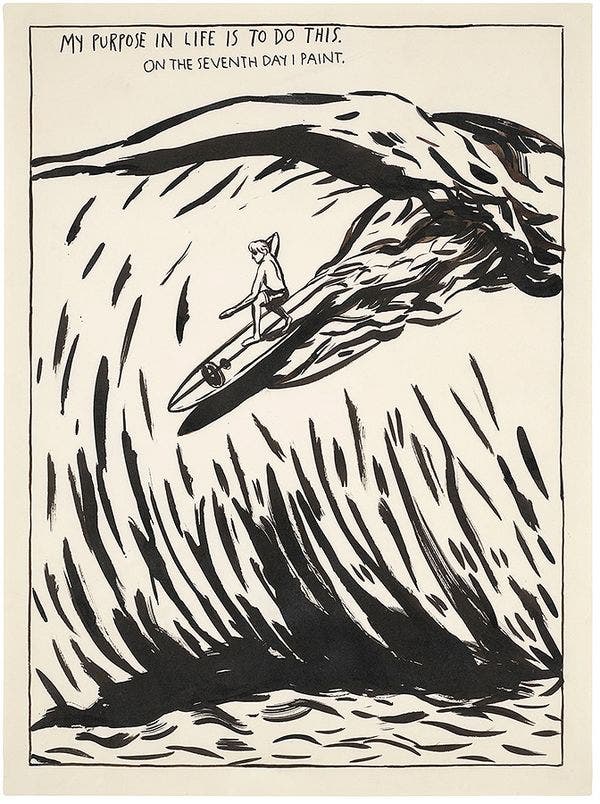
Raymond Pettibon, No Title (My Purpose in Life), 1987. New Now: Modern & Contemporary Art.
For more than three decades, gallerist Robert Berman has maintained a close working relationship with artist Raymond Pettibon, exhibiting his works in Los Angeles and loaning them to museums throughout the world. Now, Berman is bringing 27 remarkable Pettibon works to auction in our upcoming New Now sale in New York.
In this interview, Blake Koh, Phillips’ Regional Director in Los Angeles, sits down with Berman to discuss all things Pettibon, the LA art scene, and more.
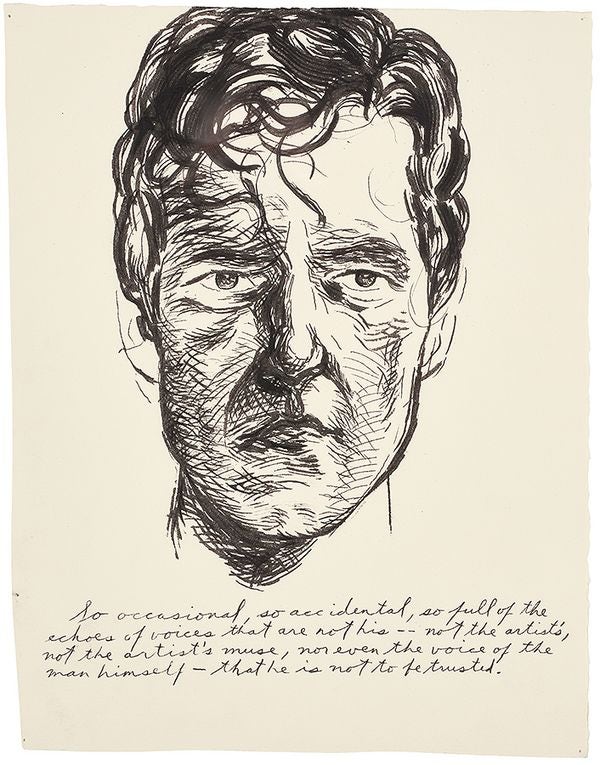
Raymond Pettibon, No Title (So occasional, so...), 1992. New Now: Modern & Contemporary Art.
BLAKE KOH: Let’s start with Robert Berman coming to LA. Or were you born in LA?
ROBERT BERMAN: Oh no, I was born in Chicago. I went to the Art Institute because I knew I loved art. I wanted to be an artist, of course, but it’s a hard road. I found that art history was more my bailiwick, and after visiting LA, I opened my first gallery in 1979 in Santa Monica. I thought I was just going to be selling prints that I had gotten in Europe, but I was inundated by a lot of really good young artists, so that’s what I started to show.
I also often visited the East Village in New York in the early ‘80s and saw some exciting art — Basquiat, Keith Haring and everything. That’s when I became friends with Keith and convinced him that I had a big enough gallery in LA, and he came out and we did a great show together.
BK: Did it work? Did you sell out the show?
RB: I wish I had kept some! But I had to sell all this great work. I sold the Basquiats that I had bought back East during an art fair at the Convention Center, it was 1989 or ’90. It was the last of a whole great series of art fairs, and Margot Levin and a lot of the big East Coast galleries were there, Gagosian was there. I had a booth in the back, and I was next to Richard Heller and Bennett Roberts, who were partners and used to buy from my gallery on Main Street. But they were next to me, and they were representing Raymond [Pettibon], so he came by. I had met him a couple of times, but he drew this incredible Gumby on the outside wall. I was there when he did it, and I asked if I could buy it. Bennett says that he cut it out of the wall, but I think I cut it out of the wall, and I still have that piece — it’s been in a lot of museum shows. So that’s really how my relationship with Raymond started, because in the next couple of years, the show Helter Skelter came to Los Angeles. That was over 30 years ago, but is still one of the greatest shows that MOCA ever did in my opinion. All the artists were phenomenal, and it was really challenging. It broke all the rules.
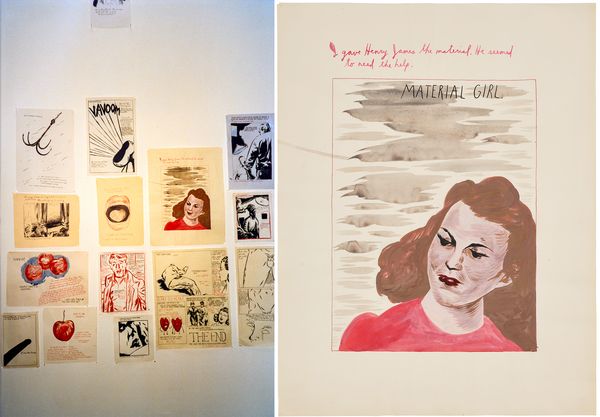
Left: Raymond Pettibon works on view at Robert Berman Gallery in Los Angeles in the 1990s. Right: Raymond Pettibon, No Title (I gave Henry...), 1991. New Now: Modern & Contemporary Art.
BK: And was Raymond’s work in that show?
RB: He was all over that show! Jeff Poe just reminded me this weekend that I was able to get all the work from the Helter Skelter show, which we’re showing here. I sold some of them, but I managed to keep the best pieces and put them in museum shows with Raymond’s help over the years. These works traveled all over Europe, the Sonic Youth Show, the Hague Show, and then, very luckily, I was able to get about 25 pieces into the show with the New Museum.
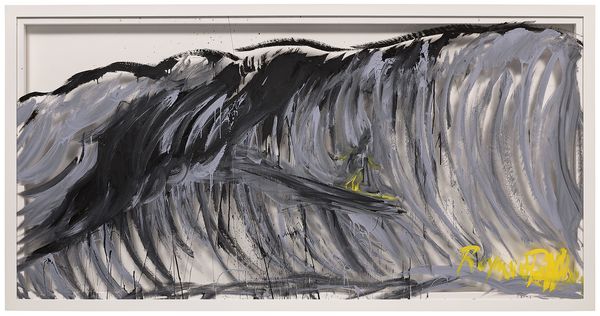
BK: Music and performance have always been central to his work, so talk about one of the great works that we’re selling for you, the great wave painting, that was almost a performance on its own that you filmed and photographed, right?
RB: It was a performance, yes. It involved my good friend Richard Shulman, who’s an amazing photographer, and asked me if I can get Raymond to come back to the gallery and do the action paintings, like were done in the Fluxus movement. Picasso also did this.
BK: And famously Pollock.
RB: Yes, Jackson Pollock too, and his were in Life magazine. So, I went out and got the materials needed. Raymond came with his dog, and he painted away, painted the great wave. It’s really strong. It works as a flat painting, but because of how it’s framed, the back can come out and you can make it basically a four-dimensional painting. Like Duchamp would say, out of the shadows comes the new dimension.
Raymond Pettibon, No Title (Surfer in the...), 1993. New Now: Modern & Contemporary Art.
BK: Honestly, it looks like it was painted yesterday, and it reads as a kind of performance. I mean, how many people can capture a wave the way that Raymond Pettibon captures a wave?
RB: Millions of artists have made waves, but not like this.
BK: You’ve got Hokusai and then you’ve got Raymond Pettibon. (They both laugh.)
RB: That’s right!
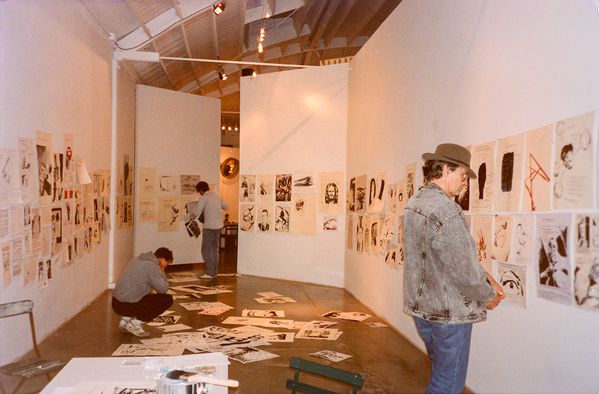
Installation day at Robert Berman Gallery in Los Angeles, ca. 1990s.
BK: Obviously, you’ve known Pettibon’s work for so long, but can you remember some of the things that first drew you to it? I love the idea that one of the first works you buy, he painted right there on the wall, and you took it out of the wall, but what drew you to it?
RB: Well, I love that I had no idea what most of them meant. And they were completely random with the imagery. Not all the time, sometimes they were right on, but in most of the works, he just went on and on, whether it be James Joyce or Plato or…
BK: His own words!
RB: Yes, his own poetry! He really went out and captured this. It matches the imagery in a way that I’ve never seen another artist do it.
BK: He likes to put groups of works together right?
RB: Right, it’s the ultimate salon. Each one plays off the one next to it.
BK: Exactly. He would hang works in a way for them to interact almost in the same way that the text and the images are interacting in different and strange ways.
RB: Right. When he came into my gallery on Broadway to do the show, he threw hundreds of works on the floor and just started to pin them up. And you know I’m laughing because some of these works are worth hundreds of thousands of dollars today, but that’s because of the market.
BK: Absolutely. Especially works that somebody like yourself has put together, having known the artist for so long. It’s really a joy to work with them, and they really do communicate with each other. Having them here on view, being able to see them all together, it’s an amazing dialogue that they have together.
RB: Yeah. That’s why in the past when you see them come to auction you only see one or two or three.
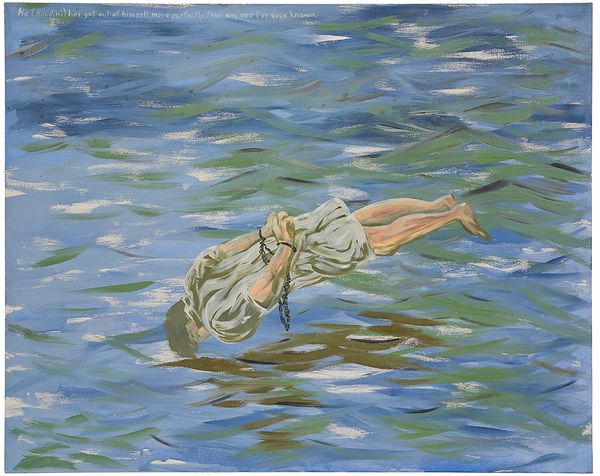
Raymond Pettibon, No Title, (He (Houdini) has...), 1988. New Now: Modern & Contemporary Art.
BK: Tell me about the Black Flag Years show that you did.
RB: Well, that came out of the night that LA was burning down, and I called my preparators and I said, go to the gallery. I have some valuable art other than this, but I said go to the gallery, get all the Pettibons (they both laugh). Get the prints, get the drawings, get the sketches, get the canvas, but get them out of the gallery. Then, all of a sudden, I had all this work together for the first time in a big truck. We brought it back into my gallery, and I realized I’ve never done a later show of my collection. This is a kind of show that I did 30 years ago, and these are all still part of the halcyon days of Black Flag, when Raymond did all the album covers.
BK: And the posters.
RB: Yes, the posters, the Zines. Raymond’s brother was the leader of the group, and like every rock’n’roll punk group, they’d gone through some changes. But those were the years that Black Flag was very exciting, along with Sonic Youth and many of the groups at the time. 90 or 95 percent of the 27 works you have are from between 1986 and 1994. So those are the years.
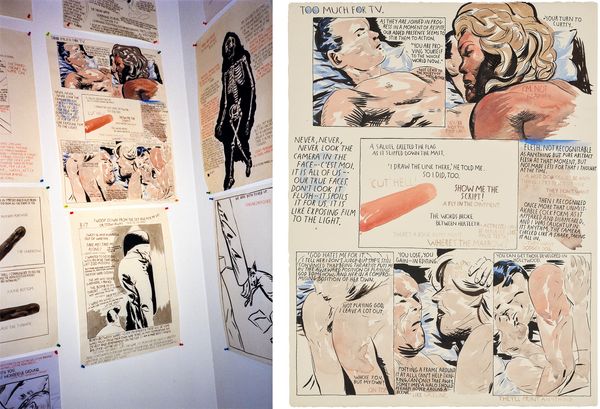
Left: Raymond Pettibon works on view at Robert Berman Gallery in Los Angeles in the 1990s. Right: Raymond Pettibon, No Title (Too much for...), 1991. New Now: Modern & Contemporary Art.
BK: So the works that you’ve selected for Phillips, these are works that came from that moment in the late ‘80s, early ‘90s.
RB: It’s the juicy part. It’s from when the original works were a hundred bucks, two hundred bucks. That’s why I was able to buy all those works that came out of the Helter Skelter show, because I was selling them like candy, but I knew how important he was. As far as art history, you look in the books now, there’s a book that the Pompidou published for the 2006 show called Los Angeles 1955–1985: Birth of an Art Capital. It’s an amazing historical book and all the great artists are in there, but then as soon as they hit the late ’70s and the ‘80s, there are 3 or 4 pages just on Raymond. Almost more on Raymond than anybody else in the book.
BK: He was continuing a throughline of great art right from here in LA.
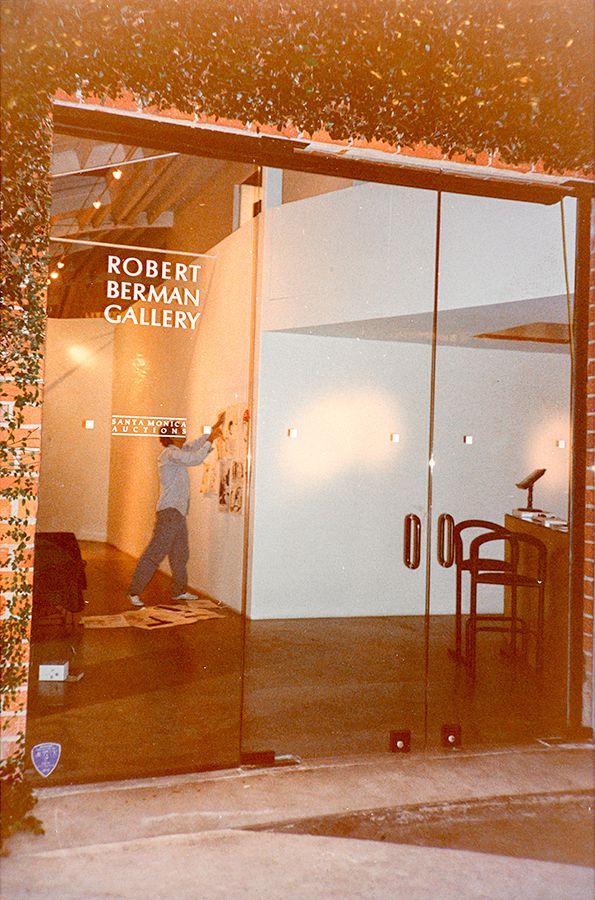
Installation day at Robert Berman Gallery in Los Angeles, ca. 1990s.