Article | The History Of Ultra Thin Watchmaking
The History of Ultra-Thin Watchmaking
A non-exhaustive guide to horology's never-ending pursuit of thinness.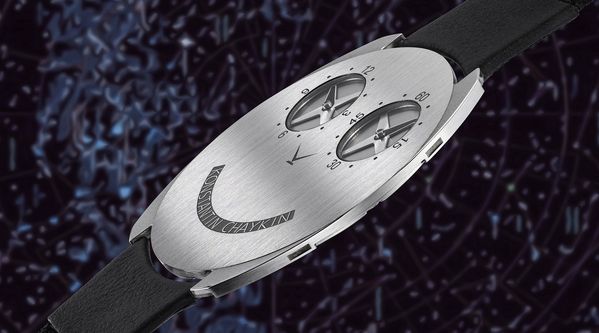
Our first live auction of 2025, the PHILLIPS Geneva Watch Auction: XXI, takes place on 10 - 11 May, at the Hotel President, at Quai Wilson 47, in central Geneva. The auction includes nearly 200 of the world's finest watches – and though we are loath to boast, we truly think it's one of the best catalogs we've ever put together. We'll be highlighting a number of the most interesting lots and stories featured in the sale over the next month, including all the prototype Konstantin Chaykin ThinKing detailed below.
– By Logan Baker
For over a century, watchmakers have vied to create timepieces as thin as possible – not just for bragging rights, but for the elegance and technical virtuosity ultra-thin watchmaking represents.
An ultra-thin watch has a certain magic: it slips under a cuff with ease, feels almost weightless on the wrist, and showcases a watchmaker's prowess in engineering and design.
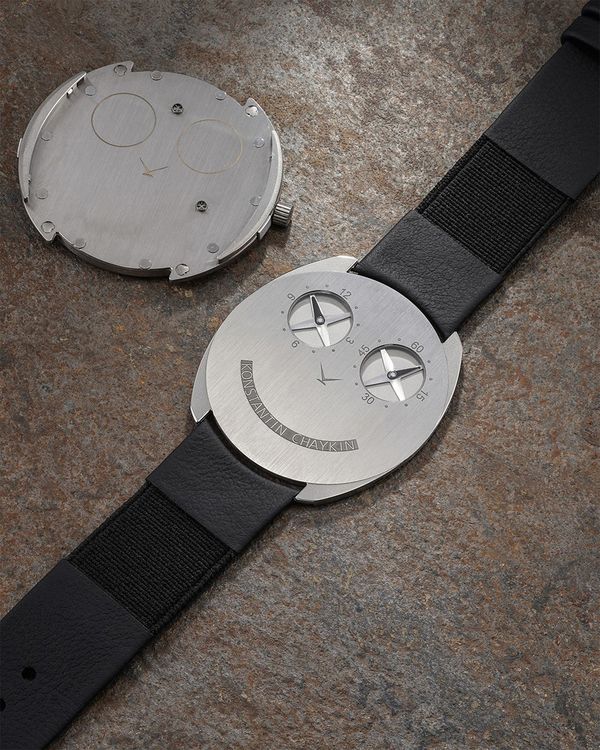
Lot 15: The world's current record holder for the thinnest wristwatch, the Konstantin Chakin ThinKing. A 2025 prototype is included in the Phillips Geneva Watch Auction: XXI. Estimate: CHF 350,000 - 700,000
The history of ultra-thin watches is all about innovation and competition. It starts in 18th-century Paris and continues to today’s independent watchmakers, including the surprising current record holder for the world's thinnest wristwatch.
Lépine’s Slim Revolution in the 1700s
Our story begins in the 18th century with Jean-Antoine Lépine, a French watchmaker to King Louis XV.
In an era when most pocket watches were bulky pieces built with stacked plates and fusee chains, Lépine dared to rethink the architecture of movements. Around 1765, he devised a new construction that did away with the traditional top plate and instead used a series of cocks and bridges to hold the gear train. By eliminating the thick “sandwich” of plates and pillars, Lépine dramatically thinned down traditional movement construction.
Lépine’s innovations, such as the hanging barrel and bridged movement design, paved the way for all subsequent thin watchmaking.
Early 20th-Century Breakthroughs
Fast-forward to the early 1900s, and thinness was again in focus – this time for wrist and dress pocket watches.
A key figure was French watch designer Edmond Jaeger, who around 1903 challenged Swiss makers to produce the ultra-thin movements he had conceived. Jacques-David LeCoultre answered the call. By 1907, LeCoultre (who would later form Jaeger-LeCoultre) introduced the Calibre 145, an astonishingly slim movement of just 1.38 mm thickness. Nicknamed the “Couteau” (French for “knife”), this caliber powered several razor-thin timepieces.
Another milestone came in 1938, when Audemars Piguet unveiled the Calibre 9ML. This hand-wound movement was only 1.64mm thick, making it the thinnest wristwatch movement in the world upon its debut. Audemars Piguet’s achievement with the 9ML was remarkable – by reducing the number of bridges and cleverly rearranging components, they attained a new level of thinness while maintaining rigidity.
Mid-Century Slimdown
The 1950s ushered in a golden age of ultra-thin wristwatches. It was during this era that several now-legendary calibers appeared, each vying for the title of thinnest. Vacheron Constantin struck first.
In 1952, Vacheron launched Calibre 1001, a manual-wind movement measuring only 2.94mm thick. Just three years later Vacheron (in collaboration with Jaeger-LeCoultre) outdid itself with Calibre 1003, which shaved the thickness down to a mere 1.64mm. Jaeger-LeCoultre, which had the manufacturing muscle and know-how, produced many of these 1.64mm thin ebauches for Vacheron and others.
Amid this flurry, Piaget emerged as the specialist of thin. Observing the trend, Piaget decided to develop an ultra-thin movement independently. The result was the Piaget Calibre 9P, unveiled in 1957, a manual wind movement just 2.0 mm thick. Although the 9P wasn’t quite as paper-thin as Vacheron’s record-setting 1003, it was an impressive achievement in its own right.
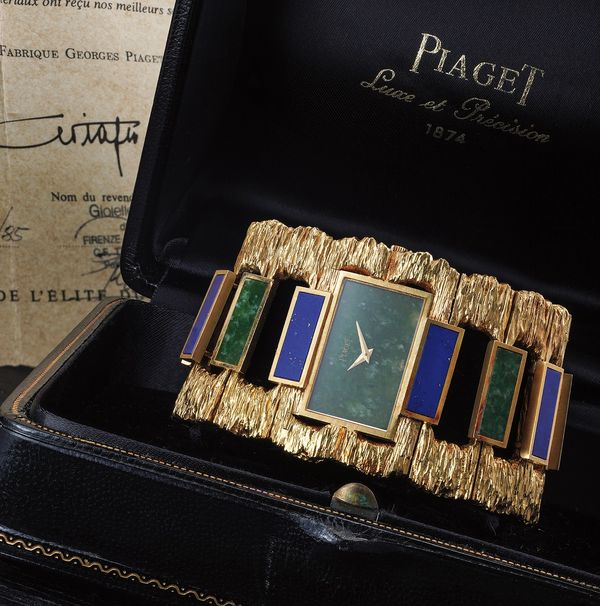
A 1970 Piaget bracelet watch featuring ultra-thin caliber 9P that sold for CHF 53,340 at the Phillips Geneva Watch Auction: XVII, in May 2023.
More importantly, it laid the foundation for Piaget’s identity as the master of ultra-thin. Only three years later, in 1960, Piaget introduced the Calibre 12P, an automatic movement a scant 2.3 mm in height – the thinnest self-winding caliber in the world at that time. To accomplish this, Piaget used a clever micro-rotor recessed into the movement.
The 1970s–1980s
By the 1970s, the watch world was changing. The Quartz Revolution brought a new challenger to mechanical thinness: battery-powered movements. Quartz watches could be made extremely flat with relative ease, since they lacked the stacks of gears and mainsprings of mechanical pieces. The traditionalists were not about to cede the thinness crown without a fight, though. This era saw both some of the thinnest mechanical movements ever – and some wild experiments.
In 1976, independent watchmaker Jean Lassale stunned the industry with the Calibre 1200 and 2000. These calibers, at about 1.2mm (manual) and 2.08mm (automatic) thick, pushed the limits of feasibility. The Lassale calibers achieved thinness by using a “hanging” mounting for gears and barrels (eliminating top plates), and ultra-thin ball bearings for support.
At the same time, quartz watches were breaking records unthinkable for mechanicals. In 1979 the Concord Delirium came out – a quartz watch so thin it was under 2mm in total case thickness. (One later version of the Delirium was even under 1 mm!) These “film wafer” watches were marvels of miniaturization, using the caseback as the circuit board.
Mechanical watchmakers, however, took a different approach: they needed to innovate structurally. For example, in the late 1970s Jaeger-LeCoultre responded with the Calibre 920 – a thin automatic movement (3.05 mm) that, while not record-breaking, was used to create slim sport watches like the Audemars Piguet Royal Oak and Patek Philippe Nautilus from 1972 to 1976 and beyond.
One standout mechanical accomplishment of the 1980s was Audemars Piguet’s Calibre 2870. Unveiled in 1986, this was the world’s thinnest self-winding tourbillon wristwatch. The entire watch was only 4.8mm thick. To achieve this, AP used a tiny platinum rotor on the periphery of the movement and a tourbillon cage a mere 7.2 mm in diameter. The Calibre 2870 watch looked like a slip of metal on the wrist, yet it housed one of horology’s most prestigious complications. It was a technical tour de force that remained the thinnest automatic tourbillon in the world for an astonishing 32 years.
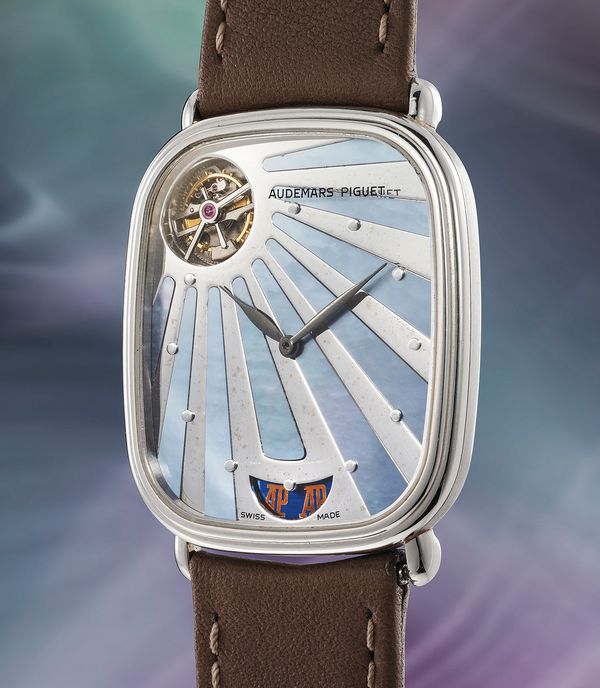
A circa 1990 Audemars Piguet ref. 25643 with the record-setting calibre 2870 inside that sold for CHF 101,600 at Phillips RELOADED in November 2024.
By the end of the 1980s, ultra-thin watchmaking had survived the quartz onslaught, albeit as a niche of high craftsmanship. The stage was set for a resurgence. Indeed, as the mechanical renaissance bloomed in the 1990s and 2000s, brands like Piaget, Jaeger-LeCoultre, and Audemars Piguet continued to refine thin movements (JLC’s Master Ultra-Thin line, AP’s ultra-thin perpetual calendars, etc.).
But it was in the 2010s that the race for ultra-thin records truly heated up again, reaching heights – or rather, thicknesses – that previous generations could hardly imagine.
The 21st Century Arms Race
In the 21st century, ultra-thin watchmaking has become an all-out arms race among a few key players, with each pushing the boundaries of engineering.
After a period of relative calm, Piaget fired the opening shot of the modern race. In 2013 Piaget released the Altiplano 38 mm 900P, a watch that ingeniously merged movement and case into one. The entire watch was just 3.65 mm thick, making it the thinnest mechanical watch in the world at the time. Piaget achieved this by using the caseback as the main plate for the movement and placing some wheels and hands on the dial side to save space.
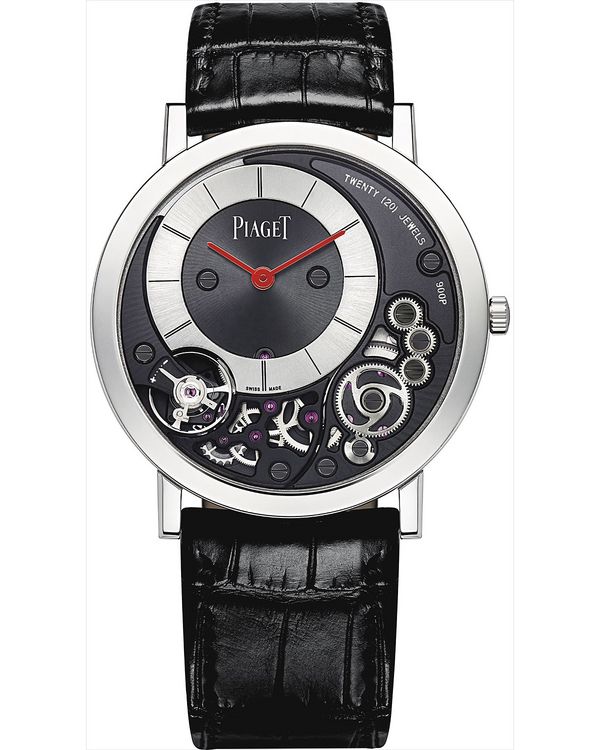
A unique Piaget Altiplano 900P 38mm, made for Only Watch 2015, which sold for CHF 75,000.
Little did we know, however, that a new contender was about to enter the arena and set off a flurry of record-breaking unlike any seen before. Bulgari, the Roman jeweler-turned-watchmaker, had acquired the haute horlogerie know-how of Gérald Genta’s manufacture in the 2000s, and by the mid-2010s Bulgari set its sights on ultra-thinnes with the Octo Finissimo – a line of boundary-pushing watches that would systematically smash records.
It all began in 2014, when Bulgari unveiled the Octo Finissimo Tourbillon. Housed in a sharp, angular case only 5.00 mm thick, it was the thinnest tourbillon watch in the world at the time. Its hand-wound tourbillon movement, the BVL 268, was just 1.95 mm thick. Bulgari’s approach was bold: start with a prestigious complication (a tourbillon) and make it as flat as possible, then build the watch around it.
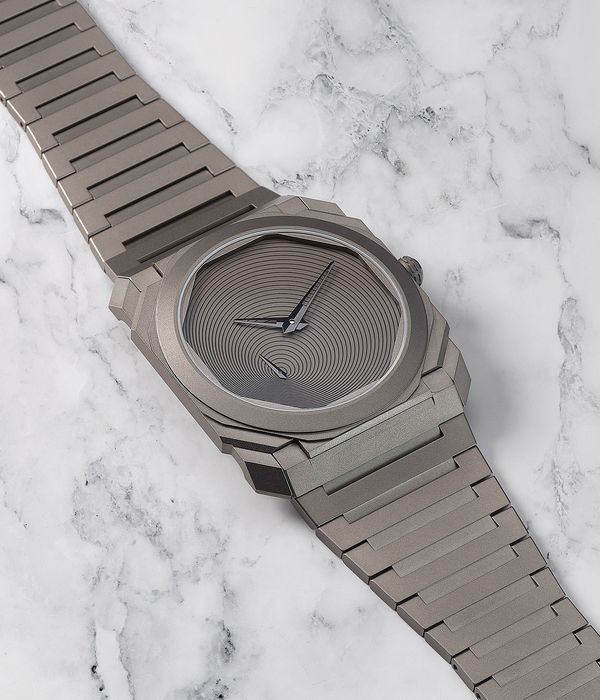
A 2019 Bulgari Octo Finissimo Automatic - Tadao Ando Limited Edition that sold for CHF 27,720 at Phillips Geneva Retrospective 2000 - 2020, in November 2020.
Bulgari didn’t stop there. In 2016, it released the Octo Finissimo Minute Repeater, the thinnest minute-repeating watch ever made. The titanium-cased marvel was just 6.85 mm thick, with a 3.12 mm tall movement. Achieving a chiming watch in that slim a profile required re-engineering everything – even the hour markers were cut out to serve as sound apertures on the dial.
Then came 2017’s Octo Finissimo Automatic, a simple three-hander that took the title of world’s thinnest automatic watch at that moment. Its case was 5.15 mm thick, containing a 2.23 mm micro-rotor movement. The Octo Finissimo Automatic won awards and wowed collectors with its sandblasted modern look and improbably light feel. Piaget answered in the same year with the Altiplano Ultimate Automatic 910P, which at 4.30 mm thick trumped the Bulgari by a hair.
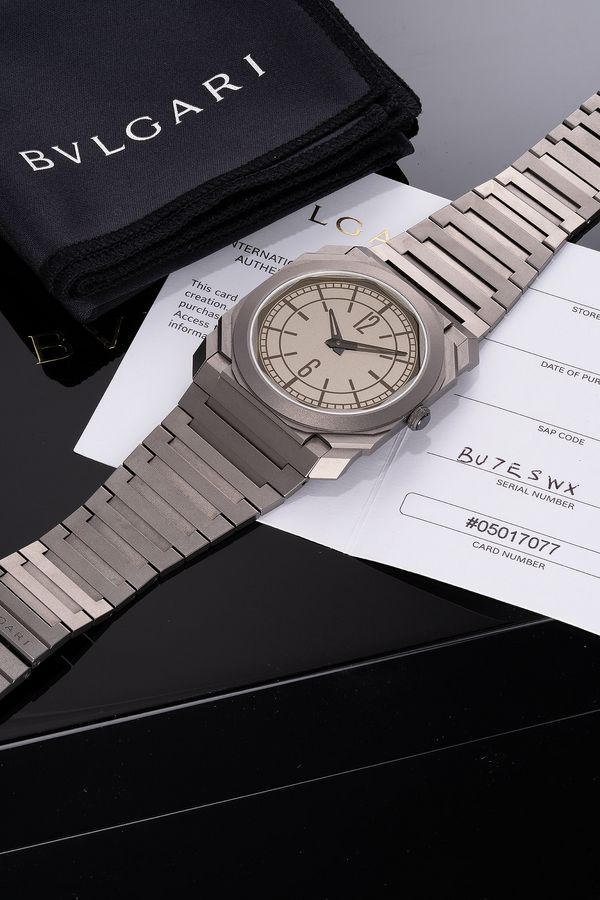
Phillips in Association with Bacs & Russo collaborated with Bulgari on our own limited-edition take on the Octo Finissimo Automatic in late 2022. Limited to 50 pieces in titanium with a sector-style dial, this example sold at auction for HKD $107,950, at the Phillips Hong Kong Watch Auction: XIX, in November 2024.
Bulgari’s streak of record-smashing continued into the late 2010s. In 2018, they unveiled the Octo Finissimo Tourbillon Automatic, which set two records at once: thinnest automatic watch and thinnest tourbillon watch, both courtesy of one design. How? Bulgari took their 1.95 mm tourbillon caliber and added a peripheral winding rotor to it, managing to keep the whole watch only 3.95 mm thick. This leapfrogged Piaget’s 910P and snagged back the “world’s thinnest automatic” title for Bulgari.
In 2019, Bulgari introduced the Octo Finissimo Chronograph GMT, a chronograph unlike any other. With a movement only 3.3 mm thick, it became the world’s thinnest mechanical chronograph (in a 6.9 mm case). Impressively, it was a fully integrated chronograph with a column wheel and even a second time zone display, all in a movement about the size of two credit cards.
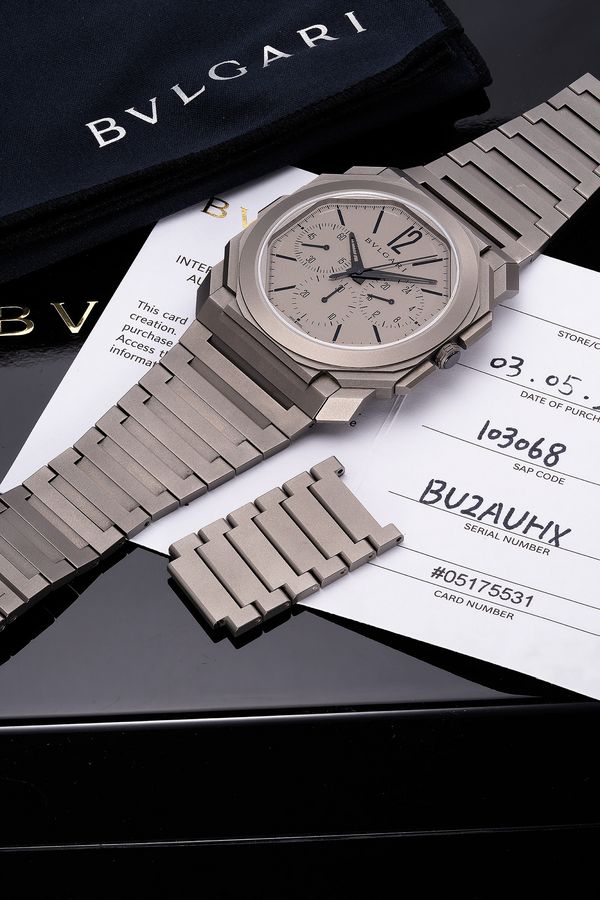
A circa 2022 Bulgari Octo Finissimo Chronograph GMT in titanium that sold for HKD $101,600 at the Phillips Hong Kong Sessions, Fall 2024, Online Auction.
In 2020, Bulgari combined complications by launching the Octo Finissimo Tourbillon Chronograph Skeleton Automatic, a tongue-twister of a name for a watch that itself was ultra-thin at 7.40 mm. It fused the chrono and tourbillon, setting a record for thinnest tourbillon chronograph ever. And then in 2021, Bulgari completed an ultra-thin grand slam with the Octo Finissimo Perpetual Calendar, the world’s thinnest perpetual calendar at just 5.80 mm thick.
Yet the race was far from over. Just when it seemed Bulgari might rest on its laurels, along came a challenger from an unexpected place: Richard Mille. Known for futuristic, extreme designs, Richard Mille teamed up with Ferrari in 2022 to create the RM UP-01 Ferrari, a watch that looked more like a sliver of metal than a traditional timepiece. The RM UP-01 stunned the industry by achieving an overall thickness of only 1.75 mm – beating Bulgari’s record for thinnest watch (which was 1.80 mm with the Octo Finissimo Ultra) by a hair.
Unveiled in mid-2022, the RM UP-01 had a unique construction with a wide, plate-like case, fixed bezel (no conventional caseback), and a movement spread out flat as a pancake. It forewent a traditional dial and hands (opting for subdials and a rotating disk for seconds) to save space. With 1.75 mm “thinness”, Richard Mille held the title of world’s thinnest mechanical watch – at least for a little while.
Bulgari, of course, was not content to stay second for long. In 2022 it had already released the Octo Finissimo Ultra, a limited-edition concept-piece that tied into the digital age by featuring a QR code on its dial. The Ultra measured 1.80 mm thick and was the record-holder until the RM came along. In early 2024, Bulgari quietly tweaked that design into an even thinner Ultra chronometer-certified edition, managing to shave it down to about 1.70 mm – thus reclaiming the crown of thinnest mechanical watch (briefly). This back-and-forth, occurring within months, demonstrated how fiercely contested the ultra-thin niche had become.
Other brands weren’t standing idle either. Piaget, who had kicked off the modern race, responded in 2018 with the Altiplano Ultimate Concept (AUC), a functioning prototype watch only 2.0 mm thick in total. It took a few years to refine and put into limited production, but Piaget did eventually deliver this marvel to clients – and in 2020 it officially became the thinnest watch you could actually buy (beating Bulgari at that time).
Not to be outdone in 2024, Piaget went a step further and introduced the Altiplano Ultimate Concept Tourbillon – maintaining that same absurd 2.0 mm thickness but now including a tourbillon. In other words, Piaget grabbed the record for thinnest tourbillon watch at the time.
Perhaps the most surprising entry in this race arrived in late 2024 from the Russian independent watchmaker Konstantin Chaykin. Known for his whimsical “Wristmon” creations, Chaykin turned his talents to pure thinness and created a prototype called the ThinKing. The result was spectacular: the ThinKing came in at only 1.65 mm thick, beating the previous record holder (Bulgari’s Ultra) by just 0.05 mm. Chaykin’s ThinKing, shown as a prototype during Geneva Watch Days 2024, features a clever dual-dial display (the watch face looks like it’s smiling, in typical Chaykin humor) and some novel engineering solutions to achieve its thinness. It uses special high-hardness steel for the case to add rigidity at such slim dimensions, and even the strap was rethought to reduce stress on the ultra-thin case. With 1.65 mm, this independent watchmaker claimed the title of world’s thinnest mechanical watch in late 2024.
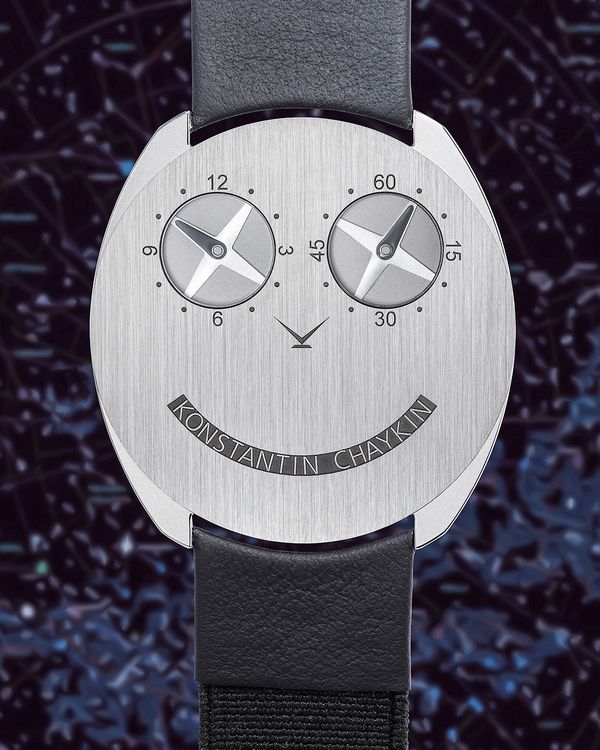
Lot 15: The world's current record holder for the thinnest wristwatch, the Konstantin Chakin ThinKing. A 2025 prototype is included in the Phillips Geneva Watch Auction: XXI. Estimate: CHF 350,000 - 700,000
Since the first presentation of the ThinKing in August 2024, Chaykin made extra changes for the production pieces, the case of the ThinKing is now made of a special nickel alloy. Further, other features were enhanced such as water resistance, interaction adjustment with the external case-carrier, and a more stable power reserve. The dual-balance system has also been significantly modified to optimize performance.
The first complete prototype of Konstantin Chaykin's ThinKing is being offered in the upcoming Phillips Geneva Watch Auction: XXI (lot 15) at an estimate of CHF 350,000 - 700,000.
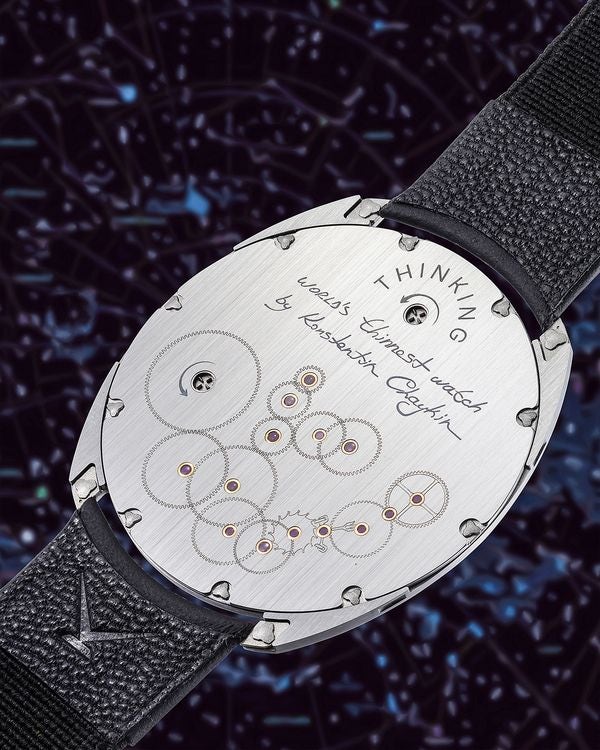
Lot 15: The world's current record holder for the thinnest wristwatch, the Konstantin Chakin ThinKing. A 2025 prototype is included in the Phillips Geneva Watch Auction: XXI. Estimate: CHF 350,000 - 700,000
Finally, we arrive at 2025, and the saga continues. At Watches & Wonders 2025, Bulgari struck yet again with the Octo Finissimo Ultra Tourbillon – marking an unprecedented tenth world record for the Octo Finissimo collection. This new Ultra Tourbillon measures a scant 1.85 mm in thickness, making it the thinnest tourbillon-equipped watch ever. By adding a tourbillon escapement to a watch under 2 mm thick, Bulgari snatched back the tourbillon thinness title from Piaget.
Engineering an Ultra-Thin Future
Looking back over this history, one sees a pattern: each generation of watchmakers builds on the last, finding new ways to overcome the challenges of ultra-thin design. Those challenges are significant. A movement needs to have enough power (mainspring thickness vs. power reserve is a constant trade-off), enough rigidity (an ultra-thin watch can bend or the movement plates can flex if not properly supported), and enough reliability (tiny tolerances can lead to huge problems).
Solutions have ranged from Lépine’s bridges in the 1760s, to micro-rotors in the mid-20th century, to using the watch’s case as the movement in modern times. Almost all of the recent ultra-thin calibers incorporate novel tricks: peripheral rotors (so no rotor thickness stacked on top), offset or tiny gear trains, and components serving double duty (the caseback as mainplate, for instance, in Piaget’s and Bulgari’s approaches).
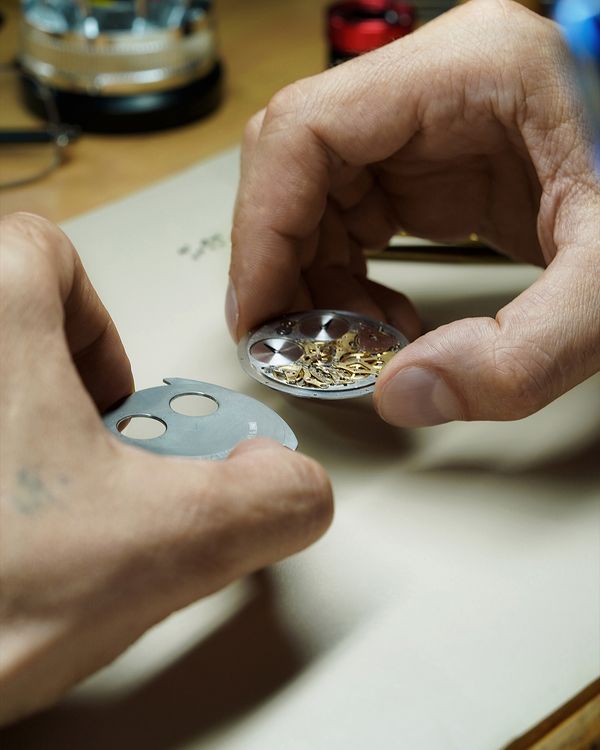
Lot 15: The world's current record holder for the thinnest wristwatch, the Konstantin Chakin ThinKing. A 2025 prototype is included in the Phillips Geneva Watch Auction: XXI. Estimate: CHF 350,000 - 700,000
What’s truly delightful is how these technical feats are executed in the spirit of friendly competition. When you read the history of ultra-thin watchmaking, it comes across almost like a sports rivalry – Piaget versus Jaeger-LeCoultre in the 1950s, Piaget versus Bulgari in the 2010s, and even independents like Konstantin Chaykin joining the fray against the big names in the 2020s.
As of this writing in April 2025, mechanical watchmaking has achieved astonishing slimness – on the order of 1.5 millimeters thin – and yet the watches still function, still keep time, still capture our imagination.
The history of ultra-thin watchmaking is still being written with each new record. It’s an endless challenge that pushes watchmaking forward.
You can learn more, place a bid, and view the entire Geneva Watch Auction: XXI catalogue right here.
About Phillips In Association With Bacs & Russo
The team of specialists at PHILLIPS Watches is dedicated to an uncompromised approach to quality, transparency, and client service. Phillips in Association with Bacs & Russo holds the world record for the most successful watch auction, with its Geneva Watch Auction: XIV having realized $74.5 million in 2021. Over the course of 2021 and 2022, the company sold 100% of the watches offered, a first in the industry, resulting in the highest annual total in history across all the auction houses at $227 million.
About Logan Baker
Logan has spent the past decade reporting on every aspect of the watch business. He joined Phillips in Association with Bacs & Russo at the start of 2023 as the department's Senior Editorial Manager. He splits his time between New York and Geneva.
Recommended Reading
How Independent Watchmakers Are Rethinking the Escapement
Why Collectors Are Falling Back in Love With Time-Only Vintage Watches
Inside The Philippe and Elisabeth Dufour Foundation