Article | Octa Reserve De Marche
A Guide to the F.P. Journe Octa Réserve de Marche Collection
With its innovative caliber 1300, 120-hour chronometric power reserve, and unmistakable design language, the Octa Réserve de Marche set the blueprint for Journe’s automatic lineage — and changed the rules of movement architecture.
Phillips in Association with Bacs & Russo is thrilled to welcome you to Watches Online: The New York Sessions Featuring the 1979 Collection, Spring 2025, running from 10:00 AM ET, Tuesday, 1 April, to 12:00 PM ET, Tuesday, 8 April. Featuring more than 65 different high-end luxury wristwatches, the sale covers everything from A. Lange & Söhne and F.P. Journe to Audemars Piguet and Patek Philippe, including the 2002 F.P. Journe Octa Réserve de Marche featured below.
– By Logan Baker
Among the many masterpieces that have emerged from the mind of François-Paul Journe, few carry the quiet confidence and foundational importance of the Octa Réserve de Marche.
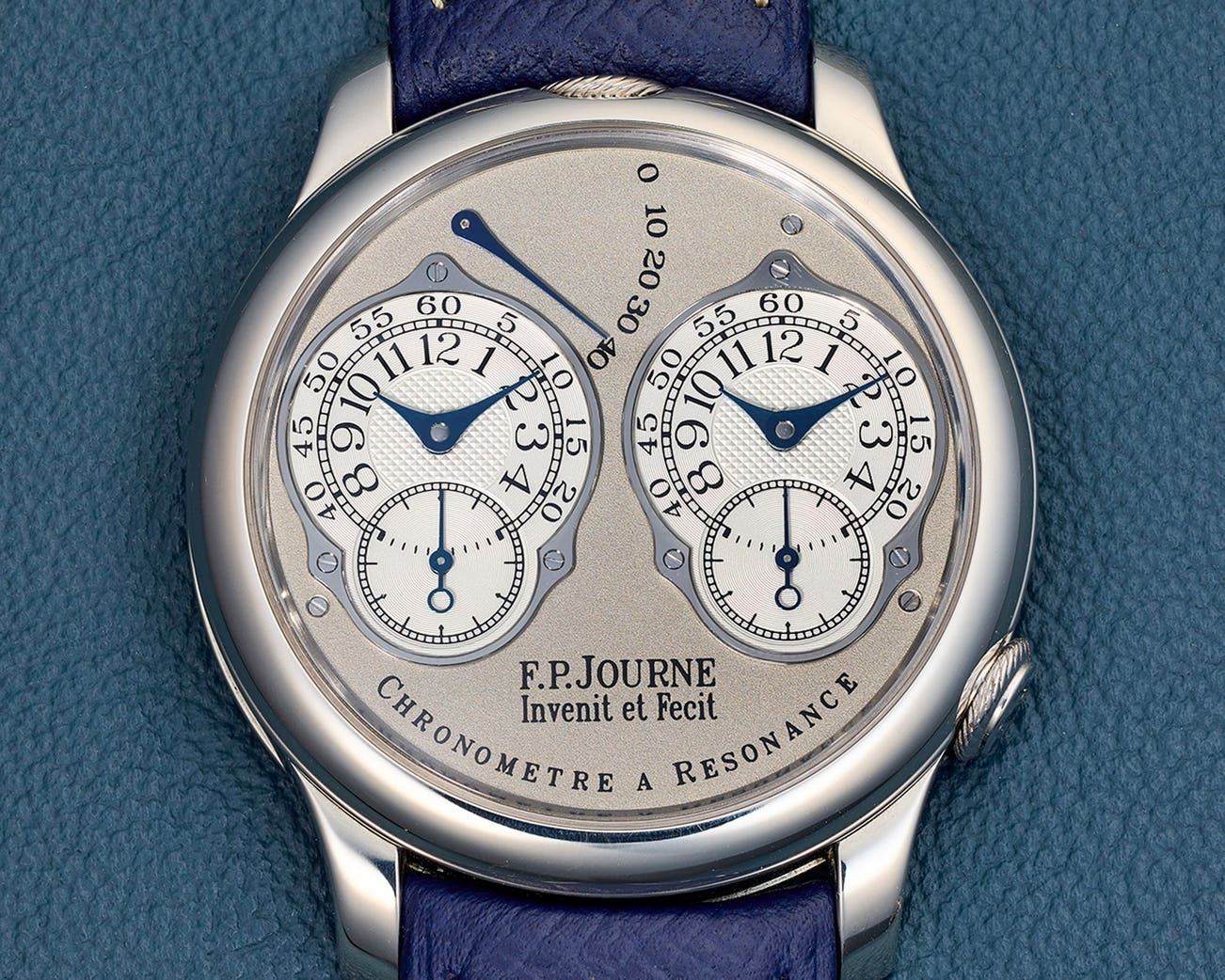
Released in 2001 as his third creation under the F.P. Journe name — following the Tourbillon Souverain and the Chronomètre à Résonance — this timepiece marked a pivotal moment in independent watchmaking. It was not just Journe's first automatic wristwatch; it was a signal that his vision of haute horology would be defined not only by intellectual complexity, but also by pragmatic ingenuity.

Lot 41: A 2002 F.P. Journe Octa Réserve de Marche in platinum with brass movement that's included in the Phillips New York Sessions, Spring 2025, Online Auction. Estimate: USD $50,000 - 100,000
The Octa Réserve de Marche debuted with an audacious goal: to deliver a self-winding mechanical movement with a chronometric power reserve of more than 120 hours, without bloating the case or compromising on precision. And, remarkably, F.P. Journe achieved exactly that. The Caliber 1300, as it was called, remains one of the most elegantly conceived and forward-thinking automatic movements ever designed.
A Movement Ahead of Its Time
Journe has always resisted modular design. Instead of layering complications on top of a base caliber, which often leads to clunky thickness and reliability issues, he sought to create a fully integrated movement that could be adapted for a variety of functions while maintaining the same dimensions. Thus was born the Octa movement: 30mm in diameter, 5.5mm thick, and capable of housing a wide range of complications from a simple date to an annual calendar, all within the same architecture.

A 2003 F.P. Journe Octa Réserve de Marche in platinum, number 1 of the original Souscription series of 20 pieces. Sold for CHF 554,400 at the Phillips Geneva Watch Auction: XIV, in November 2021.
Originally produced in rhodium-plated brass, and later transitioned to 18k gold in 2004, it features a 22k gold off-center guilloché rotor, a free-sprung balance, and 120 hours (five days) of chronometric timekeeping. The movement is a marvel of engineering and aesthetics. From the finely applied Côtes de Genève to the idiosyncratic hand-filed anglage — which Journe purposely leaves with a slightly raw texture to emphasize the human touch — this is a caliber that is as expressive as it is efficient.
The Octa's winding system is unidirectional, requiring 274 revolutions per 24 hours. The long mainspring provides a staggering torque of 850g, with a mere 25% amplitude loss at the end of the power reserve. It features a mobile stud holder, micro-flamed anachron flat balance spring, and a large 10.1mm balance wheel with adjustable inertia weights — a configuration usually reserved for serious chronometers.
The Brass Age: 2001–2004
Collectors often divide Journe's early work into two epochs: the Brass Era and the Gold Era. From 1999 to around 2004, all F.P. Journe calibers were made of rhodium-plated brass. These watches are now coveted by enthusiasts for their rarity (less than 2,000 brass-movement watches were produced across all lines) and for their intimate connection to the brand's fledgling days.

Lot 41: A 2002 F.P. Journe Octa Réserve de Marche in platinum with brass movement that's included in the Phillips New York Sessions, Spring 2025, Online Auction. Estimate: USD $50,000 - 100,000
The Octa Réserve de Marche with a brass movement is particularly beloved.
Produced between 2001 and 2004, it was housed in the classic 38mm case — Journe's original preferred size. Offered in platinum or rose gold with a range of dials, including the rarer yellow gold with silver guilloché subdials, these early pieces embody Journe's unique vision. The offset time display, the power reserve arc from 9 to 11 o’clock, the big date at 12, and the small seconds at 4:30 all create a dial layout that is as asymmetrical as it is harmonious.
The Golden Age: 2004–2014
In 2004, Journe transitioned his entire production to 18k rose gold movements. It was more than just a material change, marking a maturation of the brand, a symbolic crossing of the threshold from promising upstart to full-fledged manufacture.
The Caliber 1300.2 and later 1300.3 retained the exact same dimensions as the original, ensuring continuity and backward compatibility across the Octa line.

A 2000 F.P. Journe Octa Réserve de Marche prototype in platinum that sold for USD $250,000 at the Phillips New York Game Changers Auction, in December 2019.
Functionally, these later movements saw subtle improvements in winding efficiency and reliability, especially in the date mechanism. The aesthetics remained pure: a finely finished movement visible through a sapphire caseback, with Journe's signature layout and rotor design.
The watch remained available in 38mm and 40mm sizes, with dial variations in white, rose, and yellow gold, paired with platinum or rose gold cases. The power reserve indicator, unlike later Journe models that used a "time since winding" scale, continued to show remaining energy in the mainspring — a practical and elegant touch.
Black Label
Introduced around 2006, the Black Label collection was available exclusively to existing clients and only through F.P. Journe boutiques, Black Label watches feature a platinum case with a glossy black lacquer dial and white printing. The effect is both stealthy and luxurious.
The Octa Réserve de Marche Black Label is among the rarest of the line. Produced until around 2010, it encapsulates everything that makes Journe special: technical ingenuity, aesthetic restraint, and insider appeal.
Under the black dial beats the same 18k gold Caliber 1300.3, but the watch feels entirely different in spirit. It’s a piece for those who whisper rather than shout.
The 20th Anniversary
In 2021, to mark 20 years of the Octa line, F.P. Journe released the Octa Automatique 20th Anniversary. Limited to just 99 pieces, it was a direct homage to the 2001 original, complete with a yellow gold dial, silver subdials, and — most significantly — a brass movement.
Yes, for this edition, Journe returned to his roots, using rhodium-plated brass for the Caliber 1300.3. It was a poetic gesture, acknowledging the enduring legacy of the early Octa and giving new collectors a taste of what made those first pieces so magical. The case was 40mm, but the spirit was pure 2001.
Design That Endures
Visually, the Octa Réserve de Marche is unmistakably Journe. The rope-patterned crown, the grained or guilloché dials, the asymmetrical displays — each element has become part of the brand's design DNA. But more than any individual feature, it’s the cohesion of the whole that defines the watch.
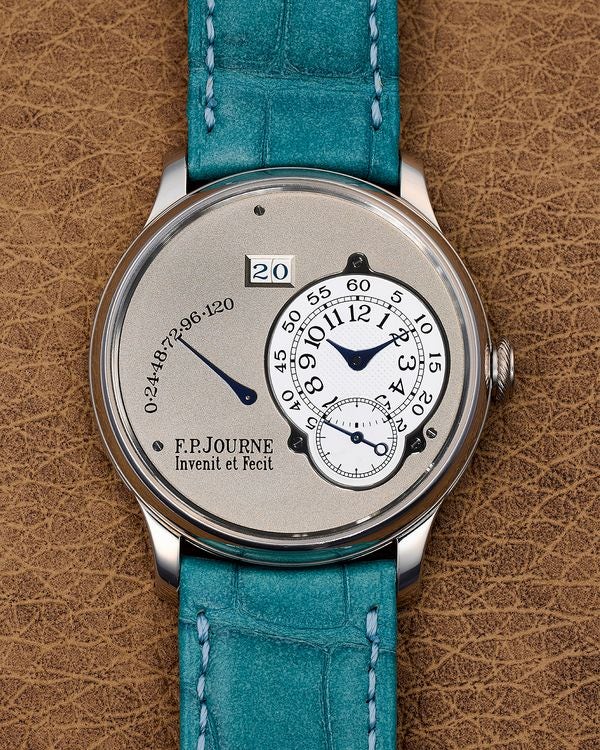
Lot 41: A 2002 F.P. Journe Octa Réserve de Marche in platinum with brass movement that's included in the Phillips New York Sessions, Spring 2025, Online Auction. Estimate: USD $50,000 - 100,000
The Octa Réserve de Marche speaks the language of 19th-century French watchmaking while operating at the cutting edge of modern movement design. It is a daily-wearable dress watch that also happens to be a technical tour de force.
Over two decades after its debut, the Octa Réserve de Marche still feels fresh. It’s not a relic, but a cornerstone — a watch that established a philosophy of watchmaking that continues to guide F.P. Journe to this day.
You can view the complete catalog for the Phillips Watches Online: The New York Sessions Featuring the 1979 Collection, Spring 2025, right here.
Our new online auction app for iOS offers a seamless way to browse and bid in online auctions. Download now to bid in the Phillips Watches Online: The New York Sessions Featuring the 1979 Collection, Spring 2025. Phillips Online is currently only available on iOS. Android users can browse and bid via their mobile browser.
About Phillips In Association With Bacs & Russo
The team of specialists at PHILLIPS Watches is dedicated to an uncompromised approach to quality, transparency, and client service. Phillips in Association with Bacs & Russo holds the world record for the most successful watch auction, with its Geneva Watch Auction: XIV having realized $74.5 million in 2021. Over the course of 2021 and 2022, the company sold 100% of the watches offered, a first in the industry, resulting in the highest annual total in history across all the auction houses at $227 million.
About Logan Baker
Logan has spent the past decade reporting on every aspect of the watch business. He joined Phillips in Association with Bacs & Russo at the start of 2023 as the department's Senior Editorial Manager. He splits his time between New York and Geneva.
Recommended Reading
The Different Shapes of Cartier
Three References, One Legacy, A Look at the Patek Philippe Calatrava
In-Depth: The Sculptural Modernity of the Romain Gauthier C Collection