Article | All The Cartier Art Deco Clocks To Know About In The Hong Kong Watch Auction Xix
All the Cartier Art Deco Clocks to Know About in the Hong Kong Watch Auction: XIX
Collecting vintage Cartier Art Deco clocks is a journey into one of the most innovative eras in horology. These clocks, crafted in the 1910s, 1920s, and 1930s, showcase Cartier’s mastery of opulent yet restrained design, combining Eastern influences with modernist Art Deco aesthetics. Particularly c
Collecting vintage Cartier Art Deco clocks is a journey into one of the most innovative eras in horology.
These clocks, crafted in the 1910s, 1920s, and 1930s, showcase Cartier’s mastery of opulent yet restrained design, combining Eastern influences with modernist Art Deco aesthetics. Particularly captivating are Cartier’s Pendule Mystérieuse or "mystery clocks" and La Pendule Magnétique water clocks, where time indicators seem to float magically on the dial, a design made possible by concealed magnetics and engineered by Maurice Couet, Cartier’s master horologist.
Each piece was a statement, using jade, lapis lazuli, coral, and enamel to create stunning works of art with cultural significance. Some pieces, like the jade-based clocks with Chinese-inspired engravings, reflect Cartier's homage to Eastern art, integrating delicate carvings and imperial symbols like dragons and chimeras. These clocks, often uniquely commissioned, served as meditative art objects, rare both for their craftsmanship and cultural narrative, making them highly desirable in today's auctions and collections
Lot 910
Master of levitation, an exceptional illusionist with his signature magic trick, Maurice Coüet at the age of 28 bewilders his audience every single time with his creations. Leaving everyone beguiled with one question in mind, how is this possible? Described as “marvels of horology” by influential French magazine, the Gazette du Bon Ton in 1925, the Cartier Mystery clocks draw wonders since 1912 starting with its enigmatic Modèle A. Taking muse from French clockmaker and illusionist Jean Eugène Robert-Houdin of his experimentation with the reflective quality of glass, Coüet together with Louis Cartier harnessed the creativity and pushed technicality into a new realm, with greater finesse, greater lightness, greater transparence.
Truly first of its kind, the Modèle A Mystery clock captures the audience attention with its seemingly levitated hands within its pellucid block-shaped rock crystal. These early creations of the Modèle A were bejewelled art pieces that highlights the mastery of Cartier’s craftmenship and design skills. First devised with a double-axle mechanism and soon after single central axle, the “Mystery” is solved thanks to the separate crystal disc hidden within. These discs are each surrounded by a tooth-edged boarder and driven by screws fixed at the ends of the axles, working at the levels of 3 and 9 o’clock, the driving pinions of the hands are hidden in each column of the frame. The rotation of the axles is activated by the movement hidden in the base, therefore, it is not the hands which move but each disc on which they are individually set at two different speeds, one for the hours and one for the minutes.
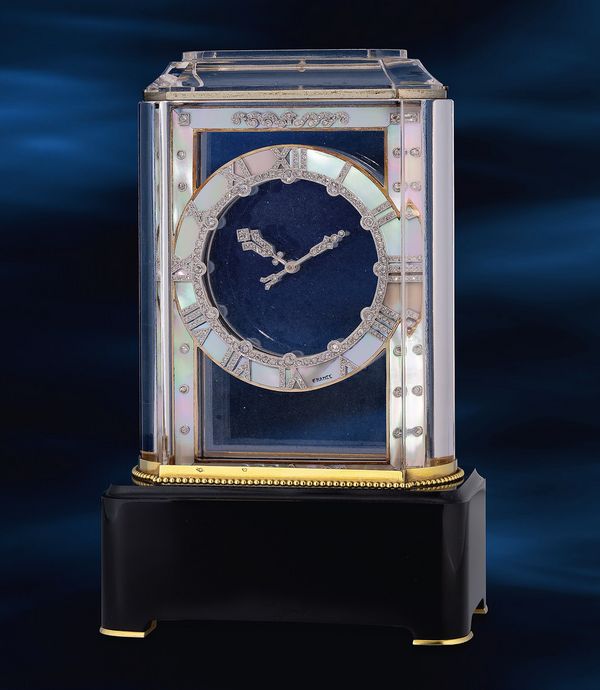
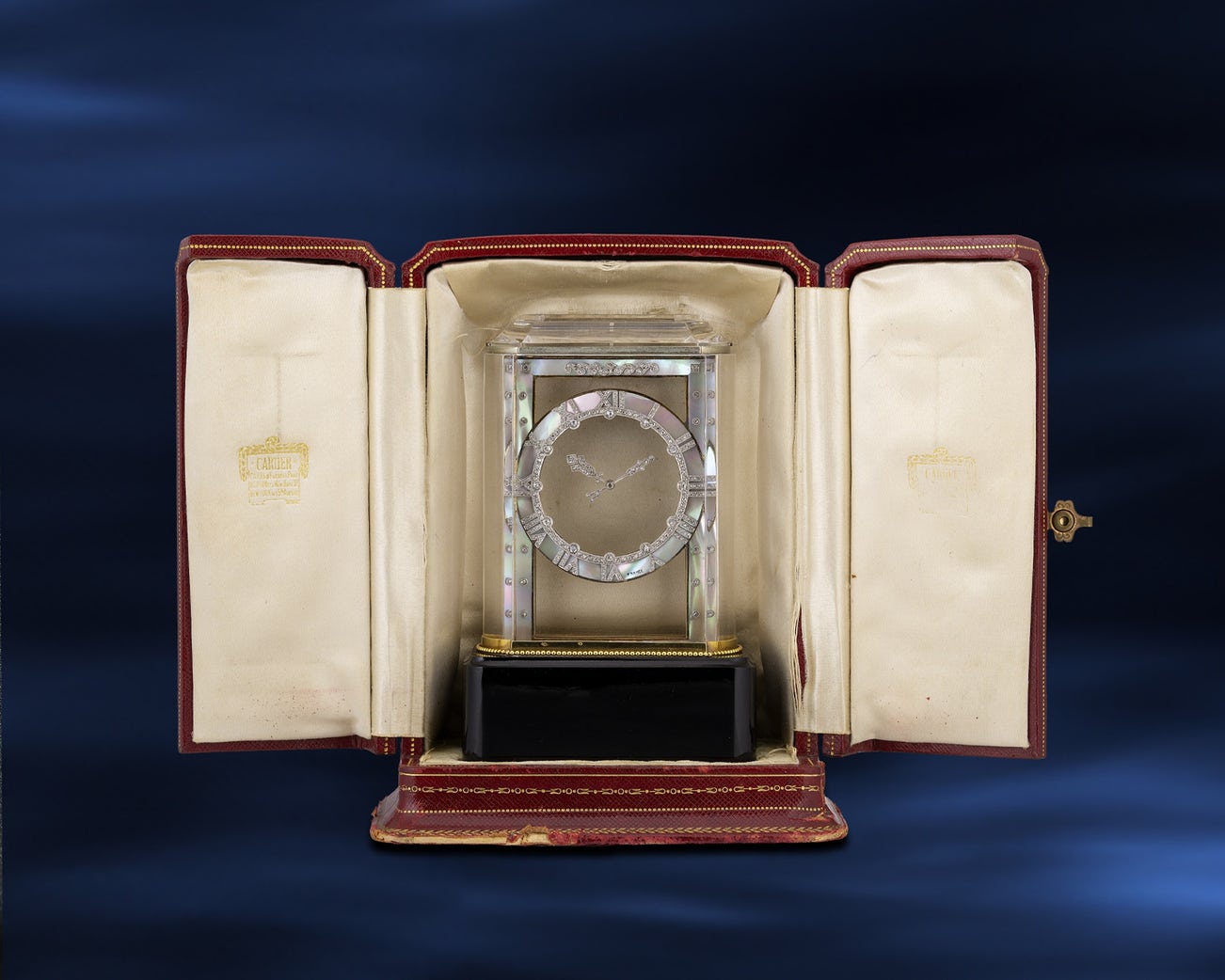
Lot 910: A unique, extremely rare and historically important rock crystal, mother-of-pearl, yellow gold, onyx, diamonds Art Deco mystery clock with original key and presentation box. Estimate: HKD $2,800,000 - 5,600,000
A ground breaking timepiece, Modèle A Mystery Clocks were bought by glamourous celebrities and important figures of the society such as banker Jean Pierpont Morgan who bought the second clock created in 1913, Count Greffulhe (in 1914), Sir Bhupindra Singh, the maharajah of Patiala (in 1921). Each unique with sophistication, these handmade clocks boast variations on the type of base: agate, onyx, obsidian, nephrite, lapis lazuli, gold and jade, while other difference involved the decorations on the frames and chapter rings.
Made by Cartier France, the present Modèle A is incredibly important as the original drawing is documented in The Cartier Collection: Timepiece by Franco Colongi and François Chaille – the official tome by Cartier for their extensive archives. Crafted in rock crystal, gold, mother-of-pearl, and diamonds, it states that it is from 1929 in the Cartier Archives.
A matching one to one production to the Model A drawing, the radiant glow of the mother-of-pearl within the gold columns and chapter ring shines with elegance. The platinum hands are fully adorned with sparkling diamonds which sets balance together with the diamond-set Roman numerals and art deco motifs on its frame. Its black onyx base is also decorated with subtle row of gold beaded lining where two vivid and crisp hallmarks can be found: an eagle beak for its French origin and a diamond shaped MC hallmark.
Powered by a European Watch & Clock Co Inc. 8-day movement with Swiss lever escapement, bimetallic balance, the hand-key-setting and winding mechanism is set underneath the base.
As an even nicer touch, the Modèle A retains its original fitted presentation box and original numbered key, with the Cartier hand stamped number corresponding to the one on the clock. A well-preserved objet d’art having first appeared on the market three decades ago, this historically significant Mystery clock will most likely remain hidden and cherished again for many years to come. Extremely limited in production according to scholarship only approximately 60 examples were made of the Modèle A. Its public sale at auction offers a unique chance for collections to acquire one of the greatest optical illusion of horological history. Not just all smoke and mirrors but a milestone for technical prowess of Cartier, this is also an historically significant museum-worthy Art Deco piece.
Lot 911
Since 1920s, Cartier mastered the Art Deco era of the Far East decorative objects for decades. Louis-Francois Cartier having been a distinguished connoisseur of oriental languages, Louis Cartier and his brothers were exposed to exoticism via fairs such as the late nineteenth century Universal Expositions in Paris at an early age. This new curiosity from the East extends from arts to architecture were known as Chinoiserie and Japonaiserie. Other sources also enriched their imagination such as the illustrations in Owen Jones’s Examples of Chinese Ornaments. Seeded with cultural inspiration, it was not until the 1920s that Cartier’s exotic taste would be translated into a series of clocks and art objects. A three-dimensional playground and a desire to “Never copy, only create”, an impressive range of techniques and exotic influences can be found in an array of mystery clocks, screen clocks, and desk clocks. From mythical creatures, animals, figurines to exotic materials, many were sourced from antique merchants or from their travels to the East. Notably these includes the Chimera carved from nephrite from China, Kuan Yin figurines, carps and elephants from 18th century jade sculptures, or lacquered scenery from screens all founded amongst Cartier’s clock creations.
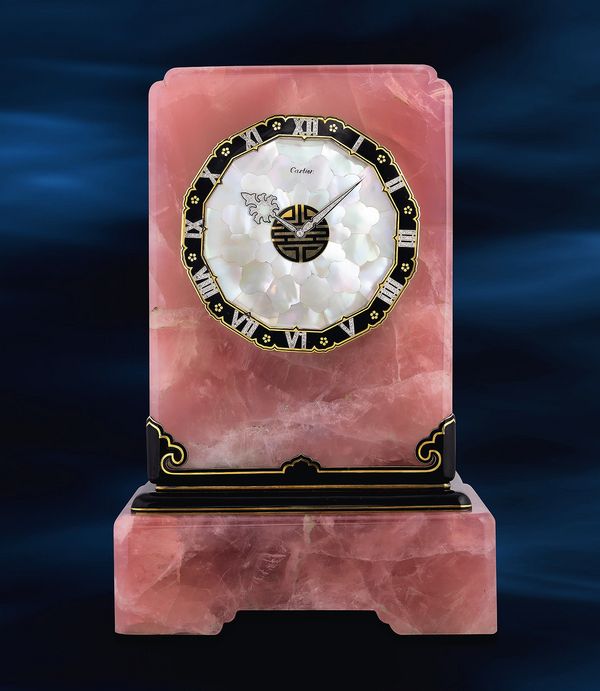
Lot 911: A unique and magnificent rose quartz, diamonds, mother-of-pearl, enamel and yellow gold Art Deco desk clock with original key. Estimate: HKD $1,200,000 - 2,400,000
An impressive creation by Cartier Paris, the present desk clock from the 1930s is inspired by the Far East. Translucent with a calming soft pink hue crafted from a massive block of rose quartz stone, the corners are elegantly shaped with smooth rounded corners also known as the “coins Japonais, Japanese corners”. Anchored with a decorative base frame with black enamel and yellow gold, the motif further encircles the Cartier signed dial of this desk clock. Set with rose-cut diamonds Roman numerals, the 5 min markers are decorated with a five petal Sakura flower graphic that harmonize with the cherry blossom glow of the rose quartz. The fanned-out marquetry works crafted with mother-of-pearl radiates in iridescent sheen, cleverly planned out in symmetry the hours are clearly divided. A large diamond sets the centre of the Art Deco hands, an “Shou” symbolled gold plate meaning longevity, adds as a finishing finesse of the Far East theme. Powered by a European Watch & Clock Co 8-day key wound movement, the desk clock is numbered 583, its winding key is further stamped “1511”.
Fresh-to-the-market and kept in private hands for three decades, this is the only known Cartier signed example to appear in the market. Known for its symbolism of infinite peace and harmony, the present unique rose quartz masterpiece preserved with unparalleled condition and quality not only underlies its importance amongst Cartier’s history, but also demands attention as a unique museum worthy collection.
Lot 912
Louis Cartier joined the family business in 1898 at the age of 23, bringing a fresh perspective that propelled Cartier into new realms with ambitious goals. As an Haute Joaillerie maison, Louis inherited impeccable taste, refined cultivation, and an open mind, aiming to carve a niche in the world of timepieces. His designs were heavily influenced by the Louis XVI style, characterized by gold decorations, while also integrating his personal aesthetic of pure, geometric lines.
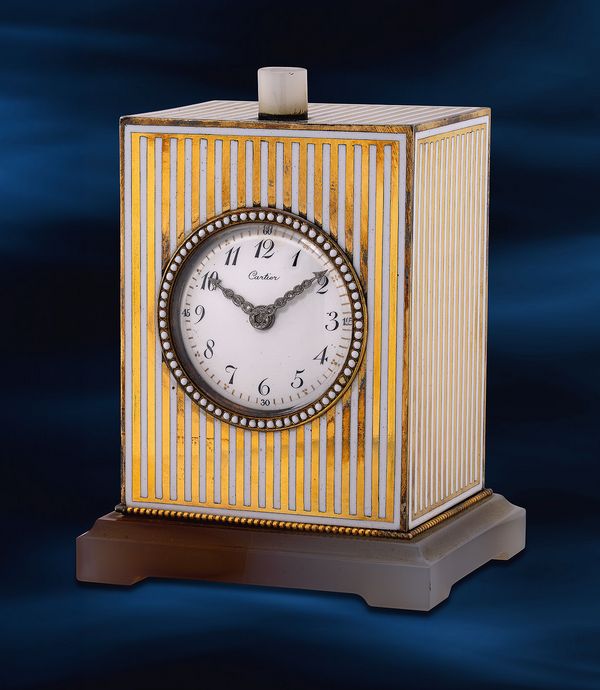
Lot 912: A very rare and attractive gold, silver, moonstone, agate and enamel minute repeating desk clock with enamel dial, diamond-set hands and fitted presentation box. Estimate: HKD $80,000 - 160,000
The present cubic desk clock from circa 1910 perfectly embodies Louis’ design philosophy. While some examples feature various colors of enamel with guilloché patterns, this particular iteration is a rare and unusual combination of gold, silver, and enamel stripes. Delicate and elegant, the clock is set on an agate base, which beautifully complements the rich tones of the clock body. The enamel dial is exceptionally well-preserved, encircled by a ring of white enamel dots, with rose-cut diamond-set hands that enhance the overall brilliance of the piece. A moonstone pusher at the top activates the minute repeating function, allowing the hour and minutes to chime elegantly, reminiscent of a cathedral bell.
The original fitted travel box accompanying the clock is equally delicate and intriguing. Perfectly designed to house the clock, it features a secret compartment for storing the key. A lift of the leather flap reveals the dial, enabling the time to be read instantly without removing the clock. The box is also stamped, indicating it was sold at Cartier Paris on 13 Rue de la Paix.
Previously owned by HRH Prince Tomislav of Yugoslavia, this clock was sold nearly 30 years ago and has been passed down as an heirloom from HM Queen Maria of Yugoslavia. It has since been kept in an important private collection and remains untouched. In excellent overall condition, the clock shows no signs of restoration, making it a beautifully preserved and striking piece of art by Cartier.
Lot 913
From the sinuous sensuality of Belle Époque to the sleek geometry of Art Deco, Cartier clocks have long captured imaginations while encapsulating each era's essence. The 1920s and 30s marked a particularly creative apex for Cartier timepieces, as bold lines, novel materials and oriental influences transformed clocks into modernist treasures.
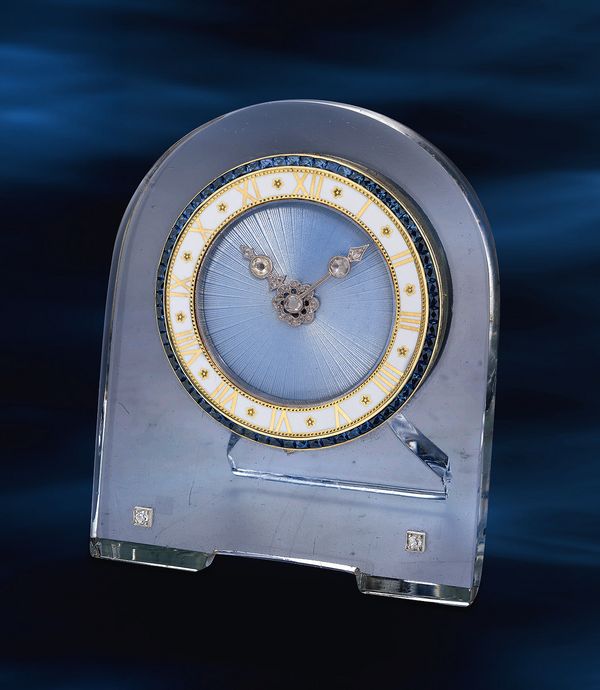
Lot 913: A rare and attractive gold, enamel, sapphires and diamond-set rock crystal desk clock with strut, blue guilloché enamel dial and presentation box. Estimate: HKD $120,000 - 240,000
Jean Eugène Robert-Houdin, the great 19th century French clockmaker and illusionist who pioneered mystery clocks was a huge inspiration for Maurice Coüet, a descendant from generations of esteemed Parisian watchmakers. Coüet's collaborations with Cartier brought traditional skill to groundbreaking designs such as the “Comet” clocks.
This desk clock with a rock crystal surround and strut from circa 1925 exemplifies the masterful creations of Coüet. Within a circular dial, translucent pale blue enamel over guilloché-ground depicts radiating lines to further heighten the diamond-set hour and minute hands. The delicate white enamel chapter ring decorated with gold Roman numeral markers and floral motif (appearing often on Cartier timepieces throughout the 1920s) is adorned with blue sapphire diamonds surrounding the outside. A century later, well-preserved and kept with its original fitted Cartier box, the rarity and beauty of this clock remain undimmed.
Lot 1021
A creation of East meets West, Cartier under the leaderships of Louis Cartier and Maurice Coüet created some of the world’s most exquisite clocks during the 20th century. A marriage of Asian influence effortlessly blending with the Western Art Deco style, and array of creations where exotic motifs and materials decorates the room of aristocrats and royals alike.
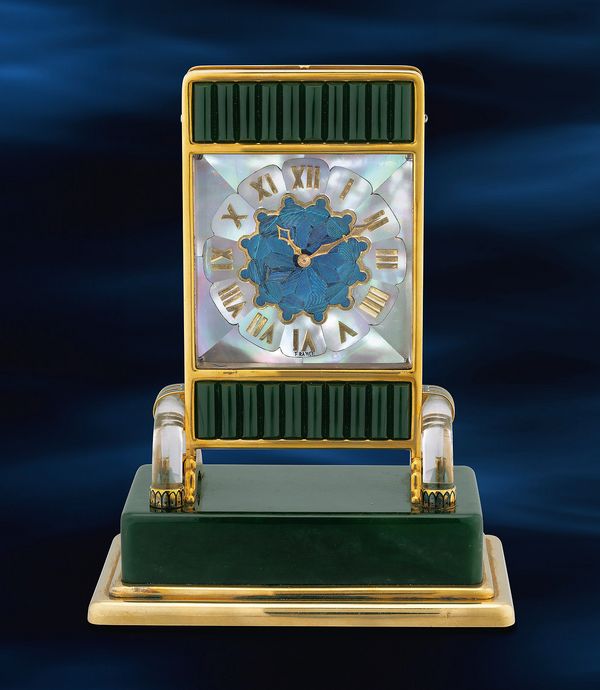
Lot 1021: A unique and exquisite screen table clock with green jade, rock crystal, yellow gold, enamel, marquetry mother-of-pearl and kingfisher feather mosaic dial and original winding key. Estimate: HKD $640,000 - 1,280,000
Inspired by Oriental screens, the Écran, French term for panel, was first produced in 1923. Very few examples were ever produced, thereby making each and every one a rare collectable. Crafted with in rich green jade and yellow gold, the arches are contrasted with the translucent rock crystals that are often used for Mystery clocks. The panels that frames the clock is decorated with enamel and ribbed jade columns to add a three-dimensional hand feel to the overall smooth silhouette.
Crafted by Cartier Paris as denoted on the dial, the impressive marquetry mother-of-pearl floral motif reflects a touch of femininity in contrast with the dark green jade. Extremely elegant, Cartier topped it off with a rare craft to this already stunning clock. Tian-Tsui, is a Chinese craft featuring kingfisher feathers. For 2,000 years, the Chinese have been using the iridescent quality of these blue feathers of the majestic bird as inlay for fine art objects, panels and screens. Its unique electric blue sheen from the bird achieves a vivid colour that no enamel can replicate. An extremely painstaking artisanal technique that demands the most skilled craftsmen, back in the days Cartier was able to deliver this rare trade in their Parisian workshop.
Numbered 2619, the present clock is signed Cartier, Paris, Londres, New York, made in France on the base with a clever feat to hide the winding key within. Numerous deep French eagle hallmark can be found on the clock, as well as the MC hallmark that is preserved in crisp condition throughout. Housed within is a Longines ébauche based manual key wound European Watch Clock & Co. signed 8 day movement. A highly rare example to feature kingfisher feathers, the present Pendule Écran Art Deco from circa 1928 has been in a private collection for over three decades.
Lot 1022
The Roaring Twenties were in full swing by 1925, as people began to move past the tragedies of World War I. The increasing accessibility of cars, trains, and planes allowed many to indulge in the pleasures of speed and travel. This era saw a surge in the production of travel clocks and watches, designed by Cartier in an elegantly modernist style. Technological advancements also brought new conveniences to daily life, including wireless radios, telephones, and portable handheld cameras.
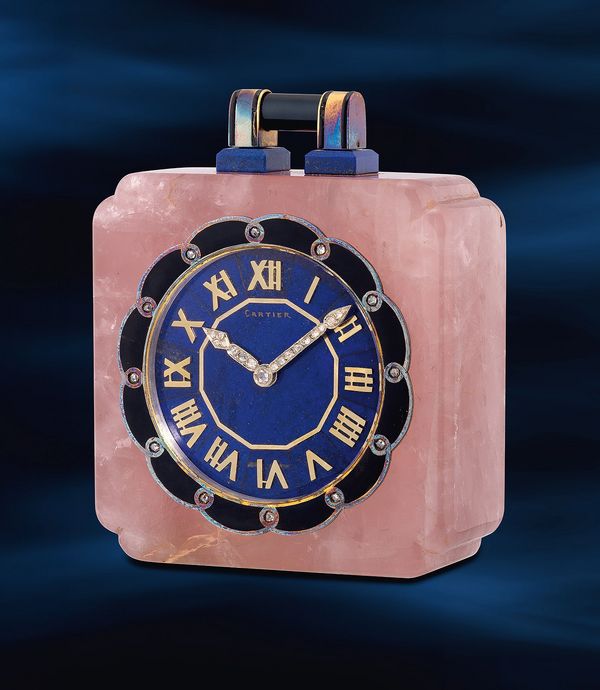
Lot 1022: An extremely attractive, well-preserved and rare rose quartz, lapis lazuli and gold desk clock with black enamel, gold and silver and diamond-set bezel, applied Roman numerals, diamond-set hands and lapis lazuli dial. Estimate: HKD $120,000 - 240,000
Influenced strongly by Art Deco during the late 1910s and 1920s, Cartier’s timepieces featured distinctive identities and geometric lines, culminating in the iconic Cartier Tank and its sub-models which epitomized the golden age of design. Not limited to wristwatches, Cartier also created numerous clocks with utmost craftsmanship and timeless designs that continue to be cherished by collectors today.
The present clock is an iconic Cartier desk clock, strikingly crafted from pink quartz. Known as a symbol of love, pink quartz has historically been associated with emotional balance and the release of negative energies, often used in meditation practices. This heavy block of stone features a Japanese-style smooth rounded edge, elegantly corner-cut.
Decorated with exquisite artistry from the esteemed Haute Joaillerie maison, the dial incorporates pieces of lapis lazuli, adorned with applied gold Roman numerals and rose-cut diamond hands. A rosace pattern encircles the dial, with diamonds set at the hour markers. The striking contrast between the black enamel and blue lapis lazuli enhances the pink quartz body. The handle is further embellished with a lapis lazuli base and 18K yellow gold, contributing to the overall symmetrical appeal.
The craftsmanship of this piece is exceptional, with meticulous attention to detail. The clock remains in very well-preserved condition, with both the stone and decorations intact. The case numbers and hallmarks are crisp and perfectly legible. The gold surface exhibits a layer of attractive patina, a testament to its time in an important private collection since it last appeared internationally more than 30 years ago. A beautiful creation from Cartier, this clock represents the ultimate expression of the Art Deco period and is sure to remain a classic for years to come.
BONUS: Lot 1025
While Art Deco vanity cases by Cartier were extremely successful during the 1920s amongst the ladies, the Cartier brothers also created pieces for men during the interwar years. While smoking had been de rigueur for decades with pipes and cigars for a gentleman, packaged cigarettes grew in popularity for its convenience.
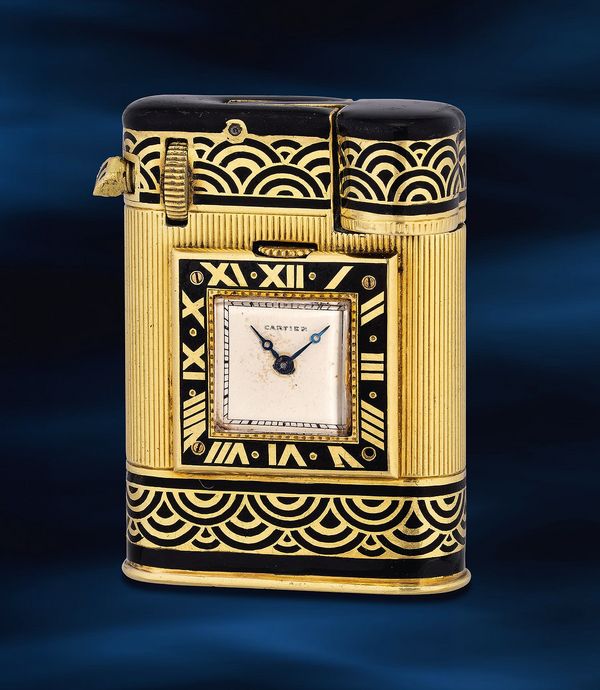
Lot 1025: A rare and elegant yellow gold art deco lighter watch with enamel. Estimate: HKD $40,000 - 80,000
In an attempt to reach a wider clientele base, Cartier established a new division to provide a larger range of beautiful yet functional objects, The Department S. S stood for silver, the division at that time aimed to provide a relatively more ‘affordable’ range of items, the collection eventually flourished into wider range of materials as demand grew. Charles Jacqueau was the head of Department S and thus, designs for unusual objects from letter openers, cigarette cases, writing instruments and lighters all incorporated with a watch were born. Part of the high society, Louis Cartier would often offer chaps cigarettes at parties from his chic Cartier case, or a light from his gold Cartier lighter, he was his own ambassador for his products. A perfect specimen from the era, the present Art Deco lighter travels back in time. A lighter and a watch at the same time, the pin striped yellow gold case decorated with enamel was made in Paris. A fascinating and witty creation with sartorial splendor, the present object is preserved with crisp hallmarks and corresponding numbers stamped throughout, furthermore the elegant blued Breguet hands are powered by a European Watch and Clock Co movement.