
Museum Ludwig © Tomas Riehle/arturimages
On occasion of Outset Germany_Switzerland's donation of an artwork by Avery Singer to the Museum Ludwig during Art Cologne week, our German Specialist in 20th Century and Contemporary Art, Alice Trier, sat down with Outset Germany_Switzerland's Director, Bettina Böhm, and the museum's Director, Yilmaz Dziewior, to discuss the current state of contemporary art patronage in Germany.

Yilmaz Dziewior, Director of the Museum Ludwig

Bettina Böhm, Director of Outset Germany_Switzerland
Alice Trier: Since Outset relaunched in Germany in 2016, it has supported ten different projects and gifted important works to museums across Germany. In April, a new piece from Avery Singer is entering the Museum Ludwig collection thanks to those efforts. Bettina, can you explain how Outset Germany_Switzerland selects different artists to support?
Bettina Boehm: As we get a lot of interesting requests by museum or exhibition curators, choosing the right project is the most challenging part of working on the Outset Germany_Switzerland programme. Quality is absolutely the very first selection criterion! The fact is that we have to prioritise what international curators desire, and it is from a very wide variety of potential projects that we have to choose what we can realize practically, both time and money-wise. In the first year of my engagement with Oustet, I had to make many of these decisions on my own. In the future, projects will be presented to the patrons before the decision and get their opinion.

Avery Singer Untitled, 2016. Acrylic on canvas, 203 x 229 x 6 cm, unique. Courtesy: the artist, Kraupa-Tuskany Zeidler, Berlin; Gavin Brown's enterprise, New York / Rome.
AT: Yilmaz, perhaps you could tell us a little bit about the acrylic work on canvas, Untitled, 2016 by Avery Singer, that is entering the collection of the museum thanks to Outset.
Yilmaz Dziewior: The work that is to be handed over to Museum Ludwig by Outset is part of a new series that Avery Singer started last year. For this recent body of work Singer for the first time used an airbrush-printer which usually is employed in an industrial context, for example, to paint airplanes. For Museum Ludwig this work is especially interesting because we have already a painting by Singer in our collection with the title "Anna Karina" from 2014 which depicts a portrait of the same women four times. In contrast to this figurative work, the majority of the new series by Singer is abstract and hovers between abstraction and figuration. Avery herself sometimes uses the word "fence" to refer to this painting.
AT: The model of philanthropy that Outset represents is an unusual one in Germany. Yilmaz, how do you see this type of support playing a role with the Museum? Why is it particularly unusual in ways that other types of support are not?
YD: Yes, the model of philanthropy that Outset represents is not so common in Germany. The Museum Ludwig is very happy about the engagement of Outset because, besides donating an artwork to our collection, Outset stimulates a wider interest in engaging with people who are not yet so familiar with the Museum Ludwig.

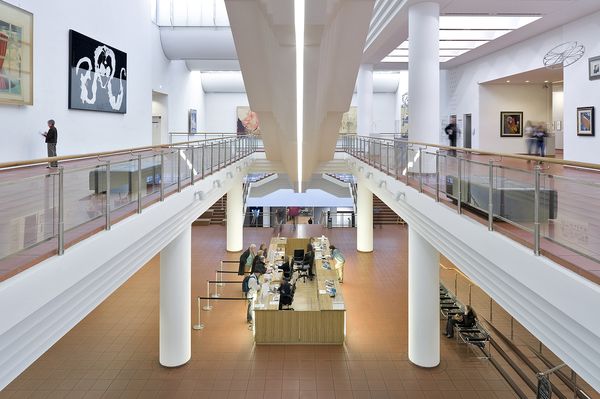
Museum Ludwig © Tomas Riehle/arturimages
AT: Yilmaz, How is the art scene in Cologne developing over the past few years. How do you find the public engages with art and architecture in Cologne today?
YD: Over the last few years the art scene in Cologne is blooming. The important institution Kölnischer Kunstverein and nonprofit places like Bruch & Dallas, Simultan Halle and Temporary Gallery, to mention only a few, create a very vivid art scene. Also young gallerists like Marietta Clages, Drei, Ginerva Gambino, Nathalie Hug, Jan Kaps and Rob Tufnell contribute to this lively discourse.
AT: Yilmaz, the 51st edition of Art Cologne opened its doors just last month. Which artists were you most excited to see and why?
YD: Besides some very beautiful works by Alice Neel, Cady Noland, Günther Förg, Sigmar Polke, Rosemarie Trockel and Christopher Williams. I especially found the young positions very interesting this year: Nicola Gördes and Stella Rossié, Mia Goyette, Arne Schmitt and Paul Spengemann, the latter of whom received an Art Cologne Award of New Positions 2017.

L-R: Bettina Boehm, Director Outset Germany_Switzerland, Moritz Wesseler Director Koelnischer Kunstverein, Avery Singer and Yilmaz Dziewior
AT: In April, the nomadic art community transitioned from Art Cologne across to the Gallery weekend in Berlin. Traveling with the patrons of Outset is always an extended and inspiring cultural experience. Given that these days there are so many collateral events around calendar moments such as Art Cologne, Bettina how do you get people to explore outside the comfort of their living rooms?
BB: Our patrons belong to the species of the cultural nomads. The question is: Why do they like traveling with Outset? What is different with us? To my mind, doors open for Outset which remain closed to other groups. Through our international contacts to the best institutions in the world and their curators, as well as to the most prestigious private collections, we are able to offer travels that hardly any other organization can offer. In addition, there is with each trip a new composition of participants, through which new and previously unimagined constellations emerge. We are a very exclusive, but not closed circle. Our patrons love it!
AT: In 2017, Outset Germany took on a Swiss chapter. Given the an amazing energy that Outset has brought into the German speaking cultural landscape since your relaunch last year, can you tell us what your upcoming plans in Switzerland are?
BB: The idea for an expansion into Switzerland came from the fact that we already have some Swiss patrons as part of the German group. The Swiss museum landscape is, of course, financially well-equipped; however it will be very important for Outset in Switzerland to build a network of patrons who are interested in funding artist projects in Germany. This does not rule out the fact that we also support Swiss institutions if there is a need. As I said, we promote completely independent institutions.
AT: Bettina, Outset Germany_Switzerland will also be supporting the German Pavillon at this year's Venice Biennale, where Susanne Pfeffer has curated a show with Anne Imhof, who is of course famous for her versatile performances. What form will Outset's engagement take – are you providing general support by directing funds into the project or will you also donate a certain piece of Imhof's to an institution?
BB: It's both, actually! We are supporting the German Pavilion with funds directly, and given that Outset's goal is always to donate artworks to public institutions, we are doing that in this case as well, taking into account the wishes of the artist as well as of the institution's curators who are interested in integrating the artist into their collection.
AT: Bettina, I remember you were once talking about the "emotional dividend" that someone gets when they become a patron of Outset. Especially in these times, it is much more satisfying supporting the arts instead of buying the hundredth pair of luxury shoes. Phillips wishes you the best of luck finding lots of new patrons for Outset Germany_Switzerland and congratulates you, Yilmaz on obtaining such a wonderful piece of art for Museum Ludwig.
BB: Dear Alice, I must say that the support that Phillips gives to Outset Germany_Switzerland is outstanding. With your support, we are able to cover our daily costs, and this gives us the chance to remain faithful to our basic idea: each cent the patrons donate goes directly to the promotion of contemporary art!