1
William Eggleston
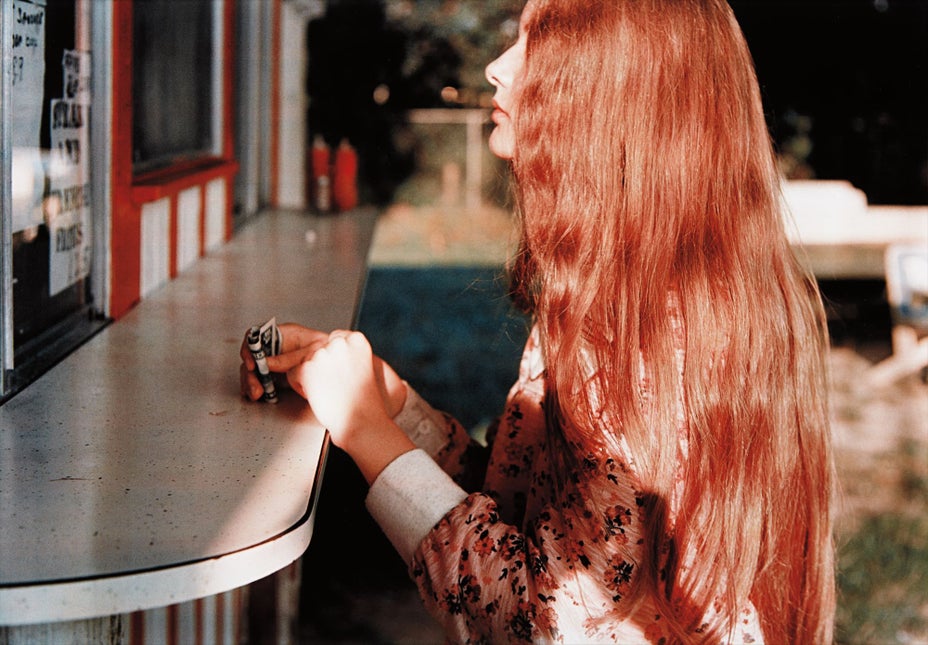
Untitled (Biloxi, Mississippi)
Full-Cataloguing
Eggleston turned his lens on his environment, noting: “The way I have always looked at it is the world is in color. And there’s nothing we can do about that.” Thereby, Eggleston contemporized the modernist view, by introducing color into the cannon of photographic composition and thus expanding upon Henri Cartier-Bresson’s idea that “In a photograph, composition is the result of a simultaneous coalition, the organic coordination of elements seen by the eye.” Indeed, it is no surprise that Eggleston was the first photographer to work in color to be selected for a solo show under the venerable eye of John Szarkowski at The Museum of Modern Art, New York in 1976.
In the present lot, Untitled (Biloxi, Mississippi), 1972, Eggleston’s lens is not preoccupied with the facial features of his subject, an unexpected decision in the realm of portrait photography, but rather with the cascading of her lush, bright red hair. The resulting image becomes akin to the powerful brush stroke by such American Color Field School pioneers as Morris Louis or Helen Frankenthaler, who lent dominance to color over form and subject. Likewise, in Untitled (Near Minter City and Glendora, Mississippi), 1970 (lot 2), Eggleston presents viewers with a disarming scene that calls for nothing but a quiet, objective meditation on the vernacular. The absence of drama and the insistence on employing a non-judgmental lens gives way to a democratic approach in viewing the work, where the different compositional elements, including color, are granted equal weight in their aesthetic contributions.
William Eggleston
American | 1939William Eggleston's highly saturated, vivid images, predominantly capturing the American South, highlight the beauty and lush diversity in the unassuming everyday. Although influenced by legends of street photography Robert Frank and Henri Cartier-Bresson, Eggleston broke away from traditional black and white photography and started experimenting with color in the late 1960s.
At the time, color photography was widely associated with the commercial rather than fine art — something that Eggleston sought to change. His 1976 exhibition at the Museum of Modern Art, Color Photographs, fundamentally shifted how color photography was viewed within an art context, ushering in institutional acceptance and helping to ensure Eggleston's significant legacy in the history of photography.