61
Longines
Lindbergh Hour Angle
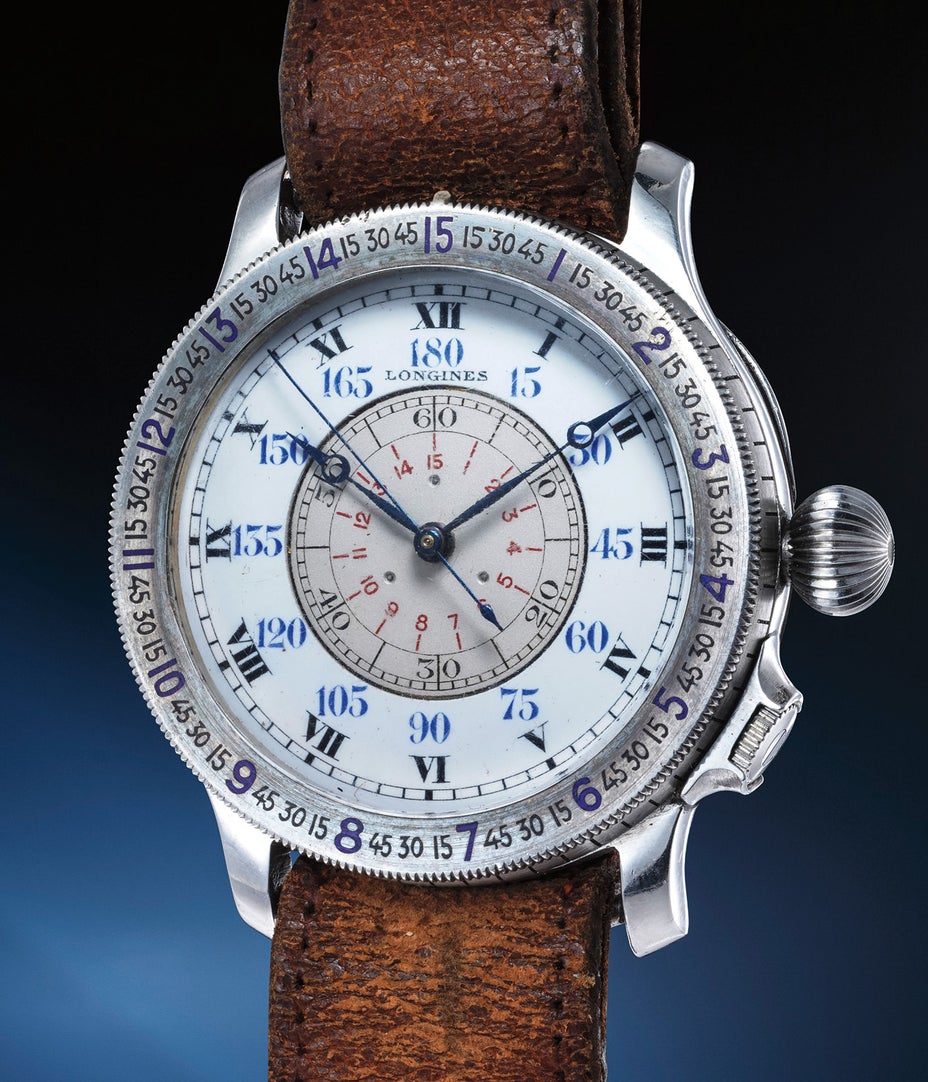
浪琴,極度精細,大型精鋼飛行員腕錶,備琺瑯錶盤、可旋轉中心盤。
估價
CHF20,000–40,000
€20,800–41,600
$22,800–45,700
成交價
CHF30,480
製造商
Longines
年份
1944
機芯編號
5'607'053
錶殼號碼
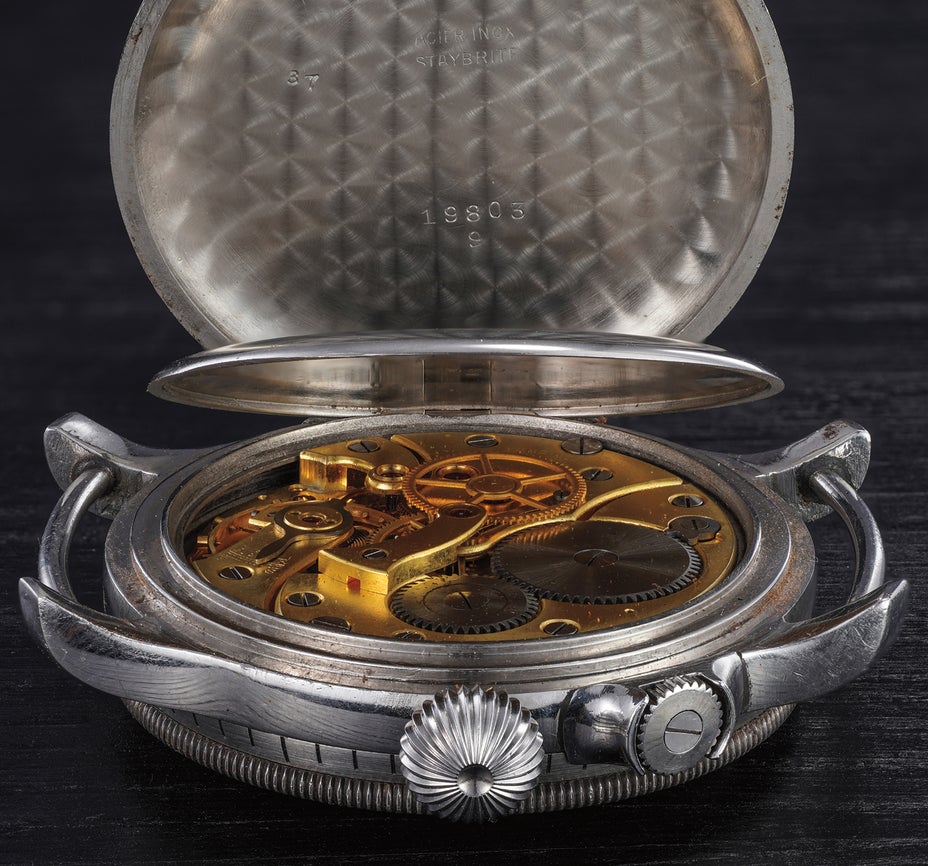
19803, 9, 37
型號名稱
Lindbergh Hour Angle
材料
Stainless steel
機芯
Manual, cal. 37.9, 17 jewels
錶帶/ 錶鏈
Leather pilot's strap
錶扣
Stainless steel pin buckle
尺寸
47mm Diameter
簽名
Case, dial and movement signed
配件
Accompanied by Longines Extract from the Archives confirming production of the present watch and its subsequent invoicing to the company "Bensadon" - their Morocco agent - on November 23, 1944
完整圖錄內容
The 1920s and 1930s were a golden era for aviation. The combination of a relatively novel field - holding the promise of flight nonetheless, one of humanity’s most ancient dream - relative socio-economic stability of the time, and the incumbent winds of war prompted the aggressive development of more and more reliable aircraft, eventually achieving transcontinental flight (Charles Lindbergh, 1927).
Lindbergh was also the brain father of the present complication: the Hour Angle. Improving on the simpler Weems Seconds setting system (which allowed to easily and precisely synchronise the watch with a radio signal), the Hour Angle was designed for aircraft pilots to precisely locate and understand their position during flight.
It was following his return to St. Louis after his successful flight across the Atlantic that Lindbergh started drawing a wristwatch meeting the requirements of pilots during long distance flights.
In 1930, Lindbergh sent his drawings to John Heinmüller, who was the president of the International Aviation Federation and the director of Longines-Wittnauer in the United States. After only 5 months, a first prototype was ready and the final watch launched soon after. The result: a timepiece that could find longitude based on Greenwich mean time.
Fitted with an enamel dial, the present watch is offered in absolutely astounding condition. The enamel is free of cracks or hairlines, and the case is incredibly sharp and tight.
It represents an incredibly well preserved historical relic from a time when a couple of missed seconds on a pilot’s watch could send the aircraft miles off course, potentially jeopardising the life of the crew. It can thus be said that these timepiece were truly and literally vital pieces of equipment for aviators of the time, as important to the plane survival back then as they are sought-after by collectors today.
Lindbergh was also the brain father of the present complication: the Hour Angle. Improving on the simpler Weems Seconds setting system (which allowed to easily and precisely synchronise the watch with a radio signal), the Hour Angle was designed for aircraft pilots to precisely locate and understand their position during flight.
It was following his return to St. Louis after his successful flight across the Atlantic that Lindbergh started drawing a wristwatch meeting the requirements of pilots during long distance flights.
In 1930, Lindbergh sent his drawings to John Heinmüller, who was the president of the International Aviation Federation and the director of Longines-Wittnauer in the United States. After only 5 months, a first prototype was ready and the final watch launched soon after. The result: a timepiece that could find longitude based on Greenwich mean time.
Fitted with an enamel dial, the present watch is offered in absolutely astounding condition. The enamel is free of cracks or hairlines, and the case is incredibly sharp and tight.
It represents an incredibly well preserved historical relic from a time when a couple of missed seconds on a pilot’s watch could send the aircraft miles off course, potentially jeopardising the life of the crew. It can thus be said that these timepiece were truly and literally vital pieces of equipment for aviators of the time, as important to the plane survival back then as they are sought-after by collectors today.
Longines
Swiss | 1832Auguste Agassiz founded Longines in 1832, and today is considered to be a pioneer in the evolution of the chronograph. During the 1930s, Longines' chronograph wristwatches were used as tools for wartime aviators and military personnel. As one of Switzerland's largest manufacturers, Longines was an important supplier of wristwatches to militaries of multiple nations.
Today, they are owned by the Swatch Group and produce wristwatches for both men and women. Their vintage wristwatches continue to grow in desirability amongst collectors. Some of the most sought-after models include such oversized chronographs as the Lindbergh Hour Angle designed by Charles Lindbergh, Chronostop, Tre Tacche, A-7, Tasti a Spillo and Doppia Lanchetta.