Article | Sensation Book Arnold Lehman
When 'SENSATION' Sparked a Bonfire
In this exclusive excerpt of his new book, author Arnold Lehman, Phillips’ Senior Advisor and Director Emeritus of the Brooklyn Museum, shares the inside story of the fateful September weeks when 'SENSATION' became the Brooklyn Museum's — an art history's — most controversial exhibition.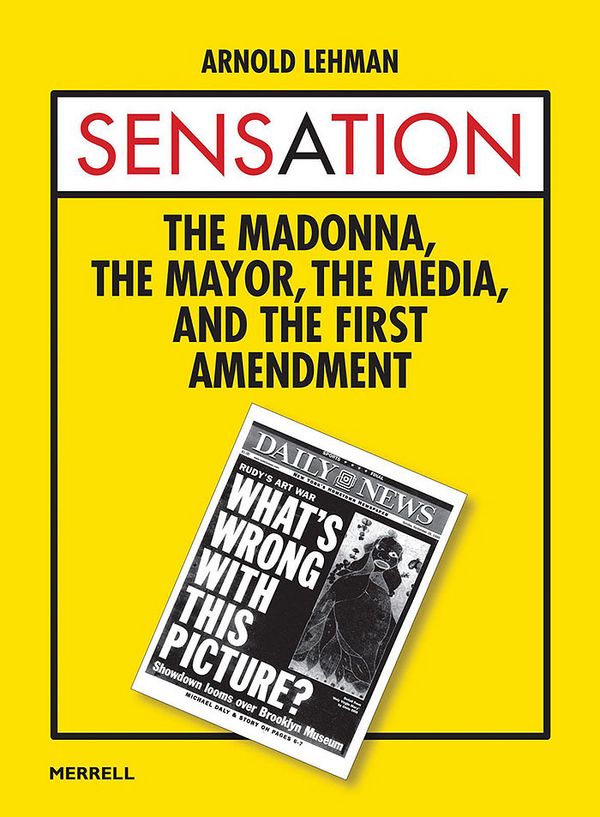
Sensation: The Madonna, the Mayor, the Media, and the First Amendment by Arnold Lehman. Available for purchase through Merrell Publishers.
Death and bomb threats over an art exhibition! A major battle with the mayor of New York City and the New York Times! Looking back, Arnold Lehman, director of the Brooklyn Museum, and his colleagues were not prepared for what was to happen. No one could have anticipated that SENSATION: Young British Artists from the Saatchi Collection would become the biggest art story in the history of art history.
It has taken him two decades to fully absorb and clearly reflect on what happened at the Brooklyn Museum in 1999–2000.
The intense controversy swept the exhibition, the museum, and Chris Ofili’s The Holy Virgin Mary painting to international attention for six months. While 175,000 people saw the exhibition and millions read and heard about it daily, they never knew of the threats and challenges that kept the museum staff awake at night. Mayor Rudy Giuliani, who never saw the painting, focused his rage at The Holy Virgin Mary; rescinded the museum’s municipal funding to force it to close the exhibition; and attempted to evict it from its hundred-year-old landmark. The city’s most conservative media and ultrareligious groups inflamed the conflict.
SENSATION, selected from controversial collector Charles Saatchi’s contemporary British art collection, was first shown at London’s Royal Academy in 1997, to an outcry over the portrait of child murderer Myra Hindley. Its opening at the Brooklyn Museum in 1999 drew tabloid headlines such as “B’klyn gallery of horror — Gruesome museum show,” and “Butchered animals, a dung-smeared Mary and giant genitalia.” The New York Times joined in the fray with often false and inaccurate front-page investigative reporting.
In a story as gripping as a fictional thriller, with a bold move the museum sued the mayor and the city for a permanent injunction, the restoration of city money, and substantial funds for its exceptional new entrance.
Below, read an exclusive excerpt from the book, in which Lehman recalls the fateful weeks in September 1999 ahead of the exhibition opening when "a few sparks became a bonfire."
Written by Arnold Lehman
SEPTEMBER 1–21, 1999
3. B’KLYN GALLERY OF HORROR
Looking back to Carol Vogel’s April 8, 1999 New York Times column, the article was an engaging and accurate description of SENSATION, explaining how it originated at London’s Royal Academy. The title “British Outrage Heads for Brooklyn” was probably a probable forecast of the museum’s forthcoming exhibition and the explosive months that bracketed it. Vogel wrote that “visitors to the Brooklyn Museum of Art this fall may be in for a shock … its classical galleries will be filled with work by young British artists who have made a worldwide reputation creating art that disturbs and outrages.” She listed Damien Hirst’s “infamous dead shark,” Marc Quinn’s “head made of his own frozen blood,” and Ron Mueck’s halfsize “sculpture of his naked, dead father” as prominent in the exhibition. Chris Ofili’s name (but no Holy Virgin Mary) was mentioned in a list of other young British artists, or YBAs as they continued to be called. Vogel’s April 8 article also included the information that, at the Royal Academy, the most extreme reaction of museum visitors — including red and blue ink and a thrown egg (or possibly eggs) — was caused by Marcus Harvey’s enormous portrait of Myra Hindley.
When Vogel interviewed me for her April article, I talked about SENSATION as a definitive moment in time for contemporary British art and this particular group of artists. It was a critical moment of attention that had not happened for British art for many years and I felt it must be seen and understood by artists, collectors, and the general public.
The major article by Matthew Sweeney appeared a week later, on April 16, in the Brooklyn Papers, but Ofili’s name was mentioned only in passing. After the early articles by Vogel and Sweeney, nothing else was written about SENSATION for five months.
Starting in the first weeks of September, a few sparks became a bonfire. The question to be asked was whether it was accidental or arson?
However, starting in the first weeks of September, a few sparks became a bonfire. The question to be asked was whether it was accidental or arson? An extensive and personally very positive article by Hugh Eakin appeared in the National News/Spotlight column of the September 1999 ARTnews entitled “From Hip-Hop to Karaoke: Arnold Lehman is devising a sweeping array of initiatives to lure visitors into the Brooklyn Museum of Art.” The article highlighted images from SENSATION of Hirst’s This Little Piggy Went to Market as well as my childhood favorite Ibis coffin from the Ptolemaic period of Egyptian art in Brooklyn’s vast collection. Eakin wrote: “A workaholic with a fondness for 17-hour days, Lehman has an affable manner and contagious smile that belie the intensity with which he approaches his job.” Referencing my panoramic view as far south as Coney Island, east to JFK in Queens, and southwest to the Verrazano Bridge and Staten Island, Eakin continued: “Sitting in his office on the sixth floor of the McKim, Mead, and White building … Lehman said, ‘every day I look out these windows … asking myself who’s out there, and why they’re not coming here.’”
Eakin goes on to depict accurately and supportively my two-year “honeymoon” since coming to Brooklyn: “Since taking over the helm of the Brooklyn Museum of Art two years ago, Lehman has embarked on a personal crusade to transform the way the 102-year-old institution connects with the public. Despite housing the second-largest art collection in the United States, the museum has in recent decades struggled to adapt to a local community in constant flux.” Eakin had a keen sense of what had been the state of the museum before my arrival in suggesting that “resources were largely devoted to maintaining the museum’s vast collections and aging infrastructure.” He quoted me saying that “This gigantic neoclassical building sat like a fortress, and everything about it said, ‘Keep out, we have our own problems to worry about,’” with me adding that our Board of Trustees had raised millions “just to keep the roof from leaking and the central court from caving in.”
I was delighted that he also wrote enthusiastically about my “array of initiatives to double attendance and increase membership by two-thirds” using the numerous new exhibitions and programs I had started over the two years since I had arrived in September 1997. He pointed to the Brooklyn Museum’s hugely diverse and successful exhibition program, which more than doubled the attendance of previous years. It included shows of Monet, Romanov jewels, Hip Hop, and Mariko Mori as well as the beginning of the free and free-wheeling First Saturday program that drew new and returning visitors from every part of Brooklyn and every borough of New York City. First Saturday would ultimately become the model program for museums throughout the country. Eakin summed up what had been taking place in the museum and said that I had “shown a willingness to deviate from the museum’s traditionally conservative programming,” which spent years emulating, with many fewer resources, the Metropolitan Museum of Art, “to bring people in.” Quoting Joe Amrhein, whose artistically fertile Pierogi gallery in Williamsburg is credited with creating the gallery scene in Brooklyn: “The museum had tended to be a little slow, not as spontaneous as it could have been…. Lehman is opening it up to all the artistic energy in Brooklyn.”
Eakin introduced SENSATION by saying, “Lehman is presenting what may be his most daring project yet.” He quoted me as saying, “It is quite a challenge when you say to your exhibition management team that they have to find a source for maggots and carcasses.” Charlotta Kotik, who as Brooklyn’s curator of contemporary art was charged with supervising the curatorial aspects of the exhibition in Brooklyn, described “installing the Saatchi works as ‘more like doing medical surgery than hanging art.’” This September ARTnews article would be one of the last measured and supportive ones to be written about SENSATION and me for what seemed like an eternity.
Next came Nancy Ann Jeffrey’s Art & Money column in the Wall Street Journal of September 10, “Will ‘R’-Rated Art Show Cause Sensation at Brooklyn Museum?,” which was often overlooked as perhaps the “smoking gun” in the evolving controversy that began less than a week later. Jeffrey’s piece was the first at that time to even mention “a religious portrait that incorporated elephant dung,” but without stating its title or the artist’s name.
Jeffrey also quoted me as saying that “SENSATION will give people in this country a chance to see an enormously energetic and influential group of artists, whose combined impact is like ‘nuclear fission.’” The article stated that “In Britain, some critics hailed the show as a major art event, a display of some of the decade’s defining art. ‘Unmissable,’ declared the Sunday Times of London.”
The WSJ printed the museum’s proposed copy for an ad campaign I had written earlier that summer. Our “tongue in cheek” campaign warned: “The contents of this exhibition may cause shock, vomiting, confusion, panic, euphoria and anxiety. If you suffer from high blood pressure, a nervous disorder, or palpitations, you should consult your doctor before viewing this exhibition.” Meant to be humorous in its hyperbole, after the first few media criticisms I regretted issuing it and pulled the campaign almost before it had started. Nevertheless, the “health warning” was repeated over and over again in the press and on shopping bags sold for a brief time in the museum shop or on airline vomit bags printed by the Catholic League in opposition to the exhibition.
And then, without warning, the bonfire was ignited!
By mid-September, it is important to understand, the opening of SENSATION at the Brooklyn Museum was still three weeks away. And then, without warning, the bonfire was ignited! On Thursday, September 16, whatever calm there had been ended abruptly. At the Daily News, a staff writer named Douglas Feiden wrote a highly provocative article that was headlined “Brooklyn art exhibit stirs shock & outrage.” The first paragraphs read: “The Brooklyn Museum of Art is about to unveil a shocking contemporary art exhibition that features real animals sliced in half, and graphic paintings and sculptures of corpses and sexually mutilated bodies. The R-rated show is the largest and most controversial in the museum’s … history — and it is sparking outrage over such works as a painting of the Virgin Mary splattered with elephant dung.” Obviously, this blatant (and likely purposeful) misrepresentation of the Ofili painting indicated that neither Feiden, nor any person from whom he might have gleaned information about it, had ever seen the painting.
In the article, Feiden quoted William Donohue, the New York-based president and spokesperson of the highly conservative Catholic League for Religious and Civil Rights. “This has gone beyond the vulgar, the blasphemous and the scatological,” Donohue raged, without, of course, like Feiden, ever having seen the exhibition. This would be true of almost every reporter, religious leader, and politician who ranted about SENSATION during the weeks before the exhibition opened — and even afterwards, as very few of SENSATION’s detractors ever came to see it. Donohue continued: “We’re into a whole new dimension here, and on Thursday we’re going to call on all New Yorkers to boycott the Brooklyn Museum.” And, while previously having promised me to see the exhibition first before commenting, Ingrid Newkirk, then president of PETA, weighed in immediately. “It’s cheap, low and ghoulish to use, dominate and dissect animals in this way.”
Sunny Mindel, Mayor Giuliani’s press secretary, had responded to Feiden’s commentary with a modicum of restraint (that was soon to change) in saying, “Assuming the description of the exhibition is accurate, no money should be spent on it,” referring, it would appear, to the incorrect assumption that city funds were supporting the SENSATION exhibition. Mindel, who had been appointed to her position only several months earlier, was often credited at the time and long afterwards “with getting Rudy to go to war with the Brooklyn Museum of Art,” as Michael Wolff wrote in his hilariously frightening April 30, 2007 article “Crazy for Rudy” in Vanity Fair about Giuliani’s “nuttiness,” relating to his campaign for president. Among the examples Wolff gave of Giuliani’s extreme fights was the mayor’s “jihadish campaign against the Brooklyn Museum,” using a word — even more common in later years — that was, however, terrifyingly descriptive of what had occurred and totally evocative of my experience.
Feiden’s Daily News article listed and briefly described five works of art in the exhibition in order as among the most controversial: The Holy Virgin Mary by Chris Ofili; Self by Mark Quinn; This Little Piggy Went to Market, This Little Piggy Stay at Home by Damien Hirst; A Thousand Years, also by Hirst; and Myra by Marcus Harvey. By and large, aside from The Holy Virgin Mary, the descriptions of the other four works were accurate. Neither before the publication of the article nor afterwards had Feiden ever asked me — or anyone else at the museum — to talk about these five works of art or any of the objects in SENSATION. Indeed, Feiden was one of several reporters I have tried to reach (unsuccessfully) for this book in order to get his “hindsight” view of the controversy and the role he personally had played in its making.
The Holy Virgin Mary was further described in the September 16 article by Feiden as a “collage … in which elephant dung is splattered on linen.” Incredibly, this vile impression would be repeated over and over by reporters and critics of the exhibition including, of course, all those who had not seen the painting prior to the opening of the exhibition and, incredibly, by some even after the press preview on October 1 and the public opening on Sunday, October 3. All this time, of course, for anyone seriously attempting to research and write about the works in the exhibition, the SENSATION catalogue had already been available for two years.
Someone had left the Daily News in the cab and I was stunned to find the story while leafing through a newspaper that I rarely read before 'SENSATION' soon necessitated broader reading habits.
I unexpectedly saw Feiden’s article early that Thursday morning in a taxi going from an early dental appointment in midtown Manhattan to a meeting downtown. Someone had left the Daily News in the cab and I was stunned to find the story while leafing through a newspaper that I rarely read before SENSATION soon necessitated broader reading habits. Already somewhat speechless because of the recent multiple shots of Novocain, I asked the driver to stop at a pay phone (in the days before widespread cell phones), and calmly but with great difficulty spoke with the public relations office at the museum to let them know about the article. I then called home and, this time hysterically, told Pam the news. I asked her to run out and get copies.
Regaining some composure, I called our board chair, Bob Rubin, at his office and left a message about the article. I was certain that Bob had already seen it but hadn’t called in order not to upset me. When I called Pam back, I was stunned to learn that, in what had to be a later morning edition of the Daily News which she had bought, the story had been significantly increased in size and placed at the top of the page and, more significantly, the headline had been changed and blown up to three times the original size and now read “B’klyn gallery of horror — Gruesome museum show stirs controversy” — clearly aiming to expedite whatever might occur next! In retrospect, this alteration of the article blaringly defined how the New York tabloid press, like its London counterpart, would report on the exhibition they themselves inflamed. Although the radio talk shows were buzzing with comments about SENSATION, the New York Post entered the controversy only two days later, but with a full-page story entitled “Is this art?” However, this seemingly tame title was bolstered by the more descriptive sub-title: “Butchered animals, a dung-smeared Mary and giant genitalia spark outrage at the Brooklyn Museum.”
Not certain the point had been made, the reporter, Megan Turner, led off with “An exhibition with a blood-filled head, oversized sex organs, a religious portrait caked in elephant dung and real animals in formaldehyde has plunged the Brooklyn Museum of Art into controversy.” Turner went on to say that while the UK’s Sunday Times stated that the presentation of SENSATION at the Royal Academy in 1997 was “unmissable,” other critics “slammed it as offensive and superficial,” while others had branded the show “aesthetically bankrupt” and “morally repugnant.” She also wrote that Roger Kimball, the archly conservative managing editor of the New Criterion, told the New York Post that the exhibition was nothing but “a warped publicity stunt,” and that it was “a rather pathetic attempt by the Brooklyn Museum, which has had difficulty drawing in visitors, to pander to the lowest common denominator.… There is a certain fascination in perversity, and the museum is trading shamelessly on that.”
One positive aspect of Turner’s article was a quotation from a recent New Yorker interview with Damien Hirst, who clarified that the animals in his art were already dead, and that “he combs slaughterhouses for diseased carcasses not fit for market.” In response, and with some unplanned humor, Bruce Friedrich from PETA offered: “SENSATION sounds more like a crime scene than an art exhibit…. Our hunch is that many people who go to the exhibition will leave vegetarians.”
Quoting the constantly outraged William Donohue in summarizing the exhibition trumped any positive effect that Hirst’s comments about his using only already dead animals might have had. “What these artists are doing is elevating the scatological under the mantle of artistic expression when it is nothing but pure unadulterated filth.” The Catholic League asked that all Catholic schools eliminate any student trips to the Brooklyn Museum for a year. This, clearly, was not just to avoid any contact with the blasphemy of SENSATION, but in some roundabout way to “punish” the museum.
That evening Pam and I had an unexpected and wonderfully quiet dinner with Bob Rubin and his wife Marty. In the neighborhood restaurant, the four of us were buoyed by the various expressions of support and thumbs-up we got from Brooklyn neighbors who had been Brooklyn Museum boosters for decades, long before I started to bring whitecaps to the museum’s more typically calm waters.
Unfortunately, in addition to the human issues, the machines in the exhibition were creating havoc. Just that day we were trying to keep Marc Quinn’s frozen “bloody” head from thawing as we were converting the British electrical components to our own system, as well as to a back-up freezing unit (that might allow all of us at the museum to contemplate sleep!). That potential “bloody mess” was no longer just a British colloquialism but rather one of the almost daily art crises which plagued us throughout the run of the exhibition. To avoid meltdowns, both figuratively and literally, we needed to do what we could, as Bob had asked, to reduce the “temperature” of the talk around the exhibition so that the art could speak for itself.
Wednesday, September 22, made thawing blood seem like a minor nuisance.
Sensation: The Madonna, the Mayor, the Media, and the First Amendment by Arnold Lehman is available for purchase at Phillips' galleries at 432 Park Avenue in New York, or directly through Merrell Publishers >
Recommended Reading