Article | Pablo Picasso Homme Assis Mardi Gras
Pablo Picasso: Reinventing Rembrandt
We explore an important work from the Fiterman Collection, painted during a period when the artist found new inspiration in the Dutch Old Masters.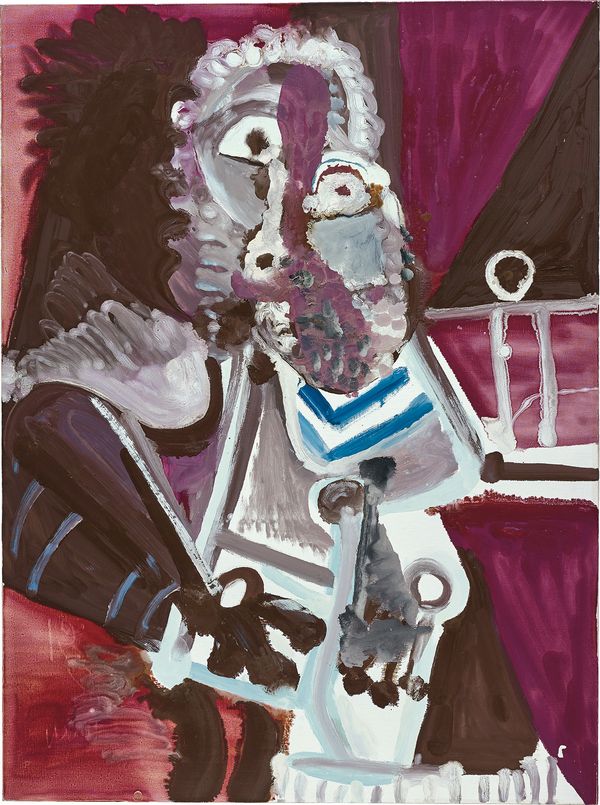
Pablo Picasso Homme assis (Mardi gras), 1972
The 15 February 1972 was Mardi Gras, traditionally the last window of indulgence before the long fast of Lent. In some places, towns go wild with hedonistic celebrations. For Pablo Picasso, these carnival celebrations were limited to his studio: on that day, he completed three oil paintings, including the present Homme assis (Mardi gras), which showcases one of the artist’s beloved and celebrated “Musketeers”. Among the several paintings that feature these whimsical characters, created between 1967 and 1972, two today reside in the major museum collections of the Metropolitan Museum of Art in New York, and the Ludwig Museum of Contemporary Art in Hungary. Selected by Picasso for his famous exhibition held in the Palais des Papes in Avignon in 1973, Homme assis (Mardi gras) was acquired by Miles and Shirley Fiterman in 1985, and is one of the leading lots in our June Evening Sale.
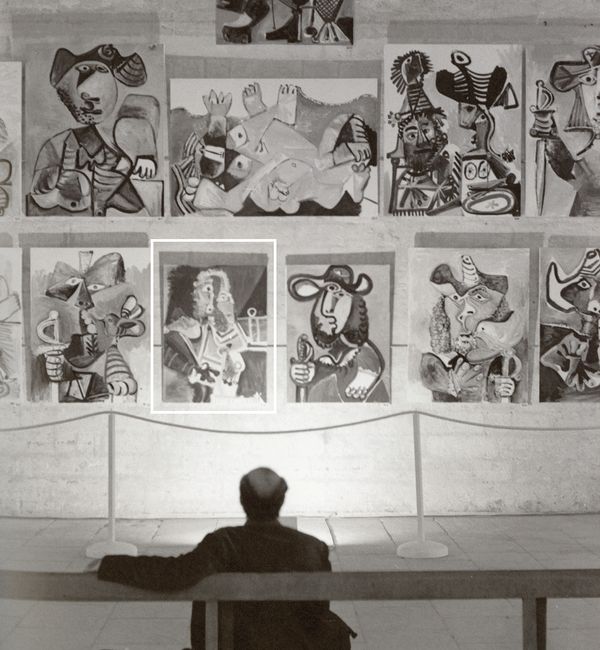
Installation view of the present work in Palais des Papes, Picasso, 1970-1972, 201 Peintures, Avignon, 1973. © Succession Picasso/DACS, London 2019.
Having first emerged in the mid-1960s, Picasso’s “Musketeers” “came to Pablo when he'd gone back to studying Rembrandt” (Jacqueline Roque, quoted in André Malraux, Picasso’s Mask, 1976). Coinciding with Picasso’s recuperation from an operation he had done in 1965, Picasso was, at this time, devouring the newly-published six-volume set of Otto Benesch’s catalogue of Rembrandt’s complete drawings. Whilst discovering this publication, Picasso was known to use a projector to project Rembrandt’s Night Watch, 1642, against a wall, allowing the characters in the composition to become life-sized. He literally immersed himself and his assembled company in Rembrandt’s artistic universe, and Homme assis (Mardi gras) can be seen as a parallel process, with the 17th century characters strutting from the wall into our worlds.
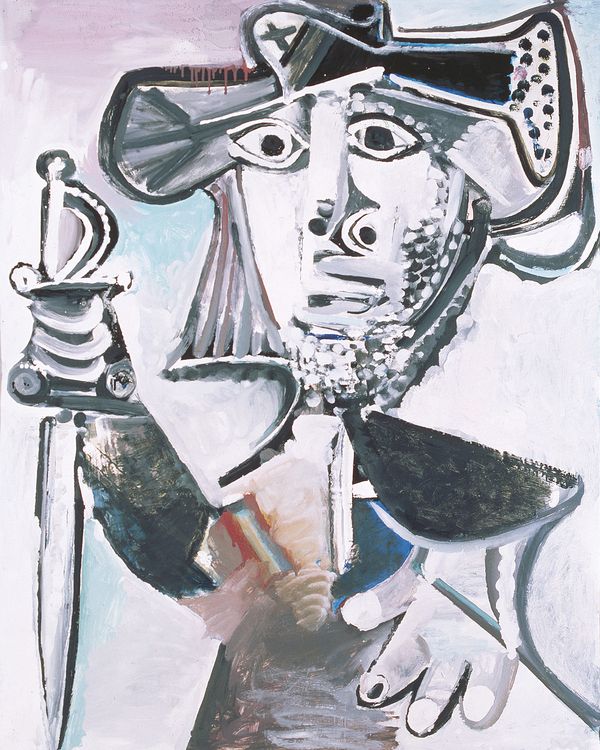
Pablo Picasso Musketeer with a Sword, 1972, oil on canvas, Ludwig Museum of Contemporary Art, Hungary. © Succession Picasso/DACS, London 2019. Image: Bridgeman Images.
“Every painter takes himself for Rembrandt,” Picasso said (Pablo Picasso, quoted in Françoise Gilot and Carlton Lake, Life with Picasso, 1964). Nowhere is this more evident than in Picasso’s works from the 1960s and early 1970s. Only the day after Picasso painted Homme assis (Mardi gras), the artist created another work showing a nude female figure, based on Rembrandt’s etching Naked Woman Seated on a Mound of circa 1631. In the case of Homme assis (Mardi gras), it is the entire era of the curls, beards and swords of the 17th century that is being conjured. Crucially, Rembrandt’s presence was all the more potent in Picasso’s work from 1969 onwards: that year had seen the proliferation of a number of exhibitions and publications on the artist, celebrating three hundred years since his death. By the time that Homme assis (Mardi gras) was painted, Rembrandt was everywhere.
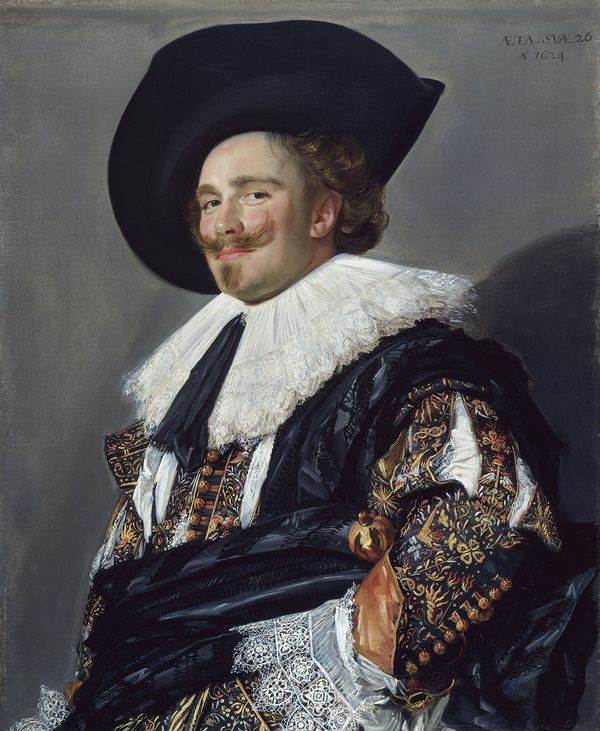
Frans Hals The Laughing Cavalier, 1624, oil on canvas, Wallace Collection, London. Image: Bridgeman Images.
The personal and artistic trajectories of Picasso as a man and artist pervade the present work. Within the composition, one sees distortions that are redolent of the Cubism with which he changed the course of modern painting. At the same time, the band of purple that falls down the middle of the subject’s face recalls the famous raie verte, or “green stripe” of his old friend and ardent colorist Matisse, from the celebrated 1905 portrait of his wife. Meanwhile, emphasizing the incredible array of autobiographical strands that underpin the “Musketeers”, Picasso may also have been thinking of the first artist he had known—his father, who was a painter and art teacher. “Every time I draw a man, I find myself thinking of my father”, Picasso confessed. “To me, a man means ‘Don José’ and it will always be so, all my life... He wore a beard... All the men I draw I see more or less with his features” (Pablo Picasso, quoted in Marie-Laure Bernadac, Late Picasso: Paintings, sculpture, drawings, prints 1953-1972, 1988).
What is a painter after all? A collector who creates his collections by painting other people's pictures that he admires. — Pablo Picasso
In Homme Assis (Mardi Gras), the entire mechanics of the making of an image are deconstructed and reassembled. Picasso’s works of this period, then, can be seen as a response to contemporary issues as well as a conversation with his artistic predecessors. Picasso himself clearly felt this, saying at the time, “If I'm painting better, it's because I've had some success in liberating myself... And every so often, there is just that little something extra” (Pablo Picasso, quoted in Pierre Daix, Picasso: Life and Art, 1993).