Article | Snap Crackle And International Pop
Snap, Crackle, and International Pop!
A new selection from our London Editions team shows how a global movement transformed mass media into shared art.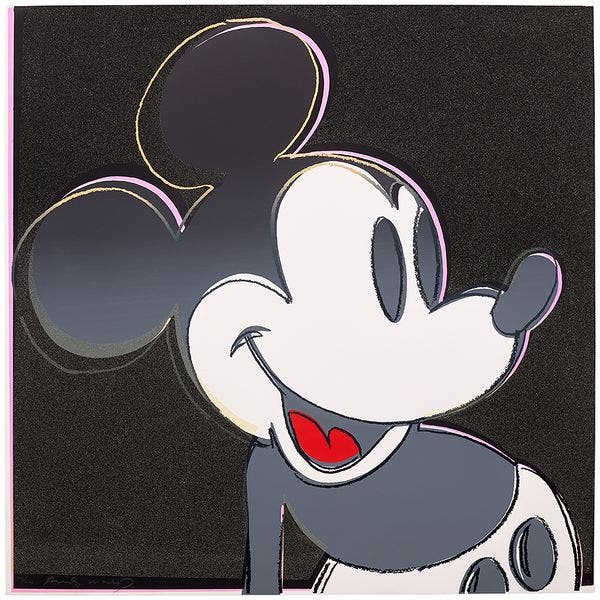
Andy Warhol, Mickey Mouse, from Myths, 1981. Modern & Contemporary Editions: Evening Sale.
Pop Art, by its very definition, is the ultimate reflection of the cultural zeitgeist. As the 1960s ushered in a tidal wave of mass production and media, it filled a post-war cultural void, opening the doors of the art world to everyone. Fluorescent colors catch your eye as Pop transports you into a kitschy, whimsical world where the everyday becomes extraordinary. Here, divine inspiration looks less like classical oil paintings and more like Hollywood stars and consumer goods, dissolving the divide between high art and mass culture. Expect the mundane to feel different. Appropriated, enlarged, and boldly distorted, Pop Art magnifies mid-century society, serving as a brilliant voyeuristic portal into the world of its creation.
I’ll Have Campbell’s Soup to Start
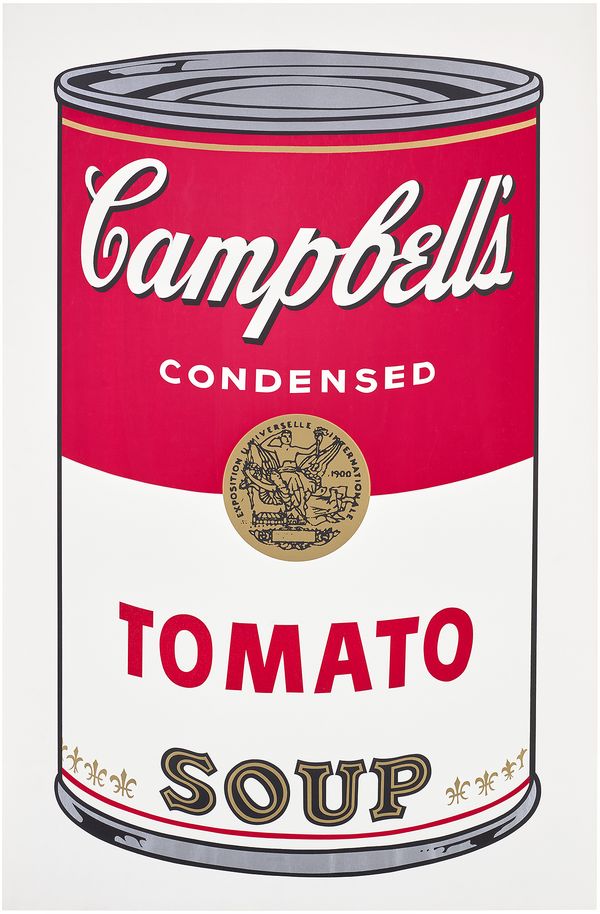
Andy Warhol, Tomato, from Campbell's Soup I, 1968. Modern & Contemporary Editions: Evening Sale.
Andy Warhol’s Campbell’s Soup can series were an overnight sensation, acting as the catalyst that ignited a widespread appetite for the candor of Pop Art. By appropriating the ubiquitous graphic imagery of a common pantry staple, Warhol crafted a literal portrait of consumer society. Having previously worked as an advertising illustrator, he understood the commodity’s reliance on reproducibility and instant recognisability. The screenprints meticulously mimicked factory-assembled packaging to comment on American society during an era of post-war economic recovery, using the uniformity of the assembly line to puncture illusions of cultural hierarchy and prove that contemporary identity was anchored in a shared commercial lexicon. By positioning a mundane object as the formal subject of a portrait, Warhol asserts that culture no longer belonged to the esoteric objects of his predecessors. This artwork became a seminal precursor for a generation of Pop artists who continued to commandeer mass culture, stripping away the mysticism of fine art — what you see (or eat) is what you get.
Cultural Rebellion Was All the Rage!
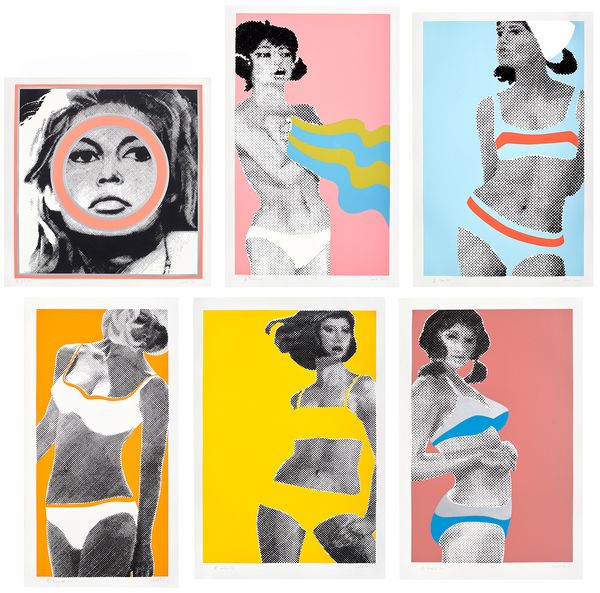
Gerald Laing, Brigitte Bardot; and Baby Baby Wild Things, 1968. Modern & Contemporary Editions: Evening Sale.
British Pop Art burst onto the scene just as youth counterculture began to boil over, defying the rigid boundaries of the establishment. Newcastle-born Gerald Laing viewed Pop Art as the Mod response to the Rocker subculture of Abstract Expressionism, trading gestural daubs of emotion for slick, bold irony. Baby, Baby Wild Thing captures this modern disposition. Utilizing vibrant, hard-edged blocks of color and fragmented imagery appropriated from mass-media fashion advertising, this alluring layout mirrors the iconic Vogue designs of Mary Quant, who popularised geometric shapes that could be mechanically produced. And, with the addition of media’s favorite French femme Brigitte Bardot, Laing shattered notions of artistic exclusivity. Successfully synthesizing high-end sophistication with everyday aesthetics, these glambots whisper aspirational promises and beckon us into the realm of mythical allure and beautified post-war optimism.
Notes on Camp
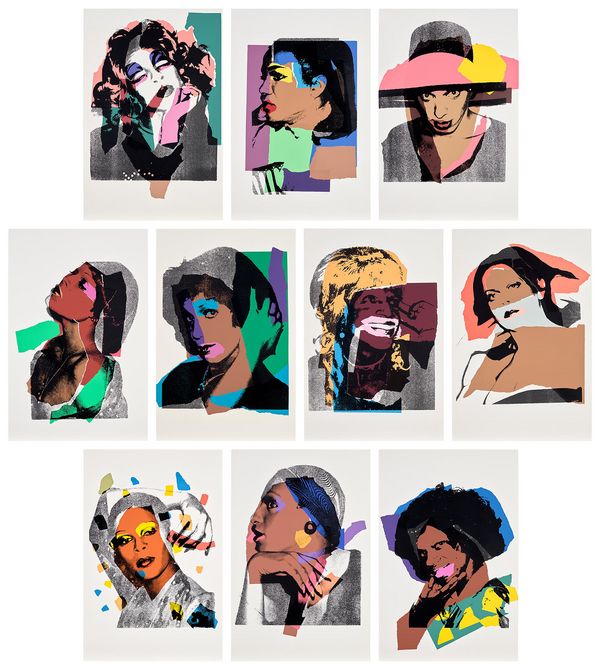
Andy Warhol, Ladies and Gentlemen, 1975. Modern & Contemporary Editions: Evening Sale.
Beyond a visual departure from tradition, Pop Art deployed a radical camp aesthetic to disrupt heteronormative institutions. For Andy Warhol and Keith Haring, camp transcended style to function as a vital queer survival tactic, a strategy crystallized in Warhol’s Ladies and Gentlemen series. Warhol captured through screenprint the visages of Black and Hispanic trans women and emerging drag queens. In his typical Warholian flair, he adorned their likenesses with flamboyant blocks of color that accentuated their performances of gender. By platforming people whose everyday non-conformity was legally dangerous, he provided a theatrical sanctuary from the very real dangers of the streets they strutted. Through this deliberate embrace of exaggeration and artificiality, the work weaponized camp to disarm oppressive social realities, converting structural trauma into a public celebration of unapologetic queerness.
The connoisseur of Camp has found more ingenious pleasures. Not in Latin poetry and rare wines and velvet jackets, but in the coarsest, commonest pleasures, in the art of the masses.
—Susan Sontag
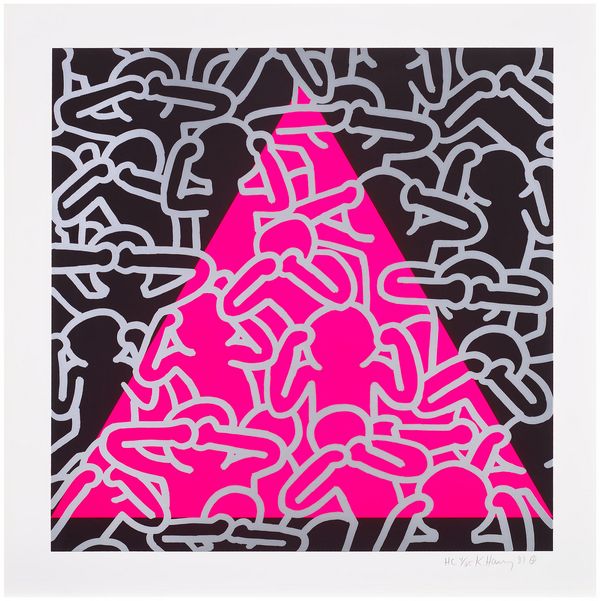
Keith Haring, Silence = Death, 1989. Modern & Contemporary Editions: Evening Sale.
Silence = Death [space between ‘=’] transforms this hyper-Pop pink triangle into a poignant protest against institutional apathy during the AIDS epidemic. Haring famously inverted the pink triangle used by the Nazi regime to brand gay men in concentration camps, reclaiming it as a symbol of pride. Overlaid with cramped, claustrophobic figures invoking the maxim “see no evil, hear no evil, say no evil,” the work fiercely rejects society’s catastrophic neglect. This confronting imagery draws a chilling parallel between the bystander culture of the 1980s and the complicit silence of fascism, utilizing queer appropriation to subvert symbols of hate. June is Pride Month, after all.
Pop Bursts the Bubble
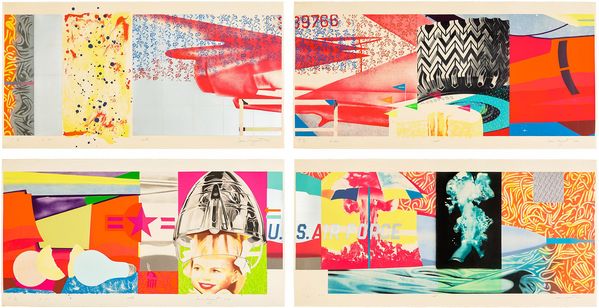
James Rosenquist, F-111, 1974. Modern & Contemporary Editions: Evening Sale.
Pop Art’s commercial hues advertised the post-war optimism propagated by the American government; it distracts, and it enchants. Underlying this seemingly naïve visual lexicon, James Rosenquist confronts the viewer with real-world tragedies hidden behind a veneer of commercial distraction. The ominous body of a General Dynamics F-111 Aardvark looms large across four monumental lithographs, fractured by imagery from mass media to create a visual battleground. On the final panel, the magenta smoke of an atomic bomb billows against a yellow sky that engulfs the fuselage. Here, the standard military lettering transitions into a nearly illegible silver, further obscured by a joyful parasol. Marrying a colorful consumer aesthetic with a darker sublimity, Rosenquist pops the Pop bubble and pulls us back to reality — a deliberate act to unveil the real-life atrocities enacted by contemporary society around us.
International Pop!
This June, Phillips’ Modern & Contemporary Editions: Evening Auction invites you to take a walk down Pop’s Boulevard of Fame. Our jet-setting lineup proves that Pop’s visual lexicon of bright color and blatant appropriation translates into every language. Pop didn’t just cross geographic borders; it erased them, forging an international community. For decades, astute collectors have pursued these works not merely as art, but as the passport to a rapidly connecting world. From London to Tokyo, Sweden to Greece, this collection of International Pop! prints has been amassed from far and wide, reflecting the trans-Atlantic influence of the movement. A Pop artwork is never a static object on a wall; it is the immortalization of the transient influx of mass media, transforming the mundane everyday into an enduring artifact of a shared human consciousness.