Article | The Stories We Tell
The Stories We Tell
Through myths, legends, and daily life, a world unfolds in our June Editions sales in London.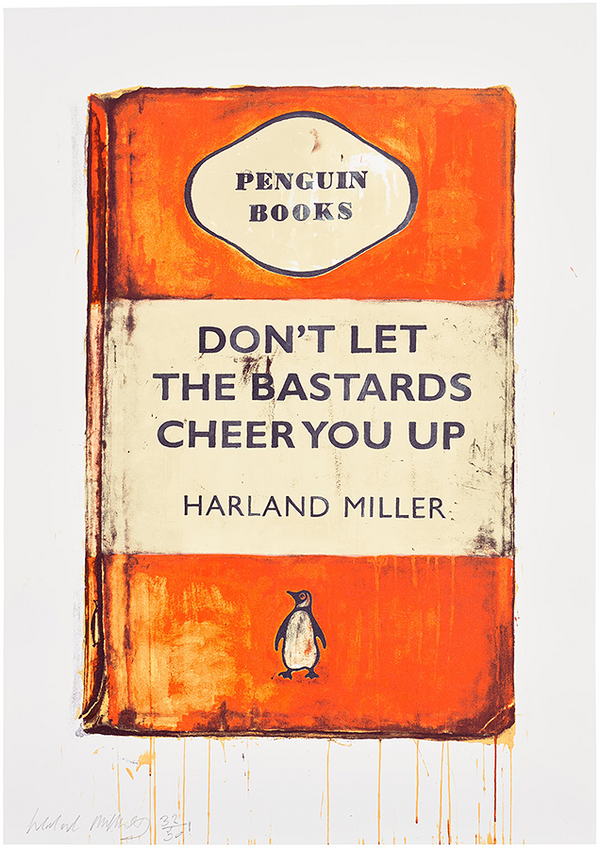
Harland Miller, Don’t Let the Bastards Cheer You Up, 2009. Modern & Contemporary Editions: Evening Sale, London.
Among the more compelling elements of any good art is its capacity for narrative connection. The best part is that it comes in many forms, whether through subject, scope, scale, or even titles, to get out of that alliterative spiral. From an early age, fairy tales and comic books merge the image and word into one, and by our first post-structuralism course (that we absolutely paid full attention to and understood immediately), we learn that everything is a text, so when we take a closer look at many of the works in our upcoming Editions sales in London, we find that the stories that stick with us most are always the ones that inspire new ways of seeing the themes we already know.
Harland Miller
Also the title of a 2009 exhibition at BALTIC Centre for Contemporary Art, Miller’s statement is something of a Yorkshire intercession, with other works from the Bad Weather series including Bridlington: Ninety Three Million Miles from the Sun, Scarborough: Have Faith in Cod, Grimsby: The World is Your Whelk, and Whitby: The Self-Catering Years. Don’t Let the Bastards Cheer You Up pivots from the pun theme to a more mantric register, and insofar as said bastards can get one down, it's their ability to one back up that really proves pernicious. A toxic cycle, int'it? And that's where Miller advises the high road by staying low. They're the sorts you can judge by the cover.
Andy Warhol
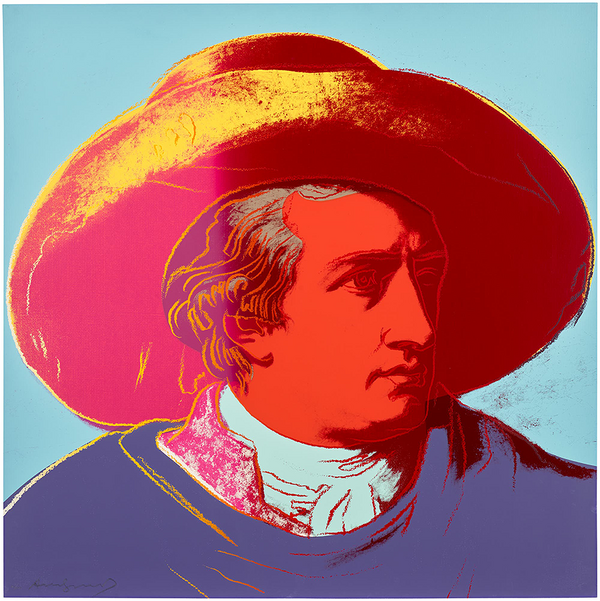
Andy Warhol, Goethe, 1982. Modern & Contemporary Editions: Evening Sale, London.
Andy Warhol’s fascination with Goethe stemmed from an encounter with Johann Heinrich Wilhelm Tischbein’s painting Goethe in the Roman Campagna (1786–87) during a visit to Frankfurt. In the work, the famed German polymath is sat reclining among pastoral ruins, as though bridging the ancients and the moderns with a singular, forward vision. Warhol removed the idyllic scene entirely, instead focusing on Goethe’s gaze and minting a new Pop icon with the close cropping of a coin face and a palette befitting both a Marilyn or Micky Mouse portrait and Goethe’s own color wheel. It is precisely in this flattening of an image to its immediate essentials that Warhol finds a link between his subject and his project: his icons are on one side of the Faustian bargain, and art history usually stands on the other, but in one fell swoop, even that distinction blurs in a wash of reds and blues.
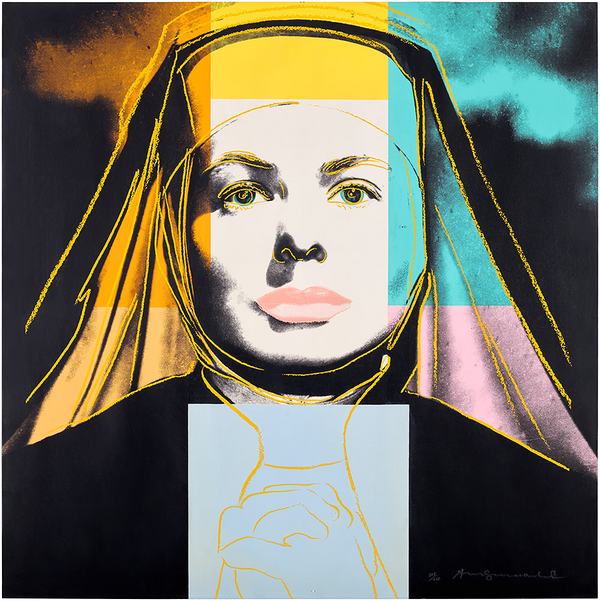
Andy Warhol, The Nun, from Ingrid Bergman, 1983. Modern & Contemporary Editions: Evening Sale, London.
Only a year later, Warhol’s fascination with enduring celebrity found a perfect conduit in Ingrid Bergman. Her decades-long American career began in earnest in 1940s Hollywood dramas and thrillers, but the apparent severity of The Nun is contrasted by the fact that the image is a composite of stills from the lighthearted 1945 comedy The Bells of St. Mary's, which cast Bergman alongside Bing Crosby. Through a combination of bold color blocking, dramatic backgrounding (there’s room for an angel or devil above each shoulder), and Warhol’s signature screenprinting, Bergman balances a sense of poise with her incredible range as an actress. Also of note is that the film debuted only a few short months after the end of the war, signaling a new landscape for the arts after wartime austerity, and Bergman’s naturalistic approach – she was a master of subtlety, nuanced emotion, and glancing tells – offers a remarkable space for Warhol to show how her complexity shines even through artifice.
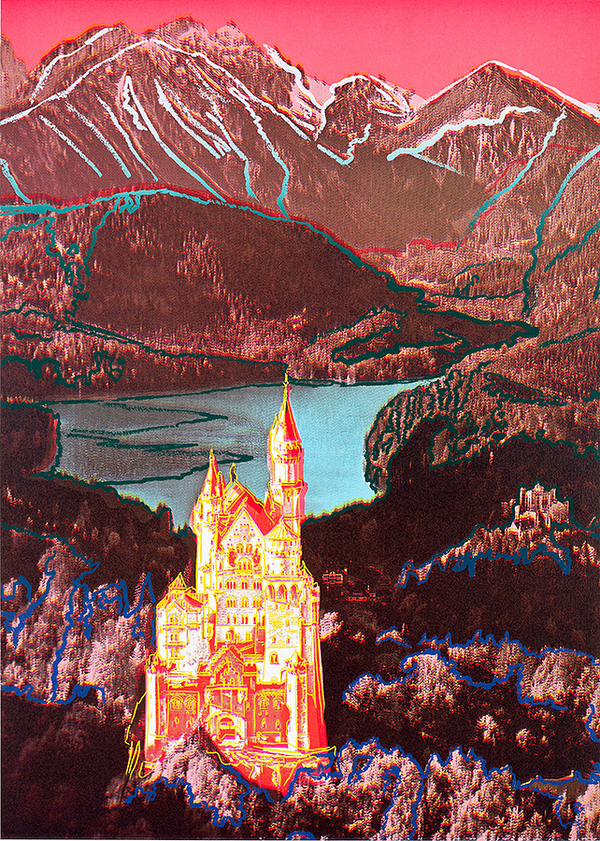
Andy Warhol, Neuschwanstein, 1987. Modern & Contemporary Editions: Online Auction.
Listen, if you were a king with lofty artistic ambitions and a castle like Neuschwanstein at your disposal, you’d get fed up with the trivial business of running Bavaria and focus on fairy tales and subsidizing Richard Wagner, too. Don’t tell us otherwise. Or are you one of the haters who tried to get our boy Ludwig II declared insane? If that’s the case, take a note from Andy Warhol and see the forest for the trees. Rather than cropping the image to silo the future Disney monument, Warhol instead situates it within a natural scene to give a sense of scale and imaginative atmosphere. The source material comes from the surroundings, and it is rendered magical by the castle, as though we are witnessing the opening page of a fantastic storybook. No doubt Warhol also took inspiration from its pastiche historicism, as Neuschwanstein’s romantic inspiration drew from Wagner’s operas, particularly Tannhäuser and the Singers' Contest at Wartburg and Parsifal, along with medieval symbolism and aristocratic flights of fancy, including multiple design tributes to Lohengrin, the Swan Knight of German literary legend.
Marc Chagall

Marc Chagall, So I Came Forth of the Sea and Sat Down on the Edge of an Island in the Moonshine..., plate 5 from Four Tales from the Arabian Nights, 1948. Modern & Contemporary Editions: Evening Sale, London.
For all the talk of obscure art references, sometimes it does what it says on the tin. Marc Chagall's lithograph is titled after a quote from The Second Voyage of Es-Sindibad of the Sea, in which the legendary mariner emerges from the ocean onto a deserted, moonlit island, where he is eventually rescued. The mythical siren beckons, and the story forms part of the narrative cycle around wealth accumulation and loss, misadventure and redemption, which all come at both great cost and great endeavor. It is a classic up-and-down narrative device, and Sindibad proves quite capable in either direction: by the end of his seven adventures, he has persevered into a great fortune after immense suffering, and his worldly successes are balanced by a necessary humility toward those who blame their lots on luck, rather than effort. Chagall brings the story to life with his masterful use of blues and greens, his ever-present sea, and a sliver of the night that shows a rising moon about to hold court over its waves.
Anselm Kiefer

Anselm Kiefer, Die Argonauten (The Argonauts), 2014. Modern & Contemporary Editions: Evening Sale, London.
There is an artistic undercurrent that cuts through the ubiquity of myth and its continuous absorption through cultural osmosis to the point that we no longer need the source material to do something incredible with its story. Anselm Kiefer takes things a step further with Die Argonauten: “It’s not absolutely essential [to reference the original]. I didn’t even reread the story of Jason first…” the artist explained; he instead tackled the Argonauts – the Greek heroes led by Jason on their turbulent, and at times, violent quest to retrieve the Golden Fleece – through a photographic series of German bombers. Rendered in industrial lead, its very medium suggests a lasting, destructive force, long after the explosions detonate. The legend becomes quotidian in that manner; the epic becomes dull, functional, brutal. Man’s violence is material instead of sublime; his pursuits are in the service of earthy gain rather than the divine. Historian Andréa Lauterwein describes the German post-war period of cultural amnesia as: “…a nation of fallen heroes, who wanted only to forget as quickly as possible their period of collective hypnosis,” and Kiefer’s revisiting of those mores from the distance of time continues to prove revolutionary.
After Jean-Michel Basquiat
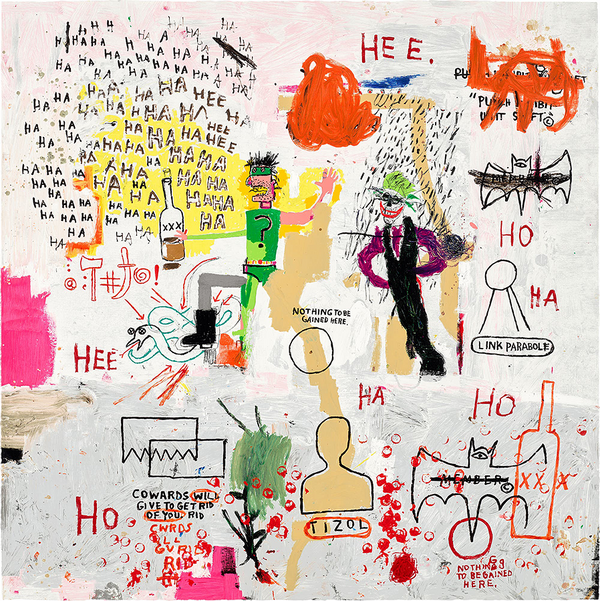
After Jean-Michel Basquiat, Riddle Me This Batman, from Superhero Portfolio, 1987/2022. Modern & contemporary Editions: Evening Sale, London.
Consider the fundamental offer of the comic book: in exchange for its distilled ethics, easy-to-follow narratives, idealized forms, good-versus-evil plotlines, and memorable characters, it requires a substantial commitment to its serialized editions, fandom, and lore. Every image and word carries significance, or to recontextualize Jean-Michel Basquiat’s observation, “every single line means something.” It goes to show then that Riddle Me This Batman employs the artist’s frenetic style to great effect within the context of the comic cell. His Riddler and Joker fall squarely into their villain archetypes, while the maniacal laughter and litany of symbols, both familiar and confrontational, give the scene its physicality. It is at once an observation of the tropes that define the style and a deeper examination of how those simplified forms convey universal themes that can be understood in youth and subverted in maturity. Twenty years before cinematic universes, there was Basquiat, and his grawlixes carry the weight of an entire subculture well before they made their way to the big screen in the form of A-list image rehabilitation.