Article | The Best Independent Watchmaking Phillips Geneva Watch Auction Xxiii May 2026 Bacs Russo
The Best of Independent Watchmaking at the Phillips Geneva Watch Auction: XXIII
From early F.P. Journe and Daniel Roth to Akrivia, De Bethune, and Roger Smith – a closer look at some of the most compelling independent watches in our upcoming Geneva sale.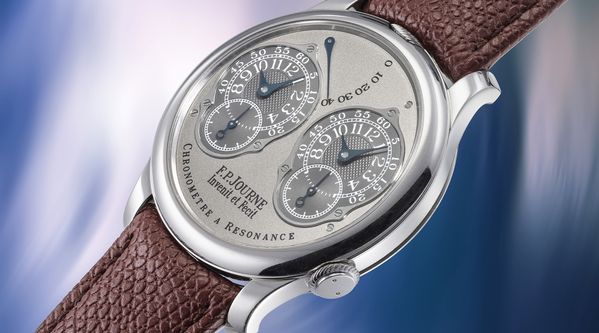
Our first live auction of 2026, the PHILLIPS Geneva Watch Auction: XXIII, takes place on 9 & 10 May, at the Hotel President, at Quai Wilson 47, in central Geneva. The auction includes more than 200 of the world's finest watches – and though we are loath to boast, we truly think it's one of the best catalogues we've ever put together. We'll be highlighting a number of the most interesting lots and stories from the sale over the next month, including the five incredible watches featuring cloisonné enamel dials featured below.
– By Logan Baker
Over the past three decades, few areas of watch collecting have evolved as dramatically as independent watchmaking.
Once a niche corner of the market known mainly to insiders, it has grown into one of the most compelling and closely followed segments of 21st century watchmaking. Collectors today are drawn not only to the technical ingenuity of these watches, but also to the deeply personal stories behind them. In many cases, each watch reflects the vision of a single watchmaker or a small team working outside the structures of the major Swiss houses.
What defines independent watchmaking is not a particular style or complication, but a spirit of experimentation. Some makers push the boundaries of chronometry, refining escapements and regulating systems in pursuit of greater precision.
Others explore entirely new ways of displaying time, transforming the wristwatch into something closer to a kinetic sculpture. Still others dedicate themselves to preserving traditional handcraft at a level rarely seen in modern industrial production. All of these approaches have created a remarkably diverse landscape where technical invention, artistic expression, and traditional craftsmanship coexist.
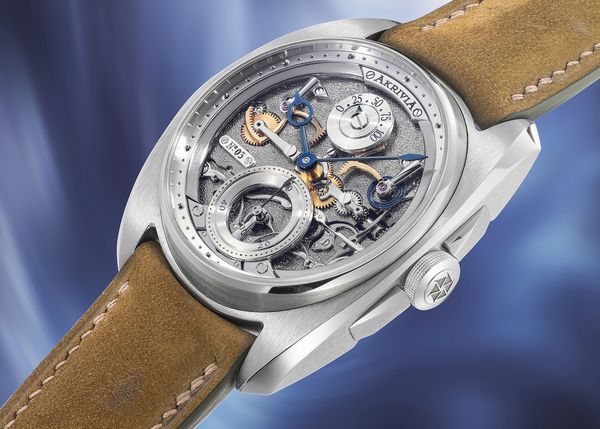
Lot 36: A circa 2018 Akrivia AK-06 in stainless steel that's included in the Phillips Geneva Watch Auction: XXIII. Estimate: CHF 350,000 - 700,000
For collectors, that diversity is part of the appeal. Independent watches often appear in extremely small numbers, sometimes just a handful of examples each year. The watches can mark important moments in a watchmaker’s career or capture the earliest experiments that later define an entire brand. As a result, they offer something that collectors increasingly value: a direct connection between the object on the wrist and the individual who created it.
Phillips in Association with Bacs & Russo has played an important role in supporting and documenting this movement. Over the past decade, we have helped bring many of the most important independent watches to a global audience, from early works by pioneering figures such as François-Paul Journe and Daniel Roth to landmark pieces by contemporary makers including Greubel Forsey, Rexhep Rexhepi, and Roger Smith. Through carefully curated auctions and dedicated scholarship, Phillips has helped highlight the significance of these pieces within the broader history of watchmaking.
The selection of independent watches presented in the upcoming Phillips Geneva Watch Auction: XXIII offers a compelling snapshot of this creative ecosystem.
Spanning several decades and a wide range of approaches, the watches featured here reflect the imagination, technical ambition, and individuality that continue to define independent watchmaking today.
Lot 6: A Circa 2000 F.P. Journe Chronomètre à Résonance ‘Souscription,’ No. 18, in Platinum And 18k Pink Gold
Estimate: CHF 450,000 - 900,000
Among modern independent watches, few pieces occupy the same rarefied territory as the earliest examples of the F.P. Journe Chronomètre à Résonance.
Collectors already treat the first generation of Résonance wristwatches as foundational works in contemporary horology. But when an example belongs to the original 20 Souscription pieces, the level of importance shifts into a different category entirely.
The watch offered here, No. 18, is precisely such a piece.
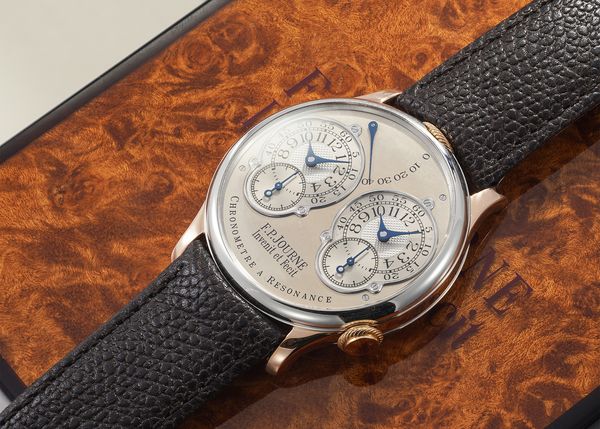
Lot 6: A circa 2000 F.P. Journe Chronomètre à Résonance ‘Souscription,’ No. 18, in platinum and 18k pink gold, that's included in the Phillips Geneva Watch Auction: XXIII. Estimate: CHF 450,000 - 900,000
To understand why these watches matter so much, it helps to return to the beginning of François-Paul Journe’s career.
Long before his name became synonymous with modern independent watchmaking, Journe spent his formative years in the workshop of his uncle, Michel Journe, one of France’s most respected restorers of antique clocks. There, he encountered the works of the great masters of the past: Abraham-Louis Breguet, Antide Janvier, and Pierre Leroy. Studying and restoring these historic mechanisms left a lasting mark. Journe absorbed their technical ingenuity and philosophical approach to watchmaking, lessons that would later define his own creations.
When Journe decided to launch his own brand in the late 1990s, he faced the same challenge many independent watchmakers face: financing the first production pieces. His solution came from history.
Following the example established by Breguet in the 18th century, Journe offered a subscription system in which a small group of early supporters would place deposits on watches that had not yet been produced. In return, they received preferential pricing and the satisfaction of helping launch a new chapter in watchmaking.
Those first 20 clients funded the creation of the Tourbillon Souverain Souscription, delivered in 1999 and individually numbered on the dial. Soon after came Journe’s second wristwatch, the Chronomètre à Résonance.
The concept behind the Résonance traces back to Antide Janvier, the 18th-century French clockmaker who built extraordinary double-pendulum clocks designed to synchronize through resonance. Journe had already experimented with the principle decades earlier.
In 1983, he succeeded in miniaturizing the idea into a pocket watch with two balances oscillating in resonance, an achievement widely considered impossible at the time. Bringing that system to a wristwatch required another seventeen years of experimentation before the Chronomètre à Résonance finally appeared in 2000.
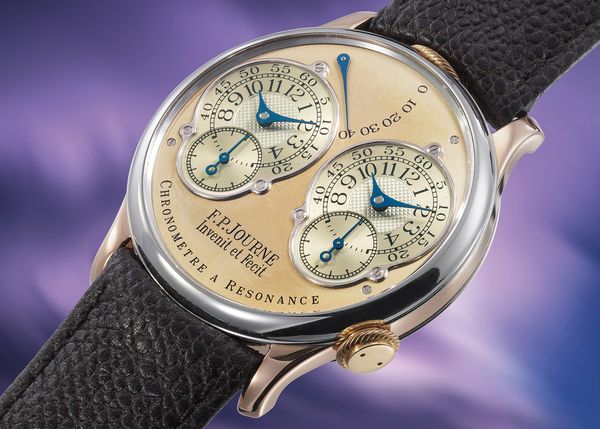
Lot 6: A circa 2000 F.P. Journe Chronomètre à Résonance ‘Souscription,’ No. 18, in platinum and 18k pink gold, that's included in the Phillips Geneva Watch Auction: XXIII. Estimate: CHF 450,000 - 900,000
The earliest Résonance wristwatches form a fascinating and complex chapter in Journe’s production history. The first 20 examples, numbered 001 through 020, were offered to the same clients who had supported the Tourbillon Souscription. These watches, known today as the Résonance Souscription series, carry the production suffix /00R and feature deeper laser-engraved casebacks that distinguish them from other early pieces.
Within this already small universe of early Résonance watches, the present example stands out.
Research indicates that only five Souscription Résonance pieces were cased in a striking two-tone combination of platinum and 18k pink gold. Of those, only three feature white gold dials like the watch offered here.
Lot 36: A Circa 2018 Akrivia AK-06 in Stainless Steel
Estimate: CHF 350,000 - 700,000
It is remarkable to consider how quickly Rexhep Rexhepi has become one of the defining figures of modern independent watchmaking. Today, his name sits comfortably alongside the most respected contemporary makers. Collectors pursue his watches with intensity, waiting lists stretch years into the future, and the brand he founded just over a decade ago has already secured a place in the modern canon.
Still, Rexhepi’s rise did not happen overnight.
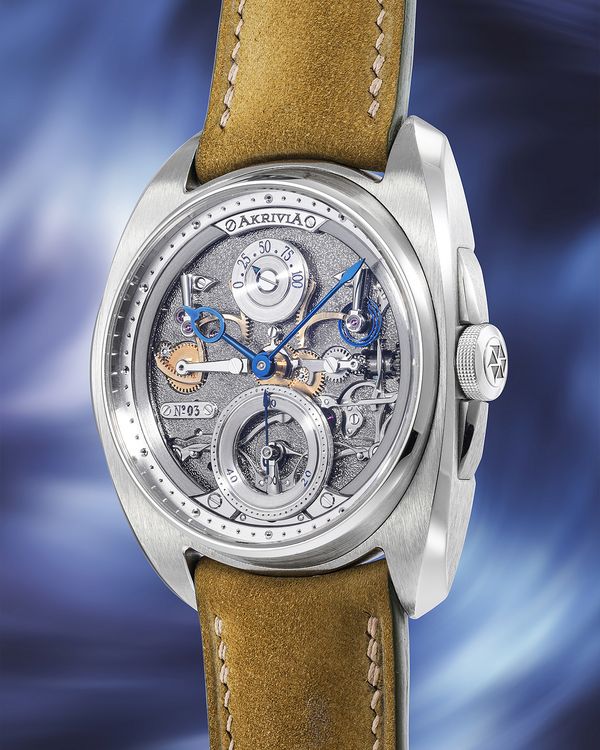
Lot 36: A circa 2018 Akrivia AK-06 in stainless steel that's included in the Phillips Geneva Watch Auction: XXIII. Estimate: CHF 350,000 - 700,000
Born in Kosovo, he moved to Geneva at the age of 12. Just two years later, he began an apprenticeship at Patek Philippe, entering one of the most demanding watchmaking environments in Switzerland while still in his mid-teens. By his early twenties, he was already supervising a team of watchmakers working on some of the most complex mechanisms in contemporary horology.
A subsequent move to F.P. Journe proved formative in a different way. Journe’s workshop demonstrated how a single watchmaker’s vision could evolve into a fully realized independent brand. With his mentor’s encouragement, Rexhepi eventually set out on his own.
In 2012, he founded Akrivia, named after the Greek word for precision. The earliest watches immediately revealed a distinctive aesthetic language. Cases combined rounded and tonneau-like forms, dials were often hand-hammered, and the movements displayed bold, symmetrical architecture finished to a level that bordered on obsessive. Tourbillons played a central role in these early pieces, establishing the brand’s technical credibility almost instantly.
The AK-06, introduced in 2017, marked a subtle but meaningful shift in Rexhepi’s approach. Rather than emphasizing visual drama, the watch focused on chronometric purity.
At the heart of the AK-06 is a manual-wind movement, with almost all of its components displayed on the dial side. The architecture unfolds with striking symmetry. Two large barrels dominate the upper portion, while the balance sits proudly at the bottom, visually anchoring the composition. The layout reflects the watch's underlying mechanical logic.
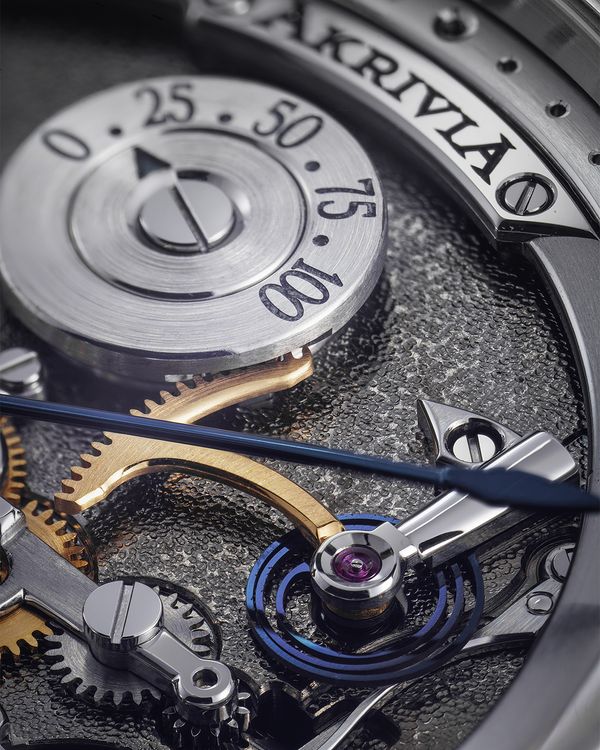
Lot 36: A circa 2018 Akrivia AK-06 in stainless steel that's included in the Phillips Geneva Watch Auction: XXIII. Estimate: CHF 350,000 - 700,000
Two complications reinforce the AK-06’s identity as a watchmaker’s chronometer.
A zero-reset mechanism instantly returns the seconds hand to zero when the crown is pulled, allowing the wearer to set the time with precision. Meanwhile, a power-reserve indication integrates directly into the movement's geometry, avoiding the feeling of an add-on dial element. Every component feels intentional.
Production of the AK-06 remained extremely limited. The model was made in just two variations of 25 pieces each. One version combined a titanium case with a yellow-gold movement back plate. The other, like the watch offered here, pairs a stainless steel case with a dark grey movement plate that gives the architecture a particularly graphic presence.
For collectors who follow the evolution of contemporary independent watchmaking, the AK-06 represents an important moment. It captures Rexhepi transitioning from an ambitious young watchmaker experimenting with form toward the mature, restrained language that would later define his Chronomètre Contemporain series.
Lot 126: A 2019 Roger Smith Series 3 in 18k Pink Gold
Estimate: CHF 300,000 - 600,000
In the landscape of modern independent watchmaking, Roger Smith occupies a unique position.
Working from a small workshop on the Isle of Man, he continues the tradition of hand-built mechanical watchmaking established by his mentor, George Daniels. Production remains deliberately small, not as a marketing strategy but as a consequence of the work itself. Smith and his team complete roughly 15 watches each year, each built using methods familiar to the great English watchmakers of the 18th century.
Smith’s path into horology is inseparable from Daniels. In 1998, he joined the legendary watchmaker to assist with the Millennium series, a group of wristwatches that showcased Daniels' revolutionary Co-Axial escapement. The collaboration proved formative.
When the Millennium project concluded in 2001, Smith established his own workshop alongside Daniels’ studio, carrying forward the philosophy of true English watchmaking.
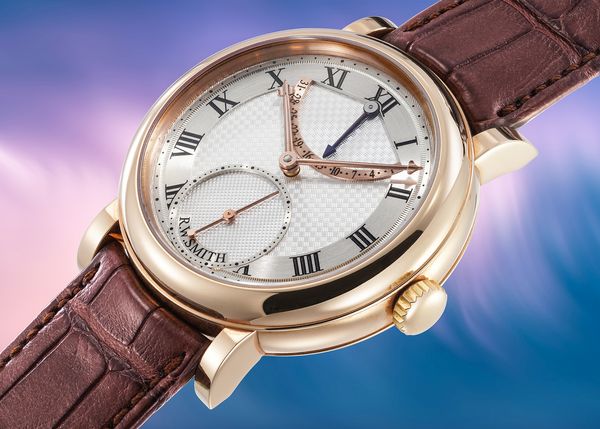
Lot 126: A 2019 Roger Smith Series 3 in 18k pink gold that's included in the Phillips Geneva Watch Auction: XXIII. Estimate: CHF 300,000 - 600,000
Early Smith watches such as the Series 1 explored classical forms while gradually developing Smith’s own visual language. Over time, the collection evolved into the Series 2 and Series 3 – watches that balance traditional English aesthetics with modern engineering.
The Series 3 offered here represents an especially appealing example. Cased in 18k pink gold and measuring a balanced 40mm across, it displays the hallmarks collectors expect from Smith’s work. The dial, crafted from solid silver, is engine-turned by hand and finished with carved Roman numerals, Smith’s distinctive spade hands, and delicately engraved lettering.
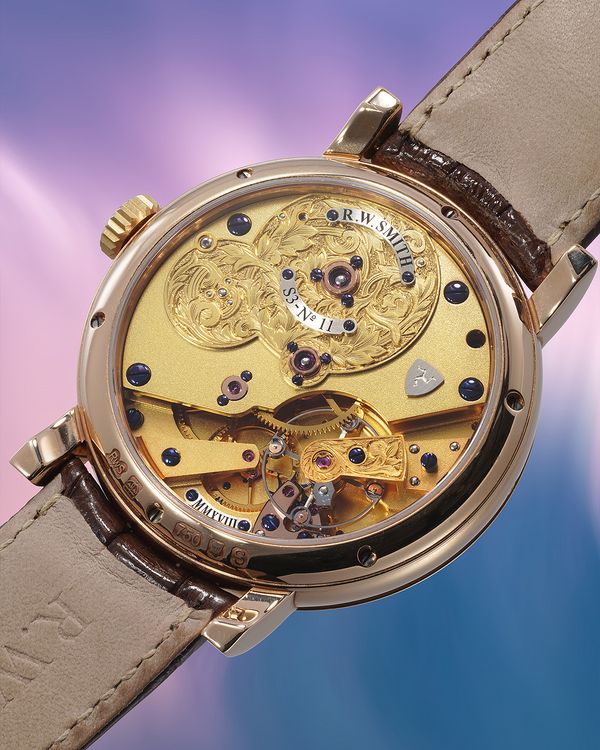
Lot 126: A 2019 Roger Smith Series 3 in 18k pink gold that's included in the Phillips Geneva Watch Auction: XXIII. Estimate: CHF 300,000 - 600,000
Turn the watch over, and the philosophy becomes even clearer. The manual-wind movement incorporates Smith’s single-wheel interpretation of Daniels’ Co-Axial escapement, finished with traditional frosted plates and hand engraving throughout.
Only a handful of 18k pink-gold Series 3 watches have been produced, and this example marks the first to appear at international auction.
Lot 5: A Circa 1989 Daniel Roth Tourbillon Régulateur Double-Face in 18k White Gold, Sold by Asprey London
Estimate: CHF 80,000 - 160,000
When Daniel Roth launched his own brand in the late 1980s, he did so with a watch that immediately announced his ambitions. The Tourbillon Régulateur Double-Face, Ref. C187, arrived in 1989 and quickly became one of the defining early works of modern independent watchmaking.
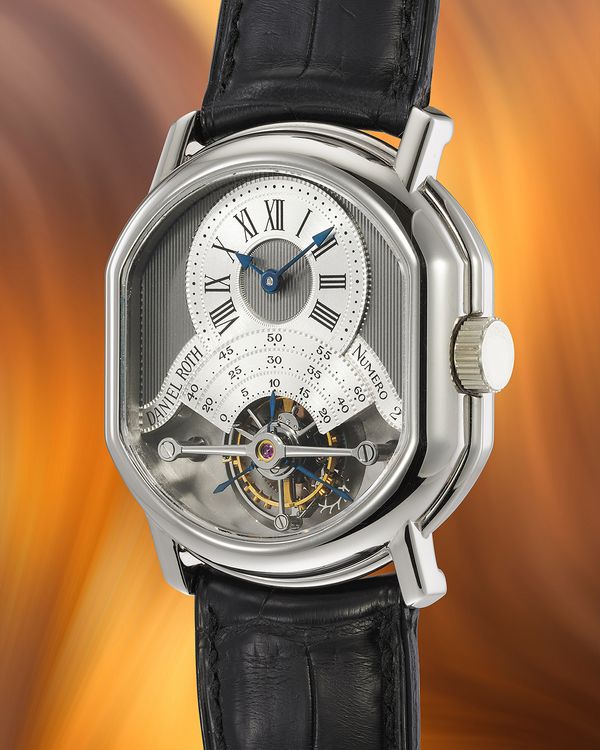
Lot 5: A circa 1989 Daniel Roth Tourbillon Regulateur Double-Face in 18k white gold, sold by Asprey London, included in the Phillips Geneva Watch Auction: XXIII. Estimate: CHF 80,000 - 160,000
Roth had already built an extraordinary reputation during his years at Breguet, where he helped revive the historic house in the 1970s and 1980s. But his own watches introduced something new: a distinctive design language that blended classical watchmaking with a bold contemporary identity. The now-famous ellipsocurvex case appeared here in full force, framing a dial that combined traditional guilloché finishing with sharply pointed hands and a regulator-style layout.
The tourbillon, naturally, takes center stage. Positioned prominently on the dial, it carries an unusual triple-armed seconds hand that travels across three 20-second tracks, creating a dynamic display that rewards close attention. Flip the watch over, and the second dial reveals additional complications, including a retrograde power-reserve indicator and a date. The result is a watch that invites interaction from both sides.
The example offered here is especially appealing. Cased in 18k white gold, it represents the rarest metal used for the reference. Research suggests that only a handful of 18k white-gold examples have surfaced publicly over the years, making this configuration particularly desirable among collectors of early independent watchmaking.
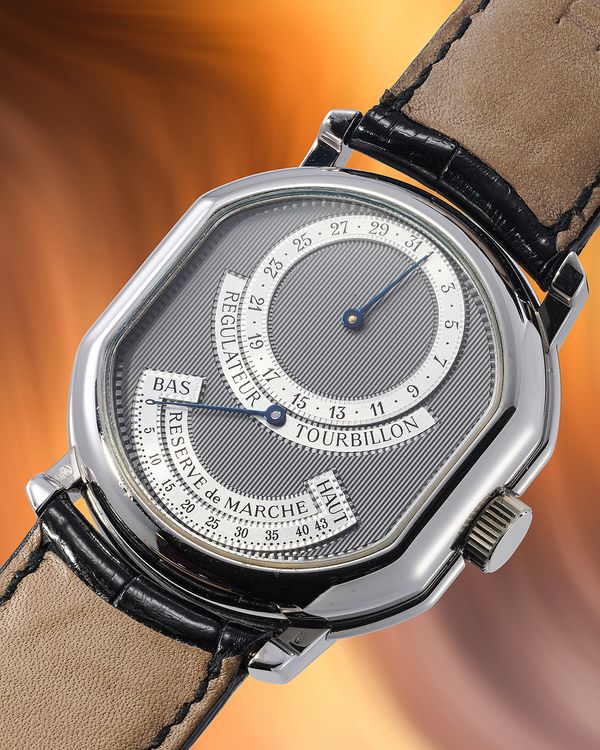
Lot 5: A circa 1989 Daniel Roth Tourbillon Regulateur Double-Face in 18k white gold, sold by Asprey London, included in the Phillips Geneva Watch Auction: XXIII. Estimate: CHF 80,000 - 160,000
Adding another layer of interest, the watch was originally sold through the legendary London retailer Asprey, a name long associated with special commissions and important clientele. It is accompanied by its Official Swiss Chronometer Watch Rate Certificate, along with the original Asprey presentation box and instruction manual.
More than three decades after its introduction, the Tourbillon Régulateur Double-Face remains one of the foundational watches of the independent era. In it, Roth established a visual and mechanical vocabulary that continues to influence watchmaking today.
Lot 128: A 2001 F.P. Journe Octa Chronographe in Platinum with Brass Movement, Straight Côtes de Genève Movement Finish, and 'Shiny' 18k Yellow Gold Dial
Estimate: CHF 150,000 - 300,000
In the early years of F.P. Journe, every new model represented an experiment in pushing mechanical ideas further than the industry expected.
The Octa Chronographe, introduced in 2001, stands as one of the most technically ambitious examples from that formative period and today remains among the rarest watches ever produced by the brand.
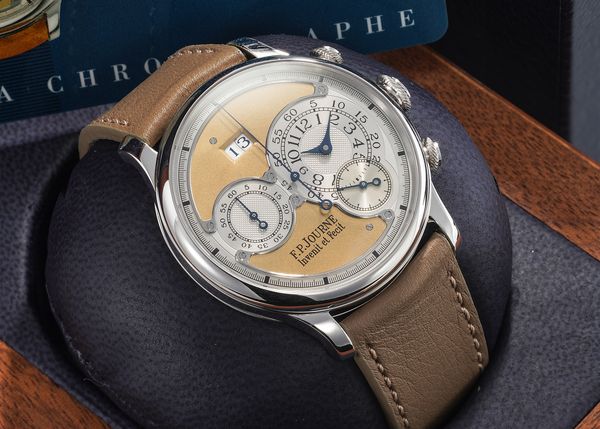
Lot 128: A 2001 F.P. Journe Octa Chronographe in platinum with brass movement, straight Côtes de Genève movement finish, and 'Shiny' 18k yellow gold dial, included in the Phillips Geneva Watch Auction: XXIII. Estimate: CHF 150,000 - 300,000
At its heart is the automatic calibre 1300, the movement that launched Journe’s Octa line.
The premise behind the Octa concept was deceptively simple yet technically demanding: every complication in the series would share the same base movement architecture while maintaining a constant 120-hour power reserve. Achieving that level of autonomy in an automatic chronograph was unprecedented at the time. In fact, when introduced, the Octa Chronographe was the first automatic wristwatch chronograph to combine a large date display with a flyback function and a five-day power reserve.
The present watch belongs to the earliest generation of this already scarce model. Its brass movement features straight, linear Côtes de Genève decoration, a detail believed to appear only on the first 10 movements produced before Journe adopted the circular Geneva stripes seen on later examples.
Even within this early group, the configuration offered here is exceptionally uncommon. Research suggests that just three examples combine a 38mm platinum case, brass movement with straight Geneva stripes, and the distinctive “shiny” yellow-gold dial.
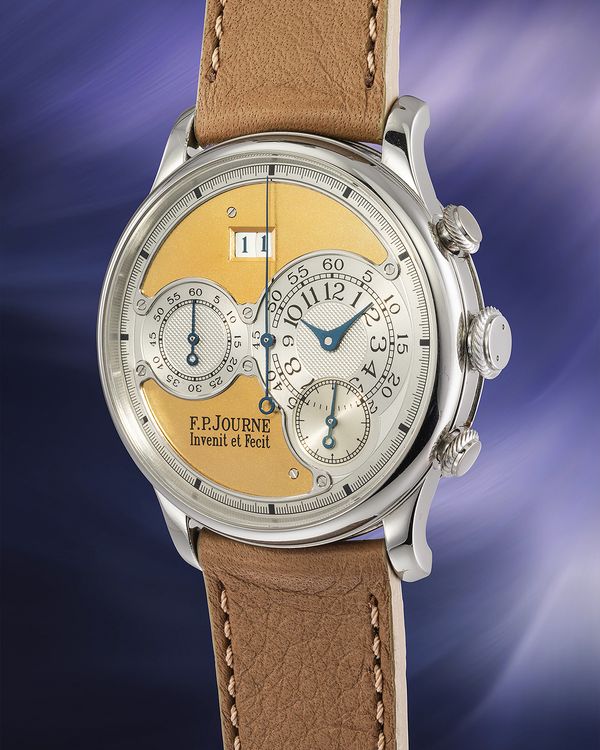
Lot 128: A 2001 F.P. Journe Octa Chronographe in platinum with brass movement, straight Côtes de Genève movement finish, and 'Shiny' 18k yellow gold dial, included in the Phillips Geneva Watch Auction: XXIII. Estimate: CHF 150,000 - 300,000
The watch's number adds another layer of historical interest.
Marked 021/01, it follows a numbering convention Journe reserved for early clients of the brand. Numbers 1 through 20 were set aside for buyers of the Tourbillon Souverain Souscription watches, which were delivered slightly later. As a result, this example bearing number 21 and delivered in 2001 appears to be among the very first Octa Chronographe watches ever delivered.
Within the broader story of Journe’s early production, watches like this capture the experimental spirit of those first years, when the brand was still defining the technical language that would eventually shape modern independent watchmaking.
Lot 206: A 2006 Haldimann H1 Central Tourbillon in Platinum
Estimate: CHF 70,000 - 140,000
Independent watchmaking often celebrates the most visible names. Yet some of the most remarkable work happens far from the spotlight. Beat Haldimann belongs firmly in that category.
Working from his atelier in Thun, Switzerland, Haldimann has spent more than two decades crafting watches almost entirely by hand. Step into his workshop and you will not find the industrial machinery common in modern watchmaking. No CNC machines. No automated processes. Instead, the work follows a slower, traditional rhythm, with only a handful of watches leaving the atelier each year.
From the beginning, Haldimann’s creations have combined technical ambition with a philosophical streak. His watches explore unusual ideas about how time should be displayed or even perceived. The H3, for example, features a central tourbillon but no conventional hands, while the later H9 obscures the time display behind a darkened crystal. The watch continues to run, yet the time remains hidden from view.
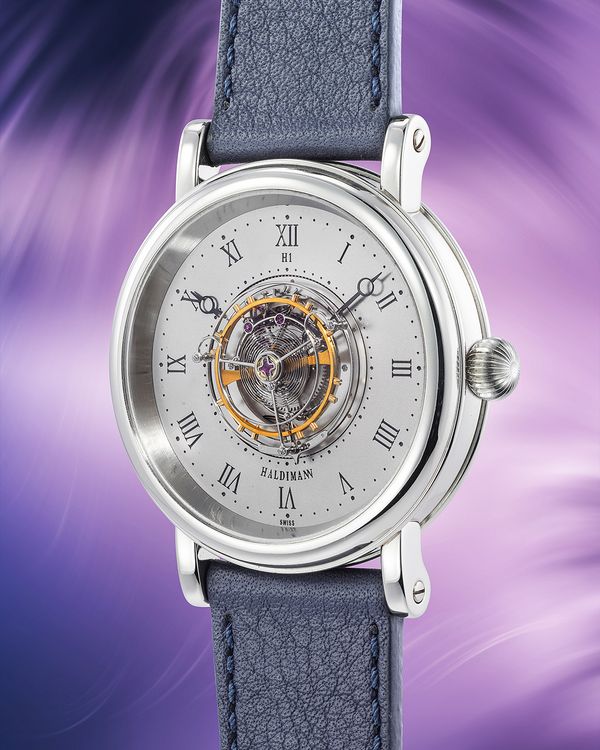
Lot 206: A 2006 Haldimann H1 Central Tourbillon in platinum that's included in the Phillips Geneva Watch Auction: XXIII. Estimate: CHF 70,000 - 140,000
The H1 Flying Central Tourbillon, introduced in 2002, remains his most recognizable creation. At its center sits a dramatically raised flying tourbillon, elevated above the dial and mounted within a lyre-shaped cage measuring an impressive 17.8mm in diameter. The oversized escapement recalls the proportions of historic pocket watches, where large balances were prized for their chronometric stability.
Powering the watch is Haldimann’s manual-wind calibre H-Zen-A, driven by three mainspring barrels and offering a 38-hour power reserve. The aesthetic balances classical restraint with subtle individuality. The 39mm platinum case provides a reassuring weight on the wrist, while the silver dial features hand-engraved numerals and elegant hands inspired by an 18th-century Haldimann Frères pocket watch. The seconds indication is ingeniously displayed through the rotation of the tourbillon cage itself.
Haldimann watches rarely appear on the secondary market. In fact, this example represents only the third H1 ever offered at international auction, underscoring both the scarcity of the model and the lifestyle of its maker.
Lot 127: A Circa 2005 De Bethune DB8 Single-Button Chronograph No. 000 in 18k White Gold
Estimate: CHF 40,000 - 80,000
Among independent watchmakers of the last two decades, De Bethune has built a reputation for relentless technical experimentation. Founded by David Zanetta and Denis Flageollet, the brand quickly became known for unconventional engineering, futuristic aesthetics, and a willingness to rethink the fundamentals of mechanical watchmaking.
Yet the DB8 shows another side of the manufacture.
Introduced in the early years of the brand, the DB8 evolved from De Bethune’s first wristwatch, the DB1. While many collectors associate the brand with dramatic celestial dials and avant-garde case forms, the DB8 takes a more restrained approach.
Its defining feature is a classic single-button chronograph, a configuration that recalls the earliest 20th-century chronographs, in which start, stop, and reset functions were all controlled by the crown.
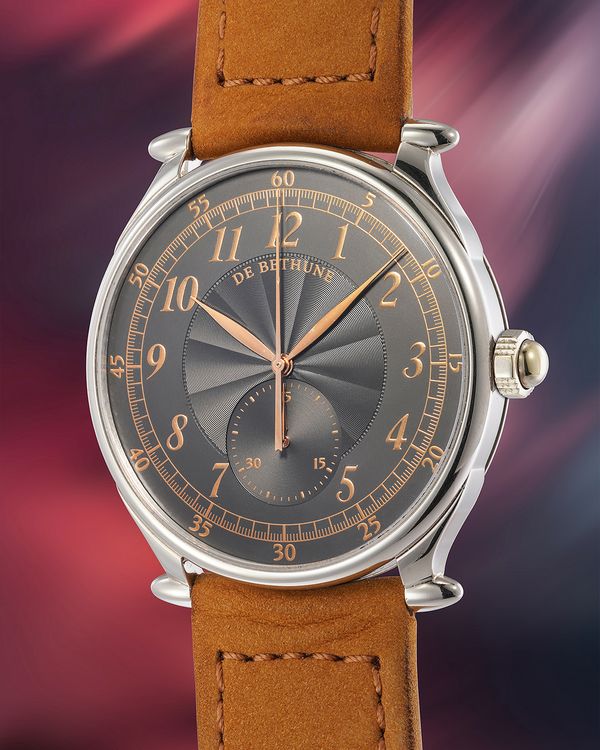
Lot 127: A circa 2005 De Bethune DB8 Single-Button Chronograph No. 000 in 18k white gold that's included in the Phillips Geneva Watch Auction: XXIII. Estimate: CHF 40,000 - 80,000
The watch offered here holds a particularly intriguing place within the model’s history. Numbered “000,” it has been confirmed by the brand as a prototype, effectively representing the starting point of the DB8’s production.
Visually, the watch balances classical watchmaking cues with subtle De Bethune character. The large dial is finished in dark grey guilloché, paired with pink-gold feuille hands and applied numerals that lend warmth to the otherwise monochromatic palette. This same dial configuration would later appear on the limited-edition DB12 created for the Chicago retailer Swiss Fine Timing.
The 18k white-gold case remains relatively slim despite the generous dial opening, with De Bethune’s distinctive bullet-shaped lugs ensuring the watch sits comfortably on the wrist.
Discontinued long ago, the DB8 remains a seldom-seen chapter of early De Bethune history. As the prototype bearing the number “000,” this example captures the moment just before the model entered production, offering a rare glimpse into the experimental beginnings of one of today’s most inventive independent watchmakers.
Lot 2: A 2023 Krayon Anywhere 'Métiers d’Art, Azur' in Platinum
Estimate: CHF 80,000 - 160,000
Few modern independent watches capture the poetry of time quite like those from Krayon.
Founded by Rémi Maillat, the brand made an immediate impression with its debut model, the aptly named Everywhere, unveiled in 2017. The watch accomplished something genuinely new: it displayed the exact times of sunrise and sunset for any location on Earth and allowed the wearer to adjust the setting themselves. The concept earned Krayon the Innovation Prize at the 2018 Grand Prix d’Horlogerie de Genève, instantly placing the young brand on the map.
The Anywhere, introduced shortly afterward, refined that original idea into a more streamlined format. The watch still indicates sunrise and sunset for a chosen location, though the adjustment is performed by a watchmaker rather than directly by the owner. Once set, however, the display unfolds with remarkable elegance.
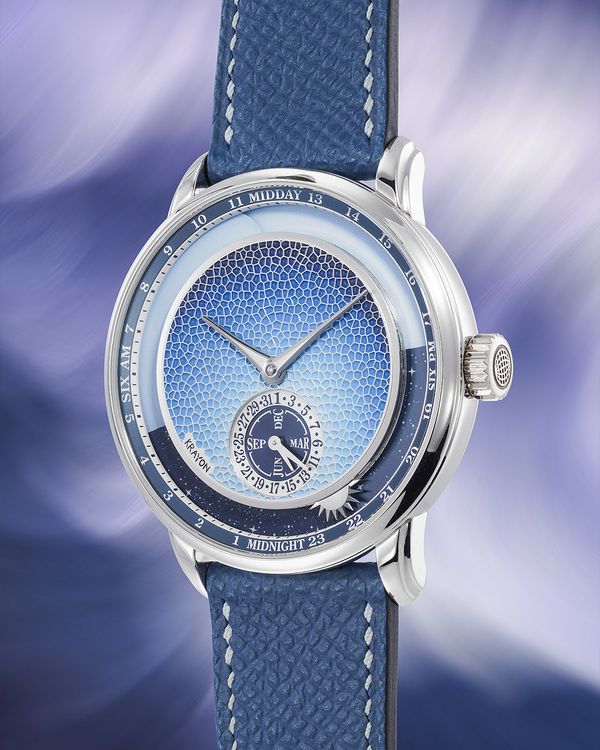
Lot 2: A 2023 Krayon Anywhere 'Métiers d’Art, Azur' in platinum that's included in the Phillips Geneva Watch Auction: XXIII. Estimate: CHF 80,000 - 160,000
Time is read through conventional central hour and minute hands, while a subdial at six o’clock carries the date and month. Around the edge of the dial, a bi-color ring illustrates the length of the day across the year. A pale blue sector represents daylight, while a darker blue marks the night. On a 24-hour scale, a small sun-shaped pointer traces the passage of the day from sunrise to sunset.
Beneath this poetic display lies a remarkably complex mechanism. The movement comprises 432 components, with the upper section devoted to timekeeping and winding, while the lower portion houses the intricate system that calculates sunrise and sunset for the selected latitude and longitude.
The present example stands out thanks to its Métiers d’Art “Azur” dial, a mosaic of lacquered blues that transitions subtly from light to dark, echoing the shifting tones of the sky. Limited to just 15 pieces, it is one of the most visually striking interpretations of the Anywhere.
As a final touch, Krayon will offer the successful bidder a complimentary adjustment of the sunrise and sunset city, allowing the watch to be tailored precisely to its new owner’s location.
Lot 149: A Circa 2009 F.P. Journe Chronomètre à Résonance 'Pisa' Edition in Platinum
Estimate: CHF 450,000 - 900,000
Limited editions have always been rare in the world of F.P. Journe.
When they do appear, they tend to mark special relationships between the manufacture and a handful of historically important retailers. The Chronomètre à Résonance “Pisa” edition belongs firmly in that category.
Created for the famed Milanese retailer Pisa Orologeria, the watch was produced in an edition of just five pieces. Even within the already scarce universe of Résonance watches, that number places it among the rarest modern variants of François-Paul Journe’s most recognizable creation.
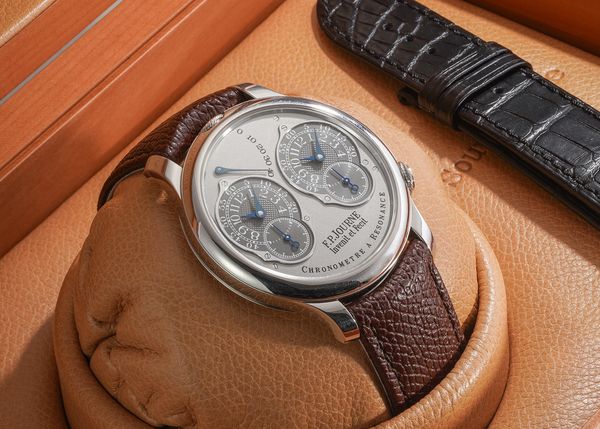
Lot 149: A circa 2009 F.P. Journe Chronomètre à Résonance 'Pisa' Edition in platinum that's included in the Phillips Geneva Watch Auction: XXIII. Estimate: CHF 450,000 - 900,000
The Chronomètre à Résonance itself represents one of the defining technical achievements of contemporary watchmaking. Its principle traces back to the 18th-century French clockmaker Antide Janvier, who experimented with double-pendulum clocks that synchronized through resonance.
The concept remains captivating. The movement uses two independent balances that oscillate side by side. As they run, the balances gradually synchronize through resonance, subtly correcting one another’s deviations and improving overall stability.
The present example belongs to the second generation of the model, introduced in 2004 and often referred to as the “Résonance Nouvelle.” These watches feature a slightly larger 40mm case and a movement crafted from 18k rose gold, a material that replaced the brass movements used in the earliest pieces.
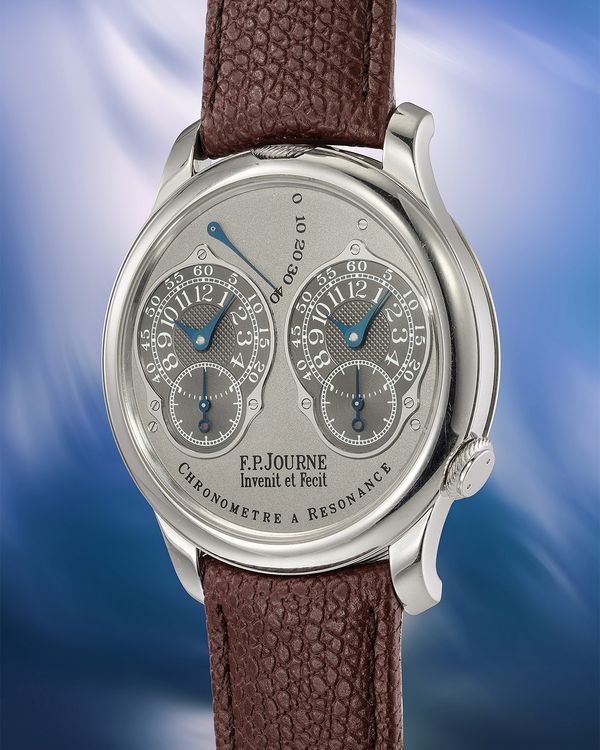
Lot 149: A circa 2009 F.P. Journe Chronomètre à Résonance 'Pisa' Edition in platinum that's included in the Phillips Geneva Watch Auction: XXIII. Estimate: CHF 450,000 - 900,000
Visually, the Pisa edition stands apart from standard production examples. The platinum case frames a white-gold dial paired with dark grey ruthenium-plated subdials, creating a striking contrast rarely seen in the Résonance family. The result feels both dramatic and refined, amplifying the architectural symmetry that defines the design.
Produced in just five examples, the Résonance “Pisa” represents the intersection of one of modern watchmaking's most important innovations with the exclusivity of a historic retailer collaboration.
Lot 184: A 2017 Greubel Forsey Tourbillon 24 Secondes Edition Historique in Platinum
Estimate: CHF 120,000 - 240,000
Few contemporary brands pursue mechanical watchmaking with the intensity of Greubel Forsey.
Since its founding in 2004, the firm has primarily focused on one central idea: improving chronometric performance by rethinking the tourbillon.
The Tourbillon 24 Secondes became one of the clearest expressions of that philosophy. First introduced in 2007 as the Tourbillon 24 Secondes Asymétrique, the watch immediately stood out thanks to its inclined tourbillon cage, set at a dramatic angle within the dial. Unlike traditional tourbillons that rotate once per minute, Greubel Forsey’s mechanism completes a full revolution every 24 seconds, a rapid rotation intended to average out positional errors more effectively.
Just as distinctive is the architecture surrounding the mechanism. The asymmetrical case and dial layout direct the eye toward the tourbillon aperture, allowing the inclined cage to dominate the visual composition. Over time, the design became one of the brand’s most recognizable signatures.
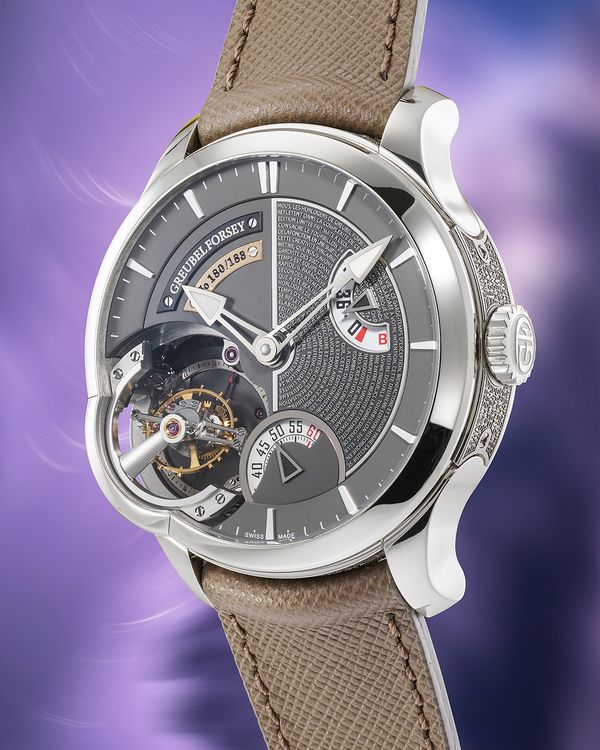
Lot 184: A 2017 Greubel Forsey Tourbillon 24 Secondes Edition Historique in platinum that's included in the Phillips Geneva Watch Auction: XXIII. Estimate: CHF 120,000 - 240,000
The Tourbillon 24 Secondes Edition Historique, introduced at SIHH in 2017, marked the closing chapter of this important model.
In keeping with the series' concept, the dial features a distinctive element exclusive to this edition. One entire section is dedicated to finely printed text describing Greubel Forsey’s philosophy of watchmaking, transforming the watch into something of a manifesto in miniature.
Turn the watch over, and the movement reveals the finishing for which the brand has become famous. Frosted bridges contrast with wide, polished bevels, while slightly domed jewels sit within gold chatons set into mirror-polished countersinks.
Greubel Forsey has also offered a complimentary service for the future owner.
Lot 207: A Circa 1991 Unique Franck Genève 'Janus' World-Time Single-Button, Double-Sided Chronograph in 18k Yellow Gold
Estimate: CHF 70,000 - 140,000
In the late 1980s and early 1990s, few figures captured collectors' imaginations quite like Franck Muller.
Long before his brand became a global name, Muller was already building a reputation as one of the most inventive watchmakers of his generation, crafting highly complicated watches in small numbers for a devoted circle of collectors.
Fresh out of watchmaking school in Geneva in the late 1970s, Muller initially focused on restoring historic timepieces. That work sharpened his understanding of classical complications and exposed him to the great mechanisms of the past. By 1983, he had opened his own workshop, where he began producing bespoke watches signed simply “Franck Genève.”
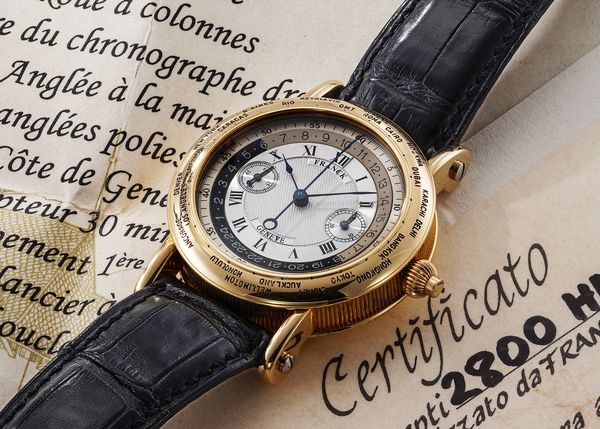
Lot 207: A circa 1991, unique Franck Genève 'Janus' World-Time Single-Button, Double-Sided Chronograph in 18k yellow gold that's included in the Phillips Geneva Watch Auction: XXIII. Estimate: CHF 70,000 - 140,000
The pace and ambition of those early creations were extraordinary. At a moment when many historic Swiss brands were still recovering from the Quartz Revolution, Muller was unveiling complicated watches at a remarkable rate, earning a reputation for mechanical daring that quickly attracted an international clientele.
The Janus world-time chronograph, introduced in 1991, represents one of the most fascinating watches from that period. The double-sided watch combines two complications rarely seen together. On the front, a world-time display based on Louis Cottier’s system is paired with a single-button chronograph. Turn the watch over, and a second dial reveals an elaborate multi-scale chronograph layout with pulsometer, tachymeter, and telemeter tracks.
The movement itself draws on early 20th-century calibres that Muller modified extensively to accommodate the complications. The front dial bears the signature “Franck Genève,” while the reverse carries “Franck Muller,” a subtle hint of the brand that would soon follow.
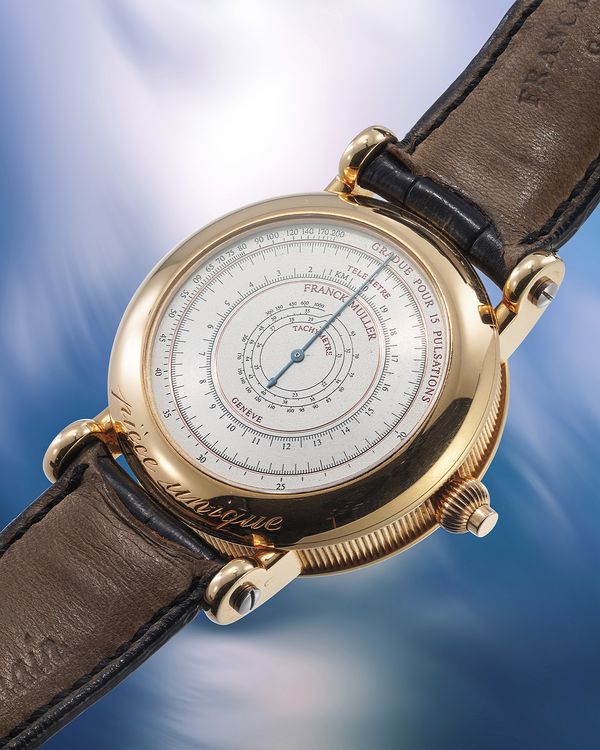
Lot 207: A circa 1991, unique Franck Genève 'Janus' World-Time Single-Button, Double-Sided Chronograph in 18k yellow gold that's included in the Phillips Geneva Watch Auction: XXIII. Estimate: CHF 70,000 - 140,000
Adding further appeal, the case was produced by the legendary casemaker Jean-Pierre Hagmann, whose initials appear inside the lugs. Hagmann’s work remains among the most admired in horology, having supplied cases to many of the most important makers of the late 20th century.
Only about 11 examples of this model were produced in 18k yellow gold or platinum. Named after Janus, the Roman god associated with duality and transitions, the watch feels like a fitting symbol for the moment it represents: the closing chapter of Muller’s early independent work and the beginning of the phenomenon that would soon carry his name worldwide.
Lot 148: A 2023 Vianney Halter Classic Liberty Limited Edition in Titanium
Estimate: CHF 20,000 - 40,000
There aren't many independent watchmakers who have influenced the aesthetic direction of modern horology as profoundly as Vianney Halter.
When he unveiled the Antiqua perpetual calendar in 1998, collectors were confronted with something entirely new. The watch looked almost archaeological, like a mechanical instrument recovered from a lost future, and it helped define what would later be called the "steampunk spirit" in watchmaking. Later projects, including the Opus 3 developed with Harry Winston, further cemented Halter’s reputation as one of the most imaginative minds in the field.
The Classic Liberty reflects that same creative independence, expressed through a more restrained platform. Produced in a limited edition of just 12 pieces for California retailer Rostovsky Watches, the model blends Halter’s mechanical sensibility with a playful set of historical references.
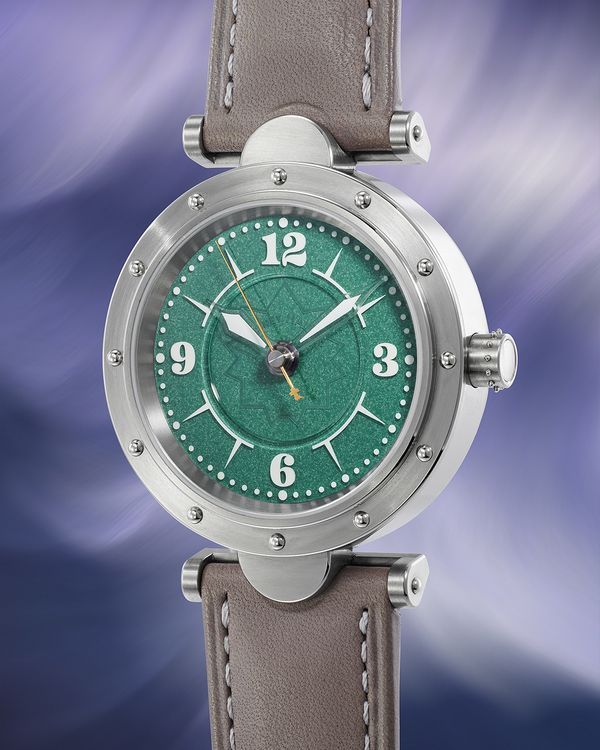
Lot 148: A 2023 Vianney Halter Classic Liberty Limited Edition in titanium that's included in the Phillips Geneva Watch Auction: XXIII. Estimate: CHF 20,000 - 40,000
The theme draws inspiration from the Statue of Liberty and the broader symbolism of freedom it represents. The sapphire dial subtly outlines Liberty Island with its distinctive 11-point star fortification. The numerals borrow their style from 18th-century American banknotes, while the dial's green tone echoes the color associated with the U.S. dollar. On the reverse, the inscription “la liberté éclairant le monde” references Édouard René de Laboulaye’s original concept for the Statue of Liberty.
Technically and visually, the watch also demonstrates Halter’s fascination with unconventional materials. Sapphire plays a central role throughout the design. Beyond the dial itself, the hands are crafted from sapphire, an unusual choice that enhances the transparency of the display. Even the rotor uses sapphire construction, allowing an unobstructed view of the movement beneath.
Housed in a titanium case with Halter’s characteristic riveted bezel design echoed on the crown, the Classic Liberty combines symbolism, mechanical creativity, and extreme rarity in a watch that feels unmistakably true to its maker.
Lot 205: A 2003 F.P. Journe Octa Réserve de Marche 'Souscription,' No. 14, in Platinum
Estimate: CHF 70,000 - 140,000
Among François-Paul Journe’s earliest watches, three models form the foundation of the brand’s identity: the Tourbillon Souverain, the Chronomètre à Résonance, and the Octa Réserve de Marche.
Together, they defined the technical and aesthetic language that would shape Journe’s career. The Octa, however, represented a particularly ambitious step forward.
Conceived during the mid-1990s, the watch introduced Journe’s first automatic movement. His goal was not simply to create a self-winding calibre, but to build a flexible mechanical platform that could support multiple complications without altering the movement’s dimensions. The result was the calibre 1300, measuring just 30mm in diameter and 5.5mm thick while delivering an extraordinary 120-hour power reserve.
At the time, this five-day autonomy was effectively a world record for an automatic wristwatch.
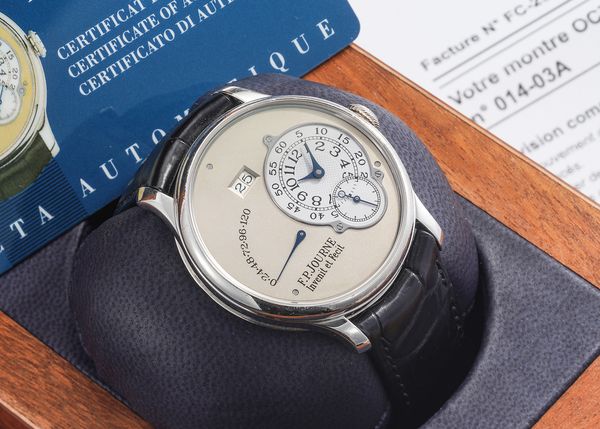
Lot 205: A 2003 F.P. Journe Octa Réserve de Marche 'Souscription,' No. 14, in platinum that's included in the Phillips Geneva Watch Auction: XXIII. Estimate: CHF 70,000 - 140,000
Journe later explained that the Octa project aimed to balance chronometric performance with everyday practicality. The long power reserve meant the watch could be left unworn for several days without stopping, a small but meaningful improvement to daily life with a mechanical watch.
The present example belongs to the highly exclusive Souscription series of the Octa Réserve de Marche. Only 20 watches were produced and offered to the same collectors who had supported Journe’s earliest Tourbillon Souverain Souscription pieces. These clients were given the opportunity to purchase the Octa with a number matching their tourbillon, reinforcing the close relationship between the watchmaker and his earliest patrons.
Cased in platinum with an 18k white-gold dial, the watch echoes the configuration seen on the very first Octa Réserve de Marche delivered. Numbered 14, it is part of this small founding batch and remains closely tied to the brand's formative years.
Offered fresh to the auction market, the watch is accompanied by its original guarantee card, early three-piece burl wood presentation box, and recent service documentation from January 2025.
Lot 33: A Circa 2003 Urwerk UR103 in 18k White Gold, Numbered 1 of a Limited Edition of 25 Pieces
Estimate: CHF 20,000 - 40,000
When Urwerk introduced the UR-103 in the early 2000s, it marked a decisive moment for contemporary watchmaking.
The young brand, founded by watchmaker Felix Baumgartner and designer Martin Frei, had already experimented with unconventional displays in the earlier UR-101 and UR-102. But the UR-103 pushed the concept dramatically further, abandoning traditional watch design in favor of something that felt closer to mechanical science fiction.
The watch was born after nearly three years of development, followed by two more years of testing. What resulted was a form that ignored nearly every conventional rule of watchmaking design. The bombé rectangular case blends sharp geometry with flowing curves, while the engraved lines across the upper surface lend the watch an almost architectural character.
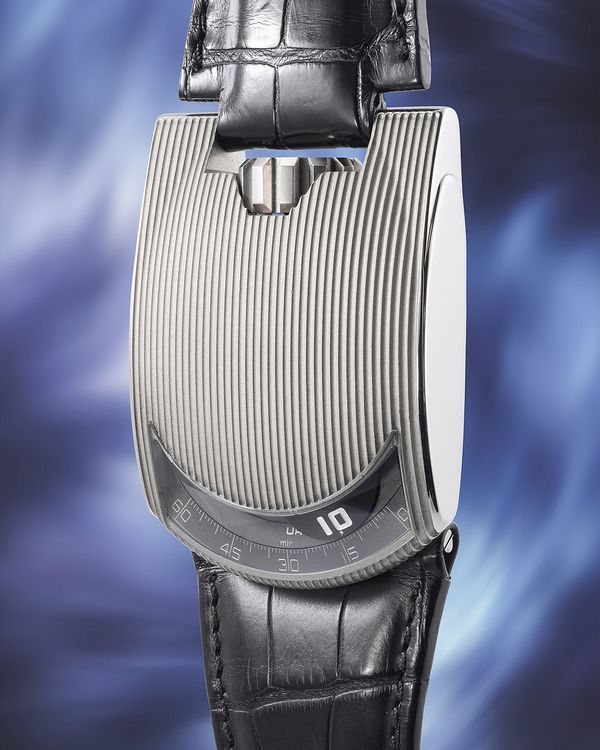
Lot 33: A circa 2003 Urwerk UR103 in 18k white gold that's included in the Phillips Geneva Watch Auction: XXIII. Estimate: CHF 20,000 - 40,000
The time display appears through an aperture at the lower edge of the case. Rather than conventional hands, the UR-103 uses rotating hour satellites. As each hour approaches the bottom of the display, it aligns with a curved minute track, allowing the wearer to read the time instantly before the satellite rotates away and the next hour advances into position.
The reverse side offers a glimpse into the brand’s engineering mindset. The caseback incorporates a power-reserve display, a small subdial for precise time-setting, and a fine-adjustment screw that lets the owner regulate the watch’s timing. This technical approach reflects Urwerk’s philosophy of combining futuristic design with mechanical transparency.
Produced in a limited run of 25 examples in 18k white gold, the present watch carries the particularly appealing number 1 in the series.
Lot 102: A 2022 Grönefeld 1941 Grönograaf in Tantalum
Estimate: CHF 70,000 - 140,000
Dutch brothers Bart and Tim Grönefeld have quietly built one of the most respected names in modern independent watchmaking.
Since founding their brand in 2008, they have become known for combining inventive mechanics with immaculate finishing, earning two Grand Prix d’Horlogerie de Genève (GPHG) awards for the Parallax Tourbillon and the 1941 Remontoire.
The Grönograaf marked another milestone when it debuted as the brothers’ first chronograph.
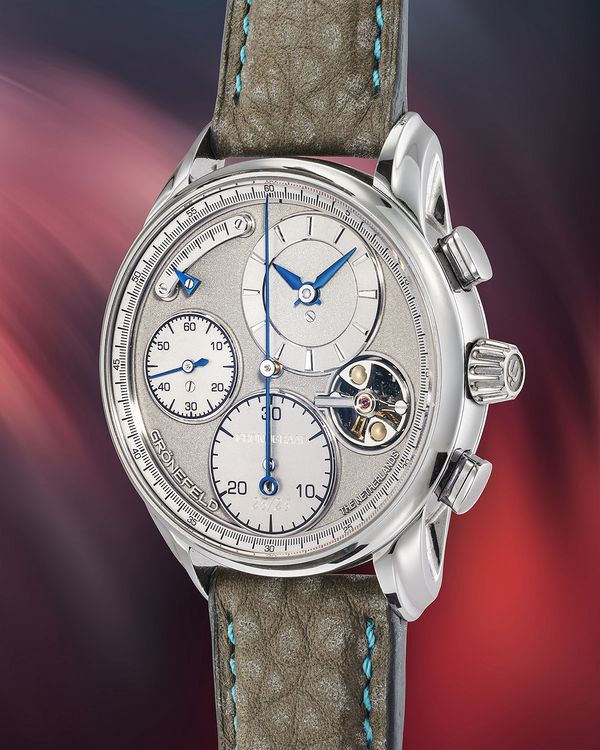
Lot 102: A 2022 Grönefeld 1941 Grönograaf in tantalum that's included in the Phillips Geneva Watch Auction: XXIII. Estimate: CHF 70,000 - 140,000
At first glance, the watch stands out thanks to its unusual dial architecture. Time is displayed on a subdial at one o’clock, balanced by a power reserve indicator at 10 o'clock, and a 30-minute chronograph counter at six o'clock. Yet the most intriguing element appears at three o’clock, where a centrifugal governor – normally associated with minute repeaters – sits prominently on display.
In the Grönograaf, this device serves as the heart of a “soft reset” system that slows the chronograph reset process. Traditional chronographs snap back to zero with considerable force, but here the governor moderates the motion, reducing mechanical stress while creating a mesmerizing visual effect. The Grönograaf took home the Chronograph Prize at the 2022 edition of the GPHG.
The model first appeared as a limited edition of 25 pieces in tantalum, followed by a larger run in stainless steel. The present watch, numbered 25 of 25, represents the final example of the tantalum series.
Lot 180: A 2022 MB&F Horological Machine 9 'Flow Titanium Air'
Estimate: CHF 70,000 - 140,000
Since its founding in 2005 by Maximilian Büsser, MB&F has occupied a unique position within independent watchmaking. Rather than simply refining traditional watch forms, the brand approaches each creation as a three-dimensional mechanical sculpture. The result is a series of Horological Machines that often resemble futuristic instruments as much as wristwatches.
The HM9 Flow draws inspiration from a different era of engineering imagination. Its design references the aerodynamic forms of mid-century automotive and aviation design, when streamlining and speed shaped everything from aircraft fuselages to racing cars. The watch’s sculptural case reflects that influence, with flowing surfaces and prominent sapphire sections that reveal the movement within.
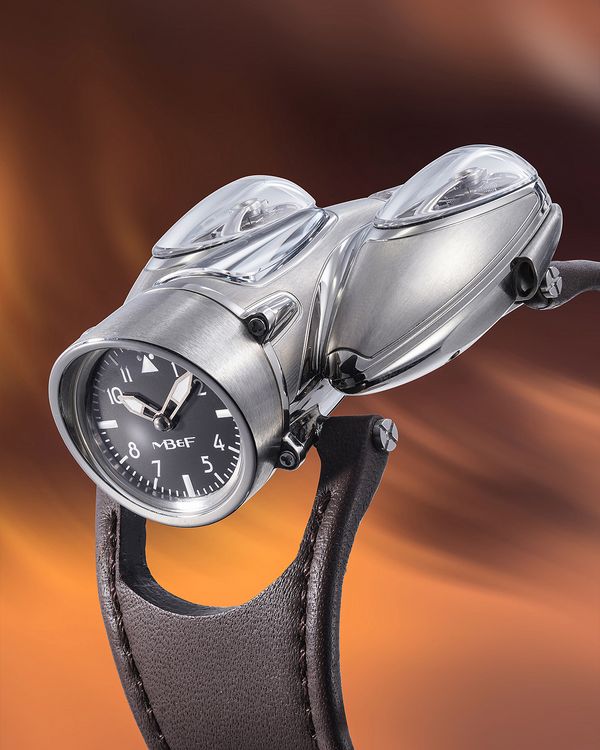
Lot 180: A 2022 MB&F Horological Machine 9 'Flow Titanium Air' that's included in the Phillips Geneva Watch Auction: XXIII. Estimate: CHF 70,000 - 140,000
Inside, the HM9 houses one of MB&F’s most technically intriguing mechanisms. Two independent balance wheels beat on either side of the watch, each regulating its own oscillation. Their rates are then combined through a central planetary differential, which averages the two signals into a single time display. The system recalls precision instruments that use multiple regulators to improve stability and accuracy.
The case construction itself represents a considerable technical achievement. Composed of multiple sapphire crystals integrated with titanium and gold components, the architecture allows the movement to be viewed from several angles while maintaining the fluid, organic shape that defines the model.
Introduced in 2018 and produced in a limited series of just 33 pieces, the HM9 Flow remains one of MB&F’s most visually dynamic creations. The “Titanium Air” configuration offered here highlights the design's lightness, allowing the mechanical architecture to appear almost suspended within its transparent shell.
Offered in excellent condition and accompanied by its full set of accessories, the watch captures MB&F’s ongoing mission to explore what a mechanical watch can become when imagination leads the engineering.
You can learn more, place a bid, and view the entire Geneva Watch Auction: XXIII catalogue right here.
About Phillips In Association With Bacs & Russo
The team of specialists at PHILLIPS Watches is dedicated to an uncompromised approach to quality, transparency, and client service. Phillips in Association with Bacs & Russo holds the world record for the most successful watch auction, with its Geneva Watch Auction: XIV having realized $74.5 million in 2021. Over the course of 2021 and 2022, the company sold 100% of the watches offered, a first in the industry, resulting in the highest annual total in history across all the auction houses at $227 million.
About Logan Baker
Logan has spent the past ten years covering the watch industry from every angle. He joined Phillips in Association with Bacs & Russo in early 2023 as Senior Editorial Manager, after previous roles at Hodinkee and WatchTime. Originally from Texas, he spent a decade in New York and now calls Geneva home.
Recommended Reading