Article | Cloisonne Enamel Dials Patek Philippe World Time 2523 South America Rolex Dragon 6085 Phillips Geneva Xxiii May 2026
The Art Of Cloisonné Enamel Dials
Cloisonné enamel has transformed watch dials into miniature works of art for more than a century. From the legendary Patek Philippe World-Time 'South America' Ref. 2523 to the Rolex 'Dragon' Ref. 6085 with a dial by Nelly Richard and contemporary masterpieces by Anita Porchet’s atelier, five remarkable timepieces in the Phillips Geneva Watch Auction: XXIII reveal the enduring artistry and technical challenge of the craft.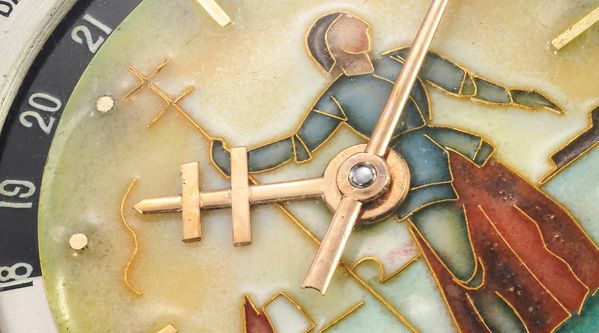
Our first live auction of 2026, the PHILLIPS Geneva Watch Auction: XXIII, takes place on 9 & 10 May, at the Hotel President, at Quai Wilson 47, in central Geneva. The auction includes more than 200 of the world's finest watches – and though we are loath to boast, we truly think it's one of the best catalogues we've ever put together. We'll be highlighting a number of the most interesting lots and stories from the sale over the next month, including the five incredible watches featuring cloisonné enamel dials featured below.
– By Logan Baker
Enamel occupies a curious place in watchmaking.
You can talk about it in romantic terms and still remain precise, because the romance grows out of strict physical limits. Powdered glass refuses shortcuts. Heat refuses compromise. Metal expands and contracts whether the artist wants it to or not. When everything works, enamel delivers something few dial materials can match. The colors never fade. The surface reads like liquid even though it has hardened into glass. Light moves through it rather than simply bouncing off it.
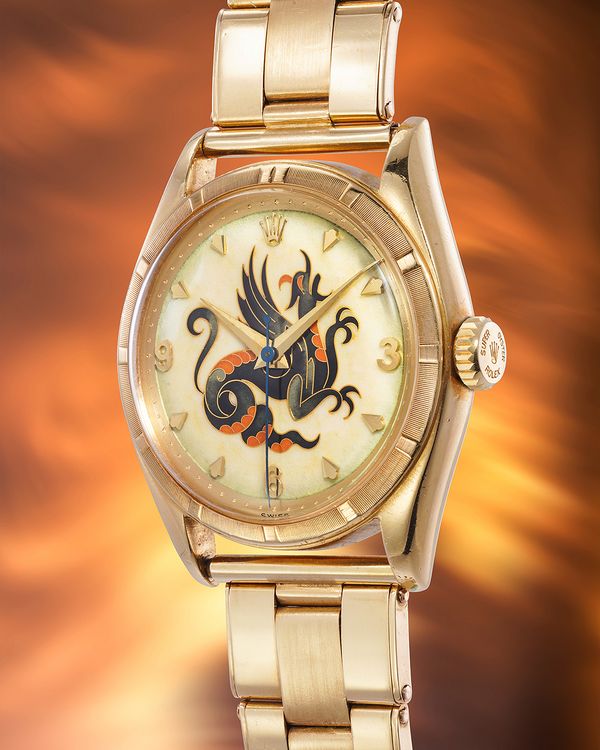
Lot 119: A 1952 Rolex 'The Dragon' Ref. 6085 in 18k yellow gold with cloisonné enamel dial by Nelly Richard, included in the Phillips Geneva Watch Auction: XXIII. Estimate: CHF 500,000 - 1,000,000
That effect begins with vitreous enamel. In simple terms, enamel is finely ground glass fused to a metal base. Silica forms the backbone. Fluxes lower the melting temperature, allowing the mixture to bond to the dial without damaging the underlying metal. Metal oxides create color. Once the powder meets the kiln, however, chemistry takes over. Pigments shift. Colors deepen. Sometimes they change entirely. What the enameller sees in the jar rarely matches what emerges after firing.
Every dial demands patience. The enamel powder is mixed with water or oil and applied in thin layers. The dial then enters a kiln, often heated to more than 800 degrees Celsius. During firing, the enamel liquefies and bonds to the metal. It shrinks as it cools. Multiple firings are required to build depth and saturation. Each trip to the kiln carries risk. The dial can crack. Air bubbles can appear. Dust can settle on the surface. Many workshops apply counter enamel to the back of the dial to balance tension and keep the blank flat through repeated heating cycles. Even with perfect preparation, rejection rates remain high. Enamel survives precisely because artisans accept failure as part of the process.

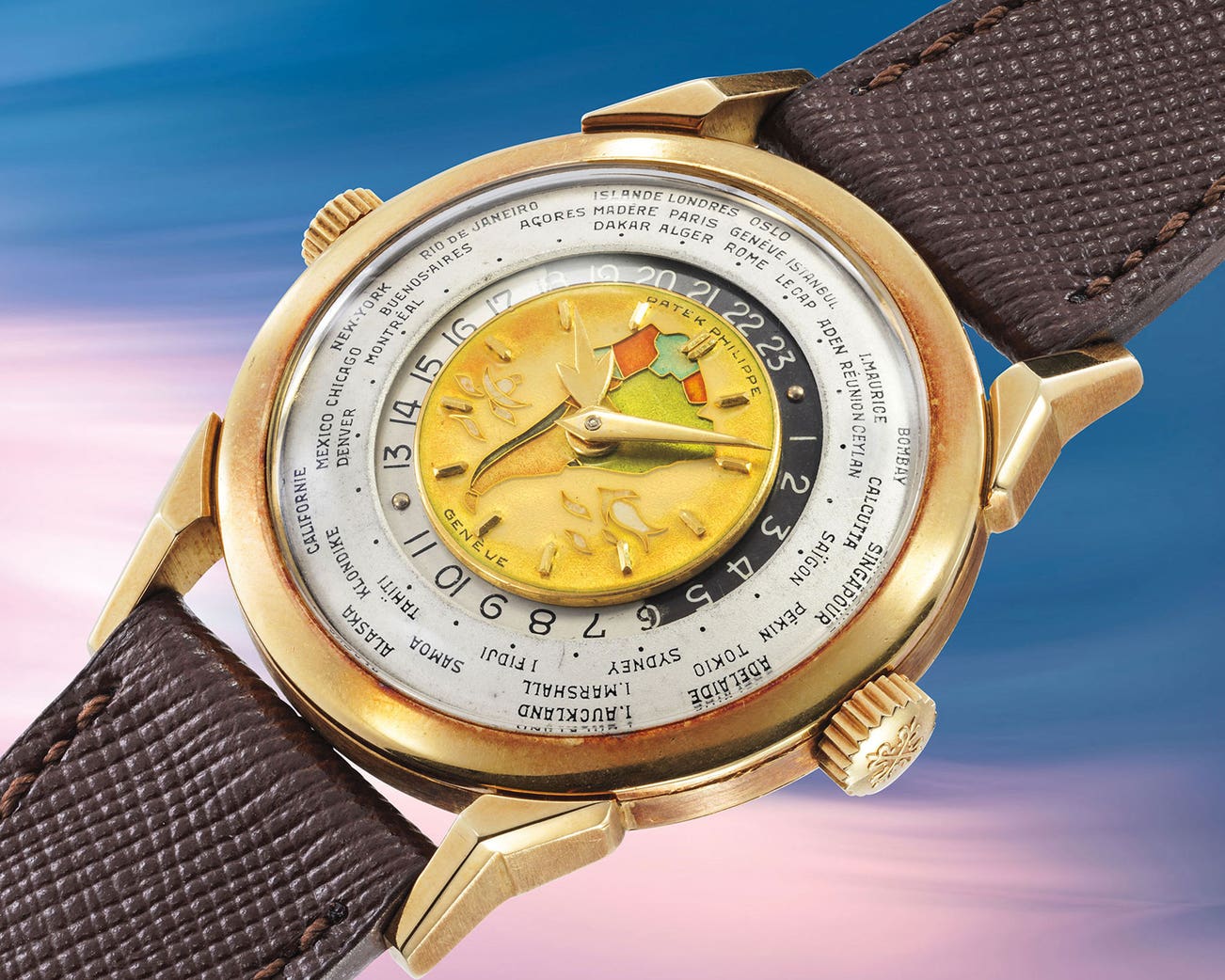
Lot 27: A 1953 Patek Philippe Two-Crown World-Time Ref. 2523 with 'South America' cloisonné enamel dial, included in the Phillips Geneva Watch Auction: XXIII. Estimate: In excess of CHF 5,000,000
Cloisonné pushes the technique further. Instead of carving recesses into the dial surface, the enameller constructs a miniature framework using hair-thin metal wires. These wires, usually gold, are bent by hand to outline the design. They are then fixed to the dial base, forming small compartments known as cloisons. Each cell receives a different color of enamel powder. The dial enters the kiln repeatedly as the enamel melts, settles, and shrinks within its boundaries.
The result looks almost like stained glass at microscopic scale. The wires keep color fields crisp and defined. They also create a graphic structure that suits certain dial layouts particularly well. World-time watches, with their tiny maps of continents and oceans, benefit enormously from the technique. Cloisonné allows geography to remain legible even within a space barely larger than a coin.
Few watches demonstrate the power of this method more convincingly than the Patek Philippe Ref. 2523 World-Time wristwatch with a cloisonné map of South America.
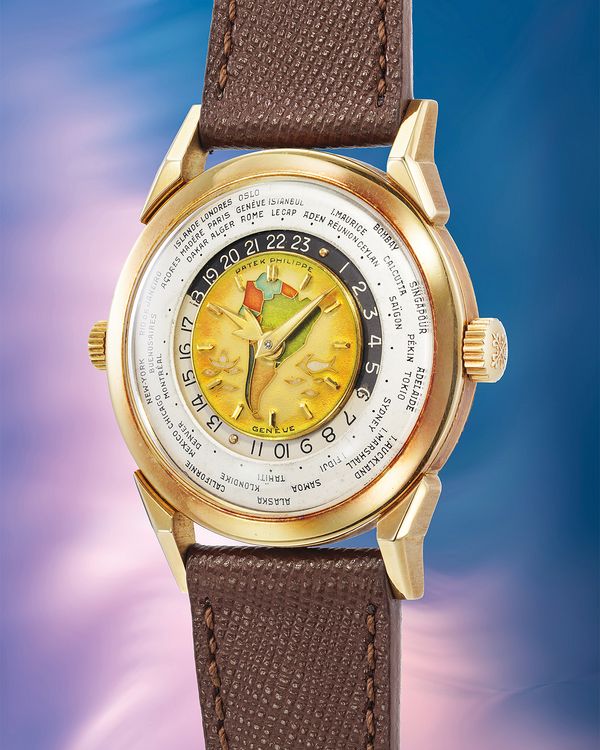
Lot 27: A 1953 Patek Philippe Two-Crown World-Time Ref. 2523 with 'South America' cloisonné enamel dial, included in the Phillips Geneva Watch Auction: XXIII. Estimate: In excess of CHF 5,000,000
Produced in 1953, the two-crown Ref. 2523 already represents one of the most refined expressions of Louis Cottier’s world-time system. The complication allows the wearer to read the time in every major city around the globe by adjusting the crown at nine o’clock, which rotates the city ring within the dial. Compared with the earlier Ref. 1415, the larger case and the internal city ring created a cleaner, more legible design.
The cloisonné versions transformed the watch into something else entirely. At the center of the dial sits a miniature enamel map, framed by the hour ring and city disc. Only three geographical motifs are known: Eurasia, North America, and South America. Each required the enameller to shape gold wires into coastlines, islands, and decorative elements before filling the cells with vibrant colors.
The South American dial stands out even within this rare group. The continent’s elongated silhouette leaves wide expanses of ocean, which the artist used to introduce small narrative details. A sailboat drifts across one side of the dial. A sea creature glides through the opposite waters. These details might seem playful, but they also demonstrate the freedom cloisonné offers when executed by a confident hand.
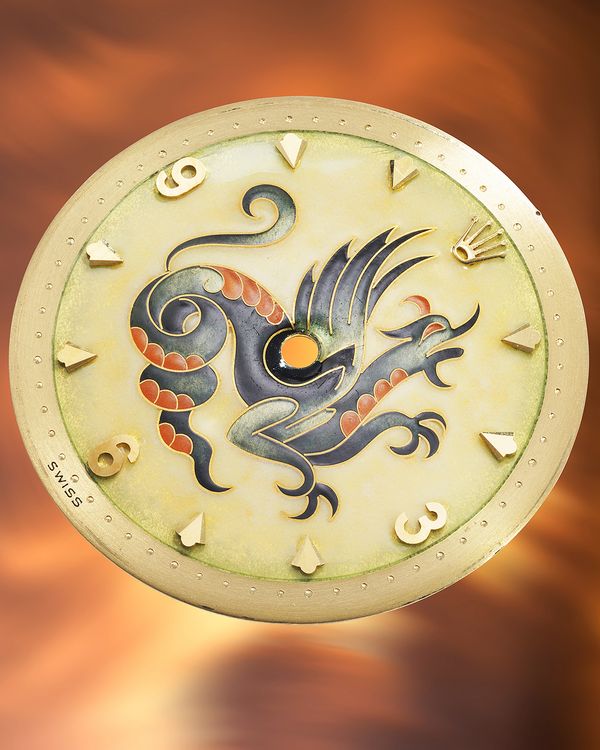
Lot 119: A 1952 Rolex 'The Dragon' Ref. 6085 in 18k yellow gold with cloisonné enamel dial by Nelly Richard, included in the Phillips Geneva Watch Auction: XXIII. Estimate: CHF 500,000 - 1,000,000
Vintage cloisonné dials possess a visual quality that collectors immediately recognize. The colors appear unusually deep. The gloss seems almost wet. Part of that effect comes from pigments that are no longer used today. Certain metal oxides once employed by enamellers have since been restricted for health and safety reasons. As a result, the palette available to contemporary artisans differs from that used in the mid-20th century.
Modern cloisonné remains impressive, but vintage examples often display a particular luminosity that feels impossible to replicate.
Rolex explored the same decorative language during the early 1950s, though far more sparingly.
The Ref. 6085, known as “The Dragon,” illustrates how the technique could transform an otherwise conventional wristwatch into a miniature work of art. At first glance, the watch resembles a classic time-only watch with a center seconds hand. The dial tells a very different story.
The dragon motif was executed by the Geneva enameller Nelly Richard, one of the most respected artisans working with famed dialmaker Stern Frères during the period. Stern produced dials for numerous Swiss brands and maintained relationships with several independent enamel painters, each contributing their own style and color sensibility.

Lot 119: A 1952 Rolex 'The Dragon' Ref. 6085 in 18k yellow gold with cloisonné enamel dial by Nelly Richard, included in the Phillips Geneva Watch Auction: XXIII. Estimate: CHF 500,000 - 1,000,000
In Richard’s hands, the dragon becomes fluid and animated, twisting across the dial in shades of green, orange, and blue. The creature’s belly transitions into a translucent iridescent tone that mimics the reflective quality of scales.
The effect depends entirely on cloisonné. Gold wires define every curve of the body and every flame-like detail of the mane. Within those narrow borders, the enamel layers build up color and shading. A dark background frames the figure, allowing the dragon to emerge vividly from the dial surface.
Only five dragon dials are known across different Rolex references, which explains why collectors place them among the most desirable decorative Rolex watches ever produced.
Cloisonné enamel was not limited to wristwatches intended for collectors or enthusiasts.
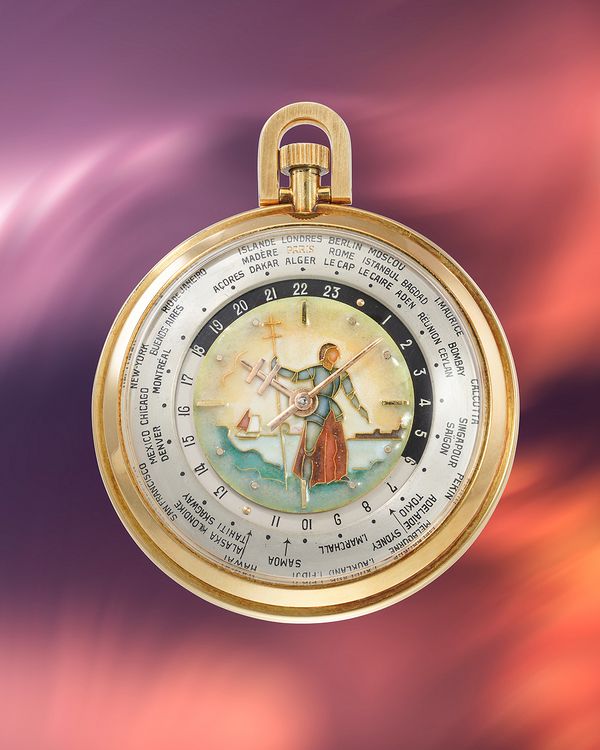
Lot 24: A1945 Agassiz Watch Co. World-Time Pocket Watch in 18k yellow gold with polychrome cloisonné enamel dial, gifted to General Charles de Gaulle, and included in the Phillips Geneva Watch Auction: XXIII. Estimate: CHF 300,000 - 600,000
The Agassiz World-Time pocket watch, created for General Charles de Gaulle in 1945, demonstrates how the craft can serve as a vehicle for symbolism and historical narrative. Produced to commemorate the Allied victory in World War II, the watch forms part of a small series of four unique pieces presented to the principal leaders of the victorious nations.
The dial of the de Gaulle pocket watch depicts Joan of Arc, the patron saint of France, planting a staff topped by the Cross of Lorraine. Ships move calmly across the horizon behind her. The image balances martial symbolism with a sense of peace returning after conflict.
Michel Deville, working for Stern Frères, executed the cloisonné enamel scene with remarkable clarity, considering the limited surface of a pocket watch dial already occupied by the world-time display.
Here, the gold wires serve a narrative purpose. They trace the outlines of the figure, the ships, and the distant shoreline, guiding the eye across the composition. Enamel colors build the scene layer by layer. Blues suggest sky and water. Subtle tones shape Joan of Arc’s clothing and armor. The finished dial operates simultaneously as a time display, a political symbol, and a historical artifact.
Cloisonné never disappeared from watchmaking, but for decades it survived largely through the efforts of a handful of specialized artisans. Today, the craft has experienced a revival, particularly within haute horlogerie. Modern masterpieces often combine traditional techniques with the complexity of contemporary watchmaking.
The Patek Philippe Sky Moon Tourbillon Ref. 6002 represents one of the most ambitious examples of this approach. Introduced in 2013 as the successor to the Ref. 5002, the watch contains 12 complications, including a minute repeater with cathedral gongs, a tourbillon, and a perpetual calendar. Yet the mechanical complications only form part of its appeal. The dial itself features cloisonné and champlevé enamel decoration integrated into an elaborate ornamental design.
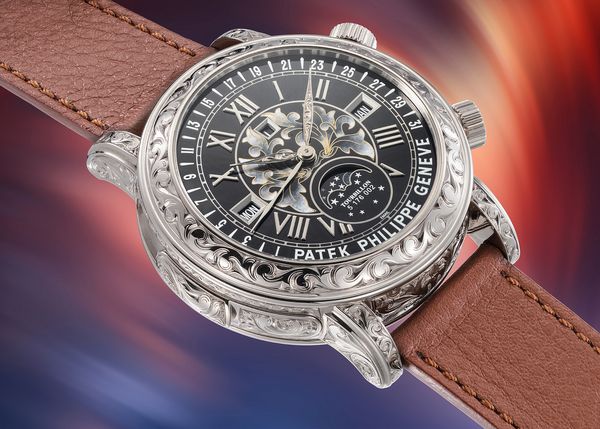
Lot 144: A 2018 Patek Philippe Sky Moon Tourbillon Ref. 6002G-010 in 18k white gold with black dial, included in the Phillips Geneva Watch Auction: XXIII. Estimate: CHF 2,000,000 - 4,000,000
On the Ref. 6002, the enamel does not depict maps or animals but rather intricate foliate motifs that echo the hand-engraved scrollwork covering the case. The wires define each tendril and leaf before enamel fills the spaces between them. It demonstrates how cloisonné can handle both pictorial storytelling and pure ornamental structure.
Contemporary cloisonné often involves collaboration with some of the most celebrated enamel artists working today. Among them, Anita Porchet stands as perhaps the most influential figure of the modern era. Her atelier has produced countless dials for major Swiss houses, blending traditional cloisonné with techniques such as miniature painting.
A recent example appears in the Patek Philippe Golden Ellipse Ref. 5738/50G-019 Rare Handcrafts “Callithrix.”

Lot 86: A 2023 Patek Philippe Golden Ellipse Rare Handcrafts 'Callithrix' Edition Ref. 5738/50G-019 in 18k white gold with cloisonné and miniature enamel dial, included in the Phillips Geneva Watch Auction: XXIII. Estimate: CHF 60,000 - 120,000
The dial depicts a small monkey perched among bamboo branches.
Gold wires outline the leaves and stems while miniature painting adds shading and texture to the animal’s fur. The composition feels almost three-dimensional despite occupying a space a little larger than a postage stamp.
Porchet’s work demonstrates how modern cloisonné differs subtly from vintage examples.
Contemporary artists often combine techniques within a single dial. Cloisonné provides structure, while miniature painting or grisaille enamel adds nuance and volume. Kiln technology and materials have improved, reducing failure rates and allowing greater precision. Yet the essential challenge remains unchanged. Each dial still requires steady hands, careful firing cycles, and a willingness to start over if the enamel cracks during the final firing.
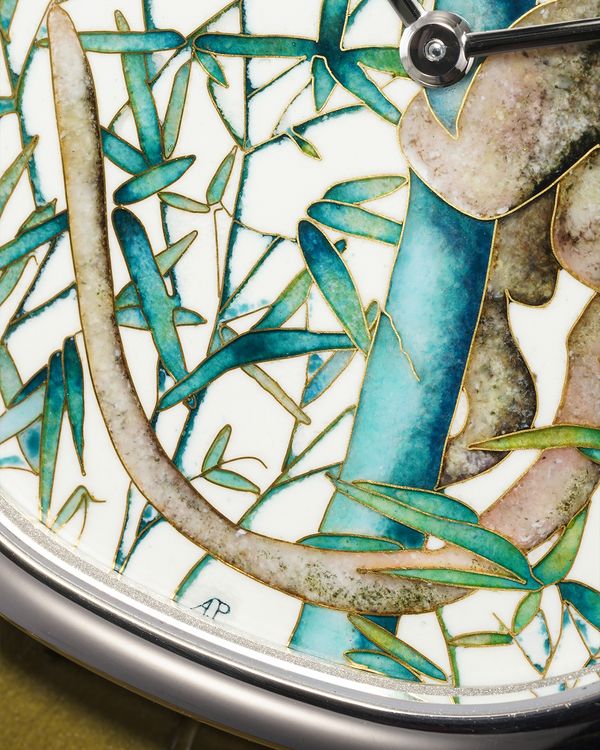
Lot 86: A 2023 Patek Philippe Golden Ellipse Rare Handcrafts 'Callithrix' Edition Ref. 5738/50G-019 in 18k white gold with cloisonné and miniature enamel dial, included in the Phillips Geneva Watch Auction: XXIII. Estimate: CHF 60,000 - 120,000
These five watches illustrate the extraordinary range of cloisonné enamel in watchmaking.
In the mid-20th century, the technique turned world-time watches into tiny cartographic masterpieces and transformed ordinary wristwatches into mythological canvases. It also commemorated historic moments, as in the "Victory Watch" honoring de Gaulle.
Today, it continues to evolve within the most complicated and artistically ambitious timepieces produced by leading watchmakers.
You can learn more, place a bid, and view the entire Geneva Watch Auction: XXIII catalogue right here.
About Phillips In Association With Bacs & Russo
The team of specialists at PHILLIPS Watches is dedicated to an uncompromised approach to quality, transparency, and client service. Phillips in Association with Bacs & Russo holds the world record for the most successful watch auction, with its Geneva Watch Auction: XIV having realized $74.5 million in 2021. Over the course of 2021 and 2022, the company sold 100% of the watches offered, a first in the industry, resulting in the highest annual total in history across all the auction houses at $227 million.
About Logan Baker
Logan has spent the past ten years covering the watch industry from every angle. He joined Phillips in Association with Bacs & Russo in early 2023 as Senior Editorial Manager, after previous roles at Hodinkee and WatchTime. Originally from Texas, he spent a decade in New York and now calls Geneva home.
Recommended Reading