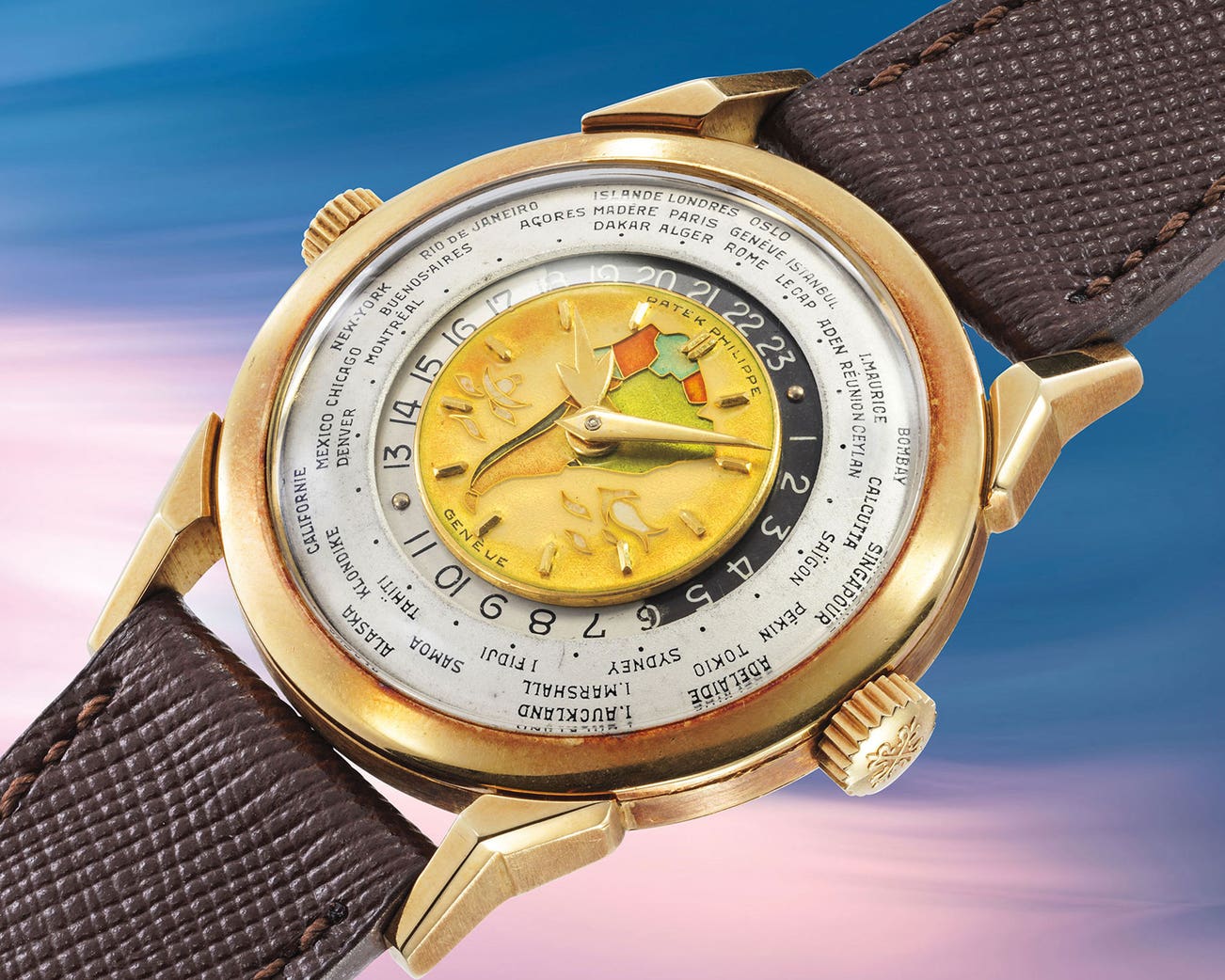
Article | Vintage Triple Calendar Wristwatches Audemars Piguet 5503 Rolex 6036 6062 Vacheron 4764 Phillips Geneva May 2026
The Golden Age of the Triple Calendar
Featuring an extraordinarily rare Audemars Piguet Ref. 5503, pristine examples of the legendary Rolex Ref. 6036 and Ref. 6062, and important watches from Vacheron Constantin and Breguet, this group of seven triple-calendar wristwatches in the Phillips Geneva Watch Auction: XXIII highlights the brilliance of the full-calendar complication during the mid-20th century and beyond.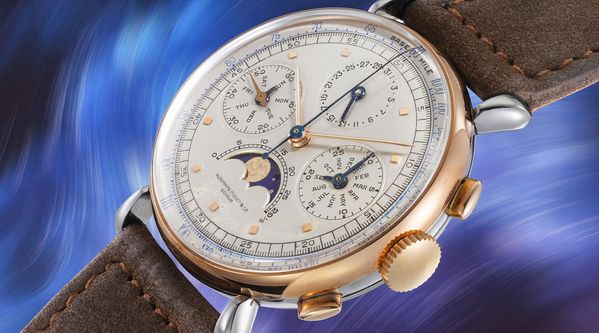
Our first live auction of 2026, the PHILLIPS Geneva Watch Auction: XXIII, takes place on 9 & 10 May, at the Hotel President, at Quai Wilson 47, in central Geneva. The auction includes more than 200 of the world's finest watches – and though we are loath to boast, we truly think it's one of the best catalogues we've ever put together. We'll be highlighting a number of the most interesting lots and stories from the sale over the next month, including the seven incredible vintage triple-calendar wristwatches featured below.
– By Logan Baker
Several complications flourished during the golden age of mid-20th-century watchmaking, but few capture collectors’ imaginations today like the triple calendar.
The display of day, date, and month, often paired with a romantic moon-phase, brought together technical ingenuity and visual richness in a way that felt unmistakably lavish. The dial becomes a stage for information, yet when executed well, it never feels cluttered. Instead, it creates a sense of balance and depth that still defines some of the most beautiful wristwatches ever produced.
The seven triple-calendar watches gathered in the Phillips Geneva Watch Auction: XXIII catalogue illustrate how differently the world’s great manufactures approached that same idea.
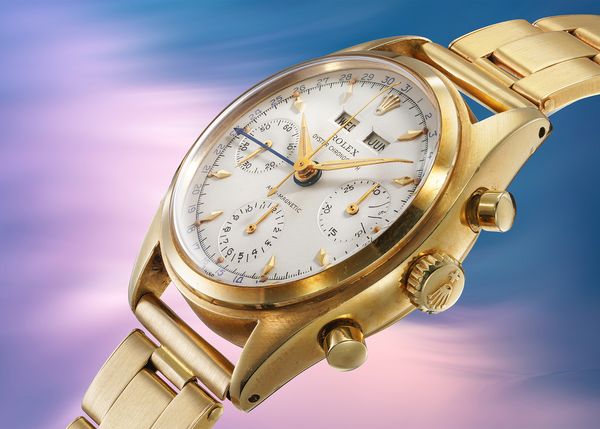
Lot 118: A circa 1955 Rolex 'Datocompax Killy' Ref. 6036 in 18k yellow gold that's included in the Phillips Geneva Watch Auction: XXIII. Estimate: CHF 500,000 - 1,000,000
From the wartime ingenuity of Audemars Piguet to Rolex’s brief but fascinating flirtation with high-end calendar complications, from Vacheron Constantin’s sculptural design language to the restrained elegance of mid-century Breguet, each example reveals a distinct interpretation of what a triple-calendar wristwatch could be.
If one piece captures the sheer rarity and mystique of vintage complicated watchmaking, it is undoubtedly the Audemars Piguet Ref. 5503 in stainless steel and 14k pink gold.
Produced between 1941 and 1943 in only five examples, these triple-calendar chronographs with moon-phase belong to a category of watches so scarce that even seasoned collectors rarely encounter them in person. Wartime restrictions on precious metals almost certainly explain this unusual two-tone material choice, resulting in a watch that is visually striking today but was likely born of necessity rather than design bravado.
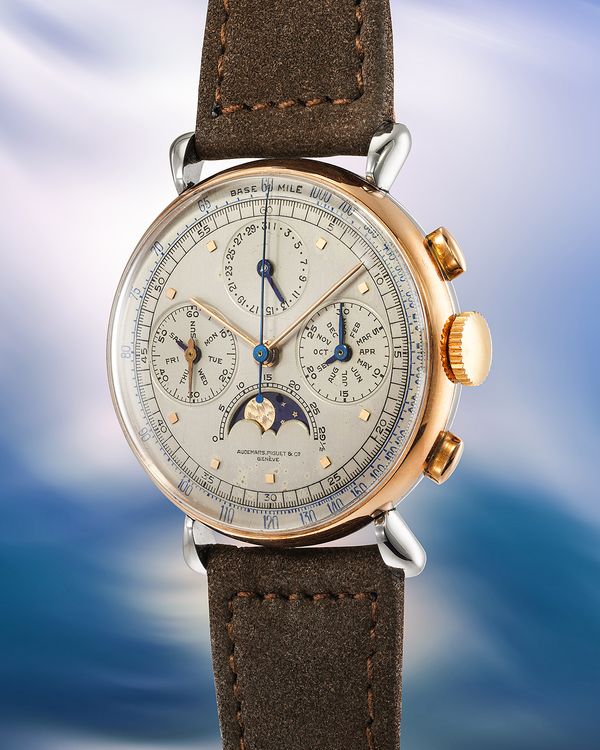
Lot 26: A 1942 Audemars Piguet Ref. 5503 in stainless steel and 14k pink gold, included in the Phillips Geneva Watch Auction: XXIII. Estimate: CHF 400,000 - 800,000
The reference itself began life as the "photograph" Ref. 1534 before being redesignated as 5503 in 1951. Inside beats the calibre 13VZAQ, built around a Valjoux chronograph base with a calendar module supplied by Alfred Aubert. Only 20 examples of this movement were produced, and they were offered in a variety of case types, sizes, dials, and metals.
The result is a watch that unites several complications that rarely coexist in vintage wristwatches: a full/triple calendar, a moon-phase display, and a chronograph. Even in the 1940s, when many brands experimented with complicated wristwatches, this combination represented a near-pinnacle of what could be achieved.
The present example, produced in 1942 and sold three years later through Audemars Piguet’s American distributor Roehrich, perfectly illustrates the model’s enduring appeal. Its 36mm case feels remarkably modern for the era, especially when paired with the thin bezel and elegant teardrop lugs that visually expand the dial opening.
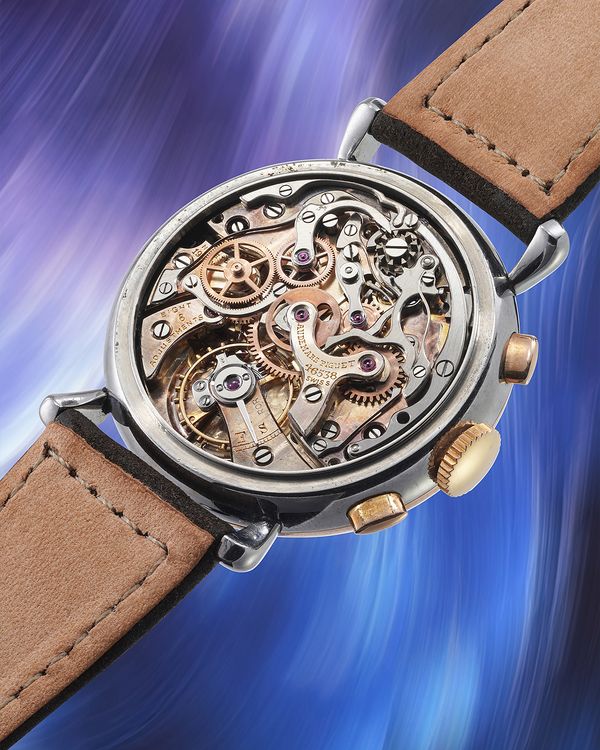
Lot 26: A 1942 Audemars Piguet Ref. 5503 in stainless steel and 14k pink gold, included in the Phillips Geneva Watch Auction: XXIII. Estimate: CHF 400,000 - 800,000
The silver Stern Frères dial, punctuated by a vivid blue tachymeter scale and large chronograph registers, gives the watch a theatrical presence that few calendars can match. Even more remarkable is that this exact watch is illustrated in the 2018 reference book, Audemars Piguet 20th Century Complicated Wristwatches, cementing its place in the historical record.
Among collectors of complicated vintage Audemars Piguet, watches like the Ref. 5503 redefine the meaning of rarity.
Rolex approached the triple calendar from a very different perspective.
During the 1940s and 1950s, the brand briefly explored complicated wristwatches that went far beyond the tool watches it would eventually become famous for.
The results are some of the most captivating watches the company has ever produced.
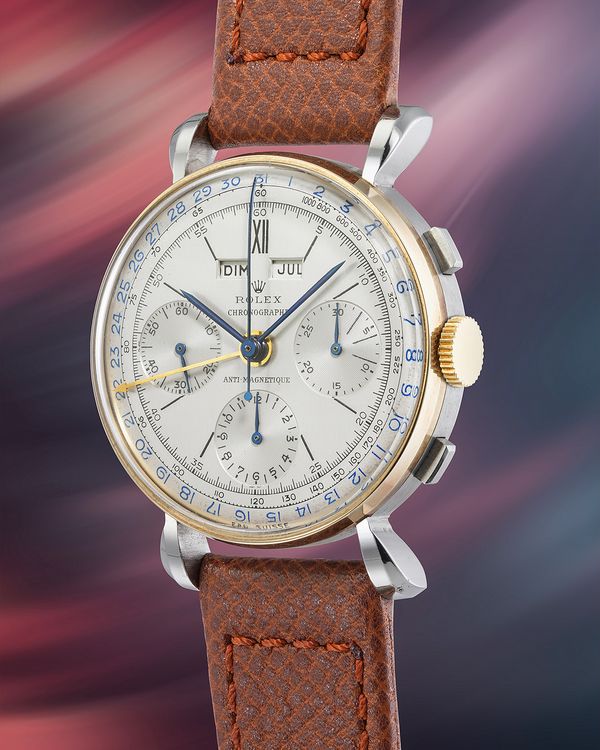
Lot 18: A 1948 Rolex 'Anti-Magnetique' Ref. 4768 in stainless steel and yellow gold that's included in the Phillips Geneva Watch Auction: XXIII. Estimate: CHF 90,000 - 180,000
The Ref. 4768 represents one of the earliest chapters of that story. Introduced in 1947 and produced in relatively small numbers, it was Rolex’s first antimagnetic triple-calendar chronograph. Unlike the later Oyster-cased models that collectors often associate with the “Dato-Compax” family, the Ref. 4768 features a non-Oyster case that emphasizes elegance rather than ruggedness. The example offered here is especially attractive in its two-tone configuration, pairing a stainless steel case with an 18k yellow gold bezel, crown, and gilt date hand.
The dial layout reflects the classic triple-calendar chronograph format that would later appear in watches like the Ref. 6036. A pair of registers anchors the chronograph display while day and month windows sit beneath the 12 o’clock marker. The central date hand, tipped with an arrow, sweeps gracefully around the outer track. Combined with elongated tear-drop lugs and a balanced silvered dial, the watch feels quintessentially mid-century in its proportions and aesthetic.
If the Ref. 4768 hints at Rolex’s ambitions in complicated watchmaking, the Ref. 6036 represents the concept in its most refined form. Introduced in 1951, the Ref. 6036 is one of only a few Rolex references to combine a chronograph with a triple calendar.
Today collectors often refer to these watches as “Killy,” after Olympic skier Jean-Claude Killy, though the Italian market historically used the term “Dato-Compax.” Technically and visually, the model stands as the apex of Rolex’s complicated vintage wristwatch production.
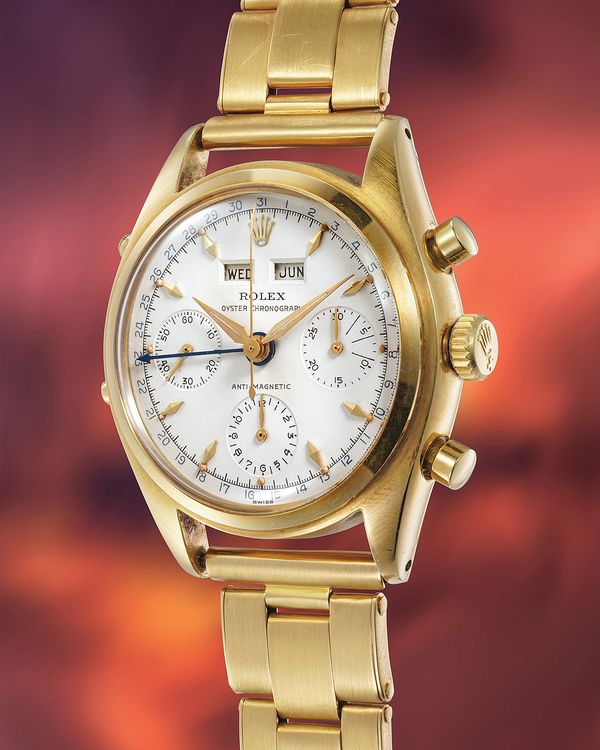
Lot 118: A circa 1955 Rolex 'Datocompax Killy' Ref. 6036 in 18k yellow gold that's included in the Phillips Geneva Watch Auction: XXIII. Estimate: CHF 500,000 - 1,000,000
In fact, across Rolex’s entire catalogue, the only modern watch with similar mechanical ambition is the Sky-Dweller, with its annual calendar and dual-time-zone display. The present example elevates the reference even further through its exceptional state of preservation. Most Ref. 6036 examples were produced in stainless steel, making this 18k yellow-gold version inherently more unusual.
Yet what truly distinguishes it is the extraordinary condition. The dial is virtually untouched, its graphics crisp, and its radium markers still perfectly formed with their characteristic sandy texture. The case retains sharp edges and unpolished surfaces, including the delicate “MODELE DEPOSÉ” engravings and rectangular motifs on the caseback that are almost always lost through polishing.
Condition often determines desirability, and watches like this represent the benchmark against which all others are measured.
While the Ref. 6036 embodies Rolex’s chronograph-driven approach to the complicated calendar, the Ref. 6062 explores a different path altogether.
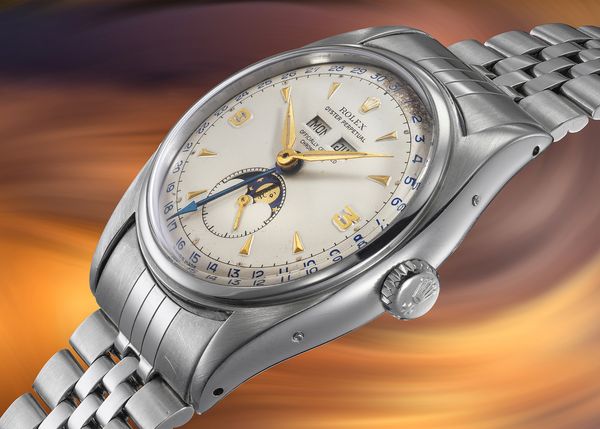
Lot 88: A circa 1953 Rolex Ref. 6062 in stainless steel that's included in the Phillips Geneva Watch Auction: XXIII. Estimate: CHF 500,000 - 1,000,000
Introduced at the Basel Fair in 1950, the Ref. 6062 paired a triple calendar with a moon-phase display inside the brand’s waterproof Oyster case. In doing so, Rolex created something genuinely unprecedented: the first automatic wristwatch combining a full/triple-calendar and moon-phase within a waterproof case. The reference exists alongside its sibling, the snap-back Ref. 8171, but the Ref. 6062 stands apart thanks to its Oyster construction.
Produced in stainless steel as well as 18k yellow and 18k pink gold, the model remains one of the most celebrated complicated Rolex watches ever made.
Stainless steel examples, like the present watch, hold a particular fascination. Because steel watches were typically purchased for everyday use, many surviving examples were worn extensively or polished heavily over the decades. Finding one preserved with sharp case proportions and a well-preserved dial is therefore extremely rare.
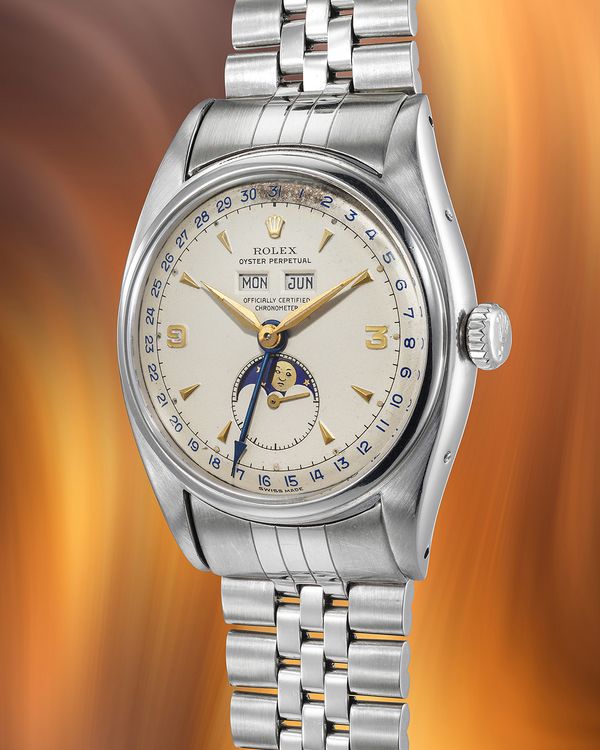
Lot 88: A circa 1953 Rolex Ref. 6062 in stainless steel that's included in the Phillips Geneva Watch Auction: XXIII. Estimate: CHF 500,000 - 1,000,000
This example reveals numerous hallmarks of originality, from its two-tone dial with ivory grené outer ring to the inky blue printing and distinctive open “6” and “9” numerals. The angled day and date apertures and crisp moon-phase display further reinforce the sense that this watch has survived remarkably intact.
Together with its beautifully preserved Jubilee bracelet, it stands as one of the most compelling examples of the reference to appear in recent years.
Moving away from chronographs and Oyster cases, Vacheron Constantin tackled the triple calendar with a focus on design.
The Ref. 4764 “Cioccolatone” illustrates how dramatically different the complication can appear when paired with bold case architecture.
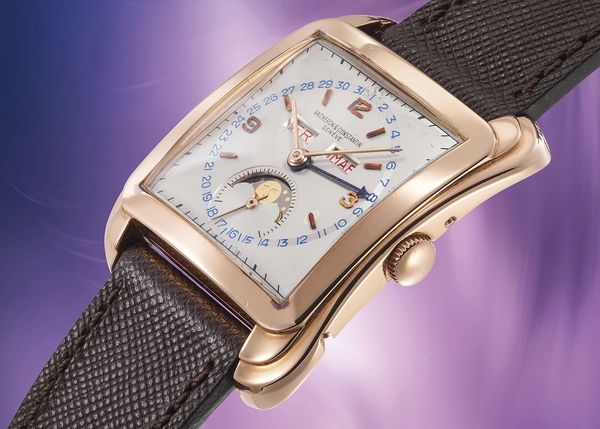
Lot 225: A 1958 Vacheron Constantin 'Cioccolatone' in 18k pink gold that's included in the Phillips Geneva Watch Auction: XXIII. Estimate: CHF 250,000 - 500,000
Introduced during the early 1950s, the Cioccolatone took its nickname from the Italian word for a square piece of chocolate, an affectionate reference to the watch’s large, square case with rounded edges. The design reflects the optimism and creative experimentation of the postwar period. With its stepped lugs, curved surfaces, and oversized proportions, the case feels almost sculptural.
Within that distinctive frame, Vacheron Constantin installed a full/triple-calendar with moon-phase, turning an already striking watch into the most complicated expression of the Cioccolatone concept.
Only 47 examples of the Ref. 4764 were produced in either 18k yellow or 18k pink gold, with the 18k pink-gold pieces being considerably rarer. The present watch, preserved in extraordinary condition, captures the full drama of the design.
Meanwhile, Breguet’s vintage interpretation of the triple calendar moves in the opposite direction.
Produced in extremely limited numbers in the mid-20th century, Breguet dress watches from this period are highly sought after by collectors. The present example from 1963 features the classic arrangement of day and month apertures paired with a moon-phase display and central date hand.
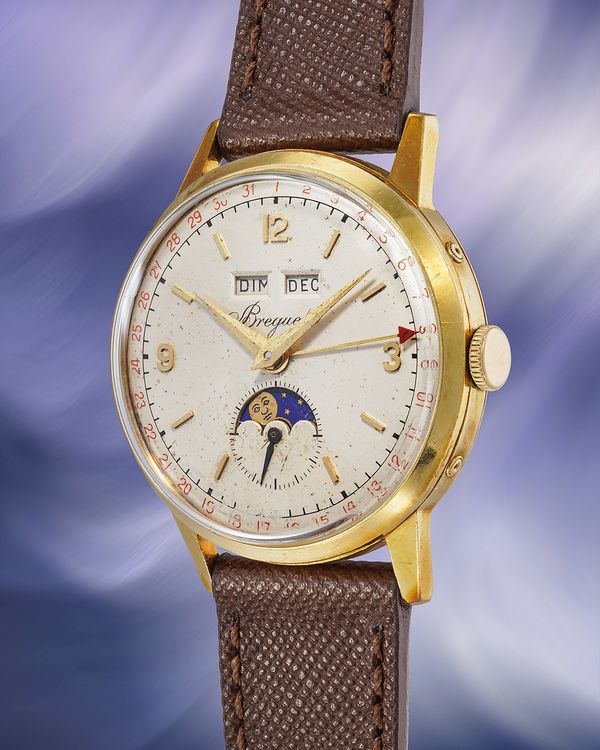
Lot 90: A 1963 Breguet Triple-Calendar in 18k yellow gold that's included in the Phillips Geneva Watch Auction: XXIII. Estimate: CHF 70,000 - 140,000
The restrained 35mm case and balanced dial layout embody the refined aesthetic long associated with the Breguet name. Yet its rarity is equally compelling. During this period, the firm devoted much of its production to mil-spec Type 20 flyback chronographs, leaving only a handful of complicated civilian wristwatches produced each year.
Surviving examples, especially those preserved in original condition with documentation, such as the present watch, offer a rare glimpse into a chapter of Breguet’s history that remains relatively underexplored.
The final watch in this group brings the story forward into the modern era. Vacheron Constantin’s Historiques Toledo 1952 Ref. 47650 draws direct inspiration from the original Cioccolatone watches of the 1950s, reviving their curved-square case and triple-calendar layout.
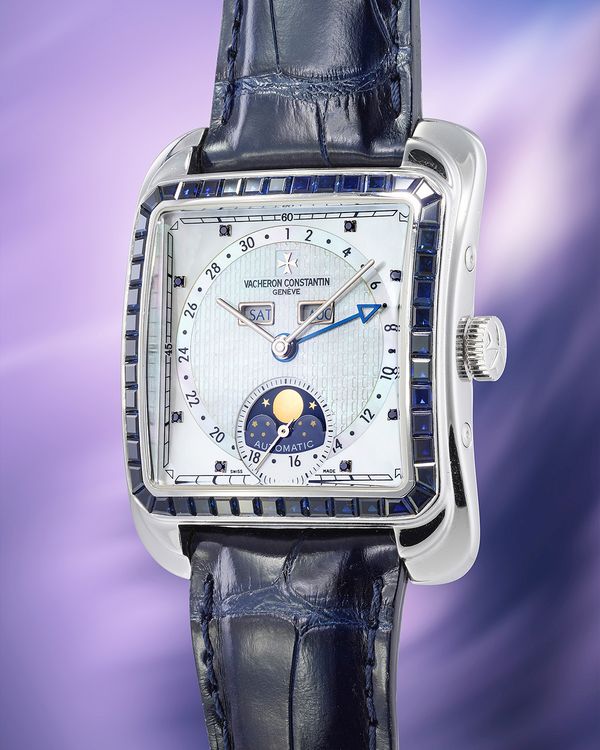
Lot 175: A 2006 Vacheron Constantin Historiques Toledo 1952 Ref. 47650 in 18k white gold with mother-of-pearl dial and sapphire-set bezel, included in the Phillips Geneva Watch Auction: XXIII. Estimate: CHF 30,000 - 60,000
Yet the execution here is unmistakably contemporary. A sapphire-set bezel frames a guilloché mother-of-pearl dial, also set with sapphires, creating an opulent interpretation of the classic design. Produced as an off-catalogue piece in extremely small numbers, it demonstrates how the vintage triple-calendar's visual language can still inspire creative interpretations today.
These seven watches demonstrate how a single complication can inspire dramatically different approaches.
The Audemars Piguet Ref. 5503 embodies the rarity and technical ambition of wartime complicated watchmaking. Rolex’s Ref. 4768, 6036, and 6062 show a brand briefly exploring mechanical complexity before turning toward the tool-watch identity that would define its later history.
Vacheron Constantin’s Cioccolatone transforms the calendar into a statement of mid-century design, while Breguet offers a quieter expression rooted in classical elegance. Even the modern Toledo reminds us that the fascination with triple calendars has never entirely disappeared.
The diversity is precisely the point.
Each of these watches tells a slightly different story about how time, information, and design can coexist on the wrist. And when seen simultaneously, they form a remarkable portrait of one of watchmaking’s most enduring and beautiful complications.
You can learn more, place a bid, and view the entire Geneva Watch Auction: XXIII catalogue right here.
About Phillips In Association With Bacs & Russo
The team of specialists at PHILLIPS Watches is dedicated to an uncompromised approach to quality, transparency, and client service. Phillips in Association with Bacs & Russo holds the world record for the most successful watch auction, with its Geneva Watch Auction: XIV having realized $74.5 million in 2021. Over the course of 2021 and 2022, the company sold 100% of the watches offered, a first in the industry, resulting in the highest annual total in history across all the auction houses at $227 million.
About Logan Baker
Logan has spent the past ten years covering the watch industry from every angle. He joined Phillips in Association with Bacs & Russo in early 2023 as Senior Editorial Manager, after previous roles at Hodinkee and WatchTime. Originally from Texas, he spent a decade in New York and now calls Geneva home.
Recommended Reading