Article | Urban Jurgensen Ref 6 Tonneau Lapis And Ref 2 Prototype Phillips Geneva Watch Auction Xxiii May 2026
A Pair of Urban Jürgensen Prototypes, Revealed
Two exceptionally rare watches from the Baumberger-Pratt period, including a prototype Ref. 2 Perpetual Calendar and one of the only known examples of the elusive tonneau-shaped Ref. 6.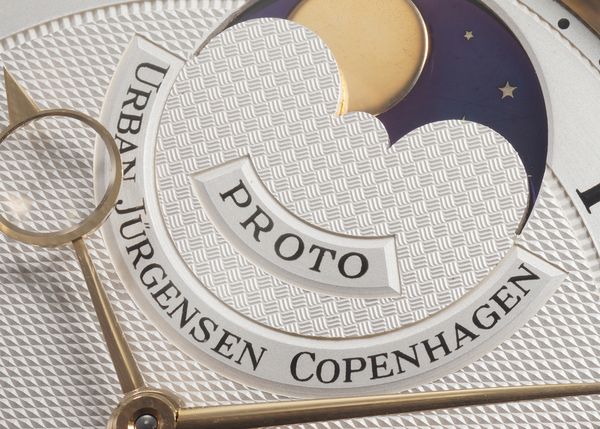
Our first live auction of 2026, the PHILLIPS Geneva Watch Auction: XXIII, takes place on 9 & 10 May, at the Hotel President, at Quai Wilson 47, in central Geneva. The auction includes more than 200 of the world's finest watches – and though we are loath to boast, we truly think it's one of the best catalogues we've ever put together. We'll be highlighting a number of the most interesting lots and stories from the sale over the next month, including the two Urban Jürgensen prototypes featured below.
– By Logan Baker
There are watches that define a brand’s public identity, and then there are watches that exist in the margins of its history.
These are the pieces that appear only briefly in catalogues, survive in tiny numbers, and are known mainly through passing references in old articles or the recollections of collectors who once encountered them decades ago.
Urban Jürgensen’s Ref. 6 sits squarely in this second category.
For many years, it has been a watch that collectors have spoken about more than they have actually seen. The present example, offered publicly for the first time, finally allows collectors to study one of the most elusive experiments of the Peter Baumberger era.
At first glance, the Ref. 6 stands apart from almost everything Urban Jürgensen produced during the late 20th century. The brand’s revival under Baumberger and Derek Pratt became closely associated with the classical language of Swiss watchmaking: rounded cases with delicate teardrop lugs, hand-guilloché dials, and the distinctive Observatoire-style hands that would become one of the firm’s visual signatures.
The Ref. 6 moves in a completely different direction.
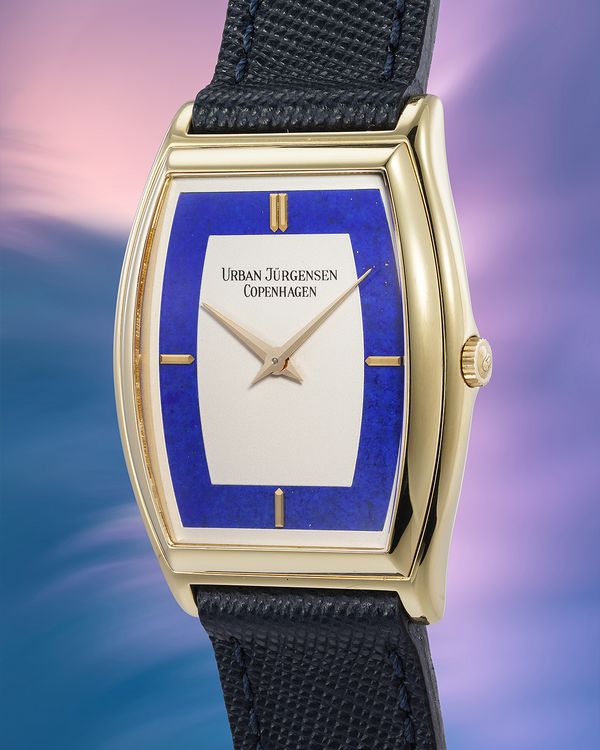
Lot 34: A circa 1990 Urban Jürgensen Reference 6 in 18k yellow gold with lapis lazuli dial that is included in the Phillips Geneva Watch Auction: XXIII. Estimate: CHF 40,000 - 80,000
Instead of the familiar round architecture, it adopts a tonneau-shaped case whose proportions stretch gently across the wrist. The bezel is widest at three and nine o’clock before tapering inward, creating a soft, organic profile that retains the pebble-like character typical of Urban Jürgensen cases while abandoning the traditional lug structure entirely. The lugs flow directly from the midcase in a continuous curve, giving the watch a sculptural quality that feels surprisingly modern for its time.
The departure from convention continues on the dial. Most watches from this period rely on classical guilloché patterns and the restrained palette that collectors now associate with the Baumberger-Pratt collaboration. Here, however, the dial is cut from lapis lazuli, its deep blue surface flecked with natural mineral inclusions that shimmer subtly as the watch moves in the light.
Stone dials were occasionally explored by Urban Jürgensen during this period, but they remain extremely unusual and, within an already scarce reference, become rarer still. Combined with the clean sword-shaped hands, which replace the familiar Observatoire style, the result is a watch that feels almost experimental. It preserves the brand’s devotion to refined finishing while testing the boundaries of its own design language.
If the exterior suggests experimentation, the movement inside reinforces that impression.
The Ref. 6 is the only Urban Jürgensen model from this era known to use a manual-wind movement rather than the automatic calibres that powered most of the brand’s production during the 1980s and 1990s.
The movement is based on a Frédéric Piguet calibre, either the 8.10 or the closely related 8.16, depending on whether the watch features subsidiary seconds. Measuring just two millimeters in height and beating at 21,600 vph, it reflects the thin, elegant watchmaking for which Frédéric Piguet supplied many of the finest houses of the period.
Urban Jürgensen finished the movement to a standard consistent with the brand’s philosophy, adding Geneva stripes across the bridges, perlage across the baseplate, and carefully executed anglage along the edges. Gold engravings on the bridge record the brand name, origin, jewel count, and total adjustment in five positions.
Despite these qualities, the Ref. 6 never gained commercial traction. Contemporary accounts suggest that very few examples were ever sold. Dr. Helmut Crott once recalled being told by the brand’s sales director that perhaps only one or two pieces had been delivered.
Even today, the Ref. 6 remains barely documented, with most scholarship relying on scattered mentions and appearances in catalogues and collector conversations. In hindsight, the watch represents a brief moment when Urban Jürgensen attempted to broaden its aesthetic vocabulary beyond the highly classical designs that defined its renaissance.
Seen in that light, the Ref. 6 becomes a fascinating counterpoint within the brand’s history.
Baumberger’s vision for Urban Jürgensen centered on a revival of 19th-century craftsmanship interpreted through modern watchmaking. Yet even the most disciplined visions allow room for experimentation. The Ref. 6 reflects a willingness to explore new forms while maintaining the finishing and attention to detail that collectors expected from the brand.
Its rarity today suggests that the experiment remained short-lived, but the watch itself stands as evidence of a period when Urban Jürgensen briefly stepped outside its comfort zone.
If the Ref. 6 represents the outer edge of Baumberger and Pratt’s design language, the Ref. 2 sits firmly at its center.
Introduced in 1986, the model played a decisive role in establishing the reborn Urban Jürgensen's identity. The watch emerged at a time when traditional Swiss watchmaking was recovering from the Quartz Revolution, and many brands sought to reaffirm their relevance through complicated mechanical watches produced in limited numbers.
Urban Jürgensen’s answer was a perpetual calendar of striking refinement that balanced technical sophistication with the artisanal dialwork for which the brand quickly became known.
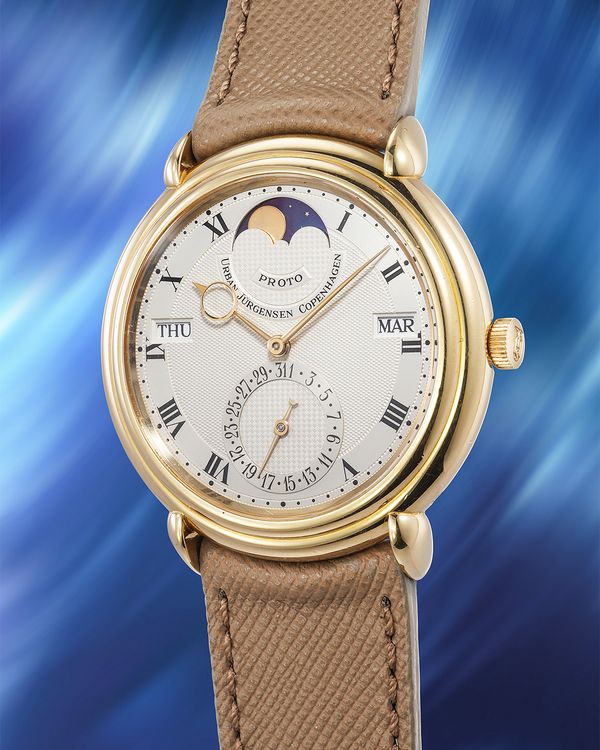
Lot 146: A 1996 Urban Jürgensen Reference 2 'Prototype' in 18k yellow gold that is included in the Phillips Geneva Watch Auction: XXIII. Estimate: CHF 40,000 - 80,000
The architecture of the Ref. 2 already displays the elements that collectors now associate with the Baumberger-Pratt era. The 38mm case is modestly sized yet elegant, with a stepped bezel and gently curved profile that sits comfortably on the wrist. The teardrop lugs, though small, give the case its characteristic grace and would appear on several subsequent references.
Inside beats the ultra-thin Frédéric Piguet calibre 71, fitted with a Lemania-developed perpetual calendar module. Measuring just 2.4mm in thickness, the movement allowed the entire watch to remain remarkably slim while still offering the full perpetual calendar display with moon-phase.
Crafted from solid silver and hand-decorated, the dial combines multiple textures in a composition that is both symmetrical and visually engaging. A brushed chapter ring with Roman numerals surrounds a clous-de-Paris center executed on a traditional engine-turning lathe. The subsidiary registers carry a basketweave pattern, while the moon-phase disc features hand-inlaid gold stars against a polished steel sky.
The Observatoire hour hand, introduced with this reference, would become one of Urban Jürgensen’s most recognizable design features. Its distinctive circular aperture and sharply pointed tip embody the brand’s careful blend of technical precision and aesthetic refinement.
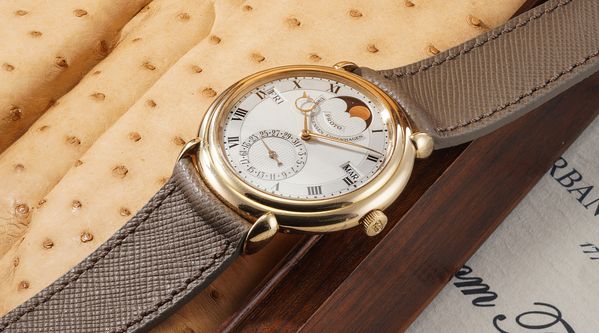
Lot 146: A 1996 Urban Jürgensen Reference 2 'Prototype' in 18k yellow gold that is included in the Phillips Geneva Watch Auction: XXIII. Estimate: CHF 40,000 - 80,000
The example offered here takes that foundation and adds another layer of intrigue.
The dial is marked “PROTO” in place of the serial number, and the movement carries the unusual number "000000," strongly suggesting that the watch served as a prototype during the initial development of the reference.
Urban Jürgensen’s archives confirm the designation, and to the best of our knowledge, this 18k yellow gold prototype is unique.
While the production Ref. 2 itself was made in relatively small numbers, prototypes from the development stage are almost never encountered. They offer a rare glimpse into the process through which Baumberger and Pratt refined the watch that would ultimately define the brand’s modern identity.
Placed side by side, the Ref. 6 and the prototype Ref. 2 illustrate two very different aspects of Urban Jürgensen’s rebirth.
One represents the brand’s classical core philosophy, executed with extraordinary care and destined to become a cornerstone of its legacy. The other reflects a moment of experimentation, when the company briefly explored new forms and materials in search of a broader audience.
You can learn more, place a bid, and view the entire Geneva Watch Auction: XXIII catalogue right here.
About Phillips In Association With Bacs & Russo
The team of specialists at PHILLIPS Watches is dedicated to an uncompromised approach to quality, transparency, and client service. Phillips in Association with Bacs & Russo holds the world record for the most successful watch auction, with its Geneva Watch Auction: XIV having realized $74.5 million in 2021. Over the course of 2021 and 2022, the company sold 100% of the watches offered, a first in the industry, resulting in the highest annual total in history across all the auction houses at $227 million.
About Logan Baker
Logan has spent the past ten years covering the watch industry from every angle. He joined Phillips in Association with Bacs & Russo in early 2023 as Senior Editorial Manager, after previous roles at Hodinkee and WatchTime. Originally from Texas, he spent a decade in New York and now calls Geneva home.
Recommended Reading
Celebrating 250 Years of Urban Jürgensen: A Video Series