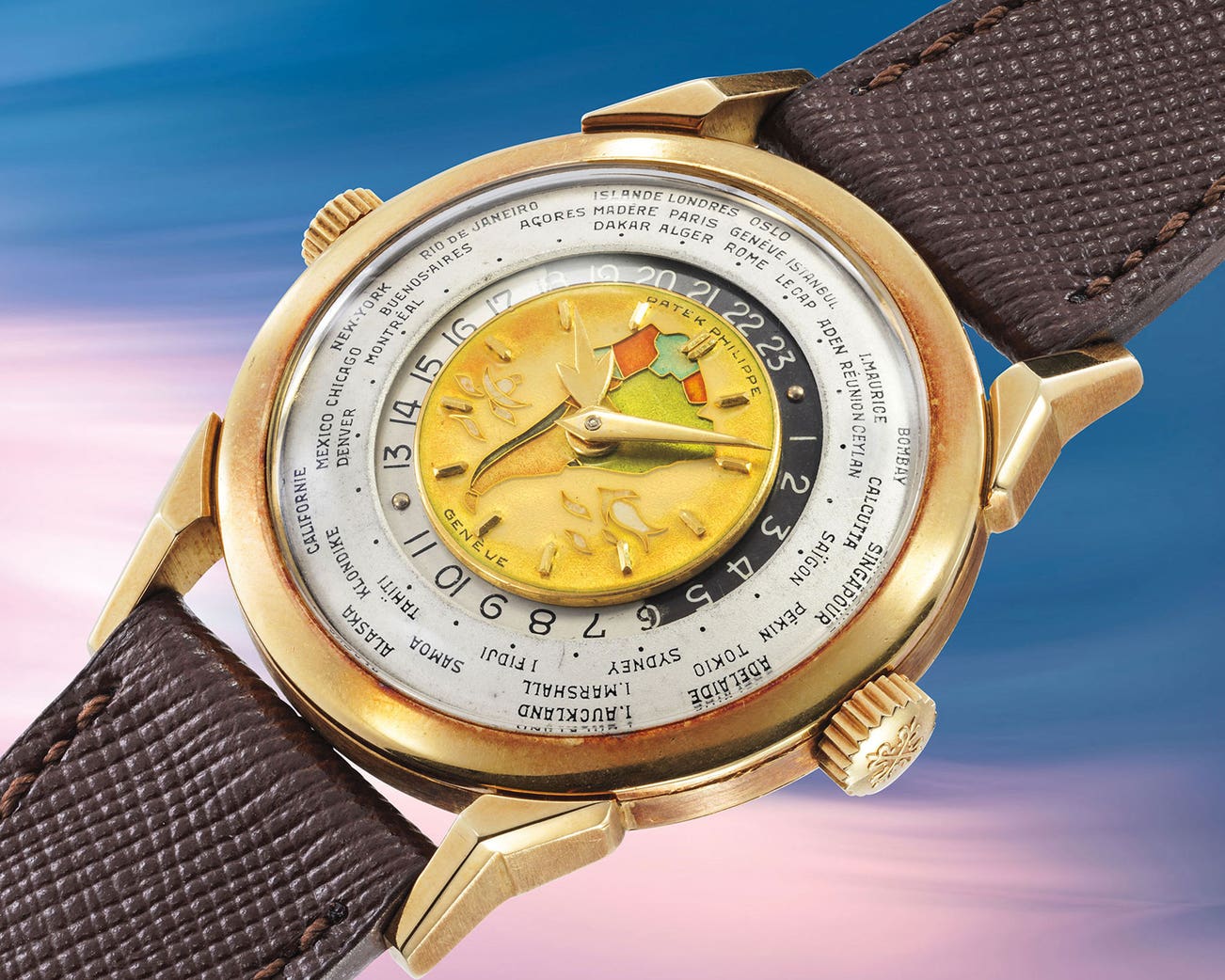
Article | Patek Philippe Nautilus Guide History 50th Anniversary 5711 Tiffany 3700 5726 Phillips Auction
From Porthole to Pop Culture: The Patek Philippe Nautilus Story
The Nautilus started as a risky steel statement. Fifty years later, it stands as a case study in design, restraint, and cultural momentum.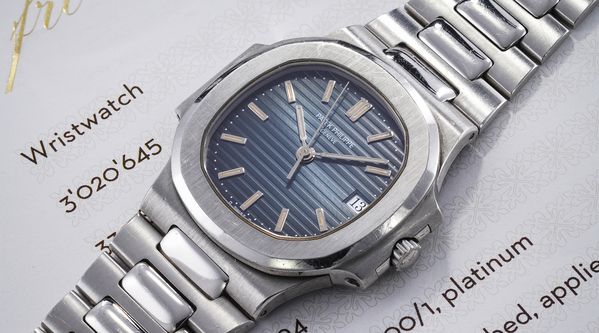
Our first live auction of 2026, the PHILLIPS Geneva Watch Auction: XXIII, takes place on 9 & 10 May, at the Hotel President, at Quai Wilson 47, in central Geneva. The auction includes more than 200 of the world's finest watches – and though we are loath to boast, we truly think it's one of the best catalogues we've ever put together. We'll be highlighting a number of the most interesting lots and stories from the sale over the next month, including a selection of Patek Philippe Nautilus timepieces, featured below.
– By Logan Baker
The Nautilus is one of the few modern watches that reads like a whole genre, not just a single collection.
When Patek Philippe launched it in 1976, the idea of a high-priced steel watch from a house known for precious-metal dress watches still sounded like a dare. Fifty years later, in 2026, it looks less like a dare and more like destiny – something only the very best designs achieve.
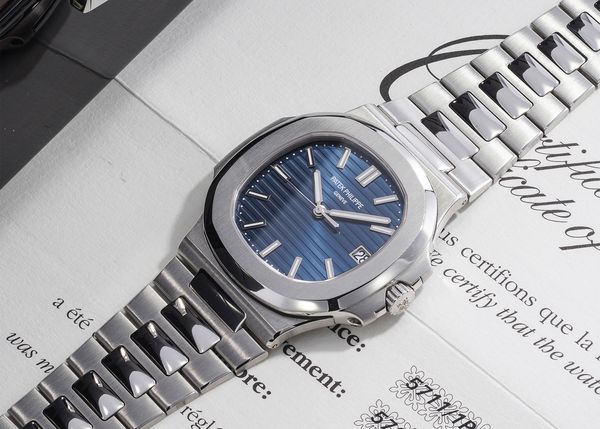
Lot 169: A 2013 Patek Philippe Nautilus Ref. 5711/1P-010 in platinum that's included in the Phillips Geneva Watch Auction: XXIII. Estimate: CHF 200,000 - 400,000
To understand why the Nautilus landed the way it did, you must remember the market it entered. In the 1950s and 1960s, mechanical watches hit a creative stride. Brands built purpose-driven tool watches that felt new and credible because they were. Divers got the Submariner-type template; racing got chronographs that leaned into legibility and robustness; aviation got pilot watches that prioritized clarity; and space travel put the Speedmaster on the map. Steel had a role, but in the classic luxury hierarchy, it sat below gold. Steel often meant practical, affordable, or strictly functional.
Then the Quartz Revolution detonated the old assumptions. Seiko’s Astron arrived in 1969 and helped kick off a decade where the average buyer learned to equate “better” with cheaper and more accurate. Mechanical watchmaking did not die, but it lost its default argument. Swiss brands that wanted to survive at the top had to sell something quartz could not easily copy. Not just accuracy, but craft, finish, and a kind of cultural status that turned a watch into an object you desired for reasons that had nothing to do with timekeeping.
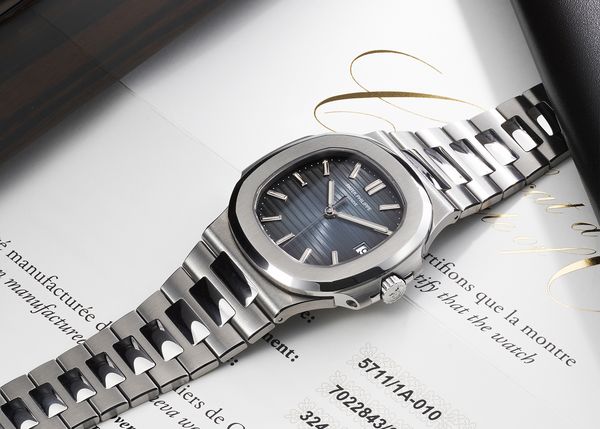
Lot 120: A 2016 Patek Philippe Nautilus Ref. 5711/1A-010 in stainless steel that's included in the Phillips Geneva Watch Auction: XXIII. Estimate: CHF 40,000 - 80,000
Audemars Piguet, in 1972, fired the shot that changed the category. The Royal Oak proved you could take a steel watch, finish it like haute horlogerie, price it like a gold dress watch, and present it as a modern luxury object. Patek Philippe could not ignore that shift. It needed its own steel statement, one that still felt like Patek. The Nautilus became that statement.
You cannot tell the Nautilus story without Gérald Genta. He defined the silhouette that still anchors the entire luxury sport-watch idea: strong geometry softened by ergonomic curves, a case that feels integrated with the bracelet instead of perched on top of it, and finishing that makes steel behave like something precious. Genta’s mythology includes the famous “drawn in minutes” origin story, sparked by the sight of a ship’s porthole while he sat in a hotel restaurant.
Whether the sketch took five minutes or fifty, the key point is simpler: the Nautilus has a single, clear metaphor, and it never tried to hide it.
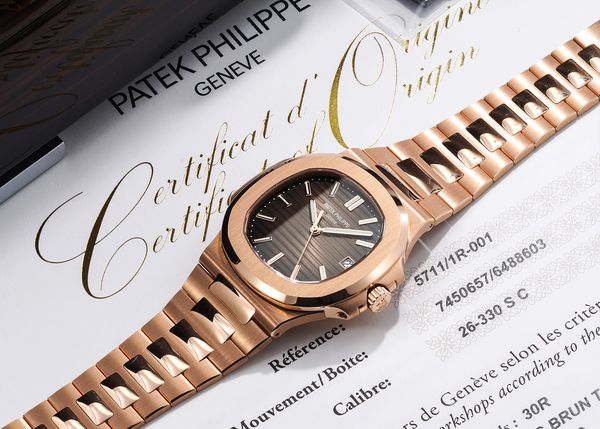
Lot 79: A 2021 Patek Philippe Nautilus Ref. 5711/1R-001 in 18k pink gold that's included in the Phillips Geneva Watch Auction: XXIII. Estimate: CHF 90,000 - 180,000
The first Nautilus, the Ref. 3700, still feels like the purest expression of the idea. Collectors call it the “Jumbo,” and the nickname matters because scale was part of the provocation. The case measured roughly 42mm across the “ears,” and it wore large for its era while staying remarkably thin. The construction also signaled intent. The early case used a monobloc-style architecture, with the movement inserted from the dial side, and a bezel assembly that sealed down against a gasket. The watch offered meaningful water resistance for a luxury piece, and it did so with engineering. You had a watch that looked elegant, wore slim, and still behaved like a sport watch.
The Nautilus case design also solved a styling problem that many later luxury sport watches still wrestle with. The Royal Oak is an octagon. The Nautilus suggests an octagon, but rounds the edges and softens the whole profile, so the watch reads less like a piece of industrial design and more like an object that belongs on a wrist. The “ears” are the visual signature. They call back to porthole hinges and also make the case feel protected, almost like the bezel is clamped in place. You can recognize a Nautilus from across a room because the profile is so specific.
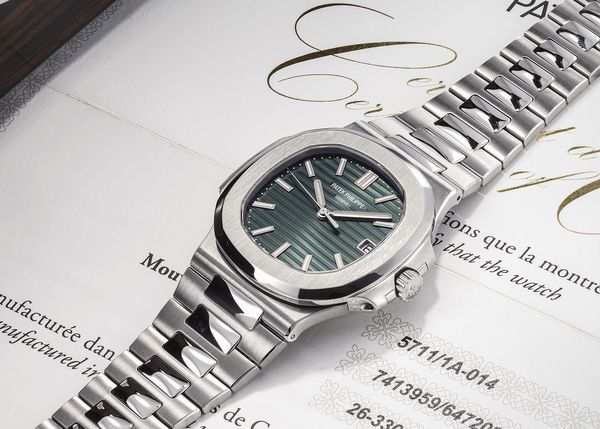
Lot 53: A 2021 Patek Philippe Nautilus Ref. 5711/1A-014 in stainless steel with green dial that's included in the Phillips Geneva Watch Auction: XXIII. Estimate: CHF 100,000 - 200,000
Then there is the dial, which might be the most influential part of the whole formula. The horizontal embossing pulls the design to the side, visually widening the watch and making the dial feel like part of the case architecture. Early 3700 dials range today from near black to warm charcoal to that elusive blue-grey tone you see described in auction catalogues, because age, exposure, and production variation all play a role. The essential effect remains the same: a dark field that catches light like water. Simple applied markers and straightforward hands keep the watch calm.
Under the dial, the earliest Nautilus used the ultra-thin Jaeger-LeCoultre-based calibre that Patek designated 28-255 C. That movement family sits at the center of the 1970s luxury sport-watch story for a reason. It delivered a thin automatic base that made “sport watch” proportions possible without turning the case into a brick. The Nautilus never wanted to be bulky. It wanted to feel sleek and expensive, like a dress watch that learned how to swim. Even within the Ref. 3700, you get the kind of granular evolution collectors love. Bracelet variations, production eras, and metal options turned the original concept into a small ecosystem. Steel defines the myth, but two-tone models played a real commercial role, and gold versions proved the design could carry true luxury cues without losing its identity.
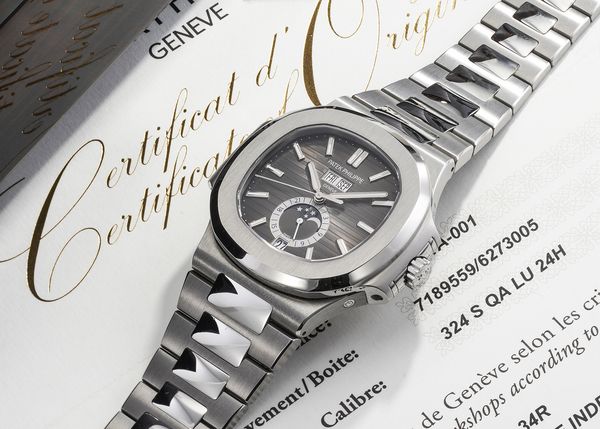
Lot 121: A 2019 Patek Philippe Nautilus Annual Calendar Ref. 5726/1A-001 in stainless steel that's included in the Phillips Geneva Watch Auction: XXIII. Estimate: CHF 40,000 - 80,000
If the 3700 is the manifesto, the 1980s and early 1990s are the brand learning how to make that manifesto into a genuine collection. The key reference here is the mid-size Ref. 3800. At a glance, it keeps the same playbook: similar case language, similar dial idea, same integrated bracelet feel. The real change is the size and the movement. The smaller case made the Nautilus wearable for a wider audience at a time when the “Jumbo” still felt intimidating. And the switch to Patek’s in-house automatic calibre 335 SC signaled something important: this was not a one-off response to Audemars Piguet anymore. Patek planned to own the category.
You also see Patek experimenting with size segmentation. The ladies’ Ref. 4700 and Ref. 3900 arrived in smaller diameters, with quartz movements. These watches matter historically, even if they do not drive today’s collecting conversation. They show Patek treating the Nautilus as a family rather than a single hero reference.
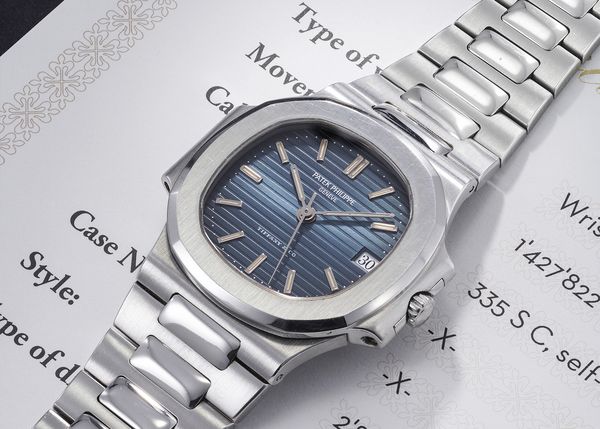
Lot 194: A 1989 Patek Philippe Nautilus Ref. 3800/1 in stainless steel with Tiffany & Co.-signed dial, included in the Phillips Geneva Watch Auction: XXIII. Estimate: CHF 24,000 - 48,000
By the mid-1990s, Patek began testing how far it could move the Nautilus away from its original visual codes without breaking recognition. The Roman numeral dial variant of the 3800 is the clearest example. Lose the horizontal grooves, add a more traditional minute track, change the hand style, and you get a Nautilus that feels almost like Patek trying on a different personality. Some collectors overlook these today because they want the “Genta DNA” in its most obvious form. But at the time, these dials helped keep the watch current and brought in buyers who wanted a Nautilus that felt less like an industrial design object and more like a conventional luxury watch.
Around that same era, the seed of the Aquanaut appears, growing directly from the Nautilus's experimentation. The strap-based Ref. 5060, with its different case treatment and its move away from the integrated-bracelet identity, now reads like a bridge between two worlds.
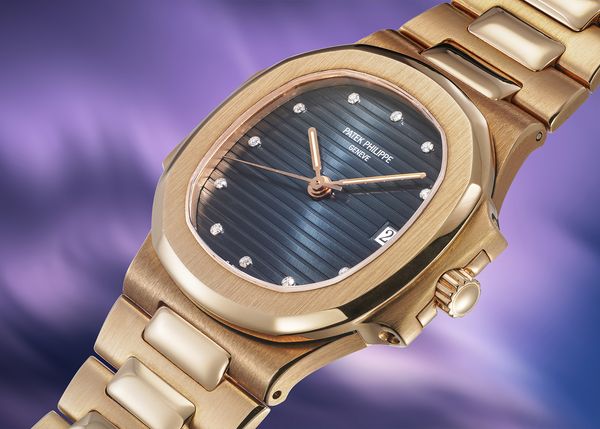
Lot 192: A 1989 Patek Philippe Nautilus Ref. 3800/1 in 18k pink gold that's included in the Phillips Geneva Watch Auction: XXIII. Estimate: CHF 200,000 - 400,000
Complications arrived slowly at first, and then all at once. The Ref. 3710 brought a power-reserve-style display (the so-called “Comet”) into the Nautilus vocabulary and, crucially, reintroduced the larger case format after the 3700 era ended. Then you get the short-lived Ref. 3712, which became a cult object because it combined the Jumbo case with a deliberately unbalanced display: power reserve, moon-phase, date, and small seconds spread across the dial in a way that should feel chaotic but somehow lands as charming.
That sets the stage for the modern era, which really begins in 2006 with the 30th anniversary refresh. This is the moment when the Nautilus stopped being just a great design with a devoted audience and developed a contemporary product strategy. The Ref. 5711 arrives as the spiritual successor to the 3700, and it does so with the kind of careful updating Patek does best. It kept the core silhouette, while modernizing almost everything else. The 5711 shifted to a three-part case with a sapphire caseback, updated the bracelet geometry, tweaked the case proportions, and included a central seconds hand. It also moved the Nautilus into a new movement generation, first with the calibre 315 SC, later moving to cal. 324 SC, and eventually to cal. 26-330 S C in late production.
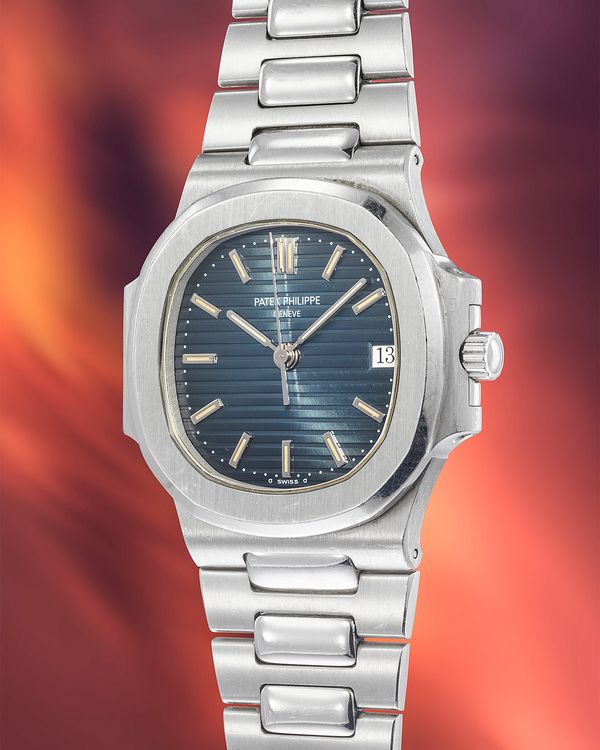
Lot 216: A 1995 Patek Philippe Nautilus Ref. 3800/1 in platinum that's included in the Phillips Geneva Watch Auction: XXIII. Estimate: CHF 80,000 - 160,000
Alongside it, Patek essentially canonized the “complicated Nautilus” by bringing the 3712 idea forward into the Ref. 5712, and introducing the chronograph variation with the Ref. 5980. The 5980 matters because it shows Patek taking a true sports complication and expressing it in a way that stays true to the Nautilus form factor. The single register at 6 o’clock, with stacked hours and minutes totalizers, avoids the busy three-sub-dial look and keeps the watch legible. It was also powered by Patek’s modern in-house automatic chronograph architecture, which signaled the brand’s long game: if the Nautilus was going to be a pillar, it would not rely on someone else’s engines.
The 2010s broadened the concept further. The annual calendar Ref. 5726 brings one of Patek’s signature “useful complication” ideas into the Nautilus in a way that feels surprisingly natural. The travel-time chronograph Ref. 5990 pushed the case language into more obviously modern engineering, because adding pushers and travel-time controls forced compromises to the iconic “ear” construction. Then you get the anniversary punctuation marks that remind you how carefully Patek leans into its own mythology. For the 40th anniversary in 2016, Patek focused on precious metals and limited production, with pieces like the platinum Ref. 5711/1P variant and the oversized white-gold chronograph anniversary Ref. 5976/1G. The message was clear: the Nautilus had graduated from “Patek’s sport watch” to “Patek’s modern symbol” – and symbols invite ceremony.
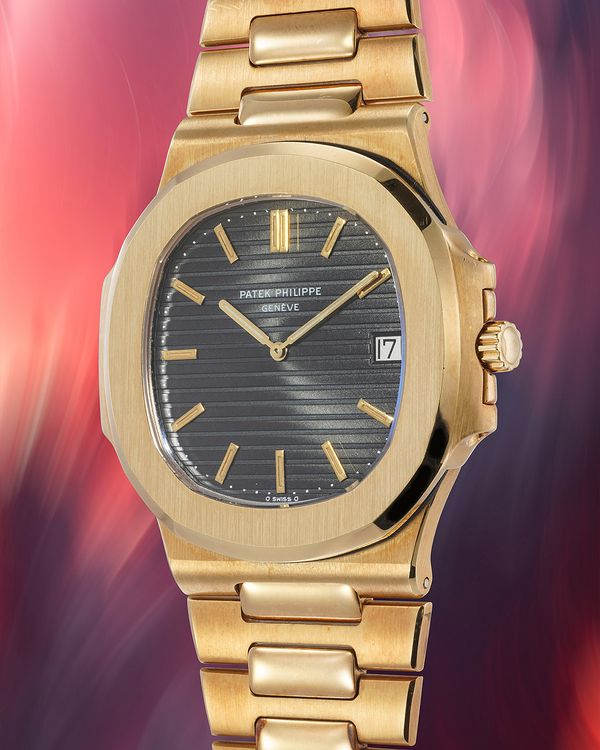
Lot 218: A 1983 Patek Philippe Nautilus Ref. 3700/11 in 18k yellow gold that's included in the Phillips Geneva Watch Auction: XXIII. Estimate: CHF 80,000 - 160,000
That confidence carried straight into 2018, when Patek Philippe did something that felt both inevitable and slightly insane. It put a perpetual calendar inside a Nautilus. The Ref. 5740G arrived as the brand’s first Nautilus QP, executed in solid 18k white gold, 40mm across, and laid out in the familiar Patek language you know from classic watches like the Ref. 3940.
You get month and day in twin apertures, a pointer date, leap year, moon-phase, and a 24-hour indicator, all packed into a dial that still reads unmistakably Nautilus thanks to the blue gradient color, horizontal ribbing, and luminous applied markers and hands. And at just 8.42mm thick, the Ref. 5740 wears like a proper “luxury sports” watch, not a complicated dinner plate, achieved by marrying the Nautilus case to the micro-rotor calibre 240 Q, one of Patek’s most elegant perpetual calendar engines.
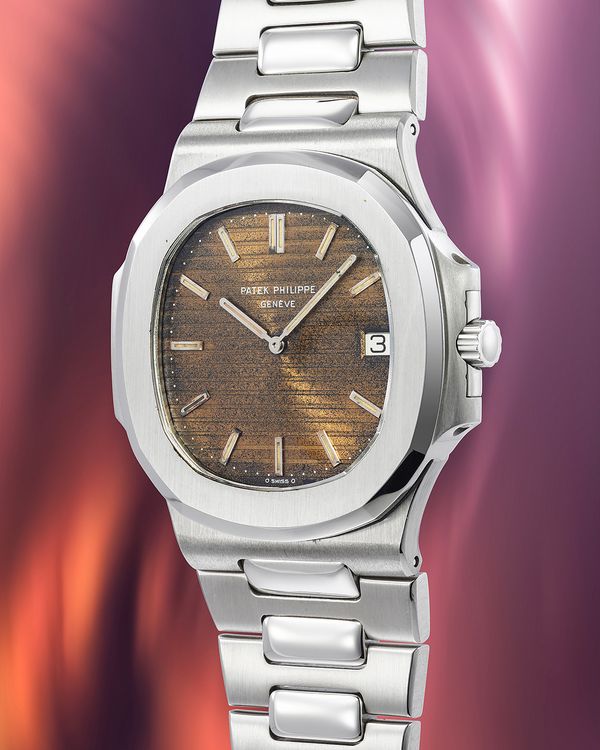
Lot 16: A 1977 Patek Philippe Nautilus Ref. 3700 in stainless steel with 'tropical' dial that's included in the Phillips Geneva Watch Auction: XXIII. Estimate: CHF 70,000 - 140,000
Around the same time, the Nautilus crossed a different threshold altogether. Somewhere in the mid-2010s, it moved from enthusiast object to cultural phenomenon. Social media did not create that phenomenon, but it amplified it and accelerated it. The Nautilus (particularly the Ref. 5711) started appearing on the wrists of athletes, musicians, and influencers. It also became an asset in the eyes of people who didn’t care about fine watchmaking, which is usually the moment collectors start feeling complicated emotions.
In 2021, the 5711 story ended. Patek concluded its run with headline-making variants, including the olive-green dial Ref. 5711/1A-014 (plus a diamond-bezel version), and then it delivered the ultimate modern watch world grenade: the Tiffany-signed, Tiffany-blue Ref. 5711/1A-018, limited to 170 pieces. The first example made was offered at Phillips New York in December 2021, where it sold for $6,503,500, with all proceeds benefiting charity.
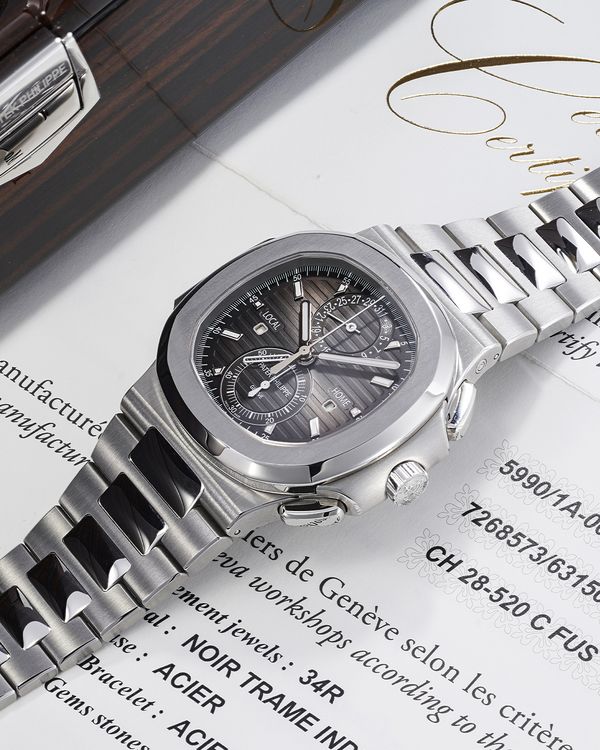
Lot 201: A 2019 Patek Philippe Nautilus Travel-Time Flyback Chronograph Ref. 5990/1A-001 in stainless steel that's included in the Phillips Geneva Watch Auction: XXIII. Estimate: CHF 40,000 - 80,000
So where does the Nautilus sit in 2026, at 50 years old? In one sense, it sits exactly where it always has, as Patek Philippe’s answer to the idea that sport and luxury can exist in the same watch. In another sense, it sits in a new chapter, because the post-5711 world forced Patek to decide what “continuity” should look like when the most in-demand steel watch on earth becomes unsustainable as a normal catalogue item.
The clearest expression of that new chapter is the Ref. 5811/1G in white gold, which Patek Philippe positions as a modern reinterpretation of its core Nautilus idea. The material choice says as much as the design tweaks do. White gold lets Patek keep the Nautilus at the center of the brand conversation while controlling steel volume and resisting the trap of simply charging luxury money for steel because the market will bear it. Design-wise, you get incremental, studied changes, including a subtle return to earlier case architecture cues, and a dial treatment that keeps the blue gradient identity alive.
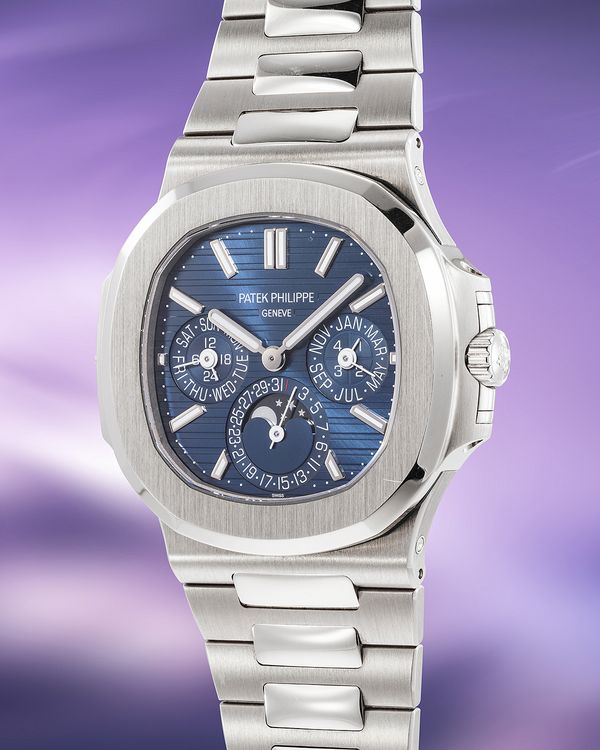
Lot 141: A 2021 Patek Philippe Nautilus Perpetual Calendar Ref. 5740/1G-001 in 18k white gold that's included in the Phillips Geneva Watch Auction: XXIII. Estimate: CHF 100,000 - 200,000
If you step back from individual references, the 50-year Nautilus story reads like a case study in how icons survive. The starting point has to be a design that is both specific and flexible. The Nautilus is specific enough that you can spot it instantly. It is flexible enough that it can absorb different sizes, different displays, different metals, and even different cultural meanings without collapsing.
The second ingredient is restraint. Patek Philippe did not flood the market with Nautilus variants in the early years. It let the design build credibility. Even when it expanded into complications, it did so in phases, and often by adapting already proven designs to the Nautilus canvas rather than inventing novelty for novelty’s sake.
The third ingredient is time. The Nautilus did not become what it is in 1976. It became what it is by staying relevant through the 1980s and 1990s, being intelligently modernized in 2006, and then being pulled into the center of modern luxury culture in the 2010s and 2020s.
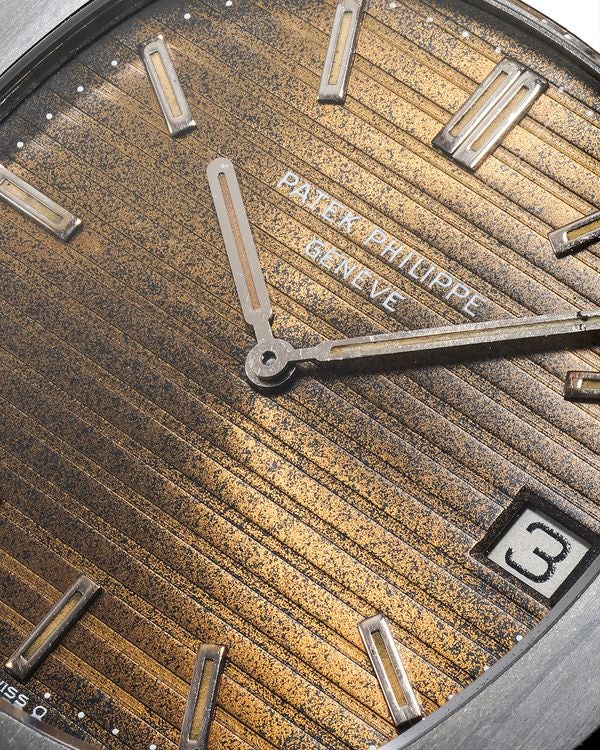
Lot 16: A 1977 Patek Philippe Nautilus Ref. 3700 in stainless steel with 'tropical' dial that's included in the Phillips Geneva Watch Auction: XXIII. Estimate: CHF 70,000 - 140,000
Fifty years in, the Nautilus still feels like a watch that should not have worked on paper. From a conservative brand, cased in steel, in the middle of a crisis, betting on a shape that was neither classic round nor aggressively avant-garde, and pricing it like a serious luxury object. Yet it worked, and it kept working, because the underlying idea was never a gimmick.
The Nautilus is a design with a point of view, executed with enough discipline that it could evolve without losing itself. That is what icons do.
You can learn more, place a bid, and view the entire Geneva Watch Auction: XXIII catalogue right here.
About Phillips In Association With Bacs & Russo
The team of specialists at PHILLIPS Watches is dedicated to an uncompromised approach to quality, transparency, and client service. Phillips in Association with Bacs & Russo holds the world record for the most successful watch auction, with its Geneva Watch Auction: XIV having realized $74.5 million in 2021. Over the course of 2021 and 2022, the company sold 100% of the watches offered, a first in the industry, resulting in the highest annual total in history across all the auction houses at $227 million.
About Logan Baker
Logan has spent the past ten years covering the watch industry from every angle. He joined Phillips in Association with Bacs & Russo in early 2023 as Senior Editorial Manager, after previous roles at Hodinkee and WatchTime. Originally from Texas, he spent a decade in New York and now calls Geneva home.
Recommended Reading