Article | Patek Philippe Annual Calendar History 5035 5960 5250 5450 5135 5150 5235 5396 5205
Thirty Years of the Annual Calendar at Patek Philippe
In 1996, Patek Philippe introduced the annual calendar and created a practical middle ground between simple calendars and perpetuals.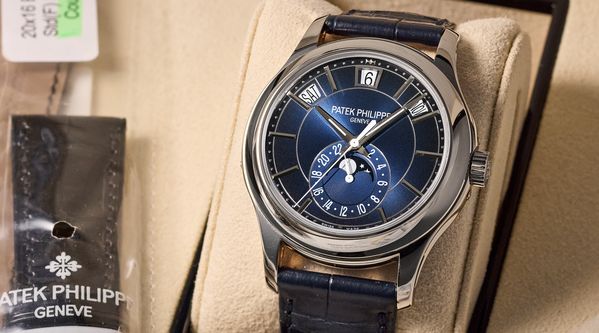
Phillips in Association with Bacs & Russo is thrilled to welcome you to The New York Sessions, Spring 2026, Online Auction, running from 12:00 PM ET, Wednesday, 1 April, to 12:00 PM ET, Wednesday, 8 April. The sale features more than 60 high-end luxury wristwatches, ranging from A. Lange & Söhne and Breguet to Audemars Piguet and Patek Philippe.
– By Logan Baker
In the long history of calendar complications, the annual calendar occupies a curious middle ground.
It sits between the simplicity of a date display and the elaborate logic of the perpetual calendar. For most of the 20th century, that middle ground simply did not exist. Watchmakers either built simple calendars that required monthly adjustment or they pursued the mechanical virtuosity of the perpetual calendar. The idea that a watch could automatically account for the varying lengths of months while still requiring a single annual correction never fully took hold.
That changed in 1996, when Patek Philippe introduced the Ref. 5035 and created an entirely new category of complication.
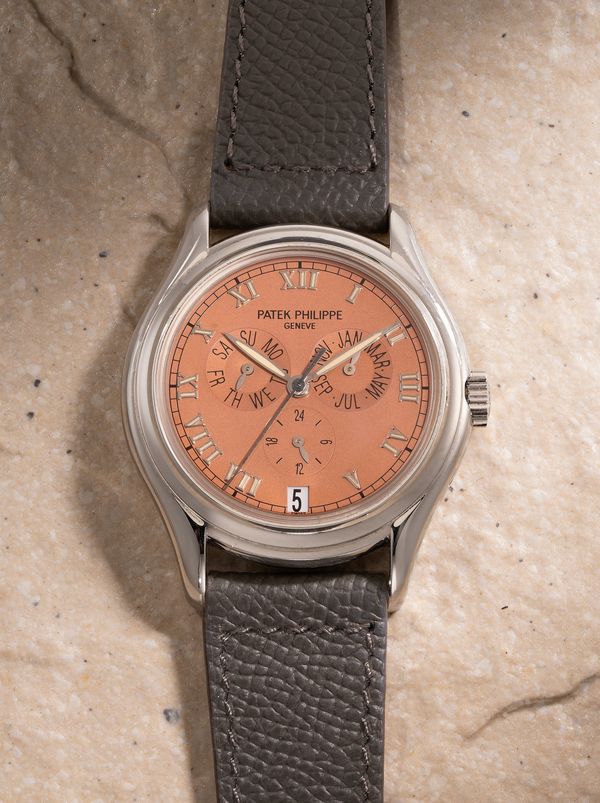
A circa 2000s Patek Philippe Annual Calendar Ref. 5035G in 18k white gold that was offered at the Phillips Hong Kong Sessions, Spring 2026, Online Auction.
To understand why the annual calendar appeared when it did, you have to picture the watch industry of the mid-1990s. Mechanical watchmaking had survived the Quartz Revolution and entered a new phase of revival. Complicated watches were back in fashion, but the landscape was shifting. Brands rushed to demonstrate their technical capabilities. Minute repeaters, tourbillons, and perpetual calendars appeared in greater numbers than anyone had seen in decades.
Philippe Stern, then president of Patek Philippe, recognized both the opportunity and the danger in this moment.
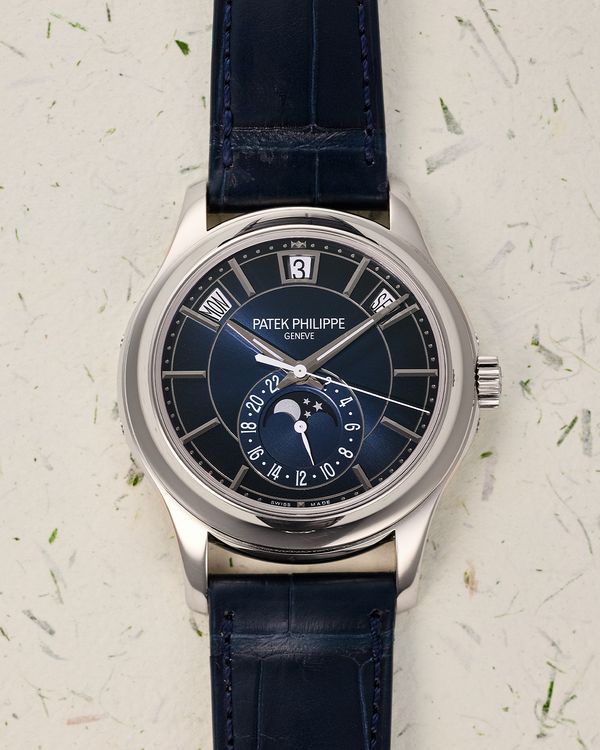
Lot 48: A circa 2019 Patek Philippe Annual Calendar Ref. 5205G-013 in 18k white gold with blue dial that’s offered at the Phillips New York Sessions, Spring 2026, Online Auction. Estimate: USD $20,000 - 40,000
High complications were becoming more visible, more expensive, and, in some cases, less rare. At the same time, the price gap between a simple time-only watch and a grand complication remained enormous. Stern believed there was room for something else. A complication that offered real practical value. Something useful enough to wear daily, but sophisticated enough to carry the intellectual appeal collectors expected from Patek Philippe.
The result was the annual calendar.
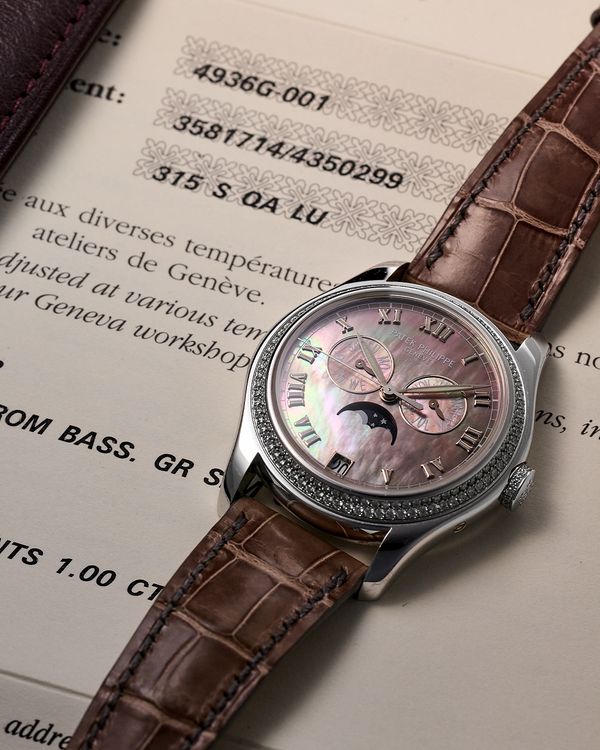
Lot 12: A 2006 Patek Philippe Annual Calendar Ref. 4936G-001 in 18k white gold with diamond setting and mother-of-pearl dial that’s offered at the Phillips New York Sessions, Spring 2026, Online Auction. Estimate: USD $15,000 - 30,000
Unveiled at the Basel fair in 1996, the Ref. 5035 looked restrained at first glance. Its 37mm 18k yellow-gold case housed a dial with three primary indications: day at nine o’clock, month at three, and a date window at six. A 24-hour indicator at six o'clock helped owners avoid having to adjust the watch during the calendar changeover period. What made the watch remarkable was not the display, but the logic behind it.
Unlike a perpetual calendar, which accounts for leap years and requires adjustment only once every century or so, the annual calendar automatically distinguishes between months with 30 and 31 days. Only February requires correction. In practical terms, that means the owner sets the date just once a year.
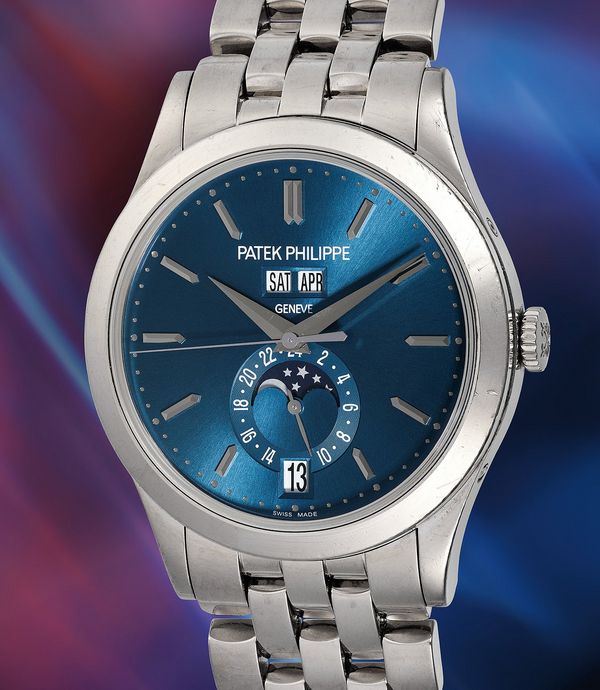
A circa 2014 Patek Philippe Annual Calendar Ref. 5396G-001 in 18k white gold that sold for USD $48,260 at the Phillips New York Watch Auction: XII, in June 2025.
The mechanism that made this possible was ingenious in its simplicity. Rather than relying on the complex system of levers, springs, and cams typically found in perpetual calendars, the annual calendar used a largely rotational architecture built around a stack of calendar wheels. The system was developed in collaboration with students from the Geneva School of Engineering, one of whom, Cédric Fague, later joined Patek Philippe and remains part of the company’s movement engineering team today.
The annual calendar module sat atop the automatic calibre 315 S, one of Patek’s workhorse movements of the period. Driven by a 24-hour wheel, the calendar advanced the date daily through a 31-tooth date wheel. During months with only 30 days, an additional mechanism advanced the date an extra step, skipping directly from the 30th to the 1st. The entire process unfolded gradually over several hours around midnight.
The concept proved immediately compelling. In 1997, the Ref. 5035 was priced at roughly CHF 18,300, less than half that of a perpetual calendar such as the Ref. 3940. Collectors suddenly had access to a meaningful complication that was both technically interesting and realistically wearable.
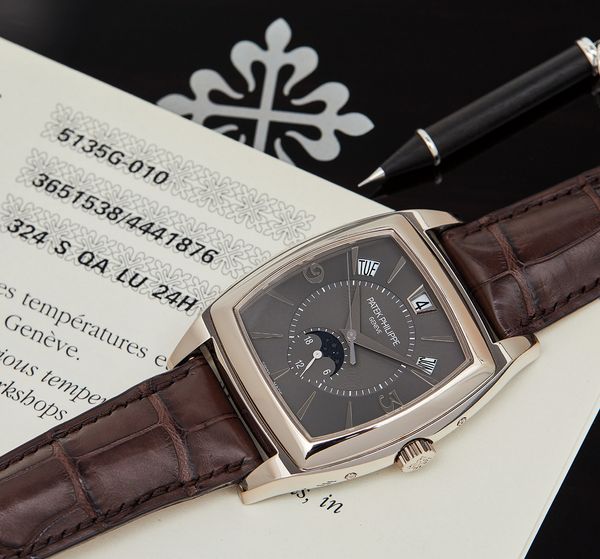
A circa 2008 Patek Philippe Gondolo Annual Calendario Ref. 5135G in 18k white gold that sold for USD $44,100 at the Phillips New York Watch Auction: SIX, in June 2022.
Patek Philippe quickly expanded the concept. The Ref. 5036 arrived in 1998, adding a moon-phase display and power-reserve indicator to the annual calendar layout. Over time, the moon-phase became almost synonymous with Patek’s standard annual calendar models, a pairing that balanced practicality with a touch of poetry.
The early 2000s marked a period of rapid evolution. In 2004, Patek introduced the Gondolo Calendario Ref. 5135. Its tonneau-shaped case and distinctive arched display of day, date, and month brought Art Deco flair to what had previously been a fairly conservative design language. Beneath the dial sat a movement based on the newer calibre 324 architecture, which improved winding efficiency and operated at a higher frequency.
Around this same period, Patek also demonstrated the adaptability of the annual calendar concept through limited-edition and commemorative pieces. One particularly interesting example is the Ref. 5150, produced in 2001 to mark the 150th anniversary of the company's relationship with Tiffany & Co. in the United States.
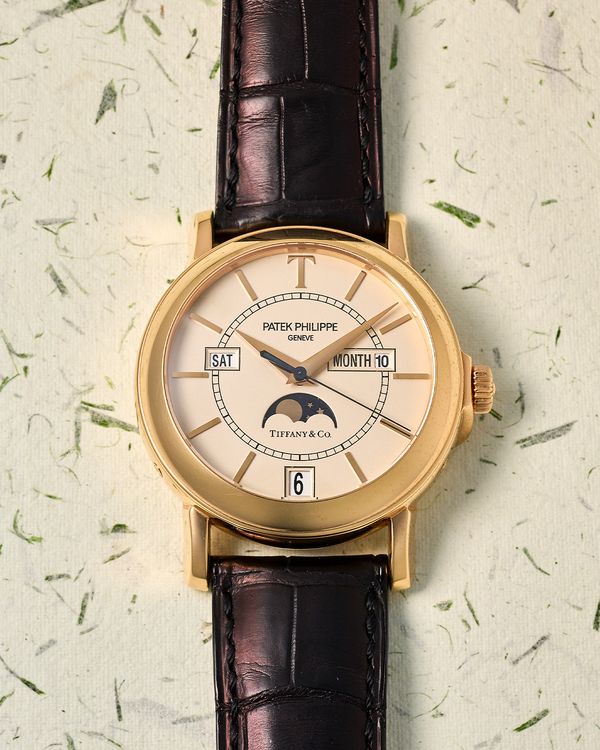
Lot 51: A 2001 Patek Philippe Annual Calendar Ref. 5150R in 18k pink gold with Tiffany & Co.-signed dial that’s offered at the Phillips New York Sessions, Spring 2026, Online Auction. Estimate: USD $20,000 - 40,000
The watch combined the annual calendar with a retrograde date display and a hand-engraved officer-style caseback. Produced in a small run of pieces in 18k white and pink gold, the Ref. 5150 showed that the annual calendar could serve not only as a practical complication but also as a canvas for decorative craftsmanship and special commissions.
In 2006, for the 10-year anniversary of the annual calendar complication, Patek Philippe unveiled one of the most significant annual calendar watches ever produced: the Ref. 5960.
With the Ref. 5960, Patek Philippe paired the annual calendar with an entirely new in-house automatic chronograph movement, the calibre CH 28-520. This was a major milestone for the manufacture. Earlier Patek chronographs relied on modified ébauches from suppliers such as Lemania or Valjoux. The CH 28-520 represented a fully integrated, modern chronograph architecture with a column wheel, vertical clutch, and silicon Spiromax balance spring.
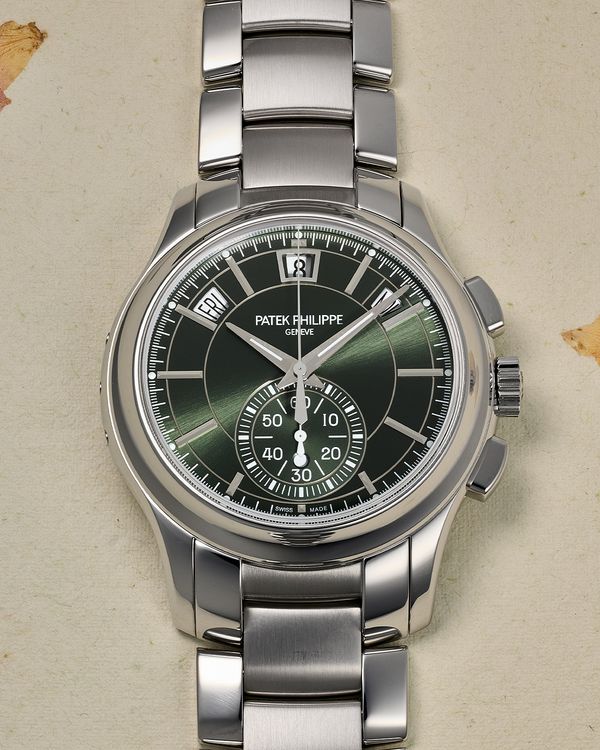
Lot 8: A 2025 Patek Philippe Annual Calendar Chronograph Ref. 5905/1A-001 in stainless steel with green dial that’s offered at the Phillips New York Sessions, Spring 2026, Online Auction. Estimate: USD $30,000 - 60,000
The dial of the Ref. 5960 mirrored the arched calendar apertures introduced by the Ref. 5135, but the lower half of the dial featured an unconventional chronograph display. Elapsed minutes and hours appeared together within a single subdial at six o’clock, creating an unusually legible chronograph layout. Despite combining a flyback chronograph, annual calendar, and power reserve indicator, the watch remained surprisingly coherent.
Around the same time, Patek Philippe used the annual calendar as a platform for experimentation through its Advanced Research program. References such as the 5250 and later the 5350 and 5450 introduced silicon components, including the Silinvar escape wheel, Spiromax hairspring, and Pulsomax escapement. These watches marked some of the first real steps toward the widespread adoption of silicon technology in modern high-end watchmaking.
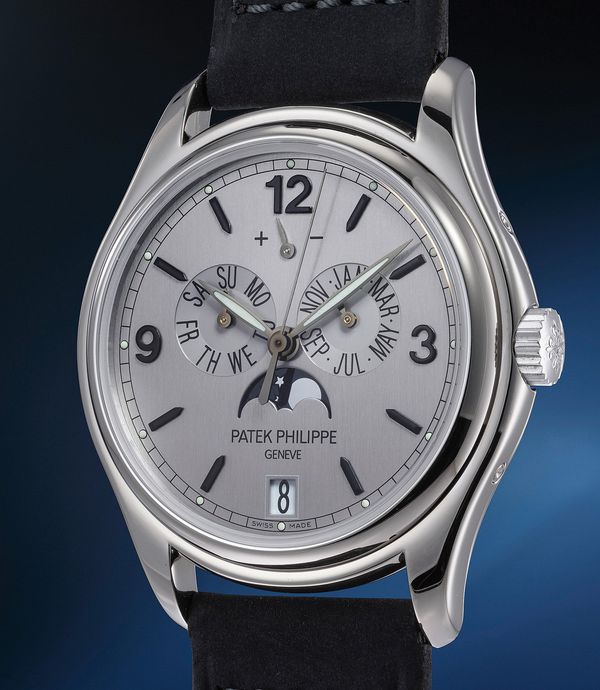
A 2006 Patek Philippe Advanced Research Annual Calendar Ref. 5250G-001 in 18k white gold that sold for CHF 48,260 at the Phillips Geneva Watch Auction: XVII, in May 2023.
The complication continued to spread across Patek’s collections. The elegant Calatrava Ref. 5396 offered a classical interpretation with twin apertures for day and month and a moon-phase integrated into a 24-hour display. The ladies’ Ref. 4936 demonstrated that the complication was equally suited to smaller watches. And in the Nautilus Ref. 5726, the annual calendar finally found its way into one of the brand’s most recognisable sports watches.
Other 2010s and 2020s releases, such as the regulator-style Ref. 5235 and the Calatrava Travel-Time Ref. 5326, show how far the annual calendar has evolved. The regulator display of the Ref. 5235 pairs the calendar with an ultra-thin micro-rotor movement developed with extensive silicon components, while the Ref. 5326 integrates a dual-time mechanism that synchronises the calendar with the local hour hand.
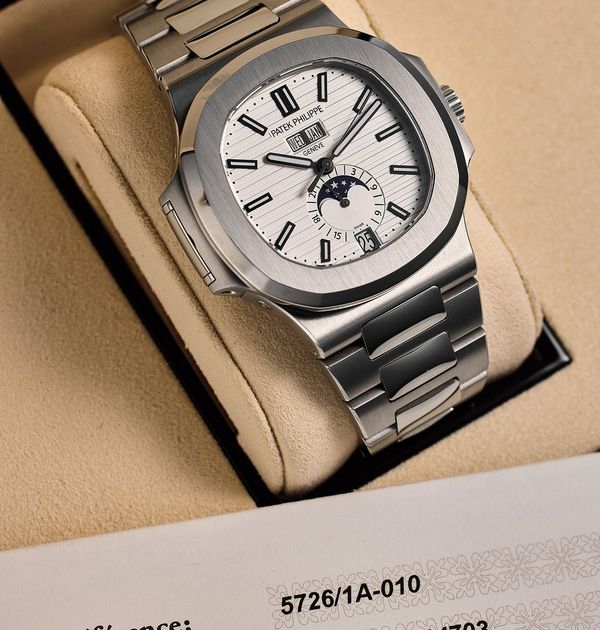
A circa 2018 Patek Philippe Nautilus Annual Calendar Ref. 5726/1A-010 in stainless steel that sold for USD $165,100 at the Phillips New York Watch Auction: XII, in June 2025.
Meanwhile, references such as the Ref. 5205 and the chronograph-equipped Ref. 5905 demonstrate how the complication has matured within the broader Patek Philippe catalogue. The annual calendar is no longer a newcomer filling a gap between simple watches and grand complications. It has become one of the manufacture’s defining complications.
Looking back, the annual calendar feels almost inevitable, which is often the sign of a truly successful idea. Yet it required a particular moment in watchmaking history and a particular mindset at Patek Philippe. Instead of chasing ever more elaborate complications, the brand chose to invent something practical, elegant, and intellectually satisfying.
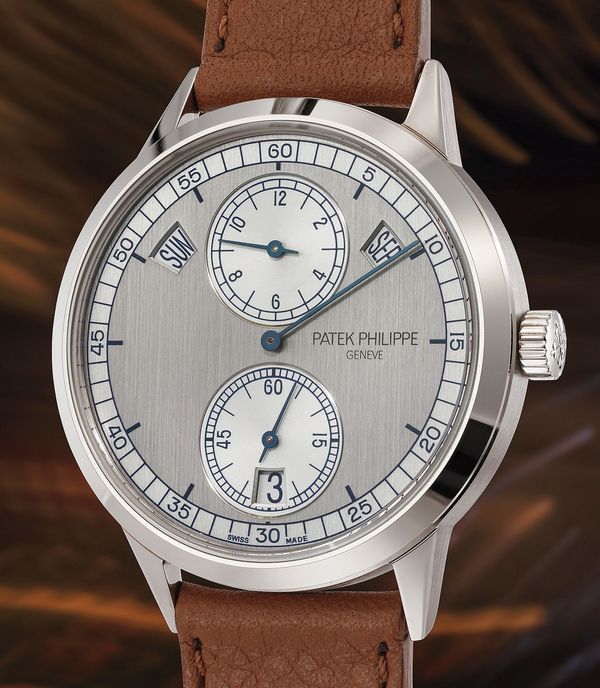
A 2013 Patek Philippe Annual Calendar Ref. 5235G-001 in 18k white gold that sold for CHF 35,560 at the Phillips Geneva Watch Auction: XIX, in May 2024.
Three decades after the original Ref. 5035, the annual calendar remains exactly that. A complication that rewards daily use, solving a problem most people never knew mechanical watchmaking had overlooked.
You can view the complete Phillips New York Sessions, Spring 2026, Online Auction catalogue here.
About Phillips In Association With Bacs & Russo
The team of specialists at PHILLIPS Watches is dedicated to an uncompromised approach to quality, transparency, and client service. Phillips in Association with Bacs & Russo holds the world record for the most successful watch auction, with its Geneva Watch Auction: XIV having realized $74.5 million in 2021. Over the course of 2021 and 2022, the company sold 100% of the watches offered, a first in the industry, resulting in the highest annual total in history across all the auction houses at $227 million.
About Logan Baker
Logan has spent the past ten years covering the watch industry from every angle. He joined Phillips in Association with Bacs & Russo in early 2023 as Senior Editorial Manager, after previous roles at Hodinkee and WatchTime. Originally from Texas, he spent a decade in New York and now calls Geneva home.