Article | Vintage 1960s Eberhard Scafograf 300 Scientigraf Phillips New York Dec 2025
A Look at Vintage Eberhard Through Two 1960s Tool Watches
Eberhard & Co. never chased the spotlight, but the Scafograf 300 and Scientigraf prove it always deserved one.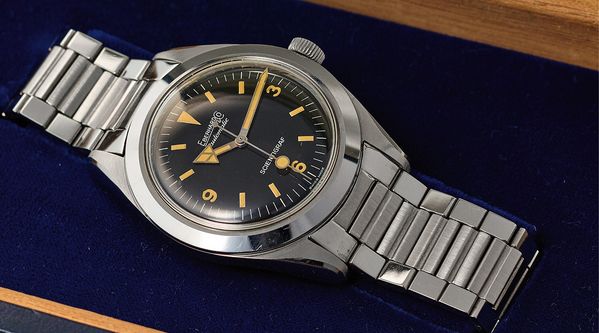
The PHILLIPS New York Watch Auction: XIII takes place on 6-7 December 2025, at our Park Avenue headquarters. The auction includes more than 140 of the world's finest watches – and though we are loath to boast, we truly think it's one of the best catalogues we've ever put together. We'll be highlighting several of the most interesting lots and stories featured in the sale right here, including the two 1960s Eberhard & Co. tool watches seen below.
– By Logan Baker
Vintage Eberhard sits in a strange but appealing corner of the watch world.
The brand never built a global empire like Rolex or Omega, yet it kept pace with them in terms of technical ambition and design instinct throughout much of the 20th century. That tension created watches that feel familiar enough to be comfortable but distinct enough to keep you coming back, something that is clearly evident in two 1960s Eberhard tool watches featured at the upcoming Phillips New York Watch Auction: XIII – a Scafograf 300 Ref. 11706 from approximately 1966, and a Scientigraf Ref. 11538 from approximately 1965.
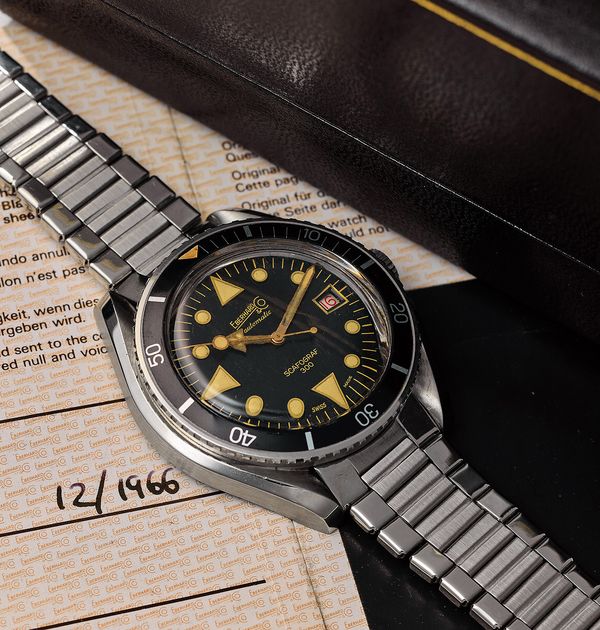
Lot 75: A circa 1966 Eberhard & Co. Scafograf 300 Ref. 11706 in stainless steel that's included in the Phillips New York Watch Auction: XIII. Estimate: USD $8,000 - 16,000
Eberhard built its reputation early. Founded in La Chaux-de-Fonds by Georges-Lucien Eberhard in 1887, the company spent the first half of the 20th century pushing chronograph development (through the pre-Extra Fort and Extra Fort lines), while cultivating deep roots in Italy. Those ties helped shape the brand’s identity, which leaned toward bold proportions, graphic dials, and a sense of practical style that matched post-war tastes.
By the time recreational diving, motorsport, and scientific work began to define the 1950s and '60s, Eberhard was ready with its own trilogy of tool watches: the Contograf for drivers (competing with the Rolex Daytona and Omega Speedmaster); the Scientigraf for scientists (marketed against the Rolex Milgauss and Omega Railmaster); and the Scafograf series for divers (contending against to the Rolex Submariner and Omega Seamaster 300). All three channeled the era’s cultural optimism while keeping a slightly eccentric edge.
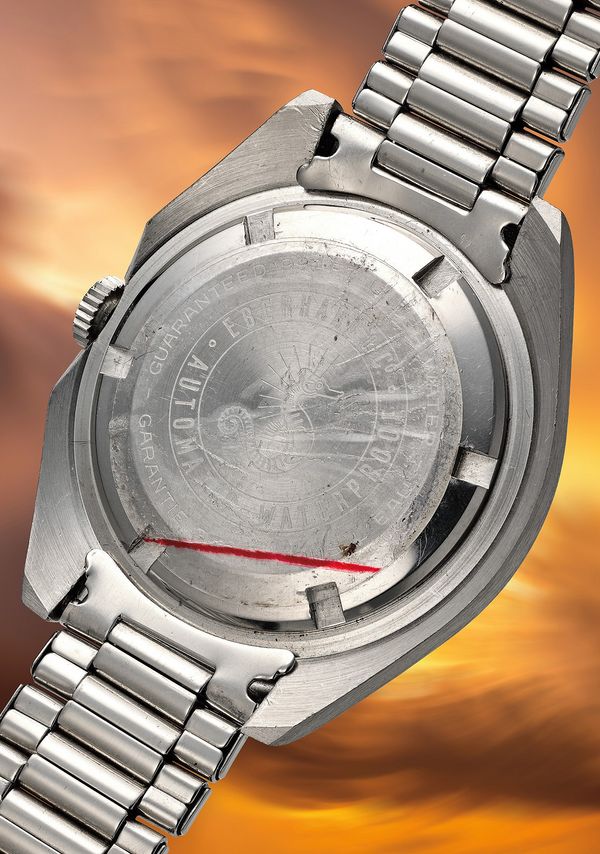
Lot 75: A circa 1966 Eberhard & Co. Scafograf 300 Ref. 11706 in stainless steel that's included in the Phillips New York Watch Auction: XIII. Estimate: USD $8,000 - 16,000
The Scafograf 300 sits at the top of Eberhard's dive-watch experiments. It followed the Scafograf 100 and 200, both produced in tiny numbers, and pushed the formula further: a larger 42mm case, 300 meters of water resistance, and a layout that blended purposeful design with an expressive aesthetic. The case came from Huguenin Frères, the same workshop responsible for many of Omega’s best-known cases from the period. Of course, that heritage is clearly visible in the twisted lyre lugs and the way the case holds its form with crisp facets and strong lines.
The circa 1966 example offered at our New York Watch Auction: XIII lands in that sweet spot where rarity meets condition. The dial features the Scafograf's signature oversized triangular hour markers at 12, 3, 6, and 9, with gilt surrounds, and a charming roulette-style date window.
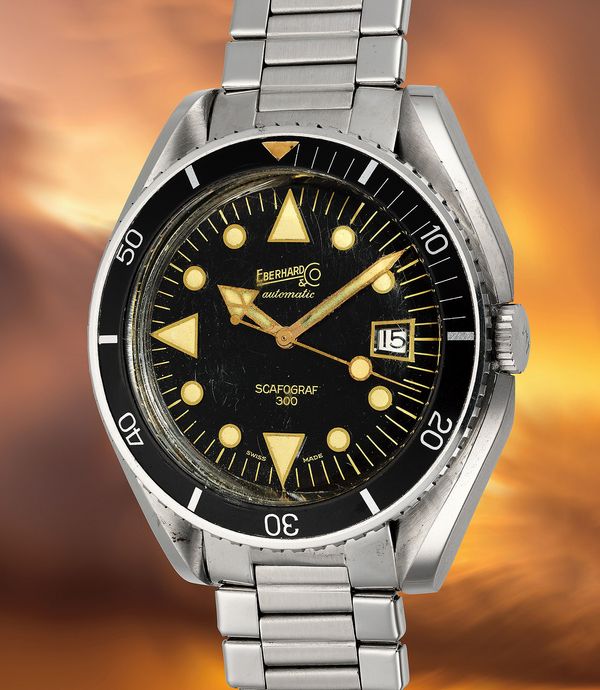
Lot 75: A circa 1966 Eberhard & Co. Scafograf 300 Ref. 11706 in stainless steel that's included in the Phillips New York Watch Auction: XIII. Estimate: USD $8,000 - 16,000
Eberhard didn’t shy away from visual character here. The layout feels intuitive and legible, but also slightly rebellious compared to the more conservative dive watches from Rolex and Omega. It features large, playful graphics, a generous amount of luminescent material, and a sense of mid-1960s flavor that hasn’t been sanded down by time. The movement inside is the automatic calibre 266-123, protected in a case that appears to be unpolished. The original bracelet, the guarantee paper from 1966, and the box complete the picture.
If the Scafograf 300 captures the adventurous, aquatic side of Eberhard's mid-century production, the Scientigraf shows the brand at its most technical.
Scientific watches were a direct response to the rise of magnetic fields in the post-war decades. The industrial world was evolving rapidly. Laboratories, hospitals, research facilities, and even everyday appliances pushed electromagnetic exposure to levels higher than ever, resulting in a potentially deleterious impact on the precision of any mechanical watch movement. Rolex answered with the Milgauss. Omega countered with the Railmaster. Even Patek Philippe produced the Amagnetic Ref. 3417. Eberhard joined the conversation with the Scientigraf, using a soft-iron inner cage to shield the self-winding calibre 11500 inside, just as a Faraday enclosure protects instruments.
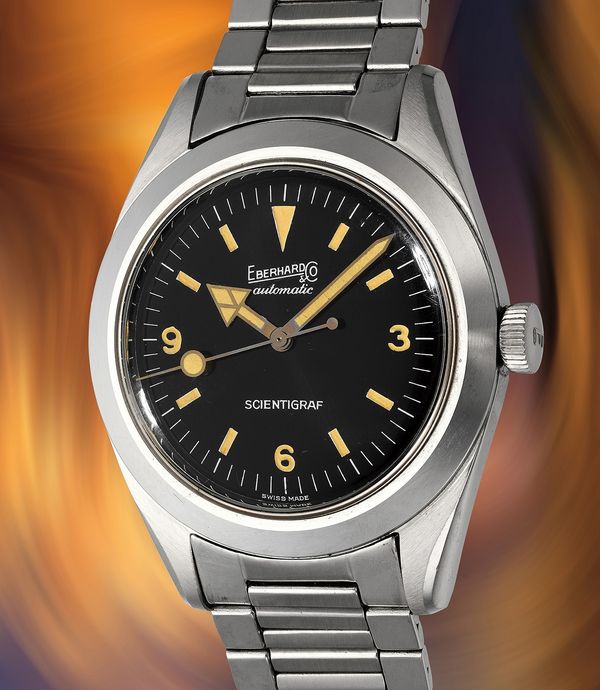
Lot 76: A circa 1965 Eberhard & Co. Scientigraf Ref. 11538 in stainless steel that's included in the Phillips New York Watch Auction: XIII. Estimate: USD $15,000 - 30,000
The Scientigraf never reached the commercial success of its rivals, and that limited production makes surviving examples far harder to find today. The circa 1965 example offered at the New York Watch Auction: XIII perfectly illustrates why vintage-watch collectors care so much for the model. The dial strikes a balance between clarity and personality, featuring a luminous 3-6-9 Arabic numeral layout, a bold arrow-shaped hour hand, and a lollipop-style central seconds hand. The case remains clean, with strong chamfers, crisp engravings, and even remnants of the original caseback sticker. The look feels serious, yet still distinctly Eberhard, which always had a knack for adding a touch of flair to its utilitarian designs.
The Scafograf 300 and Scientigraf remind us how Eberhard operated on its own wavelength. The brand lived in the same ecosystem as Rolex, Omega, and Patek Philippe, but it didn’t compete with their overall scale or marketing reach. Instead, Eberhard leaned on strong engineering, Italian culture, and a willingness to experiment with proportions and aesthetics. That’s why vintage Eberhard tool watches resonate so much with watch lovers today. You get high-quality construction, unusual – but handsome! – dial designs, and robust cases that wear like a modern wristwatch. You also contend with genuine scarcity, not because the brand intended to create something collectible, but because production numbers stayed small from the start.
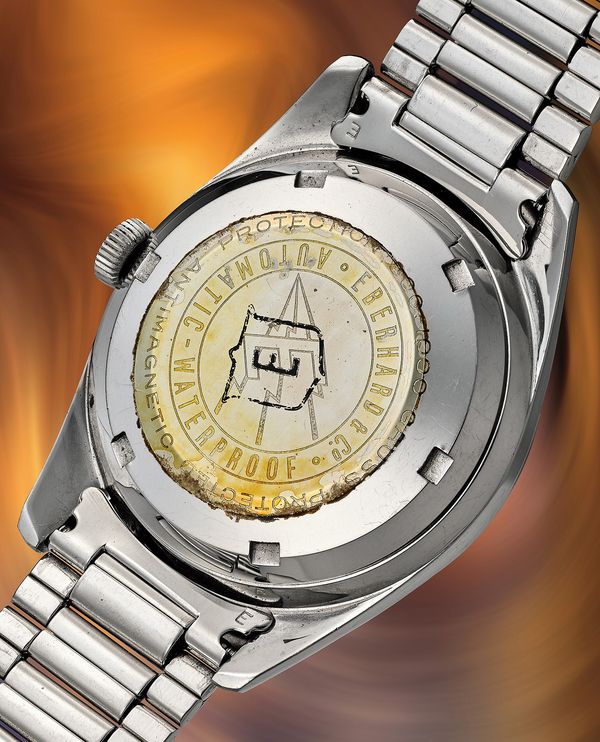
Lot 76: A circa 1965 Eberhard & Co. Scientigraf Ref. 11538 in stainless steel that's included in the Phillips New York Watch Auction: XIII. Estimate: USD $15,000 - 30,000
These two watches offer clear insight into why serious collectors continue to return to Eberhard.
One is a diver with real presence and a dial that refuses to shy away; the other is a reserved, competent anti-magnetic tool watch with a unique personality. They sit just outside the mainstream, but never far enough to seem obscure. And each reflects a moment when Eberhard pushed into contemporary culture without losing the quirks that made the brand special.
You can view the complete Phillips New York Watch Auction: XIII auction catalogue here.