Article | Patek Philippe Ref 130 Chronograph Time Only Sector Single Button Vertical
When the Modern Chronograph Was Born: The Patek Philippe Ref. 130
Before the Tasti Tondi, before the Ref. 1518, there was the 130 – the watch that made Patek Philippe’s chronographs a genre unto themselves.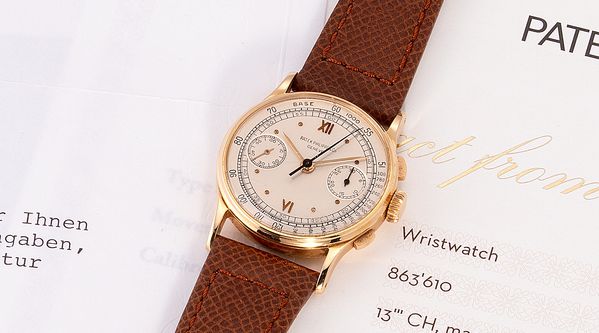
The PHILLIPS Hong Kong Watch Auction: XXI takes place on 21-23 November 2025, at our West Kowloon headquarters. The auction includes more than 300 of the world's finest watches – and though we are loath to boast, we truly think it's one of the best catalogues we've ever put together. We'll be highlighting a number of the most interesting lots and stories featured in the sale right here, including a particularly noteworthy pair of Patek Philippe Ref. 130s (lot 942; lot 1058), presented below.
– By Logan Baker
When Patek Philippe introduced the Reference 130 in the mid-1930s, the model set the standard for how a complicated wristwatch could balance technical precision with elegant design, and it established a case and dial language that would ripple through nearly every great Patek chronograph that followed. Produced for approximately three decades, the Ref. 130’s story spans the evolution of Patek Philippe under the Stern family and traces the arc from experiment to perfection.
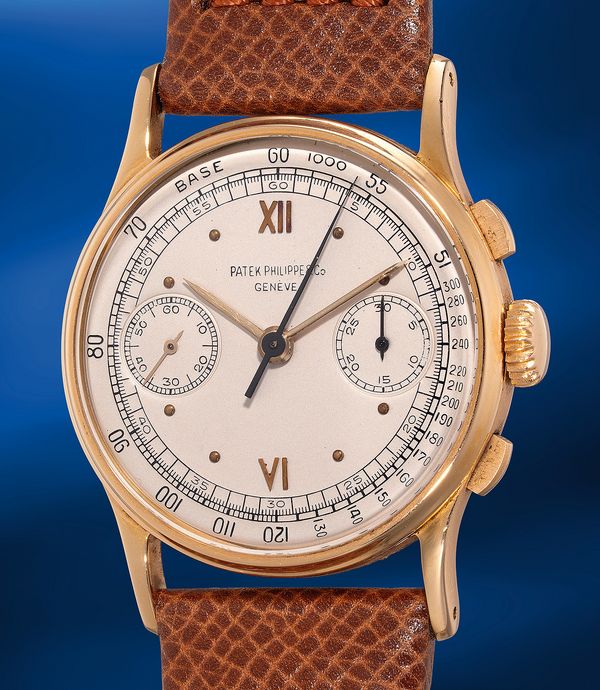
Lot 1058: A 1945 Patek Philippe Chronograph Ref. 130R in 18k pink gold that's included in the upcoming Phillps Hong Kong Watch Auction: XXI. Estimate: HKD $200,000 - 400,000
The Stern brothers, Jean and Charles Henri, had acquired Patek Philippe in 1932, during the depths of the Great Depression. Within a few years, they launched two watches that would reshape the brand’s identity: the Calatrava Ref. 96, and the chronograph Ref. 130. Together, they built the foundation of modern Patek Philippe.
The Reference 130 began life as a single-button, or monopusher, chronograph – a design both elegant and mechanically demanding. The entire chronograph function was controlled by a single pusher integrated into the crown: one press to start, another to stop, and a third to reset. This minimalist approach spoke to Patek Philippe’s pursuit of refinement and restraint, but it also reflected the technical limitations of the time. Inside these early monopusher 130s beat the 13’’’ ébauche supplied by Victorin-Piguet of Le Sentier.
A 1930 Patek Philippe Single-Button Chronograph Ref. 130 in 18k yellow gold that sold for CHF 355,600 at the Phillips Geneva Watch Auction: XVIII, in November 2023.
Single-button chronographs from Patek Philippe are among the rarest and most coveted watches the brand has ever produced. Within the Ref. 130 lineage, they represent the origin point of the design – the mechanical foundation on which all subsequent Patek chronograph wristwatches were built. Most were cased in gold, but two extraordinary examples in stainless steel exist: case numbers 504’146 and 504’147.
The first, a 35mm steel monopusher chronograph with vertically aligned sub-dials, was sold at the Phillips Geneva Watch Auction: One, in May 2015, for CHF 4,645,000. Its identical sister watch, case number 504’147, now resides permanently in the Patek Philippe Museum in Geneva, displayed in a gallery dedicated to the brand’s most important complicated wristwatches.
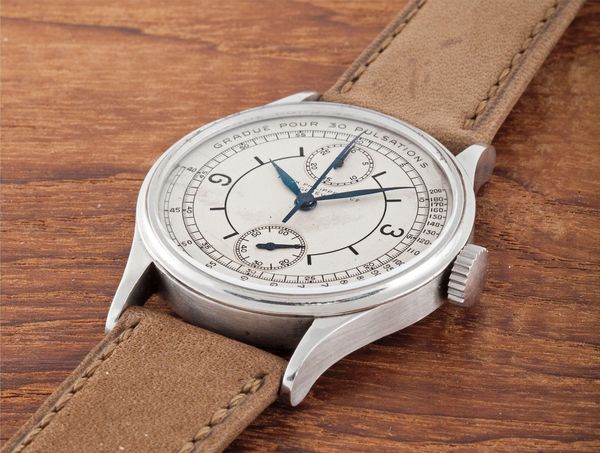
A 1927 Patek Philippe Single-Button Chronograph Ref. 130 in stainless steel that sold for a record CHF 4,645,000 at the Phillips Geneva Watch Auction: ONE, in May 2015.
As chronograph design matured, Patek Philippe transitioned from the monopusher format to a more practical two-pusher layout. The revised Ref. 130 offered independent start/stop and reset controls, allowing greater precision and usability. This evolution transformed the Ref. 130 from an experimental concept into a refined instrument for timing – and into the template for decades of Patek Philippe chronographs to come.
Across the roughly 1,500 examples produced between the mid-1930s and mid-1960s, the Ref. 130 appeared in nearly every conceivable configuration. Yellow gold dominated production, with pink gold and steel following in smaller quantities. The rarest of all were cased in steel and gold, with around 15 examples known to the market today; white-gold cases are also virtually unheard of. The steel versions, slightly larger at 33.5mm with shorter, thicker lugs, offered a more modern feel and have become especially sought after by collectors for their balance of sportiness and elegance.
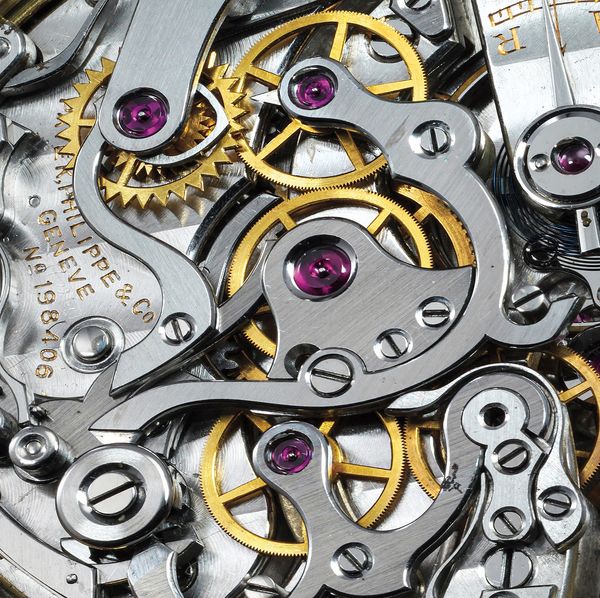
The manual-wind calibre 13'''130 inside the Patek Philippe Ref. 130.
The Ref. 130's case design – attributed to Emile Vichet – is one of the great triumphs of pre-war Geneva watchmaking. Long, tapered lugs flow seamlessly from a slim bezel, creating a visual lightness that defines the model’s silhouette. At 33mm, the proportions were perfect for the era, and remain timeless today. The Ref. 130’s case also became a structural foundation for two later icons: the Ref. 1518, the first serially produced perpetual calendar chronograph, and the Ref. 1526, the first serially produced perpetual calendar wristwatch. Together, these models form a trilogy of design evolution – all sharing the same history that began with the 130.
Underneath the caseback lies the heart of the watch: the calibre 13-130. Built on a Valjoux 13’’’ base, the movement was heavily reworked by Patek Philippe to achieve a level of performance and finishing far beyond its origin. Bridges were reshaped for balance and beauty, tolerances were tightened, and components were polished to perfection.
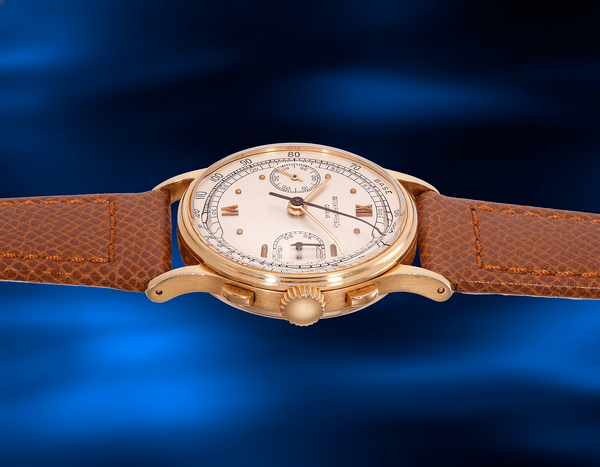
Lot 1058: A 1945 Patek Philippe Chronograph Ref. 130R in 18k pink gold that's included in the upcoming Phillps Hong Kong Watch Auction: XXI. Estimate: HKD $200,000 - 400,000
The many dial variations of the Ref. 130 reveal another side of Patek Philippe’s aesthetic diversity. Two-register layouts dominated, with running seconds at 9 o’clock and a 30-minute totalizer at 3 o’clock. Handsets ranged from dauphine to baton to cathedral, and the central chronograph seconds hand was most often in blued steel. Collectors will find versions with full Breguet numerals, with Roman or Arabic markers at 12 and 6 o'clock, or with minimalist baton indices.
Some incorporate tachymeter scales for measuring speed, while others incorporate pulsometer tracks for potential medical utility. A handful combine both, while approximately 15 known examples display the elegance of a sector dial – beloved for its graphic symmetry. The sheer variety reflects Patek Philippe’s bespoke production philosophy: each watch could be tailored to its buyer’s taste.
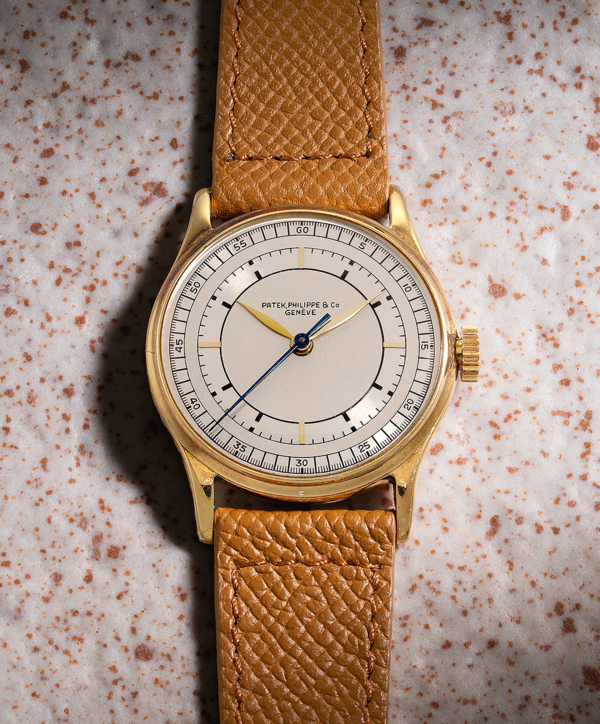
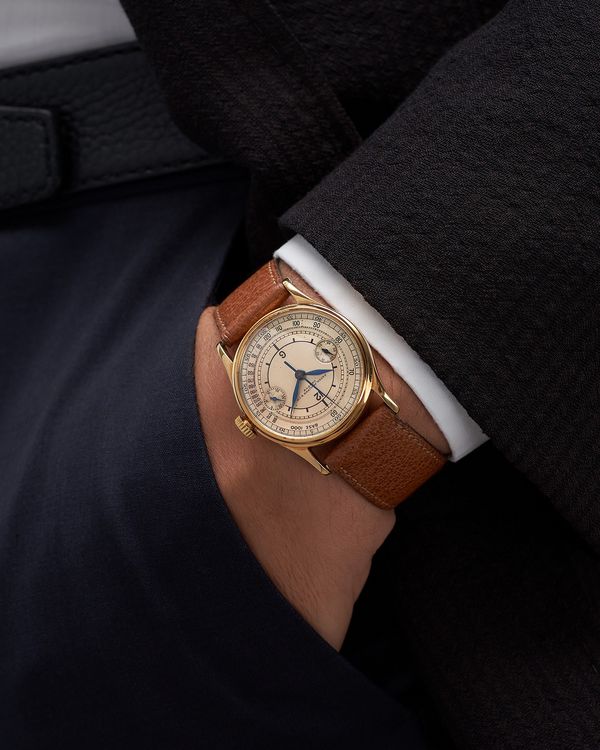
Lot 942: A circa 1935 (movement made in 1924) time-only Patek Philippe Ref. 130 in 18k yellow gold with sector dial, possibly unique and a potential early prototype. It's included in the upcoming Phillips Hong Kong Watch Auction: XXI. Estimate: HKD $780,000 - 1,560,000
Not all Ref. 130s were chronographs. A small number of time-only versions exist, produced in the mid-1930s before the chronograph layout became standardized. Among them is a remarkable yellow-gold example, case number 609’839 – likely the earliest known Ref. 130 and possibly a prototype. Fitted with a center-seconds calibre 12 SC from 1924, its sector dial by Stern Frères and Bauhaus-inspired proportions tie it directly to the design philosophy of the Ref. 96. These early time-only 130s bridge the gap between Patek Philippe’s formative wristwatches and its era of complications.
Two watches from the upcoming Phillips Hong Kong Watch Auction: XXI help illustrate these connections. The first, a pink-gold Ref. 130 from 1945, captures the post-war refinement of the model at its peak – complete with strong hallmarks and impeccable preservation. The second, the possibly unique time-only Ref. 130 mentioned above, is a transitional piece that hints at the inclusion of a chronograph yet predates its introduction.
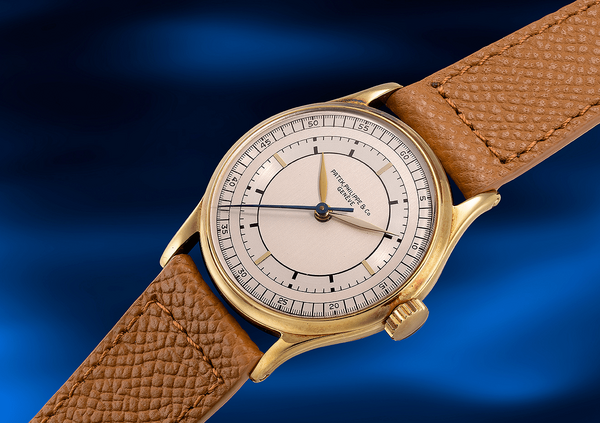
Lot 942: A circa 1935 (movement made in 1924) time-only Patek Philippe Ref. 130 in 18k yellow gold with sector dial, possibly unique and a potential early prototype. It's included in the upcoming Phillips Hong Kong Watch Auction: XXI. Estimate: HKD $780,000 - 1,560,000
Nearly a century on, the Ref. 130 still defines Patek Philippe’s philosophy: elegance through precision, and innovation through restraint.
You can view the complete Phillips Hong Kong Watch Auction: XXI auction catalogue here.