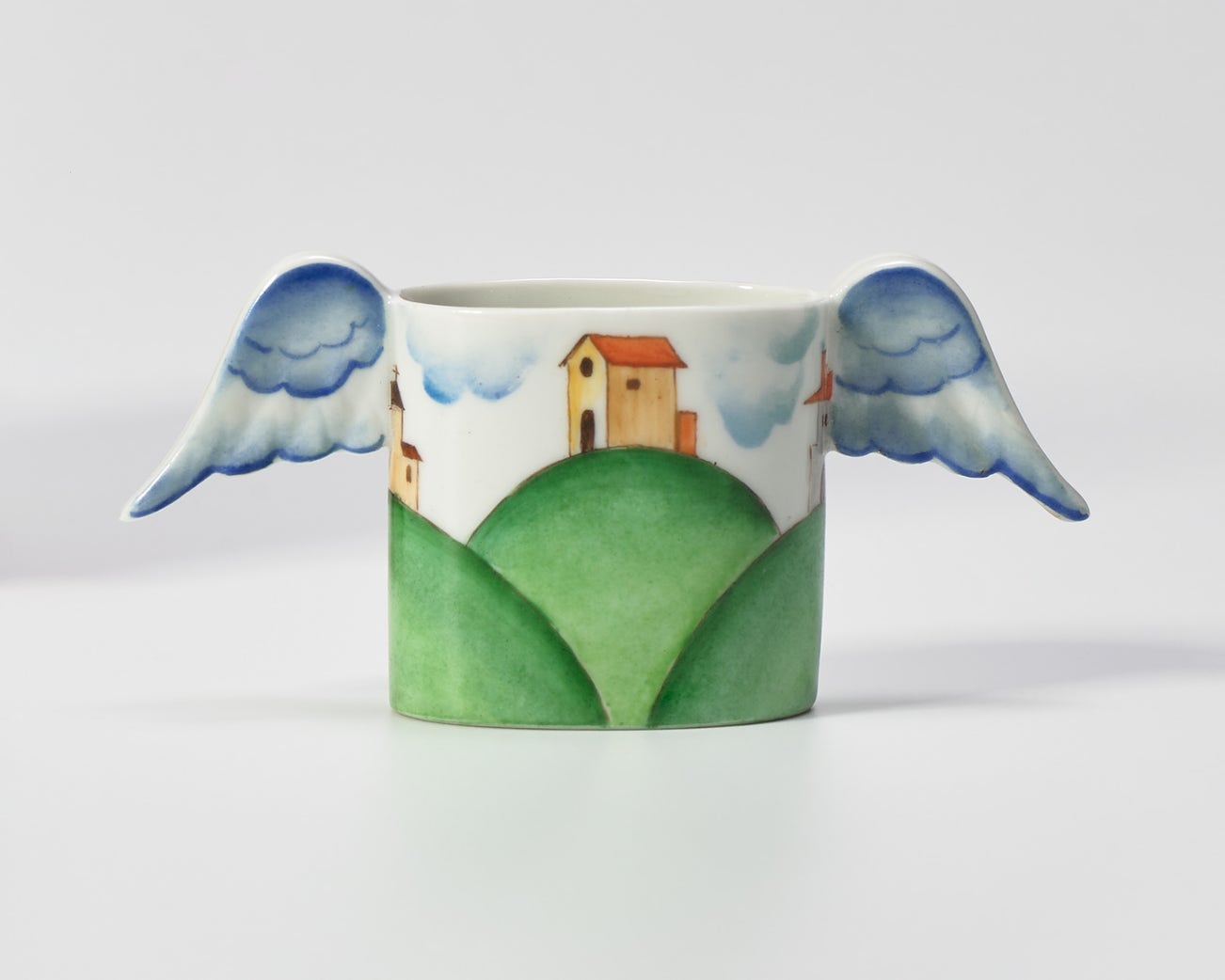
Article | Gio Ponti Design As Emotion
Gio Ponti: Design as Emotion
The legendary architect and designer's letters form a vibrant archive of his aesthetic philosophy and interpersonal sensibilities.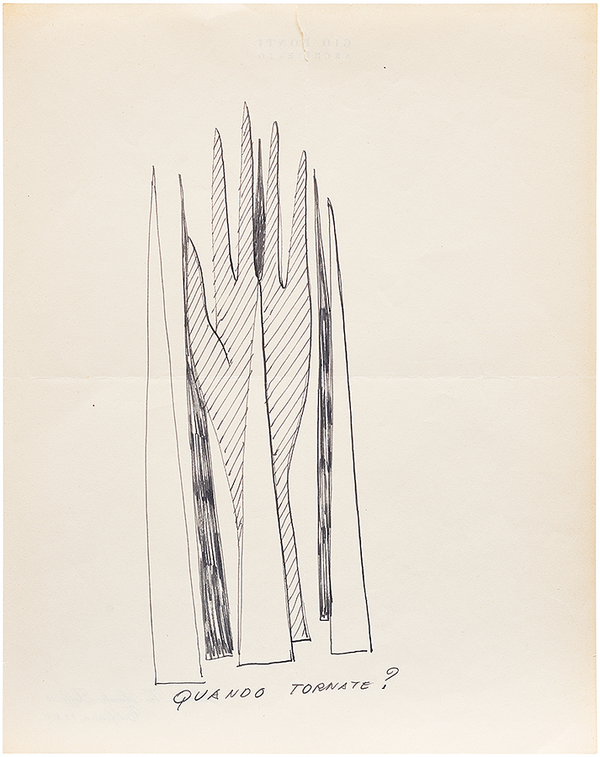
Gio Ponti, 'Mani' letter, circa 1955. Design London.
Gio Ponti's creative legacy extends far beyond the realms of architecture and design, reaching into the intimate and expressive world of personal correspondence. His illustrated letters, imbued with metaphor, whimsical imagery, and emotional subtlety, offer a rare window into the poetic core of his design thinking. Far from mere exchanges, they reveal how he consistently blurred the boundaries between functional design and poetic gesture, personal intimacy and cultural symbolism, ultimately deepening our understanding of his rich and multifaceted creative vision.
The 'Stivale' Letter: Between Fashion, Fantasy, and National Form
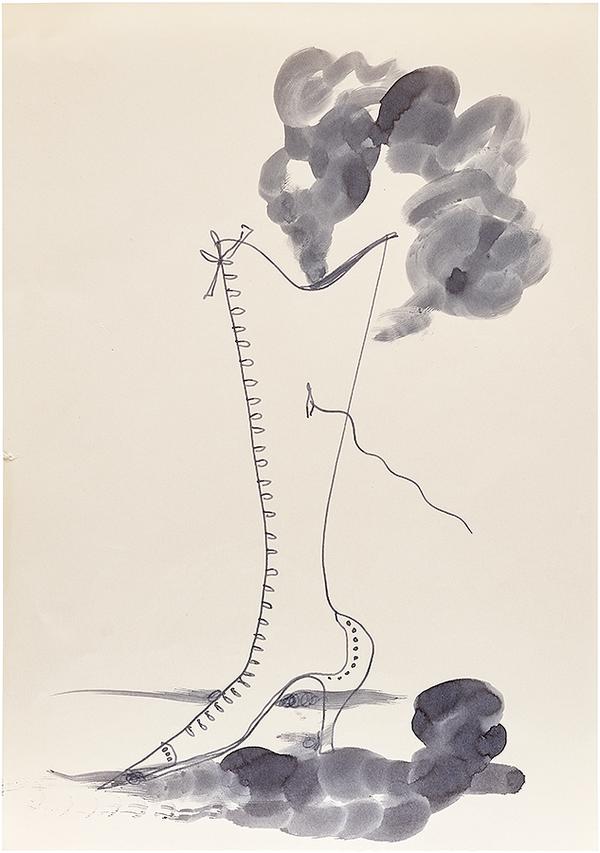
Gio Ponti, 'Stivale' letter, circa 1960. Design London.
Among the most striking entries in Ponti’s epistolary archive is the 'Stivale' letter, centered on the image of a highly stylized boot. While the form initially recalls Italy’s iconic geographic silhouette, Ponti reimagines it with a theatrical flair: the boot is elongated, high-heeled, laced, and adorned with a bow, tapering off into a curling plume of smoke.
This transformation imbues the image with surrealist energy and feminine sensibility, aligning Ponti with the visual culture of mid-century fashion illustration and the dreamlike aesthetics of Elsa Schiaparelli and Salvador Dalí. The boot becomes not a literal object, but a metaphorical site, suggestive of transformation, desire, or combustion.
Far from a design sketch, the 'Stivale' letter embodies Ponti’s refusal to separate functional form from poetic imagination. Its strangeness recalls the eccentric charm of his biscuit porcelain figurines (often caricatures of house guests) created with equal parts humor and elegance. Here, the boot is both accessory and emblem, an evocative symbol that fuses national identity with surreal theatricality.
The 'Mani' Letter: Gesture, Longing, and the Poetics of Touch
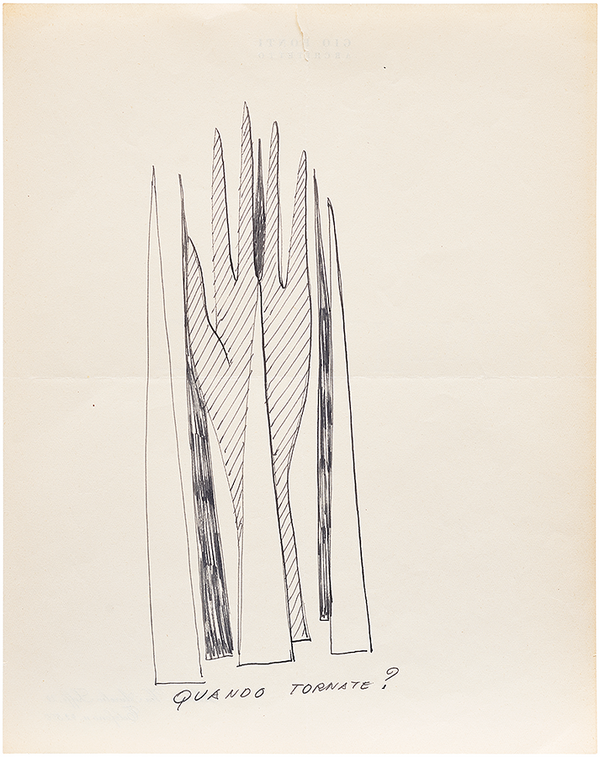
Gio Ponti, 'Mani' letter, circa 1955. Design London.
Hands recur frequently in Ponti’s visual lexicon, as icons of making, symbols of emotion, and extensions of the self. In the Mani letter, a simple yet expressive drawing of a hand accompanies the handwritten phrase, "Quando tornate?" ("When are you returning?"). This brief message, paired with the open palm, transforms the motif into a gesture of longing and affection.
The hand here is dual: it is the designer’s tool, but also the human connector. Rooted in both Renaissance symbolism and modernist abstraction, Ponti’s rendering resists pure formalism, instead emphasising affective resonance. The hand becomes a metaphor for presence, return, and relational closeness.
This motif resonates with Ponti’s gold-plated hands designed for Lino Sabattini in 1978, forms inspired by rubber glove molds, transformed into elegant sculptural objects. Whether drawn or cast, the hand for Ponti was not just anatomy, but allegory: a symbol of creativity, intimacy, and the human dimension of design.
The 'Cucchiaio' Letter: Elevating the Everyday
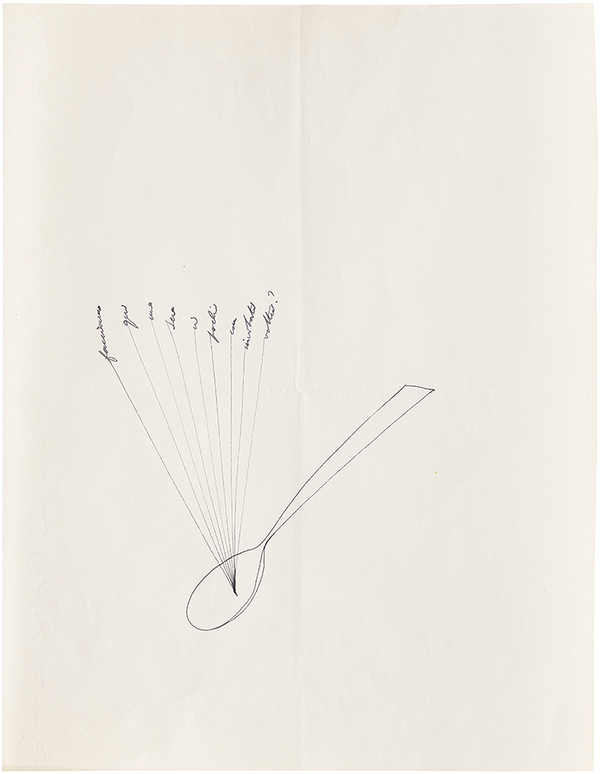
Gio Ponti, 'Cucchiaio' letter, circa 1955. Design London.
The 'Cucchiaio' (spoon) letter exemplifies Ponti’s lifelong interest in refining the design of everyday objects. His collaborations with manufacturers such as Lino Sabattini and Christofle foreground his ability to synthesize elegance with practicality, tradition with innovation.
In this letter, the spoon transcends its utilitarian function, becoming a graceful emblem of Ponti’s philosophy: that even the most humble objects deserve aesthetic consideration. The proportions are carefully drawn, the lines simple yet refined, illustrating his belief in the dignity of domestic life.
The handwritten phrase, "facciamo qui una sera in pochi con invitati vostri?" ("Shall we have a small gathering here one evening with your guests?"), adds a layer of intimacy and conviviality. As with much of Ponti’s correspondence, the letter operates on multiple levels: personal invitation, design reflection, and poetic musing. It connects to his broader role as an industrial designer, devoted to humanizing mass production through thoughtful form.
The 'L'ammirata' Letter: Admiration as Emotional Architecture
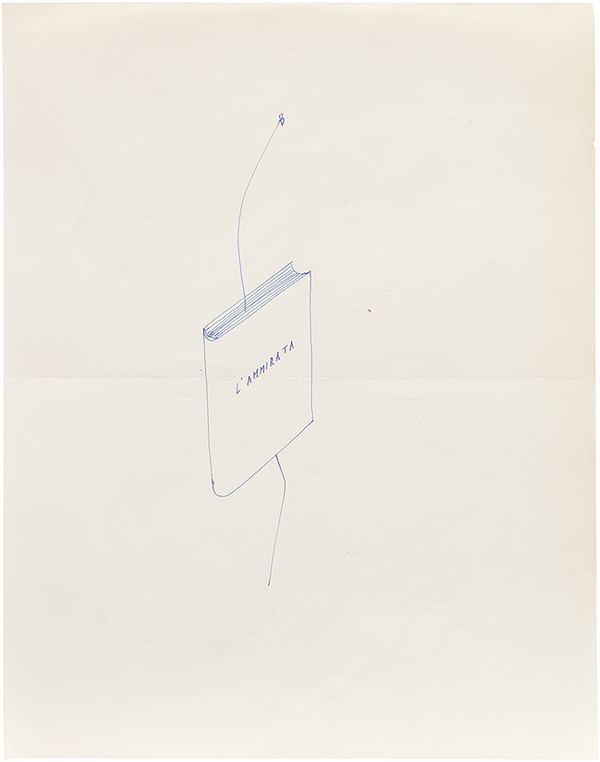
Gio Ponti, 'L'ammirata' letter, circa 1955. Design London.
Titled ‘L’ammirata’, the feminine form of “admired one”, this letter evokes themes of esteem, affection, and wonder. The name suggests a personal, perhaps romantic dimension: a correspondence addressed to someone who inspired Ponti’s admiration.
Whether directed to a muse, a collaborator, or an idea, the letter becomes a symbolic tribute. It resonates with Ponti’s enduring fascination with the dialogue between sender and receiver, designer and audience, subject and object. As a proposed title for a book cover, ‘L’ammirata’ highlights Ponti’s seamless weaving of private narrative into public expression. Like many of his letters, it straddles the line between personal artifact and cultural object, an emblem of admiration rendered through language, drawing, and design.
The delicate motifs within may recall the stylised birds Ponti designed for the enamels of Paolo De Poli, creatures of grace and abstraction, representing beauty distilled into essential form.
The 'Ieri ero a pranzo' Letter: Everyday Poetics and Abstract Nature
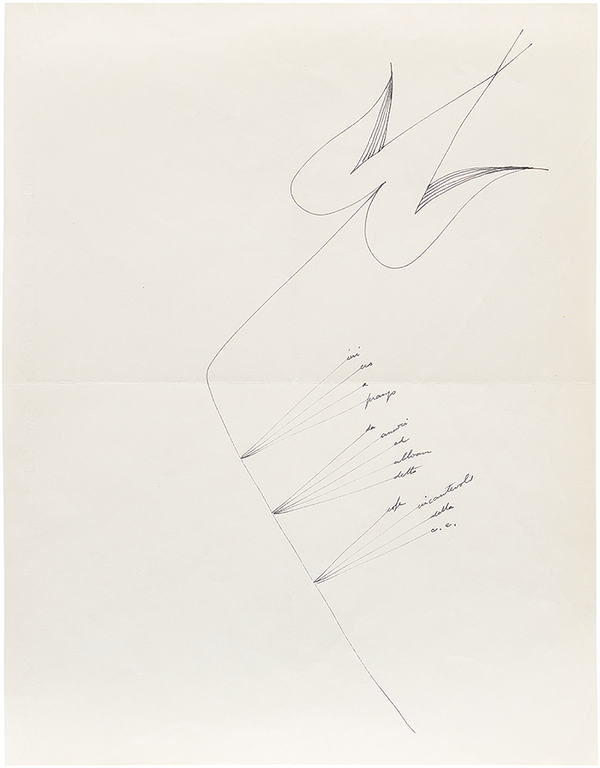
Gio Ponti, 'Ieri ero a pranzo' letter, circa 1955. Design London.
The letter titled ‘Ieri ero a pranzo’ (“Yesterday I was at lunch”) captures Ponti’s singular ability to mine poetic depth from the mundane. Abstract motifs – floral or avian in appearance – emerge not as literal representations, but as stylized evocations of memory and sensation. This abstraction reflects modernist tendencies toward essential form and emotional resonance. Rather than depict lunch as a scene, Ponti evokes its atmosphere, its colors, rhythms, and quiet intimacy, through fluid lines and suggestive shapes.
His imagery recalls not only his own work in ceramics and textiles, but the broader modernist impulse to find meaning in minimalism. The natural world, for Ponti, was a constant wellspring, not for replication, but for reinterpretation. Even a simple lunch becomes an artistic moment, a spark for imaginative seeing.
Gio Ponti’s illustrated letters transcend their function as personal notes. They are intimate, expressive, and richly imaginative artifacts that encapsulate his philosophy: that design is everywhere, that the poetic is inseparable from the practical, and that emotion is a form of intelligence.
From spoons to boots, from gestures to metaphors, Ponti’s correspondence reveals a deeply personal dimension of his creative world – where affection becomes form, and every object carries the potential for beauty. These letters form a kind of Gesamtkunstwerk – a total work of art – where design, drawing, and language come together to celebrate the human spirit.
Recommended Reading