Article | Elizabeth Fritsch Rhythm And Colour
Elizabeth Fritsch: Rhythm and Colour in 2 ½ Dimensions
Ahead of Phillips' 4 November Design auction in London, Head of Sale Antonia King examines the celebrated British Ceramic Artist’s practice and retrospective exhibition at The Hepworth Wakefield.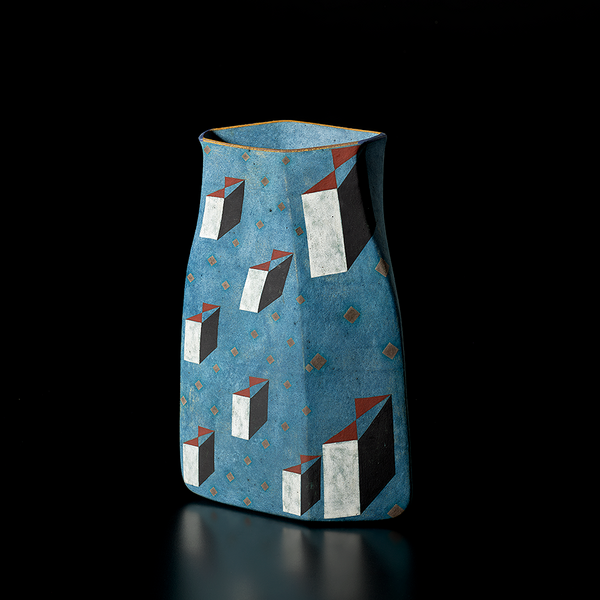
Elizabeth Fritsch, 'Floating particles' vase, circa 1989. Design London.
What is it about Elizabeth Fritsch’s work that speaks to you?
Elizabeth Fritsch (b.1940) is considered one of the UK’s most acclaimed contemporary artists of her generation. I love how original, striking, and, in some cases, bold, Fritsch’s signature style is, as seen through her exploration of colour, geometry, pattern, form, volume, and scale.
What I also find fascinating about Fritsch’s practice is the myriad influences she draws upon, including Cubism, Surrealist literature, Renaissance fresco paintings, metaphysics, mathematics, architecture, and music.
What makes Fritsch’s style so distinctive and desirable?
Fritsch’s vessels display the playful quality of perspectival and optical illusions through hand-building and manipulating the clay into foreshortened or flattened '2½-dimensional' forms. This, in tandem with her masterful use of colour and hand-painted geometrical motifs, distorts our perception of assumed three-dimensional space and depth. On a pictorial plane, such as a canvas, this would be reminiscent of painterly Cubist or even Op Art qualities. For Fritsch, who describes herself as a "painter who makes pots," the vessels are her canvas upon which she uses colour and rhymical patterns to contour and carve illusory form and space.
Fritsch was classically trained in music, first in harp at Birmingham School of Music and then piano at the Royal Academy of Music before turning her hand to ceramics. The rhythmic patterns and geometries seen in her work recall her appreciation and understanding of both classical and jazz rhythms. There is a real sense of lyricism in her practice.

Installation image of Elizabeth Fritsch: Otherworldly Vessels, The Hepworth Wakefield, 8 March 2025–22 February 2026. Image: Antonia King.
The mind boggles, you’re constantly surprised when you move around a piece, with every angle revealing a new perspective and challenging our perception of what a pot can be. Her works go beyond the ostensibly functional and become feats of architectural genius as much as they are sculptural and painterly masterpieces. Aside from their beauty, Fritsch’s visual language pushes the boundaries of the medium. By avoiding conventional ceramic descriptors, her work avoids strict or formal categorization that the traditional language provides. I think this is just one of the reasons why there is such a great and broad appreciation of her work.

Installation image of Elizabeth Fritsch: Otherworldly Vessels. Image courtesy The Hepworth Wakefield.
Which work in the show made the strongest impression on you?
To pick just one work is incredibly difficult! This is in part because the way the works are presented, it’s almost impossible to separate one work from the groupings that are on display. Visitors to this major retrospective are treated to a survey of over 100 works Fritsch made between the 1970s and 2013, many of which are from her own rarely seen personal collection.
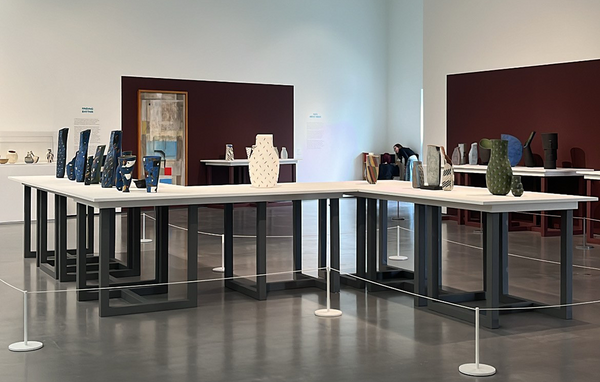
Installation image of Elizabeth Fritsch: Otherworldly Vessels. Image: Antonia King.
What is immediately apparent is that within her self-imposed boundaries there is an extraordinary variety in her works. Fritsch, along with the exhibition’s curator, Dr. Abi Shapiro, have composed meticulous groupings of (often juxtaposed) vessels, inviting you to walk around landscapes of forms and engage in the dialogues and contradictions that they evoke. Walking around, there was something of Giorgio Morandi about her groupings. We see a fascinating interplay between harmony and tension, form and decoration, order and chaos, balance and precarity, symmetry and asymmetry, stillness and movement, the real and the surreal or indeed otherworldly.
Fritsch has said: “The spaces between pots assembled in groups is, to me, more lovely and musical than any of the spatial relationships which may be incorporated into an individual piece. These groups are I suppose like movements in classical music – in which the arrangement adds up, hopefully, to more than the sum of its parts… enabling a dance and play in space.”
For this reason, these are the groupings which made the strongest impression on me:


Installation images of Elizabeth Fritsch: Otherworldly Vessels. Image: Antonia King.
Fritsch’s 'Floating particles' vase, circa 1989, will be offered in our upcoming London Design auction on 4 November. What makes this work so exciting right now?
This wonderful work we are offering in our upcoming Design sale is an intriguing and surreal object in that it asks questions of the viewer, which is an unusual quality in a pot. It displays Fritsch’s signature style beautifully – the flattened 2½-dimensional form, the geometric pattern, and the stunning blue hue.
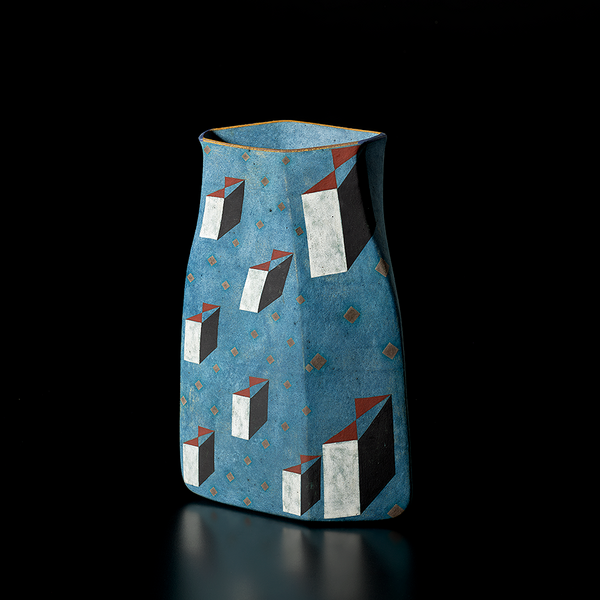
Elizabeth Fritsch, 'Floating particles' vase, circa 1989. Design London.
While many will be familiar with Fritsch’s work, Elizabeth Fritsch: Otherworldly Vessels at The Hepworth Wakefield and the deserved excitement it has generated has been a wonderful opportunity to celebrate Fritsch, her work, and reignite the conversation around her critical role in the evolution of Modern and Contemporary British Art. To have the opportunity to offer one of her beautiful works in the midst of this, is incredibly exciting to us.
Fritsch has earned national and international recognition, and her work has found home in many prestigious private and public collections worldwide, to name but a few: Victoria and Albert Museum, London; National Museum Cardiff; Crafts Study Centre, University for the Creative Arts, Surrey; Sainsbury Centre, University of East Anglia, Norwich; Musée des Arts Décoratifs, Paris; Design Museum, Copenhagen; The Metropolitan Museum of Art, New York; and The National Museum of Modern Art, Tokyo.
How do you consider Fritsch’s work within the lineage of British Ceramicists?
In the mid 1960s, deciding not to pursue a career in music, Fritsch taught herself to hand-build clay vessels at her kitchen table. She then went on to study ceramics at the Royal College of Art from 1968-71 and was taught by Hans Coper, Lucie Rie, and Eduardo Paolozzi.

Portrait of Elizabeth Fritsch. Image: © Elizabeth Fritsch Estate.
While honing her practical, technical, and firing skills, it was arguably Coper who had the most profound impact on her education. Coper encouraged his students to ask why am I making something rather than how am I making something. He encouraged Fritsch to develop her own style, to break away from traditional notions around functionality and explore the relationship between the physical form of a vessel and its influence on the intentionality of the use of colour and abstract pattern (even though his own work was monochromatic). Coper recognised Fritsch as a painter, rather than a potter, which somewhat parallels what Rie had said of Coper in 1988: "I am a potter, but he was an artist."
Fritsch was one of the first of a pioneering group of women ceramicists who emerged from the Royal College of Art during 1970s, including Alison Britton, Jill Crowley, Carol McNicoll, and Jacqueline Poncelet. This radical and progressive cohort of graduates, dubbed the 'New Ceramics' represent a key shift in the development in British ceramics, adopting a far more experimental approach. Their work blurred the lines between craft, sculpture, and art through expressions of sculptural form and colour and moved away from the more utilitarian ceramics and earthy palettes that had come before.
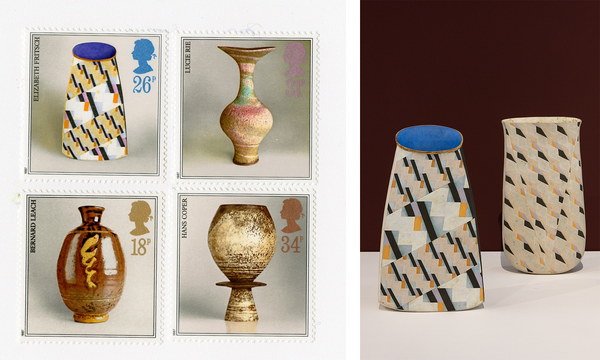
Left: Commemorative stamps issued by Royal Mail, 1987. Image courtesy Tony Evans. Right: Installation image of Elizabeth Fritsch: Otherworldly Vessels. Image courtesy The Hepworth Wakefield.
In 1987, a set of four commemorative stamps was issued by Royal Mail to mark the centenary of the birth of Bernard Leach, regarded as the father-figure of the Studio Ceramics movement in Britain. The set included a work by Bernard Leach, Hans Coper, Lucie Rie, and Elizabeth Fritsch. With her own formidable style, this further highlights Fritsch’s place alongside other titans of British studio pottery. (In 2023 Phillips was honored to sell the Lucie Rie Vase with flaring lip which also featured in this set of stamps!)
In 1995, Fritsch was made a Commander of the British Empire (CBE) for services to the Arts and elected as Senior Fellow at the Royal College of Art.
Elizabeth Fritsch: Otherworldly Vessels is on display at The Hepworth Wakefield until spring 2026 and is a must see!
Recommended Reading