Article | Jp Morgan Jr Watch Collecting Cartier Mystery Clock Charles Frodsham Pocket Bacon Decade One
Inside the J.P. Morgan Family’s Horological Legacy
The Morgan family’s passion for horology mirrored their influence in finance. A century later, two of their most important commissions – a groundbreaking Cartier Mystery Clock and a Frodsham pocket watch – resurface at the Decade One (2015-2025) auction.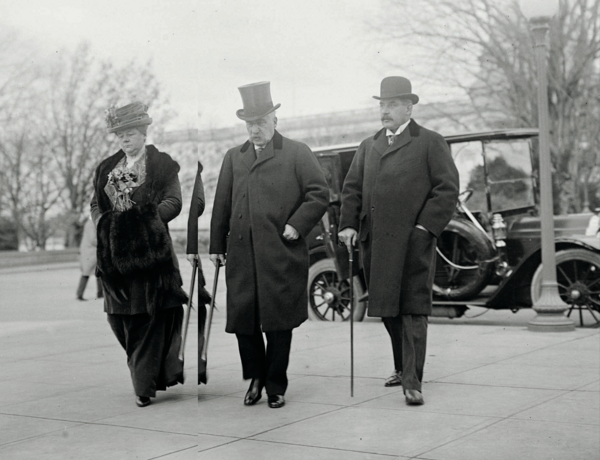
This November, Phillips in Association with Bacs & Russo will celebrate a decade of watch auctions with the Decade One (2015-2025) thematic sale at the Hôtel Président in Geneva. This landmark sale marks the successful first 10 years of the Phillips Watches department, reflecting on the remarkable watches, record-breaking results, and new scholarship that have shaped Phillips Watches since its inaugural auction in 2015.
– By Logan Baker
Few names in American history cast as long a shadow as J.P. Morgan. The titan of finance built a banking empire that shaped the modern global economy, but his influence extended far beyond Wall Street. Morgan was also one of the most important collectors of his era, amassing more than 20,000 objects in the two decades before his death in 1913 – paintings, manuscripts, gemstones, sculptures, clocks, and watches. His voracious appetite for collecting was so well known that when Tiffany & Co.’s chief gemologist identified a new variety of pink beryl, he named it “Morganite” in his honour.
Timepieces fascinated Morgan throughout his life. He catalogued his holdings with the help of British art historian George C. Williamson, who produced multi-volume inventories of everything from Chinese porcelain to portrait miniatures. Morgan’s watches – several hundred examples spanning Renaissance masterpieces to 19th-century English precision work – filled a single 350-page volume. The deluxe edition, printed on Japanese vellum and illustrated with 92 hand-painted plates, remains one of the most collectible horological books ever produced.
Morgan built his watch collection through two key acquisitions: the holdings of German dealer Carl Heinrich Marfels and British banker George Hilton Price. But he also commissioned contemporary pieces from the finest English makers of his time, including Charles Frodsham and J. Player & Son, the latter delivering his final grand complication pocket watch in 1909. When he died four years later, Morgan donated 250 of his watches to the Metropolitan Museum of Art, ensuring his name would endure not just as a financier but as one of horology’s greatest patrons.
J.P. Morgan, Jr.: Financier, Connoisseur, Custodian of Time
John Pierpont Morgan, Jr. inherited not only his father’s fortune and banking empire but also his passion for collecting.
Born in 1867, he assumed leadership of J.P. Morgan & Co. upon his father’s death and guided the firm through the upheavals of the early 20th century, including World War I, when he arranged unprecedented loans and procurement contracts for the Allied powers. Yet amid the pressures of global finance, Morgan Jr. cultivated a private world shaped by art, literature, and mechanics – and watches were central to that pursuit.
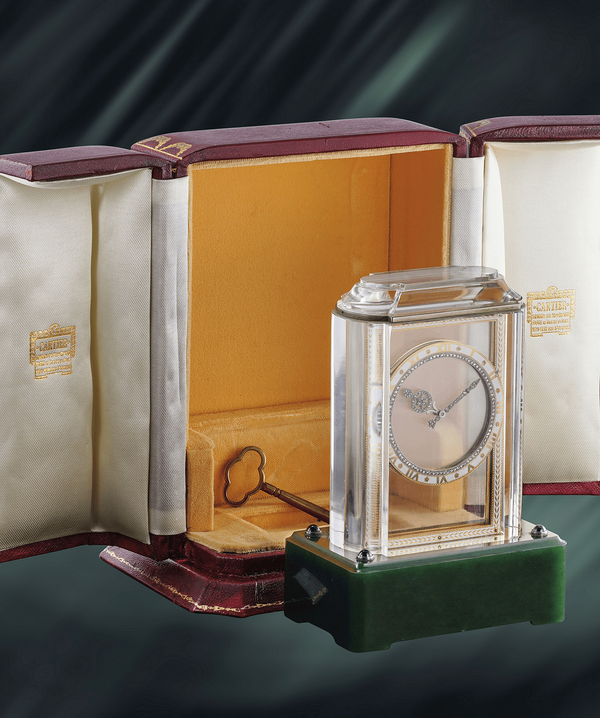
Lot 134: The first Cartier Mystery Clock Model A ever made, built in 1912 and sold to J.P. Morgan, Jr. in 1913. Included in the Phillips Decade One (2015-2025) auction. Estimate: CHF 300,000 - 600,000
Like his father, Morgan Jr. saw horology as both an art and a science, a fusion of human ingenuity and aesthetic refinement. He continued commissioning English pocket watches of exceptional quality, most notably from Charles Frodsham. Between 1898 and 1934, Morgan ordered approximately 45 watches from Frodsham, many of which were highly complicated and engraved as gifts to new partners at the bank. These timepieces were not mere tokens of employment. They were symbols of trust, responsibility, and entry into one of the world's most powerful financial institutions.
Morgan Jr. also embraced the innovations of his time. In 1913, he acquired Cartier’s very first Mystery Clock – a landmark in the history of horology and one of the most significant objects ever produced by Cartier.
This clock, alongside a complicated Frodsham pocket watch, now returns to public view as part of the Phillips Decade One (2015-2025) auction, offering a rare glimpse into the collecting tastes of one of America’s most powerful dynasties.
The First of Its Kind: Cartier’s Model A Mystery Clock
When Cartier unveiled its Model A Mystery Clock in 1912, the watchmaking world had seen nothing like it.
Conceived by clockmaker Maurice Coüet and inspired by the 19th-century magician and horologist Jean-Eugène Robert-Houdin, the design appeared to defy the laws of mechanics: the clock’s hands floated freely in a crystal pane, moving without any visible connection to a movement.
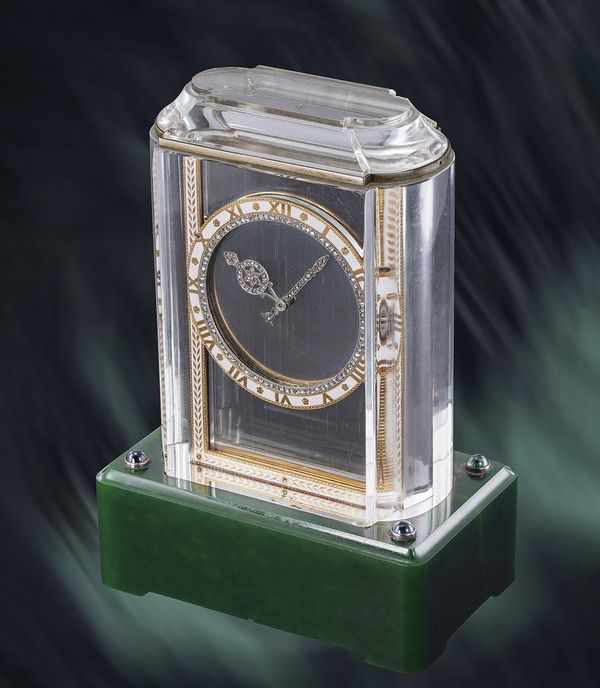
Lot 134: The first Cartier Mystery Clock Model A ever made, built in 1912 and sold to J.P. Morgan, Jr. in 1913. Included in the Phillips Decade One (2015-2025) auction. Estimate: CHF 300,000 - 600,000
The “mystery” lay in a hidden mechanism. The hour and minute hands were mounted not on a traditional arbor but on two transparent crystal discs, each edged with fine teeth and driven by concealed pinions connected to a movement hidden in the clock's base. As the discs rotated at different speeds, the hands appeared to drift magically through space. It was a feat of optical illusion and mechanical ingenuity – one that transformed Cartier’s reputation and established a new category of horological art.
The example included in Decade One (lot 134) is not just any Model A Mystery Clock. It is the very first one ever made, sold in 1913 to J.P. Morgan, Jr.
Its historical weight is immense. This clock is the genesis of an entire lineage of Cartier creations that would captivate royalty, celebrities, and collectors for more than a century. Preserved in exceptional condition, the clock features a nephrite (jade) base, a white enamel bezel, rose-cut diamond accents, and gold leaf detailing.
It has not been seen publicly since 1993, when Cartier itself confirmed in writing that it was the first Mystery Clock ever sold. A letter from the archives at the Morgan Library & Museum further documents the purchase, intended as a gift.
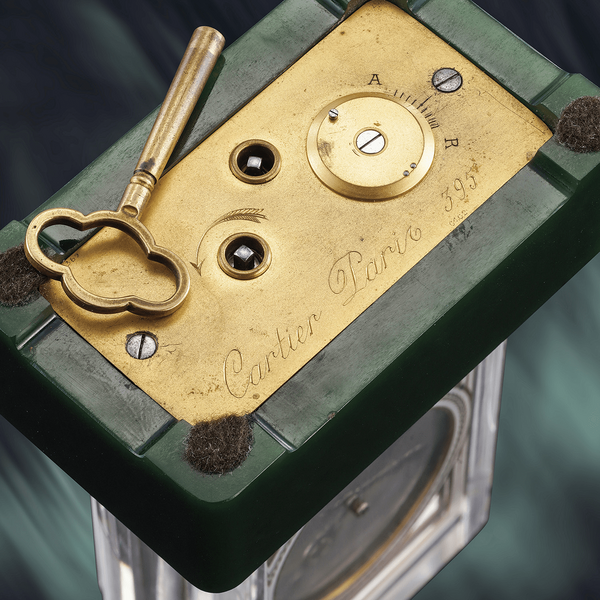
Lot 134: The first Cartier Mystery Clock Model A ever made, built in 1912 and sold to J.P. Morgan, Jr. in 1913. Included in the Phillips Decade One (2015-2025) auction. Estimate: CHF 300,000 - 600,000
The appearance of this clock at auction represents a foundational moment in the story of Cartier and 20th-century horology. Objects of such consequence rarely surface.
Once sold, it is unlikely that another Mystery Clock of this importance will return to the market for decades. It carries an estimate of CHF 300,000 - 600,000.
Learn more here.
Charles Frodsham: A Split-Seconds Chronograph Minute-Repeating Tourbillon Pocket Watch, Gifted to a New Bank Partner
If the Cartier clock reflects Morgan Jr.’s embrace of innovation and artistry, the Charles Frodsham pocket watch in Decade One illustrates his devotion to tradition and English precision.
Completed in 1922, this split-seconds chronograph minute-repeating tourbillon pocket watch is a tour de force of early 20th-century watchmaking.
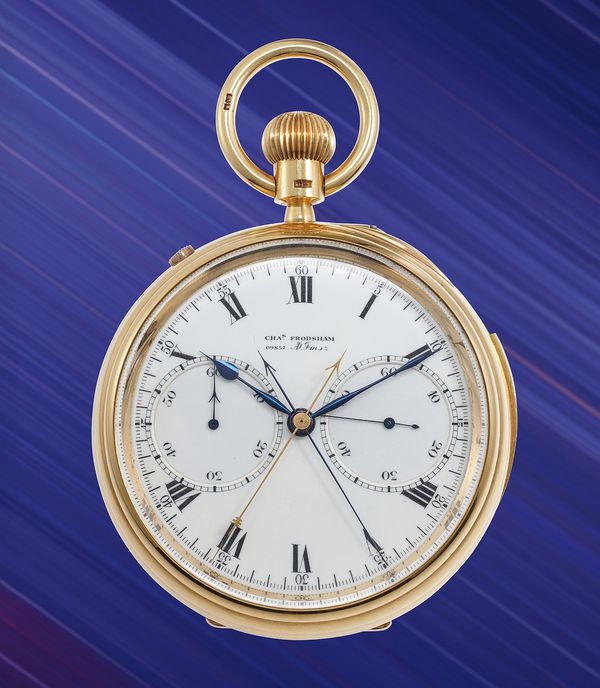
Lot 135: A 1922 Charles Frodsham Minute Repeating, Split Seconds Chronograph Tourbillon Pocket Watch in 18k Yellow Gold. Sold to J.P. Morgan, Jr., and gifted to Elliot C. Bacon. Included in the Phillips Decade One (2015-2025) auction. Estimate: CHF 70,000 - 140,000
Charles Frodsham & Co., founded in the early 19th century, had long been regarded as one of Britain’s premier watchmaking firms. In 1854, Charles Frodsham succeeded Benjamin Lewis Vulliamy as Superintendent and Keeper of Her Majesty’s Clocks at Buckingham Palace, a role that cemented his status at the pinnacle of English horology. After his death, his son Harrison Mill Frodsham continued the family legacy, incorporating the company in 1893 and expanding its reputation for exceptional craftsmanship.
J.P. Morgan, Jr. was among the firm’s most significant patrons. Over the course of more than three decades, he ordered approximately 45 timepieces from Frodsham, typically one to three each year, to commemorate the elevation of new partners into the firm. These were no ordinary gifts. Priced between £200 and £350 – an immense sum at the time – they were among the most intricate and expensive English watches available.
The example being offered at Decade One (lot 135) was presented to Elliot C. Bacon, a Harvard graduate, decorated World War I officer, and one of J.P. Morgan & Co.’s youngest partners. The inner caseback bears the inscription, “From John Pierpont Morgan to Elliot C. Bacon, to mark the occasion of his entering the firm of J.P. Morgan & Co., December 31, 1919”.
Hallmarks indicate the watch was completed in 1922, suggesting the engraving refers to the date Bacon joined the firm. Tragically, Bacon died just two years later at the age of 36, leaving behind a young family. His father, Robert Bacon, had himself been a partner at J.P. Morgan & Co. before serving briefly as Secretary of State and U.S. Ambassador to France.
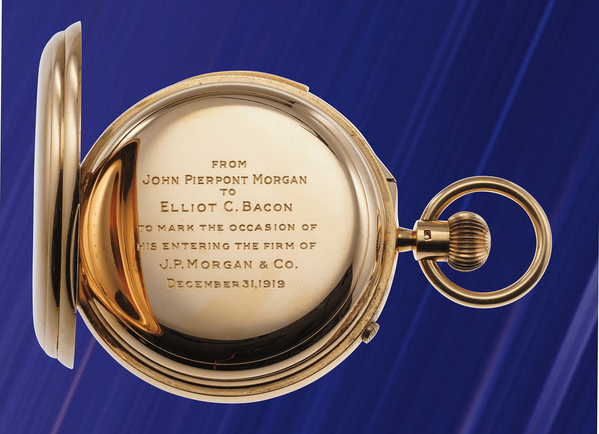
Lot 135: A 1922 Charles Frodsham Minute Repeating, Split Seconds Chronograph Tourbillon Pocket Watch in 18k Yellow Gold. Sold to J.P. Morgan, Jr., and gifted to Elliot C. Bacon. Included in the Phillips Decade One (2015-2025) auction. Estimate: CHF 70,000 - 140,000
The watch’s technical sophistication – tourbillon, split-seconds chronograph, and minute repeater – underscores both the prestige of the gift and the seriousness with which Morgan approached watchmaking. It's estimated at CHF 70,000 – 140,000.
Learn more here.
A Legacy of Time and Power
For both J.P. Morgan and his son, watches and clocks were expressions of intellectual curiosity, artistic appreciation, and technological ambition. They reflected a worldview in which time was not just a matter of money, but also a culture – a discipline to be studied, celebrated, and preserved.
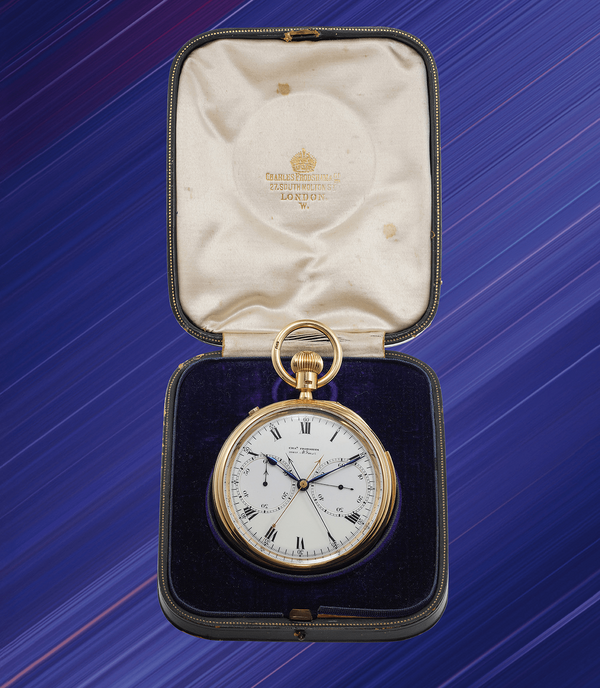
Lot 135: A 1922 Charles Frodsham Minute Repeating, Split Seconds Chronograph Tourbillon Pocket Watch in 18k Yellow Gold. Sold to J.P. Morgan, Jr., and gifted to Elliot C. Bacon. Included in the Phillips Decade One (2015-2025) auction. Estimate: CHF 70,000 - 140,000
The first Cartier Mystery Clock and the Frodsham pocket watch, featured in the Decade One (2015-2025) catalogue, capture two sides of that worldview. One is a bold leap into the future, a piece of horological magic that transformed an entire genre. The other is a masterpiece of traditional English craftsmanship, steeped in history and intricately tied to one of the world’s most powerful banks.
Together, they offer a window into the Morgan family’s singular relationship with timekeeping – and a rare chance for collectors today to own a piece of that story.
You can view the complete Phillips Decade One (2015-2025) auction catalogue here.