Article | Abstract Works On Paper Online Auction New York Modern And Contemporary Art
Color and Conception: In the Abstract
Discover many points of view in these abstract works on paper from the 1960s to now — on offer in our Modern & Contemporary Art: Online Auction in New York.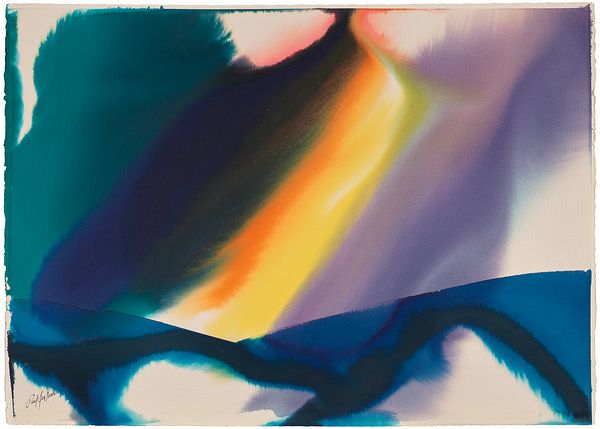
Paul Jenkins, Phenomena Lunar Prism, 1980. Modern & Contemporary Art: Online Auction, New York.
Austyn Weiner
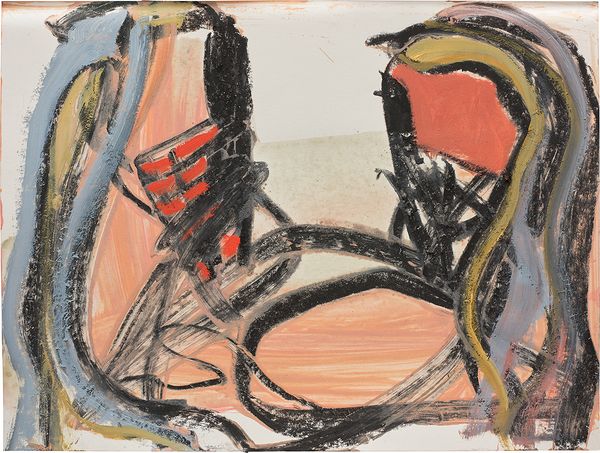
Austyn Weiner, Six Feet And A Mask But I Still Can't Stop, 2020. Modern & Contemporary Art: Online Auction, New York.
Miami native Austyn Weiner studied photography and film before moving to Los Angeles and taking up oil painting. In this work on paper, Weiner combines the use of oil and charcoal for a striking contrast. Across Weiner's practice, the curving lines of her abstract compositions often suggest glyphs or biomorphic shapes; in this work, the suggestion of two heads facing one another is affirmed by the work's charged title: Six Feet and a Mask But I Still Can't Stop clearly calls to mind the pandemic practices of social distancing that were still in full effect when this painting was made. The tension between an emergent figuration and the tangling black lines that seem to bind these two heads together speaks to the frightening realities of social life.
William Baziotes
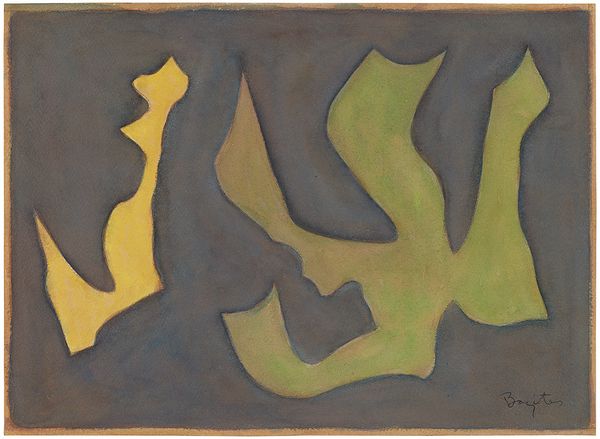
William Baziotes, Untitled, circa 1960. Modern & Contemporary Art: Online Auction, New York.
In this untitled work from American modernist William Baziotes, two jagged shapes appear in a mottled sea of blue-gray. Born in Pittsburgh and trained in New York, Baziotes explored his interest in Surrealism and Symbolism in an Abstract Expressionist milieu that included Jackson Pollock and Roberto Matta. The use of watercolor on paper — especially at the edges of the composition, where color bleeds unevenly onto the substrate — strengthens the dream-like aspect of the painting, as if these two shapes are floating on the surface of something concrete. Often, Baziotes' work concerns landscapes or animals; perhaps here we are seeing the suggestion of birds. That suggestion, though, only serves to emphasize the mystery of human perception and feeling.
Paul Jenkins
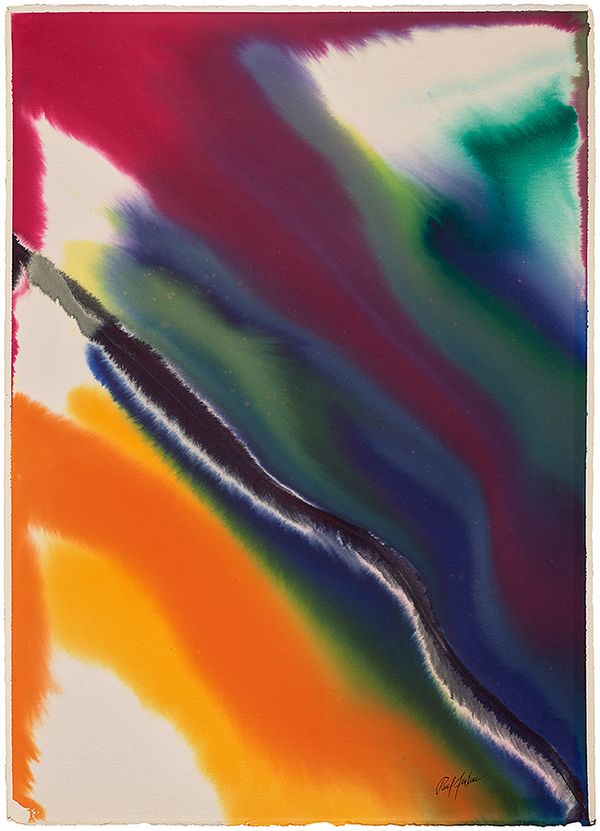
Paul Jenkins, Phenomena Emerald Rim, 1980. Modern & Contemporary Art: Online Auction, New York.
Born in Kansas City, Missouri, artist Paul Jenkins initially studied art at the Kansas City Art Institute while working at a ceramics factory on weekends. Following a stint in the U.S. Navy, he moved to New York City, where he became friends with Abstract Expressionist painters such as Willem de Kooning, Mark Rothko, and Jackson Pollock. Although Jenkins' work often includes the wide areas of color associated with Color Field painting, his process focused on precision rather than chance, using an ivory knife to carefully control the flow and distribution of paint. The emotional intensity of Jenkins' colors is made all the more so by his use of negative space, suggesting, as in one of these works' titles, the operations of a prism.
Sean Scully
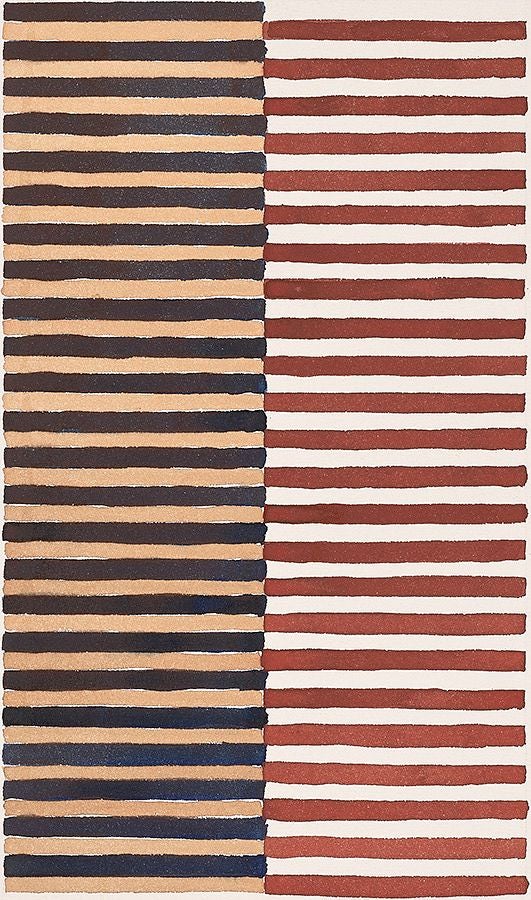
Sean Scully, #31, 1980. Modern & Contemporary Art: Online Auction, New York.
In this 1980 work by Sean Scully, the artist’s interest in geometric abstraction is explored through two columns of horizontal stripes in alternating colors. Born in Dublin, Scully has lived and worked in New York since 1975. The use of stripes, grid forms, and blocks of color comprise the major tools of Scully's practice. The artist has spoken of being influenced by specific landscapes, especially during trips to Morocco and Mexico. The rich, earthy colors of this work do seem to call the desert to mind, even as the strict patterning of the stripes works against the soft edges of each bar of color. The negative space between the stripes of red further complicates the composition: are we looking through the stripes, or at them?
Tyler Hobbs
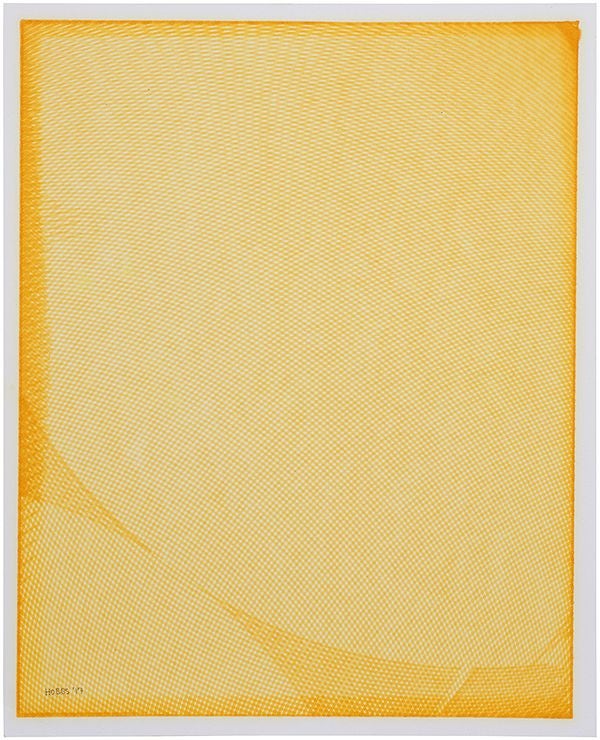
Tyler Hobbs, Plotter Drawing with Marker, 2017. Modern & Contemporary Art: Online Auction, New York.
Artist Tyler Hobbs has built a practice at the forefront of the emergent “generative art” field, using algorithms and plotters to create abstract compositions. The algorithms Hobbs develops have the ability to produce multiple “outputs,” which can all look very different from one another, troubling any easy distinction between the creative capacities of the machinic and the human. In some instances, Hobbs has developed algorithms to make work in response to specific qualities in an existing painting by another artist. In this piece, a deceptively simple composition is actually made up of many curving lines. By treating code as a creative medium and using plotters to execute his works, Hobbs intervenes in the history of practice, expanding notions of the artist's “hand.”
Amy Sillman
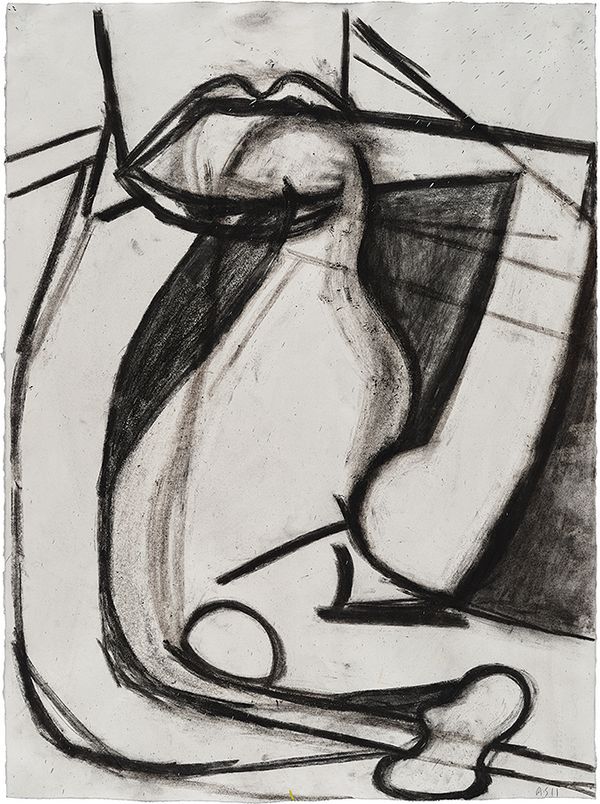
Amy Sillman, Untitled, 2011. Modern & Contemporary Art: Online Auction, New York.
This charcoal on paper work provides a crisp example of Amy Sillman’s unique approach to abstraction. Influenced by contemporary media as much as by Surrealism, Sillman has spoken of seeing herself as creating a “strange new language” out of many cultural and visual components. With bold, gestural lines, Sillman blends — as she so often does — the abstract and the figural in this piece. What might be a pair of lips seems to connect directly to what might be a limb, which in turn ends in a knobby shape that could be a bone. Though emphatic, Sillman’s mark-making also vibrates with restraint. The effect is an all-over vitalism that shines through the work.
Kevin Beasley
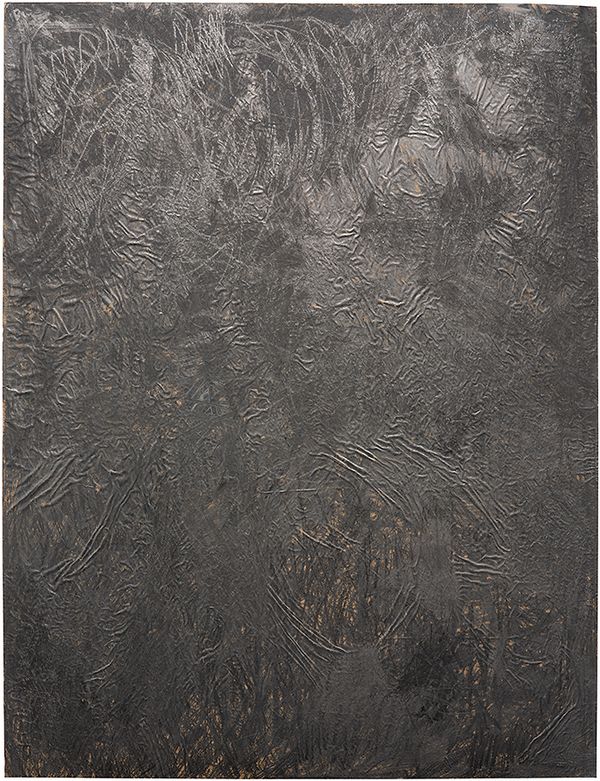
Kevin Beasley, IT BLACK OSTRICH FEATHERS ON THE HEAD. SURMOUNTED BY PLOOMS OF L, 2020. Modern & Contemporary Art: Online Auction, New York.
Artist Kevin Beasley’s practice has ranged across sculpture, painting, drawing, sound, and more. Originally from Lynchburg, Virginia, Beasley’s work takes a deep interest in unusual and found materials, particularly those connected to Black American history and identity and to mass production. In one series, for example, t-shirts, housedresses, raw cotton, and other textiles were amassed and set in resin. This work on paper, on the other hand, uses graphite, ink, and acrylic, but its title invokes another material: black ostrich feathers. Throughout history, ostrich feathers have been used across multiple cultures as a sign of status or as a tool of magical or religious ceremonies. Beasley’s carefully worked surface shines with the glint of feathers, opening the monochrome up to movement and a nascent narrative.
Emily Mason
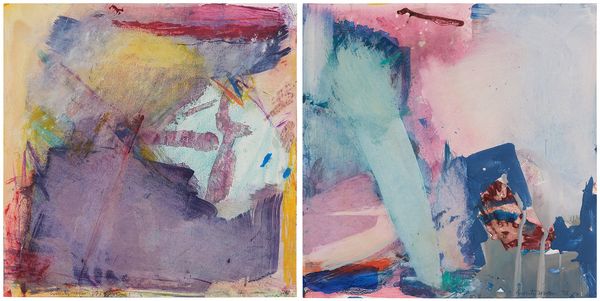
Emily Mason, Two works: (i-ii) Untitled, 1977 & 1978. Modern & Contemporary Art: Online Auction, New York.
These two works by Emily Mason exemplify this underrecognized artist’s contributions to American abstraction. Born into a striking lineage, to accomplished abstract painter Alice Trumbull Mason, herself a descendant of well-known portrait painter John Trumbull, Emily Mason studied and worked in New York and Italy. As these oil on paper paintings show, Mason’s work combines elements of Abstract Expressionism and Color Field painting, forging a visual language that prioritized color and the material capacities of paint. Less brightly colored than some of her other works, these two paintings show Mason’s ability to wield a tremendous eye for the subtleties of color and a variety of painterly techniques, blending brushstrokes with pours and drips. Her layering of color, texture, and form results in two works that almost appear to bloom.
Discover more from Modern & Contemporary Art: Online Auction, New York >
Recommended Reading