Article | The Beauty Of Split Seconds Chronographs Essay
The Beauty of Split-Seconds Chronographs
Few mechanisms inspire as much awe as the split-seconds chronograph. This September, Phillips offers examples spanning A. Lange & Söhne, IWC, and even a vintage Britix.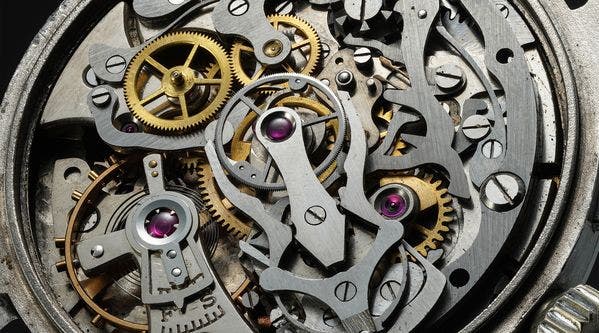
Phillips in Association with Bacs & Russo is thrilled to welcome you to The Geneva Sessions, Fall 2025, online auction, running from 12:00 PM CET, Thursday, 4 September, to 2:00 PM CET, Friday, 12 September. The sale features more than 80 different high-end luxury wristwatches, covering everything from A. Lange & Söhne and F.P. Journe to Audemars Piguet and Patek Philippe, including three fantastic examples of split-seconds chronographs.
– By Logan Baker
There’s a particular kind of magic in a split-seconds chronograph. At first glance, it looks like any other chronograph, but press the extra pusher and you see it: one chronograph hand halts to mark a lap, while the other keeps sweeping along. Hit the button again, and the paused hand snaps forward, rejoining its partner in perfect synchrony. It’s a simple gesture that hides a world of technical complexity.
The split-seconds, or rattrapante (from the French rattraper, “to catch up”), sits at the very top of the chronograph hierarchy. A standard chronograph already requires deft integration of wheels, levers, cams, and springs. Add a second seconds hand, plus a system of clamps and heart-shaped cams that allow one hand to stop independently and then rejoin the other, and you’ve entered the realm of mechanical bravado. It’s why watchmakers and collectors alike regard the split as the most demanding of all chronographs to adjust, assemble, and service.
The complication’s origins trace back to late 19th-century pocket watches. Patek Philippe produced the first split-seconds wristwatch in 1923, and by the mid-20th century, suppliers like Venus and Valjoux were building ébauches that powered splits from Breitling, Eberhard, and smaller names like Britix. The mechanism is a joy to study: the jaws of a clamp, controlled by a column wheel or lever, squeeze one chronograph wheel to a halt while the other keeps turning. Release the clamp, and the hands snap back into alignment. The principle hasn’t changed in a century, and it remains one of watchmaking's most elegant pieces of theater.
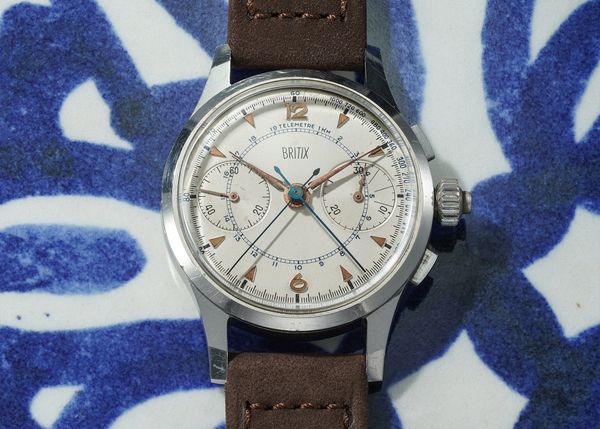
Lot 71: A Britix split-seconds chronograph in stainless steel with Venus calibre. Included in the Phillips Geneva Sessions, Fall 2025, Online Auction. Estimate: CHF 10,000 - 20,000
Collectors today gravitate to split-seconds watches for the same reasons as ever. They’re rare, they’re interactive, and they embody the tension between mechanical complexity and playful utility. You don’t need a horse race or a 24-hour endurance rally to enjoy one. Timing a pair of steaks on the grill or comparing two runners at the park can be just as satisfying. Unlike a moon-phase or a perpetual calendar, a split-seconds chronograph is something to engage with.
The Phillips Geneva Sessions Online Auction in September 2025 brings together a fascinating cross-section of the split-seconds story, from mid-century charm to modern extremes. A vintage Britix chronograph with a Venus movement offers an authentic taste of the 1940s and ’50s, when such mechanisms were produced in small numbers for brands that have largely faded from memory. These watches are beloved by enthusiasts precisely because they’re attainable, functional, and mechanically intricate. Pop open the caseback, and you’ll find the twin chronograph wheels and the tiny clamp arms that make the trick work.
At the other end of the spectrum is the A. Lange & Söhne Triple Split, perhaps the most audacious chronograph of the past decade. When Lange introduced its Double Split in 2004, collectors could scarcely believe it: a rattrapante that didn’t just track seconds, but also minutes. The Triple Split went even further in 2018, adding hours to the equation. It remains the only mechanical chronograph capable of timing two events lasting up to twelve hours simultaneously.
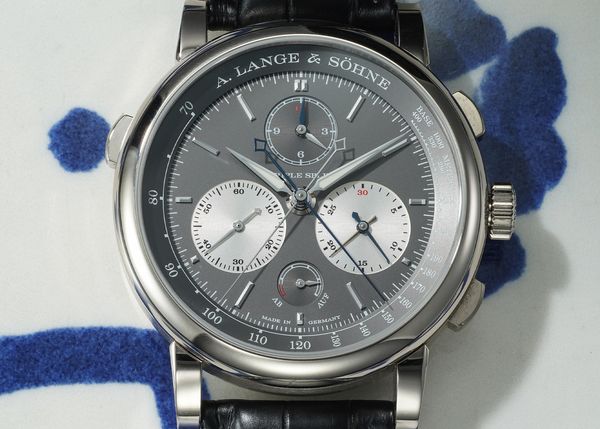
Lot 62: An A. Lange & Söhne Triple Split in 18k white gold. Included in the Phillips Geneva Sessions, Fall 2025, Online Auction. Estimate: CHF 50,000 - 100,000
Then there’s the IWC Portugieser Rattrapante Boutique Milano Edition, a limited-series watch that speaks to the complication’s broad appeal. IWC has a long history with the split, thanks to Richard Habring’s ingenious early 1990s redesign of the mechanism to work with a modified Valjoux 7750 base. That move democratized the rattrapante, making it more serviceable and more accessible, while still delivering the tactile thrill of the split hands. The Milan boutique edition takes that legacy and wraps it in the clean, nautical-inspired design of the Portugieser, making it a compelling entry point for collectors who want something functional, stylish, and historically important.
What ties all of these watches together – whether it’s a mid-century Britix, a boutique-edition IWC, or Lange’s world-beating Triple Split – is the enduring appeal of the complication itself. Collectors love rattrapantes not just because they’re rare, but because they embody watchmaking at its most interactive and alive. They’re watches that invite you to press a button, see something happen, and feel a connection to the gears and springs beneath the dial.
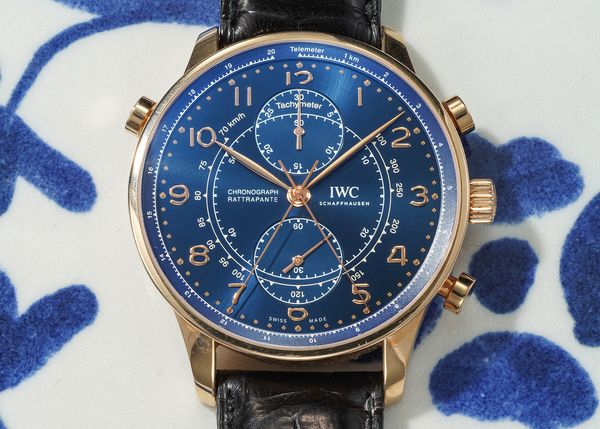
Lot 45: An IWC Schaffhausen Portugieser Rattrapante Limited Edition Boutique Milano in 18k red gold. Included in the Phillips Geneva Sessions, Fall 2025, Online Auction. Estimate: CHF 10,000 - 20,000
The split-seconds chronograph is strictly about the audacity of making two hands move as one, split apart, and then reunite perfectly on command. That delicate dance has fascinated watchmakers for over a century, and it continues to fascinate collectors today.
You can view the complete Phillips Geneva Sessions, Fall 2025, Online Auction catalogue here.
About Phillips In Association With Bacs & Russo
The team of specialists at PHILLIPS Watches is dedicated to an uncompromised approach to quality, transparency, and client service. Phillips in Association with Bacs & Russo holds the world record for the most successful watch auction, with its Geneva Watch Auction: XIV having realized $74.5 million in 2021. Over the course of 2021 and 2022, the company sold 100% of the watches offered, a first in the industry, resulting in the highest annual total in history across all the auction houses at $227 million.
About Logan Baker
Logan has spent the past ten years covering the watch industry from every angle. He joined Phillips in Association with Bacs & Russo in early 2023 as Senior Editorial Manager, after previous roles at Hodinkee and WatchTime. Originally from Texas, he spent a decade in New York and now calls Geneva home.
Recommended Reading