Article | Urwerk Emc Phillips Auction September 2025 Fine Adjustment
The Urwerk EMC: When a Watch Becomes Its Own Watchmaker
Urwerk’s EMC lets you check and regulate your own watch. Now, one of just 55 original examples heads to Phillips.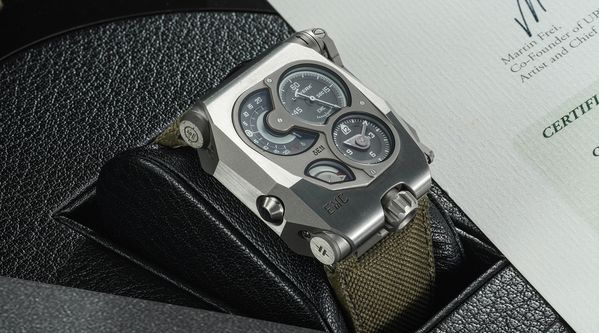
Phillips in Association with Bacs & Russo is thrilled to welcome you to The Geneva Sessions, Fall 2025, online auction, running from 12:00 PM CET, Thursday, 4 September, to 2:00 PM CET, Friday, 12 September. The sale features more than 80 different high-end luxury wristwatches, covering everything from A. Lange & Söhne and F.P. Journe to Audemars Piguet and Patek Philippe, including an Urwerk EMC.
– By Logan Baker
If you’ve ever hung around an independent watchmaker’s bench, you’ll know one sound well: the soft tick-tick of a timing machine. Watchmakers rely on devices like a Witschi to measure the accuracy of a movement, tweaking a screw here or a regulator arm there until the watch runs as close to perfect as possible. It’s one of those behind-the-scenes rituals that separates a finely tuned chronometer from a finicky timekeeper.
In 2013, Urwerk asked a question no one else had: What if you could put that process on the wrist?
The result was the EMC – short for Electro Mechanical Control – a watch that keeps the time, yes, but also measures its own accuracy and allows the owner make fine adjustments. It was a wild idea when it launched, and more than a decade later, it remains one of the most audacious feats of mechanical engineering in contemporary watchmaking.
This September, Phillips will offer an Urwerk EMC at our Geneva Sessions Online Auction – number 38 of just 55 pieces. It marks a rare opportunity to acquire a watch that, quite literally, rewrote the rules of what a mechanical wristwatch could be.
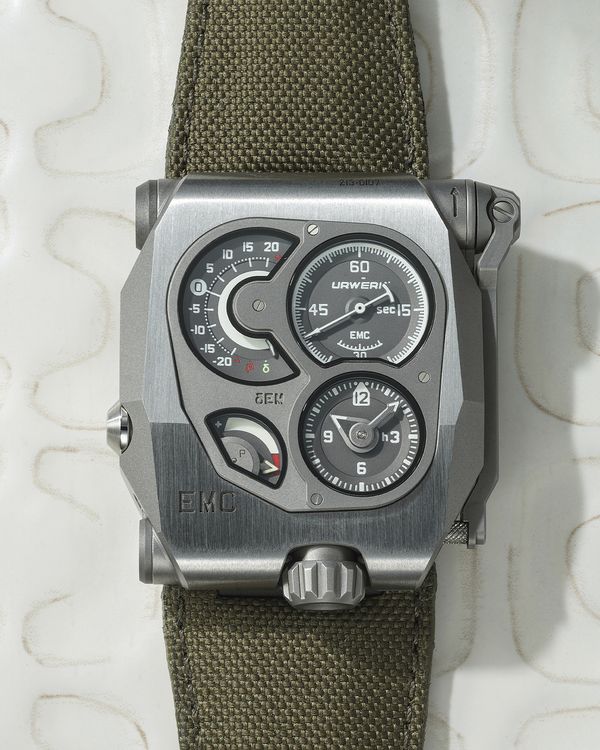
Lot 15: A 2014 Urwerk EMC wristwatch in natural titanium that's included in the Phillips Geneva Sessions, Fall 2025, Online Auction. Estimate: CHF 30,000 - 60,000
The EMC emerged from Urwerk’s U-Research Division, the brand’s experimental lab that functions as a skunkworks for ideas too radical for conventional production. If Urwerk’s satellites-and-retrogrades aesthetic defined its early identity, the EMC was the project that proved Urwerk founders Felix Baumgartner and Martin Frei could continue to think outside the box.
The concept sounds simple when you boil it down: build a watch with a Witschi inside. But nothing about executing that idea was simple.
At its core, the EMC is a fully mechanical wristwatch. Power comes from a hand-wound calibre, conceived and built in-house, running at 4 Hz (28,800 vph) and driven by twin-stacked barrels in series to deliver a steady 80-hour power reserve. The balance is crafted from ARCAP, a nickel-based alloy that resists magnetism and corrosion. By itself, that would make for a respectable independent watch.
But the magic starts when you flip open the little crank on the side of the case. A few turns feed energy into a micro-generator – produced by Maxon, the same company that makes motors for NASA’s Mars rovers – which powers a tiny optical sensor perched above the balance wheel.
Press a button on the case, and the sensor kicks into action. A built-in LED flashes across the balance; the sensor reads its oscillations over a three-second interval and compares them against a 16,000,000 Hz quartz oscillator tucked inside the case. The system then crunches the data and displays the result on a dedicated sub-dial, showing how many seconds per day the watch is gaining or losing (within a range of -20 to +20 seconds).
For the first time in horological history, a watch wasn’t just running – it was telling you how well it was running.
The EMC dial is unlike any other Urwerk, and that’s saying something. In fact, this was the first Urwerk to use central hands for the hours and minutes.
Look closer, and you see four indications, each occupying its own quadrant:
- Top left: the precision indicator, showing the daily rate deviation.
- Top right: running seconds.
- Bottom right: hours and minutes.
- Bottom left: an 80-hour power reserve.
It’s a cockpit-style display, information-rich but clean once you know how to read it. Urwerk wanted the EMC to be intuitive, even if what it was doing under the hood bordered on science fiction.
Flip the watch over and you’ll see another first for Urwerk: a display caseback. It reveals the hand-wound movement, but also something far stranger – an integrated circuit board sitting alongside traditional bridges and wheels.
It’s a jarring sight at first: Geneva stripes brushing up against microchips, anglage sharing space with soldered connections. And yet it all feels deliberate, the mechanical and electronic components working in tandem.
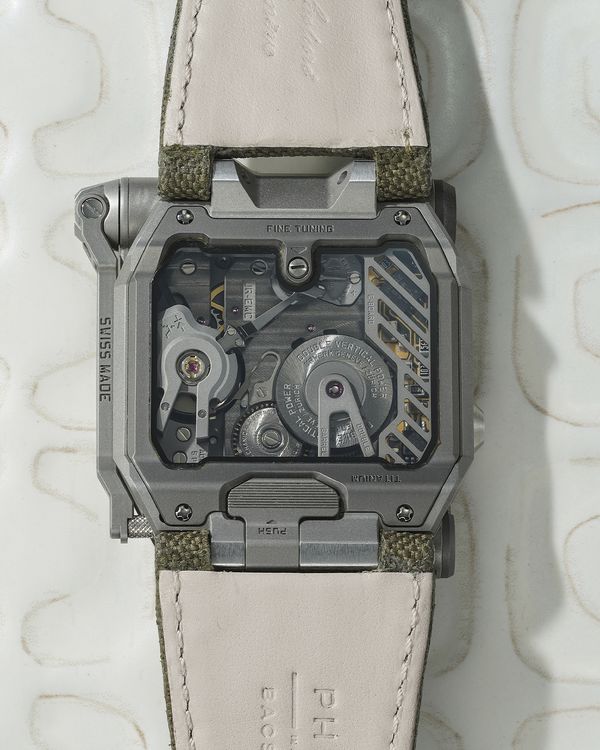
Lot 15: A 2014 Urwerk EMC wristwatch in natural titanium that's included in the Phillips Geneva Sessions, Fall 2025, Online Auction. Estimate: CHF 30,000 - 60,000
This hybrid approach doesn’t make the EMC a smartwatch. The electronic system has no influence on the gear train or escapement; it’s purely a diagnostic tool. The mechanical side tells the time. The electronic side tells you how well it’s performing.
And if you don’t like the result? That’s where the fine-tuning screw comes in. Located on the caseback, it lets the owner adjust the active length of the balance spring, effectively regulating the watch at home. No trip to the watchmaker required.
At the 2014 Grand Prix d’Horlogerie de Genève, the EMC walked away with both the Best Innovation and Mechanical Exception prizes. It was recognition of the audacity required to merge two worlds that had long been kept apart.
For collectors, the EMC represents a watershed moment in independent horology. It’s the rare watch that offers both a philosophical statement and a technical breakthrough. Philosophically, it challenges the passive relationship we usually have with our watches. Instead of entrusting accuracy to a watchmaker or machine, the EMC puts it in your hands. Technically, it also proved that electronics could coexist with fine watchmaking without undermining it.
More than a decade on, the EMC still feels ahead of its time. Interactive mechanical watches haven’t become a category – at least not yet. Which makes the EMC all the more compelling: a true outlier, produced in small series.
You can view the complete Phillips Geneva Sessions, Fall 2025, Online Auction catalogue here.
About Phillips In Association With Bacs & Russo
The team of specialists at PHILLIPS Watches is dedicated to an uncompromised approach to quality, transparency, and client service. Phillips in Association with Bacs & Russo holds the world record for the most successful watch auction, with its Geneva Watch Auction: XIV having realized $74.5 million in 2021. Over the course of 2021 and 2022, the company sold 100% of the watches offered, a first in the industry, resulting in the highest annual total in history across all the auction houses at $227 million.
About Logan Baker
Logan has spent the past ten years covering the watch industry from every angle. He joined Phillips in Association with Bacs & Russo in early 2023 as Senior Editorial Manager, after previous roles at Hodinkee and WatchTime. Originally from Texas, he spent a decade in New York and now calls Geneva home.
Recommended Reading