Article | A Birds Eye View Of The Self
A Bird's Eye View of the Self
William Kentridge's printmaking practice and the intersections of memory, meaning, and instability.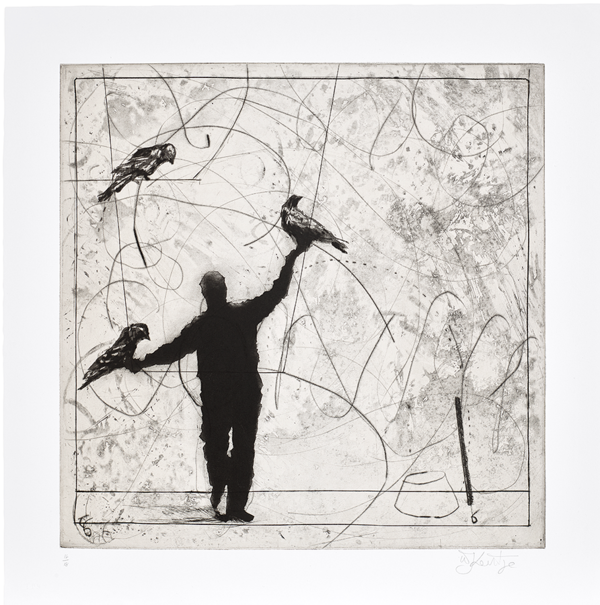
William Kentridge, Bird Catching: four plates (detail), 2006. Evening & Day Editions London.
Printmaking sits at the very heart of William Kentridge’s artistic language — a layered process of reduction and addition through which he thinks, questions, and confronts the world. Working across intaglio, lithography, screenprint, and woodcut, his prints are closely aligned with his draughtsmanship. Images are formed by accumulating lines and impressions that echo the fragmented, overlapping nature of memory and history. The formal density — often stark in its monochrome palette — is not just an aesthetic choice but a metaphor for memory’s contradictions: its revisions, ghosts, and erasures. In post-Apartheid South Africa, a place still wrestling with how to tell and retell its own stories, printmaking offers Kentridge a medium that is inherently iterative and collaborative. It is also a practice with its own radical history, from Goya to Kollwitz to the politically charged anti-Apartheid protest posters of the 1970s, which Kentridge himself helped produce as a student. Building on this lineage, Kentridge’s prints are not standalone, static statements, but visual palimpsests where image, history, and the self are in constant flux.
Born, raised, and still living in Johannesburg, Kentridge’s identity is inextricably bound to the layered histories and enduring injustices of his South African homeland. He began making prints in the early to mid 1970s while studying politics and art at the University of the Witwatersrand, producing screen-printed posters for trade unions, student protests, and theatre groups — an early fusion of activism and image-making. This formative period led him to teach etching at the Johannesburg Art Foundation between 1976 and 1978, deepening a lifelong engagement with the printed image. Over the following decades, Kentridge developed a wide-ranging practice spanning drawing, animation, performance, and opera direction, yet printmaking has always remained a vital core. Whether experimenting with the expressive line of drypoint or the bold contrasts of woodcut, he continually returns to the medium as a means to wrestle with how personal and collective histories are remembered, revised, and sometimes wilfully forgotten. As we engage with his prints, these convergences act as both a passkey for deciphering Kentridge’s layered meanings, and indeed as new directions for discovery as the artist's practice continues to develop.
Printmaking […] became a medium in which I could think, not merely a medium to make a picture [...] it has not been an adjunct to my other activities, but in many ways it has been a central thread that has gone through the work I have done in the studio over the last 40 years. —William Kentridge, Johannesburg, March 2021
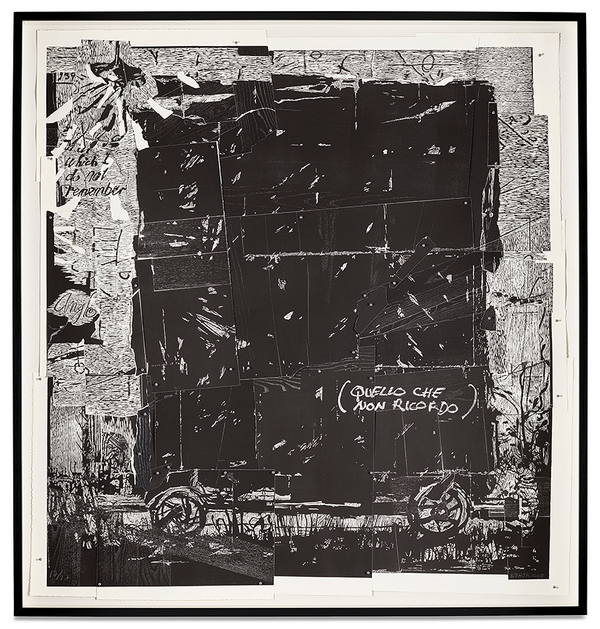
William Kentridge, That Which I Do Not Remember, from Triumphs and Laments, 2017. Evening & Day Editions London.
The notions of forging and forgetting memories are powerfully staged in That Which I Do Not Remember, one of Kentridge’s most striking and conceptually potent woodcut prints. A vast black square dominates the surface, composed of richly printed woodgrain panels — cut, torn, and collaged together — the layers suggest something concealed, obscured, or already lost. Amid this darkness, the phrase quello che non ricordo (that which I do not remember) is inscribed in white: part confession, part provocation. It hovers between personal lapse and historical amnesia, gesturing toward the gaps in memory that are both individual and collective. Unlike many of Kentridge’s works, which draw directly on classical or historical iconography, this print is defined by absence. “It gestures towards that section of history that we should know, but don’t,” Kentridge has said. The black mass becomes a rupture in the historical record. It speaks not only to personal memory and loss, but to the gestalt silence we inherit — what societies choose to forget and erase.
The square itself carries layered references, such as to Kazimir Malevich’s 1915 painting, Black Square, and its inauthenticity with regard to its claims of pure abstraction. Kentridge has also noted that the black square draws on Soviet-era censorship, when swathes of black ink nicknamed "caviar" were used to erase people from record in an officially enforced act of forgetting. Finally, the square is also grounded in the material process of printmaking itself: “the blackness of a rolled-up piece of ink,” as Kentridge describes it, becomes not just a symbol but a sensuous, physical presence. “There’s something miraculous,” he says, “about the solidness and stickiness [...] the desire of the roller for the ink and the glass.”
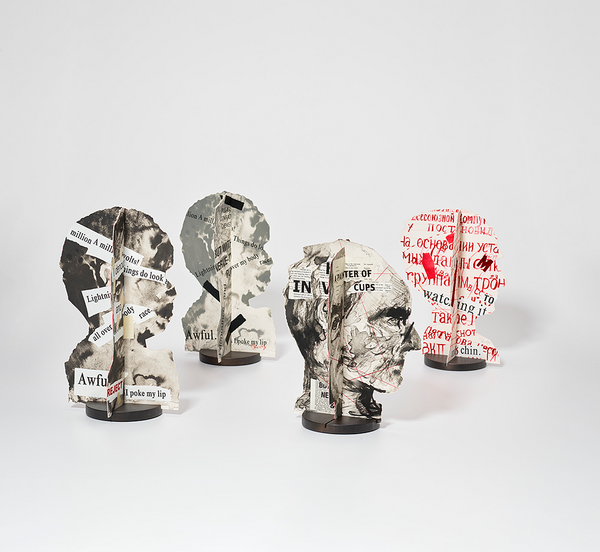
William Kentridge, Four Paper Heads, 2007. Evening & Day Editions London.
Where That Which I Do Not Remember explores forgetting and cultural amnesia through the presence of an imposing black void, Kentridge’s Four Paper Heads embrace fragmentation, excess, and contradiction at the individual level. These three-dimensional lithographic works confound easy categorisation. Constructed from two interlocking silhouettes slotted together at right angles, each forms a head in profile that evokes both the solemnity of classical portrait busts and the playfulness of children’s shadow puppets. They are adorned with newspaper headlines, expressively drawn features, and scrawled texts, appearing fractured, unstable, and alive with meaning. They hint at a mind in flux; one trying to process both the noise of the outside world and the internal chatter that whirls around one’s head. These ambiguous, disjointed heads can also be seen as metaphors for the South African body politic — fragmented, unsettled, and caught in an enduring state of re-writing and re-remembering.
Beneath their simple construction, the Four Paper Heads delve into deeper questions of identity, memory, and the splintered self — ideas that recur throughout Kentridge’s practice. The artist frequently uses his own likeness as a returning character, and here again he turns the portrait inward, creating multivalent images of the self. “They’re a mixture,” he explains. “They’re a play between sculpture and drawing, but they’re also a play between portrait […] and texts.” The language embedded on their surfaces — disjointed phrases, Cyrillic script, anatomical labels — furthers this sense of dislocation and multiplicity. The result is an object that resists stable classification — part sculpture, part print, part collage. Their shifting mediums and meanings reflect a wider concern running through Kentridge’s practice: the instability of constructed identities on a personal, political, and historical basis, particularly within the context of post-Apartheid South Africa, where national narratives remain fluid and unresolved.
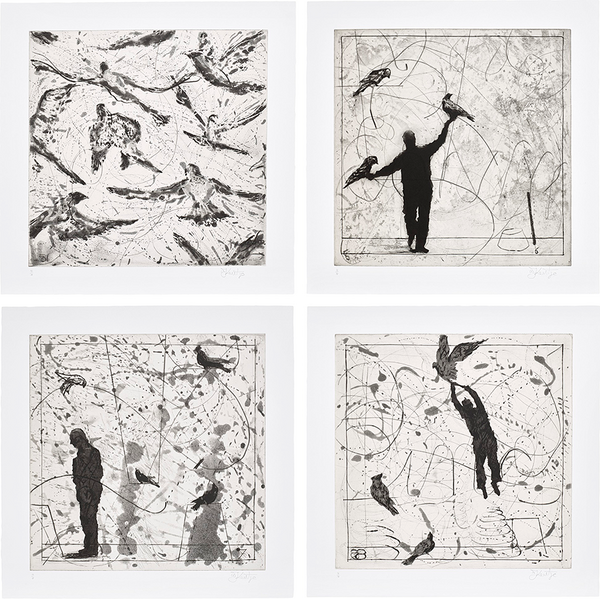
William Kentridge, Bird Catching: four plates, 2006. Evening & Day Editions London.
Kentridge’s exploration of ambiguity and flux continues in the Bird Catching drypoints. Birds are an enduring motif in Kentridge’s work; often depicted in flight and en masse, they evoke freedom, but also suggest ideas of classification, transience, and the challenge of fixing identity. In the Bird Catching series, Kentridge found his source imagery in Robert’s Birds of Southern Africa, an ornithological guide that catalogues various species from the region with photographic precision. Yet, where the book seeks taxonomy and to isolate the particularities of individual birds, Kentridge offers gestural silhouettes and expressive markmaking. His birds become symbols of liberation and self-determination, resonant not only within South Africa’s history but across broader human struggles for emancipation. Nonetheless, the birds also evoke the impulse to control or define what is, by nature, elusive. In Bird Catching, a figure leaps among the birds, hands outstretched to grasp them. It may be Papageno, the bird-catcher from The Magic Flute. Or, perhaps, it is the artist himself — reaching upward, attempting to seize the fleeting forms that flutter just out of his grasp.
Kentridge’s etchings are, as he describes, “records of damage done” — each scratch, bite, and gouge into the copper plate holding the memory of a moment. “It’s a kind of alchemy of copper,” he says, “catching the time of the hand with the burin or engraving tool or dry-point needle that was used to gouge into the copper, to leave a mark of damage. Everything is held in the copper. Whether it is Papageno jumping to catch birds or the birds in flight, it is about capturing time, the time of making, in the copper.”
Across media and time, each print embodies Kentridge’s ongoing enquiry — into the past, the self, and the act of making itself. In his work, we find the deep political and poetic possibilities of print as a medium that both reveals and withholds, not simply for its visual effects, but for its conceptual and material possibilities. Its layered, iterative nature mirrors the way Kentridge approaches history, memory, and identity: not as fixed narratives, but as evolving, uncertain, and always in motion.
Recommended Reading