Article | Danse Macabre The Night Away
Danse Macabre the Night Away
Andy Warhol’s examinations of extinction light up the auction floor.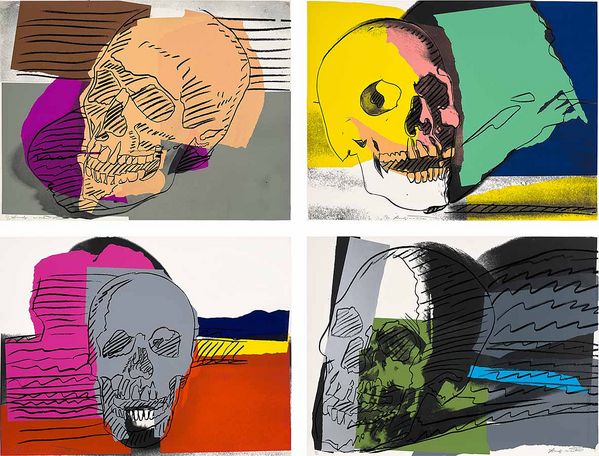
Andy Warhol, Skulls, 1976. Evening & Day Editions London.
First, some disclosure: thanks to a personalized regimen of supra-pharmacological interventions, Vitruvian sleep cycles, esoteric druid magick, carnivore/herbivore dialectic nutritional cycling, and ashwagandha supplementation (use code EDITIONSLDN20), our eyes are so glazed over by good vibes that all notions of death have vanished from what remains of our consciousness. And if these vibes should falter, fear not — our supply will last until immortal neural integration with the AI basilisk becomes possible. That’s just the way the game goes when the stakes are life or death. Plan for every eventuality, except, er, death.
Andy Warhol had more terrestrial concerns. It was the 1900s, after all. Before we solved problems like proper environmental stewardship, respect for each other and the animals with which we cohabitate, responsible thoughts about aging, and how we process death culturally. If only they knew what we know now! Among the most impactful images to emerge from the artist’s examinations of death, these screenprints from our London Evening & Day Editions Sale are standout reminders that even the pale face of death could use a bit of colour, especially when life is still an option.
No thing of the past
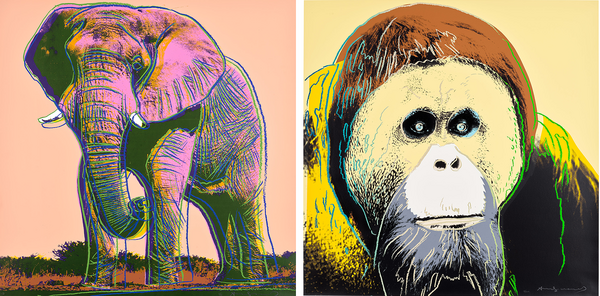
Left: Andy Warhol, African Elephant, from Endangered Species, 1983. Right: Andy Warhol, Orangutan, from Endangered Species, 1983. Evening & Day Editions London.
Portraits let everyone know you’ve arrived, or they let everyone know that you’re gone. Warhol, of course, finds a third option. Commissioned and published by gallerists and environmentalists Ronald and Frayda Feldman, 1983’s Endangered Species portfolio saw the artist return to his lifelong interest in animals and ecological advocacy. Along with the bald eagle, bighorn ram, giant panda, Pine Barrens tree frog, San Francisco silverspot, Siberian tiger, Grevy’s zebra, and black rhinoceros, the present African elephant and orangutan screenprints sought to raise public awareness and spur conservation efforts for ten animals listed in the Endangered Species Act, codified ten years prior in 1973.
With these portraits, Warhol unravels a complex relationship between image-making and promotion, and in typically Warholian fashion, makes his point in style. These "animals in makeup” take on celebrity dimensions to draw attention to our one-sided relationship with nature — its very existence is threatened by our intrusion, yet it is through our campaigning that these species might return to stability. Until then, Warhol shows, their images outnumber their populations. To keep humanity away from them, we must first make them famous.
You should be dancing
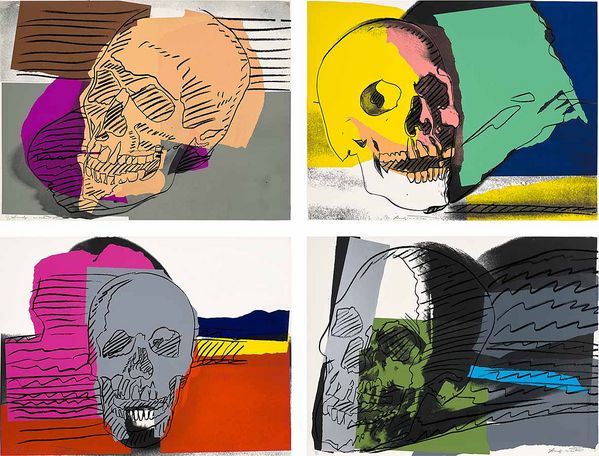
Andy Warhol, Skulls, 1976. Evening & Day Editions London.
Death, disco, and irony come for us all eventually — in 1976 New York, it just depends on where you are in the city on any given night. This hypothetical evening, Kurt Vonnegut is giving a reading uptown on his latest book about a post-apocalyptic last American president, Studio 54 is scrambling for a liquor license in midtown, and Andy Warhol is sitting for a portrait at The Factory opposite the realist, reserved Jamie Wyeth. It’s America’s bicentennial year, and the boys, Thin Lizzy reminds us, are back in town. Like four avatars in a group chat, Warhol’s skulls combine the artist’s preoccupation with death and his capacity for embalming an otherwise morbid image with badinage. The bold colours bathe each quadrant in layered light, like reflections from a mirrored ball, while the skulls’ varied angles give us a sense of banter between them.
The Skulls series was created at a pivotal time for Warhol. After being shot in 1968, his work took a profound shift away (although never too far) from fame and celebrity, and focused on the fleeting nature of life and our vain attempts to stifle death. Yet, in his inimitable way, even Warhol’s memento mori must enjoy a night out of the catacomb and trip the light fantastic.
It's a frame of mind, or: red and pink make Jack Ruby
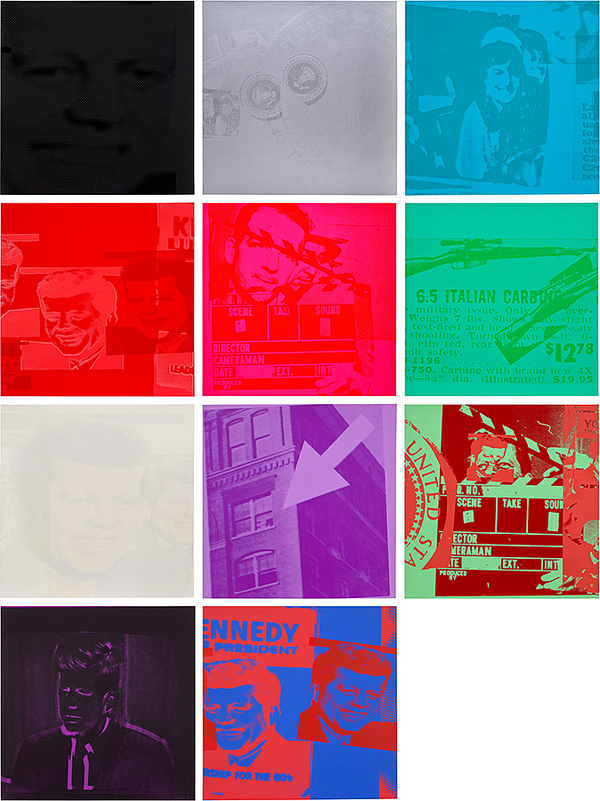
Andy Warhol, Flash - November 22, 1963, 1968. Evening & Day Editions London.
Leave it to Warhol to create his own stills for the cultural zeitgeist following the assassination of President John F. Kennedy — take a hike, Zapruder. “What bothered me was the way television and radio were programming everybody to feel so sad,” Warhol said. “It seemed like no matter how hard you tried, you couldn’t get away from the thing.” It’s no surprise, then, that roughly half of the 11 screenprints include a smiling Jack or Jackie as a shorthand for the “Kennedy Effect,” or how sustained media presence built a real-time legacy for the President that crystalized in the aftermath of 22 November 1963 and only grew over the years to become part of the 20th century canon.
Based on various newspaper and magazine photos, adverts, campaign posters, and government seals, the screenprints are joined by teletype reports reflecting the official narrative for each image, in turn acting as a palette for Warhol to examine mass media’s impact on consensus opinion, as well as the various means used to shape them. The President and First Lady’s patriotic red, white, and blue prints contrast Lee Harvey Oswald’s washed-out pink (a pinko commie!) face, the Carcano rifle’s verdant green (did it from the grassy knoll!) and the book depository’s unobstructed fuchsia (or got a clear shot from that window!). Sensationalism and desensitization, together at last, and ready to become the new normal from then onward. Over to you, Adam Curtis.
Recommended Reading