Article | Cartier Lantern Clock 1925 Egypt Iran Royal Wedding Pricess Fawzia
A Cartier Lantern Clock, a Royal Wedding, and a Lost Crown
Recently uncovered documents reveal that this illuminated Cartier masterpiece once united Egypt and Iran – and now, it’s headed to auction in Hong Kong.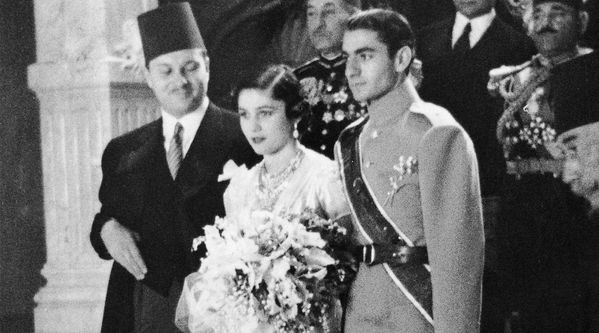
The PHILLIPS Hong Kong Watch Auction: XX takes place on 23-25 May, 2025, at our West Kowloon headquarters. The auction includes more than 280 of the world's finest watches – and though we are loath to boast, we truly think it's one of the best catalogues we've ever put together. We'll be highlighting a number of the most interesting lots and stories featured in the sale right here, including the clock highlighted below.
– By Logan Baker
When the Cartier Lantern Clock first arrived at Phillips Hong Kong, we knew its history had gaps – we just didn’t yet know how many.
It's a dazzling object from the 1920s, impeccably crafted, richly adorned, and unmistakably Cartier. The design, clearly inspired by Chinese lanterns, seemed to radiate light from within thanks to its luminous nephrite/jade panels. On one side sat a diamond-set platinum crown — the unmistakable symbol of Egypt’s monarchy. That alone made it special.
But as we soon discovered, this clock had a far more extraordinary story to tell than we ever imagined.
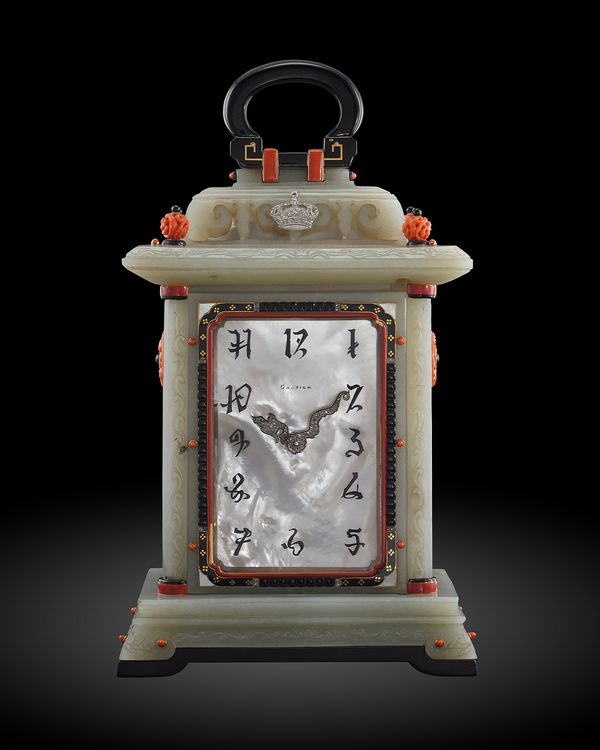
Lot 806: A unique circa 1925 Cartier Lantern Clock gifted for the Royal Wedding between Princess Fawzia, of Egypt, and the Crown Prince of Iran, Mohammad Reza Pahlavi. Included in the Phillips Hong Kong Watch Auction: XX. Estimate: HKD $960,000 - 1,920,000
This clock, included in the upcoming Hong Kong Watch Auction: XX, is not just a singular object of Art Deco beauty. It's a true vessel of history: a royal gift that serves as a forgotten connection between empires.
Let’s go back to the beginning. The 1920s were a golden age of artistic and cultural experimentation, and Cartier stood at the forefront of it. With clients ranging from the Maharajas of India to the aristocracy of Europe and royalty in the Middle East, Cartier embraced exoticism.
Their clocks (including the Portico Mystery Clock No. 3, which recently sold at Phillips for CHF 3,932,000) were some of the most imaginative creations of the era, blending special materials and mechanical ingenuity.
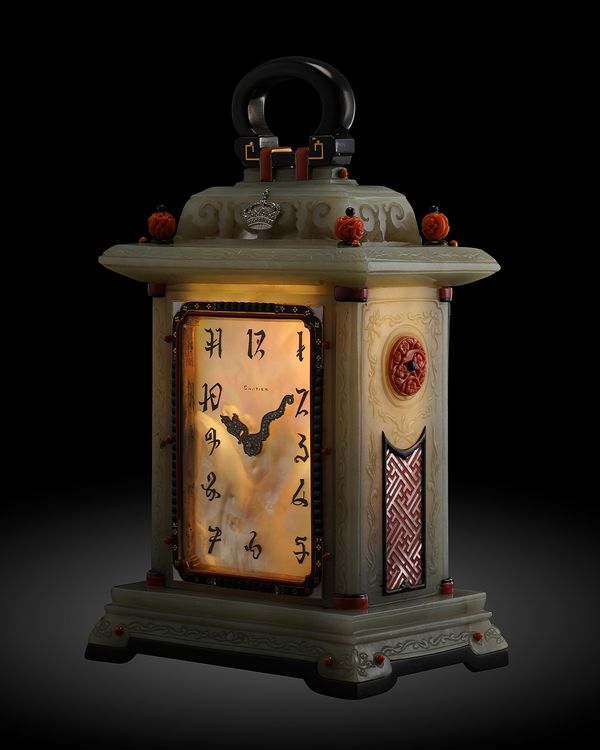
Lot 806: A unique circa 1925 Cartier Lantern Clock gifted for the Royal Wedding between Princess Fawzia, of Egypt, and the Crown Prince of Iran, Mohammad Reza Pahlavi. Included in the Phillips Hong Kong Watch Auction: XX. Estimate: HKD $960,000 - 1,920,000
This lantern-shaped clock exemplifies that spirit. Set with nephrite/jade, yellow gold, onyx, lacquer, diamond, and coral, it captures Cartier's fascination with East Asian aesthetics. When illuminated, the jade glows softly like a real paper lantern. A coral lattice pattern wraps around the body, while stylized dragons form the hands on twin mother-of-pearl dials. The time is displayed using Chinese-style numerals.
But then, just recently, came another discovery.
An envelope. A few photographs. An invoice. And just like that, the clock’s entire meaning changed.
The black-and-white photographs below — likely taken by Cartier in 1939 — showed the clock in its original form. And there, mounted proudly on either side, were two crowns: the Egyptian royal crown we recognized, and a second one we hadn’t seen before. The Pahlavi Crown of Iran.
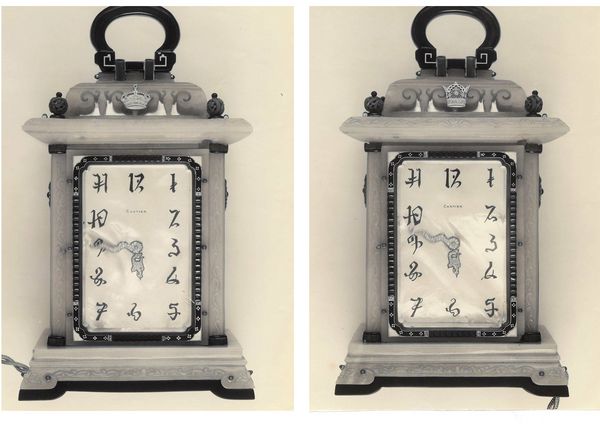
A recently unearthed photograph reveals the Cartier Lantern Clock in its original form, with both the Egyptian Royal Crown and the Iranian Pahlavi Crown. The Iranian Pahlavi Crown is now lost.
That missing crown opened a new path of inquiry.
Alongside the photos was a Cartier commercial invoice dated 15 March 1939. It described the clock in detail: "One Chinese pagoda clock in jade, mother-of-pearl, coral, enamel, onyx..." and listed two platinum and diamond-set crowns — Egyptian and Iranian — added at the buyer’s request. Total price: 21,500 French francs.
And who ordered it? Princess Fawkia of Egypt, half-sister to Princess Fawzia. The invoice was addressed to her at the Hotel Trianon in Versailles. Alongside it came a telegram, suggesting the clock was a wedding gift. A royal wedding gift.
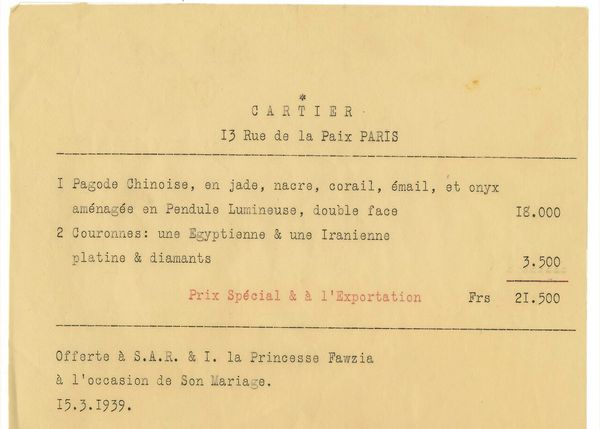
The original invoice for the Cartier Lantern Clock, dated 15 March 1939.
The date, 15 March 1939, was no coincidence. That was the day Princess Fawzia of Egypt married Crown Prince Mohammad Reza Pahlavi of Iran, the future Shah. This clock was commissioned by her sister, purchased from Cartier, and adorned with two crowns to represent the uniting of two great dynasties.
Princess Fawzia’s story is almost cinematic in scope. Born into the Egyptian royal family, celebrated as a beauty across Europe and the Middle East, and famously photographed by Cecil Beaton, she became the Queen of Iran at just 17 years old. Her marriage to Reza Pahlavi was a grand affair, with festivities spanning days and drawing international press coverage. But it was not a happy union. In 1945, she returned to Cairo and filed for divorce.
When she left Iran, we believe she brought the clock with her — but asked for the Iranian crown to be removed. Only the Egyptian crown remained.
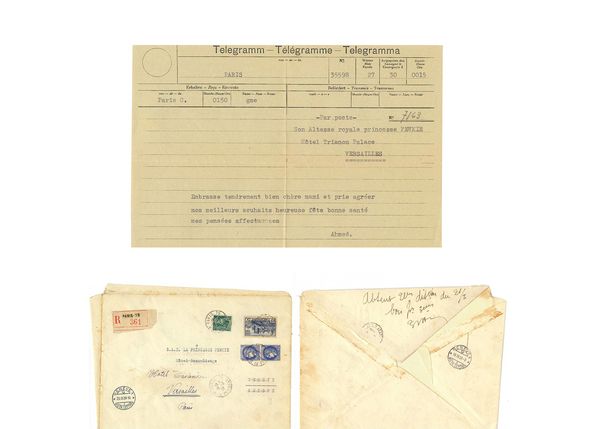
An original telegram suggesting the Cartier Lantern Clock was a wedding gift.
Fast forward to 1994. The clock reappears at a jewelry auction. It’s listed simply as a Cartier piece from circa 1925. No mention of its royal commission. No mention of its twin crowns. And certainly no trace of the emotional and historical resonance that it carried.
With the arrival of these documents, the final puzzle pieces of this Cartier Lantern Clock snapped into place. What was once an elegant clock is now a time capsule of Middle Eastern royalty and 20th-century geopolitical change.
Now, with this new context in hand, we present it once again — a rediscovered artifact of Royal history that bridges Paris, Cairo, and Tehran.
You can learn more, place a bid, and view the entire Phillips Hong Kong Watch Auction: XX catalogue right here.