Article | Pocket Watches In The New York Watch Auction Xii
Our Favorite Pocket Watches in the New York Watch Auction: XII
Reject modernity, embrace the pocket watch.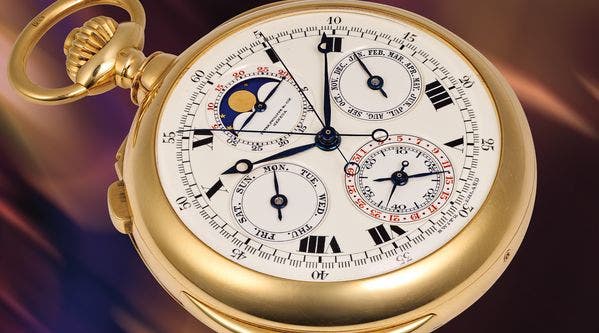
Our final live auction of the spring 2025 season, the New York Watch Auction: XII, takes place on 7-8 June, at our Manhattan headquarters. The auction includes 140 of the world's finest watches – and though we are loath to boast, we truly think it’s one of the best catalogues we've ever put together. We'll highlight several of the most interesting lots and stories featured in the sale over the next few weeks, including the watches highlighted in this article.
– By Logan Baker
Lot 18: A Circa 1915 Patek Philippe Minute Repeating Perpetual Calendar Split-Seconds Chronograph Open Face Pocket Watch
Estimate: USD $100,000 - 200,000
If you want to understand the DNA of Patek Philippe’s most celebrated complications, you have to start with the pocket watch. Before the brand became synonymous with wrist-mounted perpetual calendars and minute repeaters, it was creating some of the most technically advanced pocket watches of its era. The present example, a yellow gold minute repeating perpetual calendar split-seconds chronograph from circa 1915, is a masterclass in early 20th-century watchmaking.
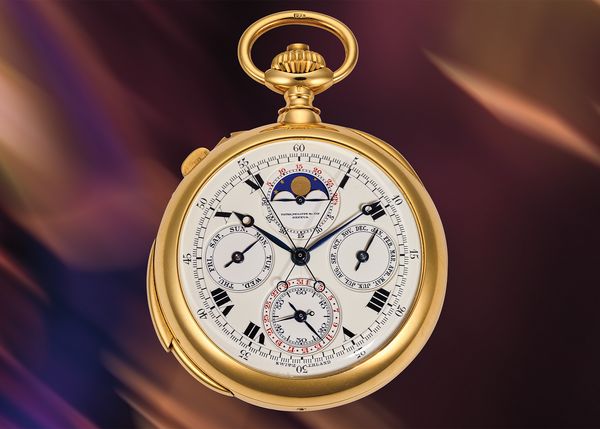
Lot 18: A Circa 1915 Patek Philippe Minute Repeating Perpetual Calendar Split-Seconds Chronograph Open Face Pocket Watch that's included in the Phillips New York Watch Auction: XII. Estimate: USD $100,000 - 200,000
The dial layout is quintessential Patek, with a moon phase and lunar calendar at 12 o’clock, a red date combined with subsidiary seconds at 6 o’clock, and a split-seconds chronograph operated through the crown and a discreet button in the caseband. The slide on the left of the case activates the minute repeater, which chimes hours, quarters, and minutes with a clarity and resonance you’d expect from Patek Philippe.
The original owner, Albert C. Middleton, was a co-founder of the Victor Talking Machine Company, later acquired by RCA in 1929. A connoisseur of fine watchmaking, he also owned a cushion-shaped minute-repeating wristwatch by Patek.
Preserved in impeccable condition with a flawless enamel dial, this grand complication pocket watch has been off the market for nearly 25 years. It’s a time capsule of Patek Philippe’s mastery in the age before wristwatches took over — and a compelling reminder of how pocket watches laid the groundwork for some of the brand’s most iconic contemporary complications.
Lot 23: A 1959 Breguet One-Minute Tourbillon Open-Face Pocket Watch
Estimate: USD $80,000 - 160,000
If you’re looking for a masterclass in early 20th-century horological excellence, Breguet No. 3357 is it. Sold in 1959 for 900,000 old Francs, this open-face pocket chronometer captures the essence of Breguet’s legacy — a blend of technical sophistication and elegant design.
Inside, it’s powered by a Victorin Piguet caliber 19''' half-plate nickel-finished lever movement, featuring a polished steel three-arm tourbillon cage crafted by Fritz A. Robert-Charrue. A protégé of Jämes Pellaton, Robert-Charrue was a name to know in tourbillon design, renowned for his work on some of the smallest tourbillons ever made. The movement is fitted with a Guillaume balance wheel, prized for its exceptional thermal stability.
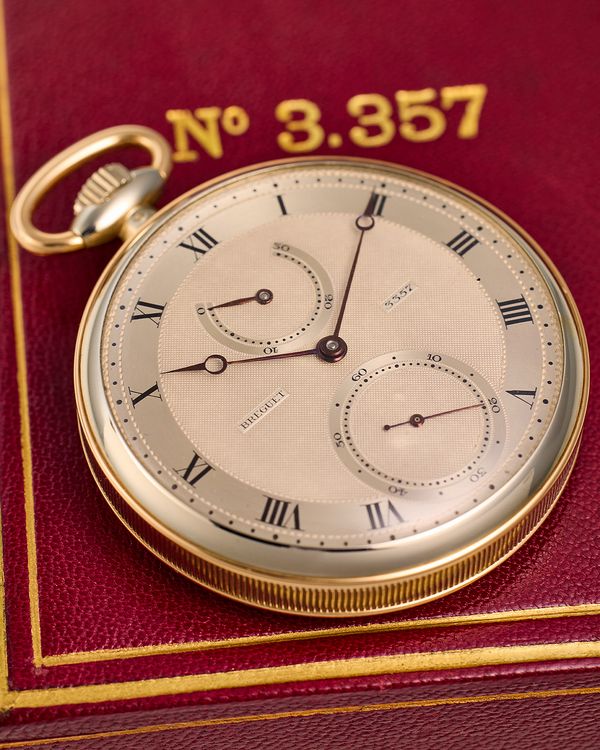
Lot 23: A 1959 Breguet One-Minute Tourbillon Open-Face Pocket Watch that's included in the Phillips New York Watch Auction: XII. Estimate: USD $80,000 - 160,000
On the dial, gold Breguet hands sweep across Roman numerals on a blank chapter ring, with a power reserve indicator and constant seconds display. The 51mm case — a mix of white and pink gold — features a ribbed central band and a sapphire crystal caseback that reveals the impeccable movement within.
Provenance adds another layer to this piece. No. 3357 was originally sold to Louis Harrison Dulles Jr., son of Secretary of State John Foster Dulles and nephew of CIA Director Allen Dulles.
Now, after a quarter-century out of sight, this extraordinary “grande complication” pocket watch reemerges as a rare testament to Breguet’s watchmaking prowess and Dulles’s discerning eye.
Lot 24: A 1916 Charles Frodsham Minute Repeating Split-Seconds Chronograph Open Face Pocket Watch with One-Minute Tourbillon
Estimate: USD $70,000 - 140,000
Few watchmakers can lay claim to as storied a history as Charles Frodsham & Co., a firm that’s been at the forefront of English horology since the mid-19th century.
In 1854, Charles Frodsham succeeded Benjamin Lewis Vulliamy as the Keeper of Her Majesty’s Clocks at Buckingham Palace, a role that placed the firm at the heart of British horological culture. After his passing, his son, Harrison Mill Frodsham, incorporated the company in 1893, carrying on the legacy with a focus on exceptional precision and technical complexity.
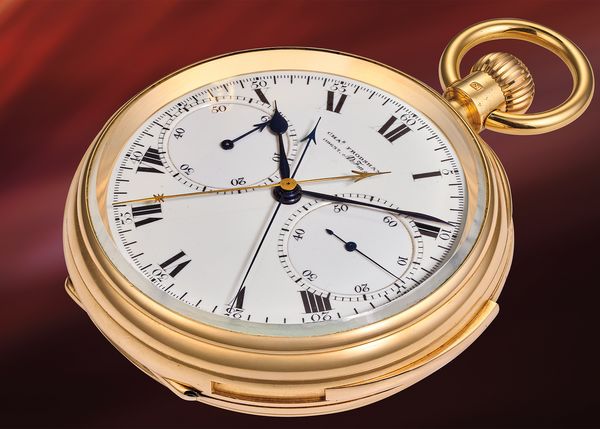
Lot 24: A 1916 Charles Frodsham Minute Repeating Split-Seconds Chronograph Open Face Pocket Watch with One-Minute Tourbillon that's included in the Phillips New York Watch Auction: XII. Estimate: USD $70,000 - 140,000
Enter the present timepiece — a 63.5mm one-minute tourbillon split-seconds chronograph minute-repeating pocket watch, one of a series commissioned by J.P. Morgan, Jr. between 1898 and 1934. Retailing between £200 and £350, they ranked among the most complex — and expensive — English timepieces of their era.
This particular example is the 13th known to surface at auction, a previously undocumented watch that underscores the Morgan family’s longstanding connection to Frodsham. According to records housed in the Morgan Library, it was part of a pair ordered on October 31, 1916, during the height of World War I. Each watch cost £200 — a considerable sum at a time when J.P. Morgan, Jr. was financing the Allied war effort through loans exceeding $500 million.
Lot 85: An 1887 Usher & Cole Minute Repeating Perpetual Calendar Hunter-Cased Pocket Watch
Estimate: USD $40,000 - 80,000
Usher & Cole is a name synonymous with marine chronometers, but complicated pocket watches? Not so much. Founded in 1861 by Joseph Usher and his apprentice Richard Wright Cole, the firm primarily catered to the British Admiralty, producing precision chronometers that found their way onto the decks of Royal Navy vessels. But every now and then, they ventured into the realm of grand complications — like the present piece.
Measuring a formidable 61mm in diameter and weighing 264 grams, this 18k yellow gold pocket watch is a rare and imposing example of late 19th-century English watchmaking. It’s a grand complication with a perpetual calendar, moon-phases, leap year indication, and a minute repeater. The watch is a masterclass in collaboration, with each component sourced from the top craftsmen of the era.
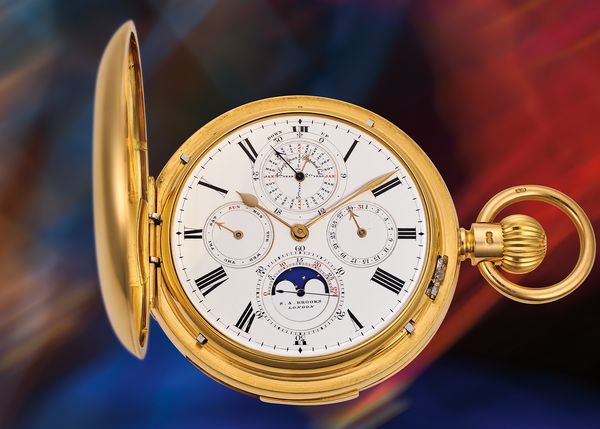
Lot 85: An 1887 Usher & Cole Minute Repeating Perpetual Calendar Hunter-Cased Pocket Watch that's included in the Phillips New York Watch Auction: XII. Estimate: USD $40,000 - 80,000
The white enamel dial, immaculate after nearly 140 years, was made by Frederick Willis, while the robust, hand-crafted case came from Philip Goodman & Sons. The movement, however, is the real star. Supplied by Swiss expatriate watchmaker Nicole, Nielson & Co., it’s a tour-de-force of 19th-century mechanical engineering, featuring mirror-polished steel bridges, screwed-in gold jewel settings, and blued steel screws.
The dial and movement bear the name S.A. Brooks, a jeweler and retailer to whom the watch was sold on July 25, 1888, for £170 — a considerable sum at the time.
But there’s one final flourish: the champlevé enamel coat of arms on the case, identified by the College of Arms as that of the Penton family, first awarded in 1698. The monogram FTP points to Frederick Thomas Penton, a career soldier and Sussex MP whose patronage of Usher & Cole speaks to the elite clientele they served.
Lot 86: A Circa 1877 Albert H. Potter Hunter-Cased Pocket Chronometer
Estimate: USD $20,000 - 40,000
Albert H. Potter isn’t a name that immediately comes to mind when discussing the great American watchmakers of the 19th century, but it absolutely should be. Born in Mechanicville, New York, in 1836, Potter started as an apprentice in Albany, honing his craft before eventually setting up shop in Chicago. By the 1870s, he was designing and building pocket chronometers with features like pivoted detent escapements and compensation balances — complications typically reserved for Europe’s finest workshops.
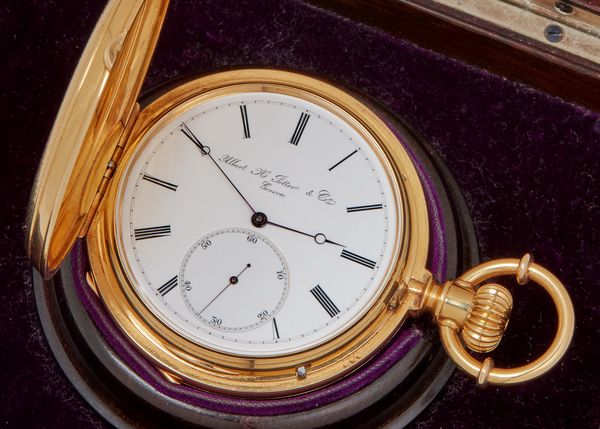
Lot 86: A Circa 1877 Albert H. Potter Hunter-Cased Pocket Chronometer that's included in the Phillips New York Watch Auction: XII. Estimate: USD $20,000 - 40,000
But in 1876, Potter made a bold move: he relocated to Geneva. Over the next two decades, he produced around 600 high-quality timepieces that could go toe-to-toe with the best from Switzerland. The present example, No. 86, dates to 1877 and exemplifies Potter’s knack for mechanical innovation and precision.
Under the dial, the nickel movement features Potter’s patented bridge layout, marked “plate den. Pat. Jan. 4.76,” and a free-sprung helical hairspring paired with a bi-metallic compensation balance. There’s also a second patent marking from 1875, confirming the pivoted detent escapement — a hallmark of Potter’s high-grade chronometers. The movement sits in an 18k yellow gold case bearing Potter’s trademark, while the pristine white enamel dial displays fine Roman numerals and a subsidiary seconds register at 6 o’clock.
This watch was acquired by the consignor at an auction in 1991, and it has remained in remarkable condition, virtually untouched for the past three decades. With Potter ceasing watchmaking in 1895 to focus on steam-powered carriages and pressure boilers, his watches have become exceedingly rare. And while he’s still a relatively obscure figure in the pantheon of American watchmaking, his Geneva-period chronometers, like the present example, are some of the finest — and most technically advanced — timepieces of their time.
Lot 87: A 1904 Wright & Craighead Minute Repeating Perpetual Calendar Split-Seconds Chronograph Hunter-Cased Pocket Watch
Estimate: USD $40,000 - 80,000
If you want a crash course in the golden age of British watchmaking, look no further than Wright & Craighead’s Grand Complication from 1904. Combining a minute repeater, split-seconds chronograph, and perpetual calendar with moon-phase, this pocket watch easily rivals anything coming out of Switzerland at the time.
Housed in a hefty gold case stamped with London hallmarks, the pocket watch is fitted with a slide mechanism at 6 o’clock that activates the minute repeater, chiming the hours, quarters, and minutes on two gongs. The split-seconds chronograph is operated through twin pushers at 11 and 1 o’clock, with elapsed time recorded on a 60-minute counter at 12 o’clock that also houses the leap year and month indicators.
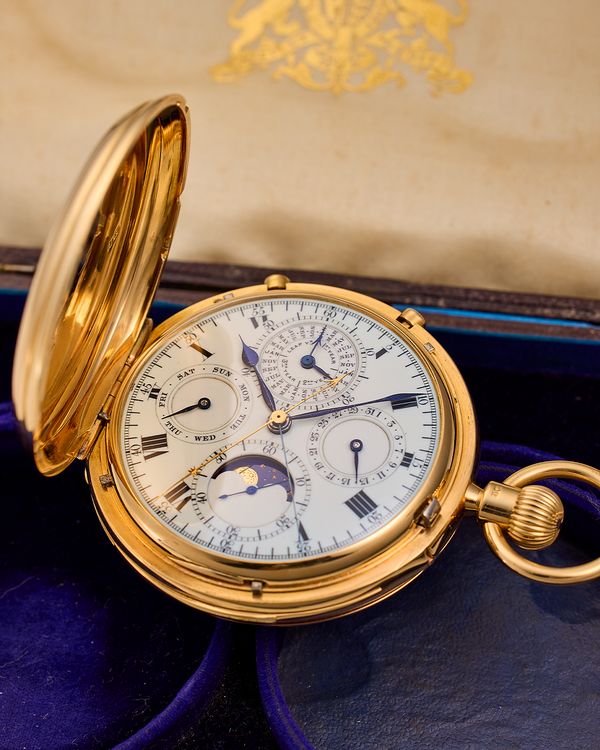
Lot 87: A 1904 Wright & Craighead Minute Repeating Perpetual Calendar Split-Seconds Chronograph Hunter-Cased Pocket Watch that's included in the Phillips New York Watch Auction: XII. Estimate: USD $40,000 - 80,000
The movement, signed by Wright & Craighead but supplied by the legendary Nicole, Nielson & Co., is a work of art in its own right. Movement number 11,829 showcases the meticulous finishing and engineering for which Nicole, Nielson was known — a firm whose complications graced some of the finest watches of the era.
Despite the exceptional quality of this piece, very little is known about Wright & Craighead. The firm was established in 1891 when Thomas Daniel Wright, a third-generation watchmaker, acquired the business of E.C. Bracebridge & Co., a firm dating back to 1780. Wright partnered with William Craighead, but after Craighead’s untimely passing the following year, Wright carried on under the combined name. Wright wasn’t just a maker of high-grade watches; he was also a respected instructor, serving as the head of the Horological Department at Northampton Polytechnic Institute and continuing to shape the next generation of British watchmakers well into the 1920s.
Lot 102: A Circa 1997 Cartier Mystery Pocket Watch with Diamond-Set Lapis Lazuli Plaques
Estimate: USD $12,000 - 24,000
Cartier’s 150th anniversary in 1997 was a milestone for the brand, marked by a series of exceptional releases that paid homage to its storied legacy. Among them was the “Mysterieux” pocket watch — a miniature mystery clock housed in a striking white gold and lapis lazuli case.
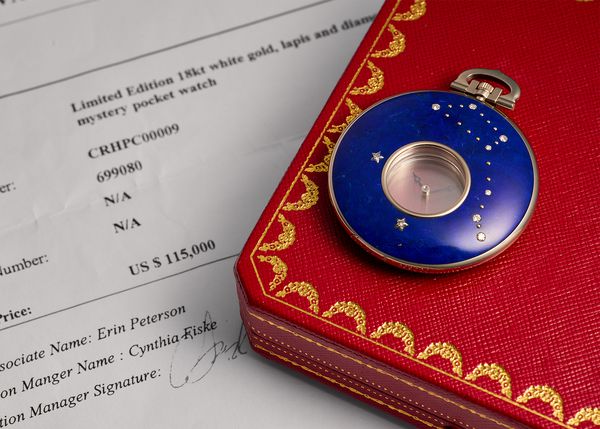
Lot 102: A Circa 1997 Cartier Mystery Pocket Watch with Diamond-Set Lapis Lazuli Plaques that's included in the Phillips New York Watch Auction: XII. Estimate: USD $12,000 - 24,000
While Cartier also released two limited editions of the “Mysterieux” pocket watch in yellow and white gold that year, both featuring delicate guilloché dials and capped at 150 pieces each, this lapis lazuli version is something entirely different. The rich, celestial blue of the lapis is set with a diamond-studded illustration of the Big Dipper — a constellation known as the “Plough” in the UK and a subset of Ursa Major, one of the most recognizable star formations in the night sky.
Here, Cartier plays with time and space in a way that feels distinctly poetic. The lapis backdrop serves as a nocturnal canvas, while the aperture revealing the mystery clock mechanism reminds us that time itself remains as elusive as the stars above.
It’s a piece that straddles Cartier’s tradition of elegant mystery clocks and its penchant for high jewelry — a rare intersection of craftsmanship and cosmic inspiration.
Lot 108: A Circa 2000s Patek Philippe Open-Face Pocket Watch with Enamel Scene by Anita Porchet Depicting a Blue Macaw
Estimate: USD $70,000 - 140,000
If you know anything about the art of enamel, you'll know the name Anita Porchet. For over two decades, she’s been the go-to master enameller for the most revered watchmakers in Switzerland — brands like Vacheron Constantin and Patek Philippe, whose collectors demand nothing less than perfection.
Porchet’s work is a masterclass in patience, precision, and artistry, bringing centuries-old techniques to life through miniature paintings that are as vibrant as they are fragile.
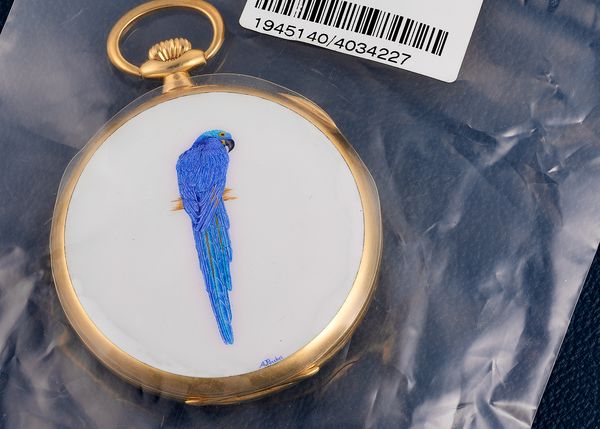
Lot 108: A Circa 2000s Patek Philippe Open-Face Pocket Watch with Enamel Scene by Anita Porchet Depicting a Blue Macaw that's included in the Phillips New York Watch Auction: XII. Estimate: USD $70,000 - 140,000
The present piece is a prime example. Porchet’s canvas is a blank expanse of off-white enamel, painstakingly created through a meticulous process involving finely crushed metal oxides mixed with water and fired at over 800°C. The slightest imperfection means starting over — a single misstep, and hours of work are lost. But when everything aligns, the result is a surface that’s impossibly smooth and lustrous.
Here, Porchet has chosen to depict the hyacinth macaw, the largest parrot species native to South America. Each feather is rendered in exquisite detail, from the bold azure of its plumage to the lifelike texture that makes it feel almost three-dimensional.
Still in factory-sealed, brand new condition and accompanied by its original numbered hang-tag, this is a piece that connects Patek Philippe’s tradition of métiers d’art with the singular vision of Anita Porchet — a rare opportunity to own a work of art that bridges nature and craft in a way few other artisans can achieve.
Lot 109: A 2003 Patek Philippe Open-Face Pocket Watch with Enamel Scene by Anita Porchet Depicting a 'Springbok'
Estimate: USD $70,000 - 140,000
Over the years, Anita Porchet has brought everything from exotic birds to delicate butterflies to life on the dials of some of Patek Philippe’s most exquisite timepieces. The present open-faced pocket watch, ref. 974/27J from 2003, is a perfect example of Porchet’s talent for capturing the natural world in miniature.
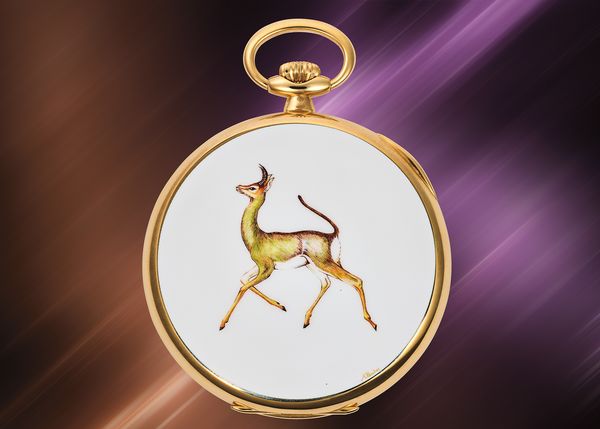
Lot 109: A 2003 Patek Philippe Open-Face Pocket Watch with Enamel Scene by Anita Porchet Depicting a 'Springbok' that's included in the Phillips New York Watch Auction: XII. Estimate: USD $70,000 - 140,000
Against a soft eggshell enamel backdrop, Porchet has delicately rendered a springbok — the national animal of South Africa. With its striking black horns and distinct striping, the antelope appears almost suspended in motion, a nod to the animal’s signature “pronking,” a series of high, athletic leaps that can reach over six feet off the ground. The scene is simple, almost like a pared-down hunting tableau from the 18th or 19th century, yet it feels unmistakably modern in its execution.
On the reverse, classic Breguet numerals keep the focus on the time, letting Porchet’s artwork remain the star of the show. The watch is preserved in excellent condition, complete with its original numbered hang-tag.
Lot 131: A Circa 1970 Piaget Pocket Watch with Nephrite Hardstone Dial
Estimate: USD $3,000 - 5,000
Slim, elegant, and undeniably opulent, this ultra-thin pocket watch is a study in understated luxury.
Measuring just 5mm thick, it’s the kind of piece you’d imagine slipping into a tuxedo pocket, tethered to a delicate white gold chain, ready to be discreetly checked during a black-tie affair.
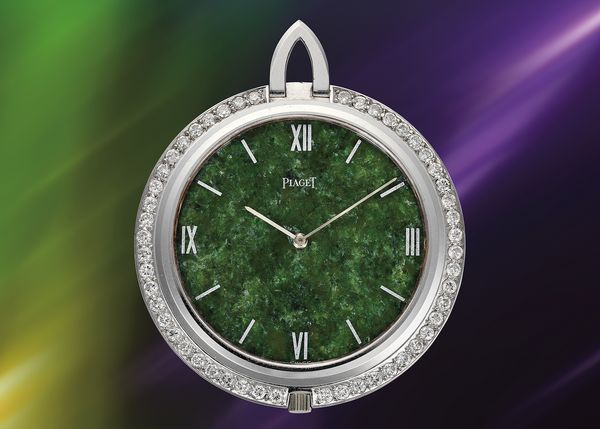
Lot 131: A Circa 1970 Piaget Pocket Watch with Nephrite Hardstone Dial that's included in the Phillips New York Watch Auction: XII. Estimate: USD $3,000 - 5,000
The star here is the dial — crafted from nephrite, a type of jade prized for its distinctive grey and green inclusions. While nephrite is more commonly associated with Cartier clocks, here it serves as a striking backdrop for silver-tone printing that harmonizes perfectly with the white gold case and diamond-set bezel. The result is a dial that feels both classic and contemporary, a subtle nod to Piaget’s penchant for exquisite materials.
Inside, the watch is powered by Piaget’s manual-winding calibre 9P, a movement renowned for its svelte profile and reliable performance. The 9P was a game-changer when it debuted in 1957, and its enduring elegance remains evident in the present example.
You can learn more, place a bid, and view the entire New York Watch Auction: XII catalogue right here.