Article | A Collectors Guide To The Patek Philippe Perpetual Calendar Chronograph Ref 3970
A Collector’s Guide to the Patek Philippe Perpetual Calendar Chronograph Ref. 3970
A closer look at Patek Philippe’s neo-vintage perpetual calendar chronograph, and the dial variations, metals, and rare configurations that have collectors clamoring for more.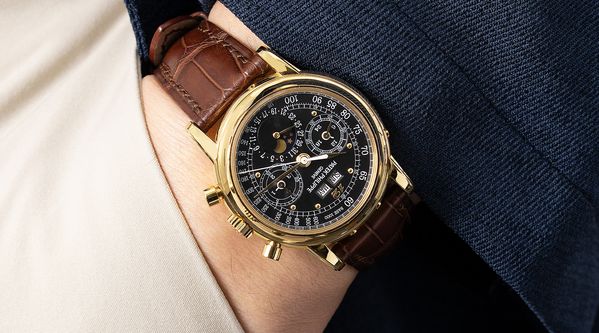
The PHILLIPS Hong Kong Watch Auction: XX takes place on 23-25 May, 2025, at our West Kowloon headquarters. The auction includes more than 280 of the world's finest watches – and though we are loath to boast, we truly think it's one of the best catalogues we've ever put together. We'll be highlighting a number of the most interesting lots and stories featured in the sale right here, including many of the watches highlighted below.
– By Logan Baker
The Patek Philippe Perpetual Calendar Chronograph ref. 3970 is often described as the connoisseur’s choice – a watch that encapsulates Patek’s most celebrated complications in a subtly evolved, modern package.
Introduced in 1986, the 3970 had big shoes to fill. It succeeded the legendary ref. 2499 (produced 1950s–1980s) and carried forward the lineage that began with the world’s first perpetual calendar chronograph wristwatch, the ref. 1518 of 1941. At the same time, it paved the way for its eventual successor, the larger 5970 in 2004. The 3970 arrived at a tumultuous time for mechanical watches – the Quartz Revolution of the 1980s – yet it stood as a bold reaffirmation of Patek Philippe’s commitment to traditional haute horlogerie. In fact, the 3970 debuted alongside the ultra-thin automatic perpetual calendar ref. 3940, signaling a new era where Patek would increase production of high complications to meet renewed collector interest.
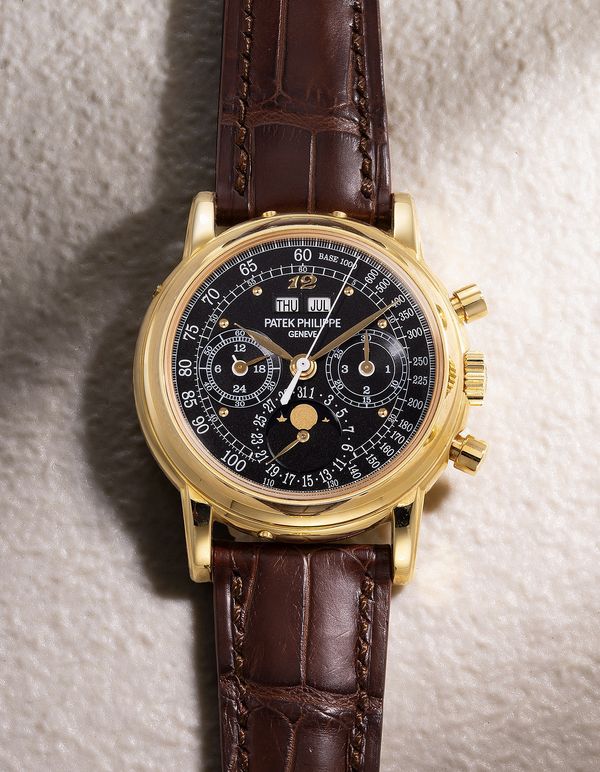
Lot 890: A 2019 Patek Philippe ref. 3970EJ-029, one of only two known, in 18k yellow gold, with black dial featuring Breguet 12 o'clock numeral and tachymeter scale, and that's included in the Phillips Hong Kong Watch Auction: XX. Estimate: HKD $3,000,000 - 5,000,000
Why is the 3970 so important? In essence, it represents the bridge between vintage and modern Patek. It retains the classic 36mm size and elegant 1940s-style dial layout of its predecessors, but under the hood it introduced technical updates like a leap year indicator and 24-hour display (features absent on the 1518 and 2499). It was also the first Patek perpetual chrono to use a Lemania-based movement (caliber CH 27-70 Q), an impeccably finished, manual-wind column-wheel chronograph ebauche that Patek modified and refined to Geneva Seal standards. In design, the 3970 kept Patek’s signature twin apertures for day and month and the three-register dial, maintaining a familial look. However, it (mostly) omitted the outer tachymeter scale that the 1518 and many 2499s featured, giving the 3970 a cleaner, more understated appearance.
For years, the 3970 lived somewhat in the shadow of the ultra-rare 1518 and 2499 and the trendier, larger 5970 that followed. Early collectors often overlooked it, and in the early 1990s, one could even find unsold 3970s lingering in dealer showcases. But today, perceptions have shifted.
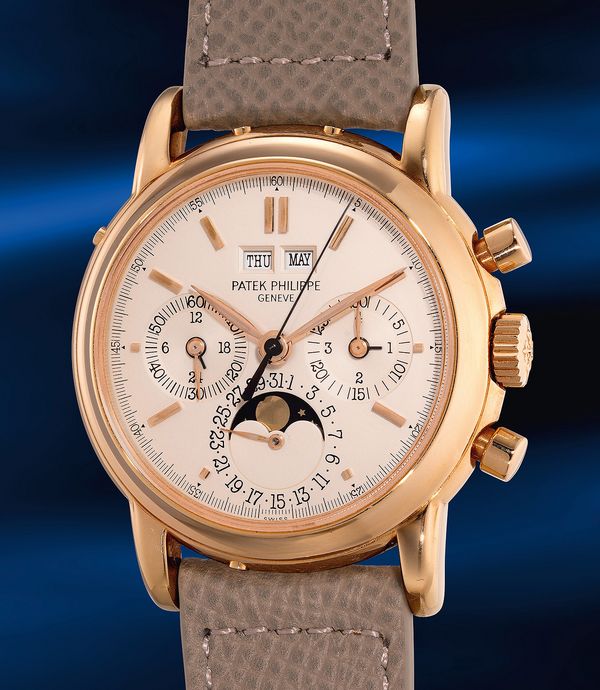
Lot 1046: A second series circa 1991 Patek Philippe ref. 3970 in 18k pink gold that's included in the Phillips Hong Kong Watch Auction: XX. Estimate: HKD $640,000 - 1,280,000
It offers all the pedigree and complexity of its forebears at (for now) a fraction of the price, in a wearable size that many consider the sweet spot. In short, the ref. 3970 has evolved into a modern classic – a watch that distills Patek Philippe’s horological heritage into a timepiece that feels just at home in a 21st-century collection as it would under the cuff of a mid-century patron of the arts.
Recent auctions have seen interest, and subsequently, prices rising for the rarest and best condition versions of the ref. 3970. Look no further than the rare second-series ref. 3970P that soared past its high estimate earlier this month at Phillips Geneva for CHF 469,900. The upcoming Phillips Hong Kong Watch Auction: XX features three lovely examples in a variety of case metal and dial configurations (lots 890, 904, and 1046, respectively) as well as a rare ref. 3971 (lot 856).
Case Metals and the Four Series of Production
One of the most fascinating aspects of the 3970 is its long production run (1986–2004) and the subtle variations that emerged over time. Collectors and scholars typically break down the 3970 into four series, each with slight differences in case design, dial details, and availability of metals. Patek Philippe itself did not officially label “series,” but these distinctions – identified later by collectors and auction houses – help us navigate the evolution of the reference.
Across all series, the 3970 was produced in four case metals: yellow gold (the most traditional choice), rose gold, white gold, and platinum. However, they were not produced in equal numbers, and not every metal was present from the start. Below is a breakdown of the four series and their characteristics:
First Series (1986-1988) – The inaugural run of 3970s was made exclusively in 18k yellow gold, Patek’s most classic metal. Only about 100 pieces were produced, making this by far the rarest batch of 3970s. These first-series examples are defined by a silvered opaline, vertically brushed dial with subtly two-tone sand-blasted sub-dials (the three calendar/chronograph sub-dials are a few shades darker than the main dial, creating a vintage-esque contrast). They feature feuille (leaf) hands and applied stick (baton) hour indexes, mirroring the aesthetic of the late 2499s. Cases have a snap-on solid back, and the water resistance was minimal. A few were even sold on an 18k bracelet (for those, Patek appended a “-1” to the reference number). These early pieces truly feel like a last gasp of the vintage era – they were all made between 1986 and 1988 (though some may have been sold a bit later, given the slow initial demand).
Second Series (1987–1990) – With the second series, Patek made the 3970 a bit more practical and broadened the metal options. The reference was updated to 3970E (E for étanche, meaning “water-resistant”), thanks to a screw-down caseback replacing the snap caseback. These cases (manufactured by Ateliers Réunis, Patek’s own case-making subsidiary, hallmarked with key “28”) were still hand-finished, which continued through all second-series production. The dial layout and leaf hands remained, but Patek eliminated the off-color sub-dials, switching to a uniform silver dial where the sub-dials match the main dial tone. Second-series watches were offered in yellow, rose, and white gold, with a few in platinum as well. Production is estimated at around 650 pieces total.
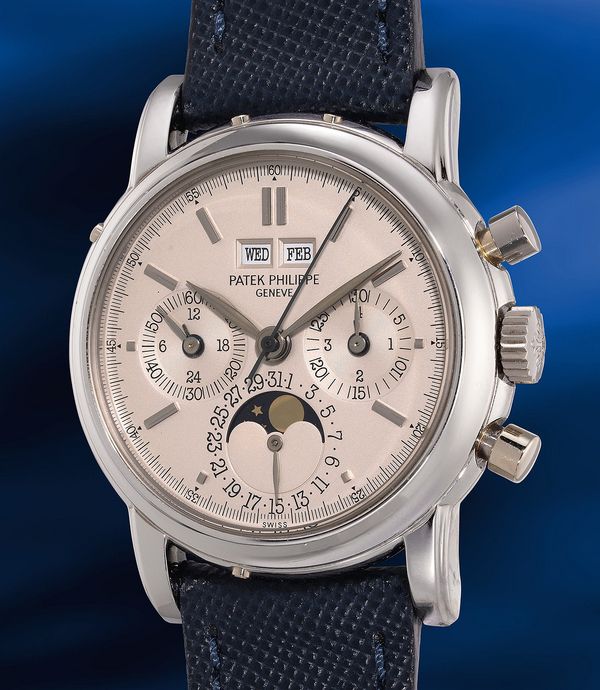
Lot 904: A second-series circa 1991 Patek Philippe ref. 3970 in platinum that's included in the Phillips Hong Kong Watch Auction: XX. Estimate: HKD $800,000 - 1,600,000
Third Series (1990–1995) – By the early 1990s, demand for high-end mechanical watches was rebounding, and Patek ramped up production of the 3970. The third series, produced roughly from 1989/1990 through 1995, saw about 1,350 pieces made in total, making it one of the most common iterations of the ref. 3970. All four metals – yellow, rose, white gold, and platinum – were now regularly produced (white metals in particular gained popularity in the ’90s). Visually, the third series is distinguished by more contemporary styling cues: Patek switched to pointed, faceted baton hour markers (replacing the earlier straight sticks) and matching pointed baton hands instead of leaf hands. The dial silver got a touch brighter, and the printing of numerals and scales became slightly bolder for improved legibility. Every watch in this series was sold with both a solid screw back and a sapphire crystal caseback included (now standard practice for Patek’s complications). In essence, the third series 3970s feel a tad “modernized” compared to their predecessors – a bit more lustrous and striking on the wrist – yet they still retain the same 36mm case and movement. These are the some of the easiest 3970s to find on the market and often the most affordable, but they remain exceptional watches in finish and functionality.
Fourth Series (1995–2004) – The final chapter of the 3970’s production largely mirrors the third series. In fact, to the naked eye a fourth-series watch is virtually identical to a late third-series: same dial and hand style (pointed markers, baton hands), same layout, and supplied with both casebacks. The main difference is in numbering: Patek’s case and movement serial numbers for the 3970 jumped into a new range in the mid-90s, marking what collectors call the fourth series. Approximately 2,000 pieces of the fourth series were made from 1995 until the reference was discontinued in 2004. Like the third series, all four metals were offered, with a broadly similar distribution across metals (by this time, platinum models were no longer unicorns but a regular part of the lineup, and rose gold had also become quite popular). One notable change: Patek began equipping the 3970 with a folding deployant clasp in this era, rather than the traditional tang buckle. Some purist collectors actually swapped the deployant for a vintage-style pin buckle, preferring the classic feel. Overall, the fourth series represents the most “mature” form of the 3970 – benefiting from two decades of production refinement. It may be the least scarce variant, but it’s the culmination of the reference’s lineage before the transition to the larger-case ref. 5970 in 2004.
In total, it’s estimated that just over 4,000 examples of the 3970 were made across all metals and series. This was an enormous increase in output compared to the 2499 (only 349 made) or the 1518 (281 made), reflecting Patek’s ability in the 1980s–90s to meet growing demand. Yet by modern luxury standards, a few thousand pieces over 20 years is still quite limited. This relative abundance means the ref. 3970 doesn’t have the extreme exclusivity of its mid-century predecessors, but it also means collectors have the pleasure of hunting down specific configurations that suit their taste.
Yellow gold, rose gold, white gold, or platinum; early style or late style – there’s a 3970 out there for everyone, from the vintage nostalgist to the modern-minded enthusiast.
Dial Variations: From Classic Silver to Unique Special Orders
The standard dial of the Patek 3970 is a study in balanced, classical design.
Most examples (especially regular production pieces) feature a matte silvered dial with applied gold baton indices (usually matching the case metal) and leaf or baton hands as described above. The layout includes twin apertures at 12 o’clock for day and month, sub-dials at 3, 6, and 9 o’clock, and a moonphase display at 6. For the first-series, the slight two-tone effect between the sub-dials and the main dial gives a charming vintage vibe, while later series have a uniform dial color. All standard 3970 dials have minimal text – just “Patek Philippe” and “Genève” at 12 – keeping the focus on the complications. Unlike the earlier 1518 and 2499, no tachymeter scale is printed on the regular 3970 dial, resulting in a cleaner look (something some collectors initially missed, but many now appreciate for its elegance). In short, a stock 3970 in any metal with the typical silver dial is the picture of Patek Philippe refinement and restraint.
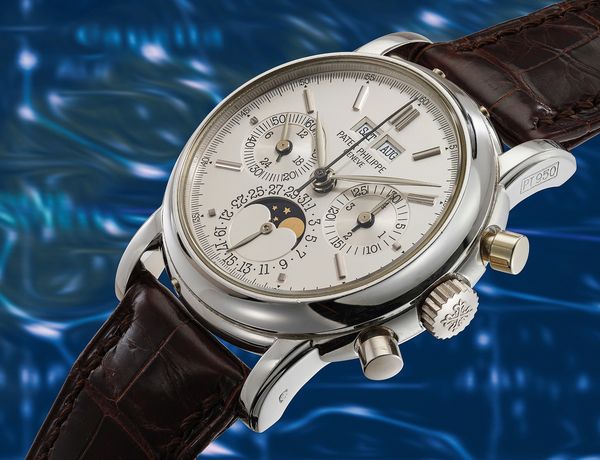
A circa 1990 Patek Philippe ref. 3970 in platinum that sold for CHF 469,900 at the Phillips Geneva Watch Auction: XXI, in May 2025.
That said, one of the reasons the ref. 3970 captivates collectors is the array of dial variations that exist, from uncommon factory options to one-of-a-kind special orders. Patek in the late 20th century was more willing to accommodate custom requests from important clients, and the ref. 3970 became a canvas for some truly special pieces. Let’s explore the known dial variations and unique configurations:
Black Dials: Black-dialed 3970s were never part of the standard catalog, but a handful were made as special orders – usually cased in platinum or white gold. Typically, when Patek fitted a black dial to a complicated watch, they would adorn it with diamond hour markers (this was something of a tradition for flagship models, especially in platinum). Indeed, most known black-dial 3970s feature small diamond indices in place of the usual batons. These tend to be very scarce. Even rarer, however, are examples of black dial 3970s that omit the diamonds and use stick markers instead – an unconventional choice that a few discerning clients requested. Those pieces, pairing a white-metal case with a pure black dial and simple gold markers, stand out because Patek typically would only do that by special request. In any configuration, a factory-black dial elevates a 3970 into a different realm of rarity and value.
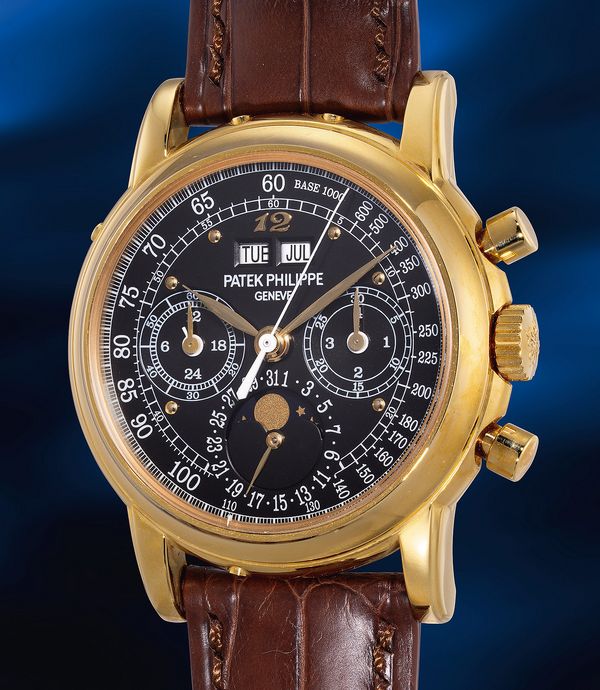
Lot 890: A 2019 Patek Philippe ref. 3970EJ-029, one of only two known, in 18k yellow gold, with black dial featuring Breguet 12 o'clock numeral and tachymeter scale, and that's included in the Phillips Hong Kong Watch Auction: XX. Estimate: HKD $3,000,000 - 5,000,000
Breguet Numerals & Tachymeter Scales: No standard 3970 was made with Breguet numerals – all regular pieces have baton hour markers. So when you see a 3970 with applied Breguet numerals, you’re looking at a special order or unique piece. Often these dials also include other custom touches like an outer tachymeter scale (bringing back the feature the stock 3970 dial left out). These touches intentionally hark back to the look of a vintage 2499 or 1518. One of the most famous examples is Eric Clapton’s Patek 3970. Clapton, an avid Patek collector, commissioned a one-off 3970G (white gold) with a stunning salmon-colored dial, applied white gold Breguet numerals, and a tachymeter scale around the edge. This unique piece looks like a cross between a 1940s perpetual chrono and a modern watch. Another known piece is a platinum 3970 with black dial, Breguet numerals and tachymeter, which has been described as “possibly unique” as well. These Breguet numeral versions are catnip to collectors, as they combine the 3970’s complexity with a decidedly old-school aesthetic. Even having a single Breguet numeral at 12 o’clock can make a difference – for instance, Patek made a London Special Edition of just 5 pieces in 2015 (more on that later) that featured a black dial with a lone Breguet “12” and dot markers elsewhere. In short, any 3970 with Breguet numerals or a tachymeter is a superstar variant – these elements never appeared on standard production dials. The upcoming Phillips Hong Kong Watch Auction: XX includes a rare (only two known) 18k yellow gold variation with a black dial, Breguet numeral at 12 o'clock, and tachymeter scale.
Luminous Dials and Other Colors: The vast majority of 3970s have no luminous material (no Super-LumiNova or tritium) on their dials or hands – they are strictly dressy in presentation. However, at least one remarkable exception has emerged: A yellow gold 3970 with a special-order champagne dial featuring luminous hands and hour markers. It also includes a tachymeter scale and Breguet-style 12, similar to the Clapton pieces, but the addition of lume makes it truly unique among 3970s. Imagine – a perpetual calendar chronograph you can read in the dark! This piece underscores how flexible Patek was willing to be for VIP clients. Other dial colors beyond silver are extremely rare; aside from salmon (like Clapton’s) and champagne (Ovitz’s), one might encounter the occasional off-catalog white or ivory dial variant, but by and large, Patek stuck to silver, black, or these special tones for the 3970. There are also a few known double-signed dials – for instance, 3970s retailed by Tiffany & Co. with the Tiffany name on the dial, which are collectible in their own right.
Diamond-Set Dials: As mentioned, Patek sometimes used diamonds as hour markers on special dials, typically when pairing a black dial with a platinum or white gold case. While not common, it is possible to find a 3970 with factory diamond indices at the hours (usually small baguette or round diamonds in place of the markers). These tend to appear only on white metal cases (WG or Pt), and as noted, often on black dials. One interesting outlier documented by collectors was a complete boxed set of three 3970s in yellow, rose, and white gold, all with diamond marker dials – an unusual trio that surfaced at auction in 2020. It’s speculated this set may have been a special commission or a one-off collector’s set, as it’s the only known example of 3970s in the gold metals having diamond indices (perhaps with custom black dials, though the details are scant). In general, if you see a diamond dial 3970, you’re looking at something quite outside the norm.
Special Anniversary Editions (London & Saatchi, 2015): Even a decade after the 3970 was discontinued, Patek Philippe wasn’t quite done with it. In 2015, for Patek’s 175th anniversary celebrations, the company dusted off a few leftover 3970 cases and movements to create a very limited run of special editions. The most notable were the so-called “London Saatchi Edition” ref. 3970ER-028 and ref. 3970EP-046. The 3970ER-028 consisted of just 5 pieces in rose gold (hence “ER” for Etanche Rosé) with a black dial featuring a tachymeter, dot hour markers, and a single Breguet numeral at 12. The 3970EP-046 was an equally small run in platinum with a similar dial. Essentially, these watches resurrected the 3970 design 11 years after its official end, proving the model’s enduring appeal. They were assembled from new-old-stock 3970 parts and so are identical in form to a regular 3970, but with that special dial configuration and unique reference number to set them apart. Unsurprisingly, these 2015 pieces are extremely coveted – modern rarities that pay homage to the original.
The upcoming Phillips New York Watch Auction: XII also includes a rarely seen second-series ref. 3970 in 18k yellow gold that's fitted with a very desirable doré dial (lot 94).
Between the various series and these dial variations, the 3970 offers a treasure trove for collectors who love nuances. Whether you prefer the purity of a standard silver dial or the intrigue of a black, salmon, or jewelled dial, there’s something enchanting about each variant. This diversity is a big part of the ref. 3970’s charm today.
The Reference 3971: A Display-Back Rarity
No discussion of the 3970 is complete without mentioning its closely related sibling, reference 3971. The ref. 3971 is essentially a sub-variant of the early 3970 – so much so that many collectors lump them together – but it has its own reference number because of one key difference: the caseback. A standard 3970 in the 1980s came with a solid caseback (snap-on for the first series, screw-down for later). The ref. 3971, introduced concurrently in 1986, was delivered with a snap-on sapphire display back instead of a solid back. This allowed the proud owner to admire the beautifully finished Lemania-based caliber inside, a novelty at the time for a Patek grand complication.
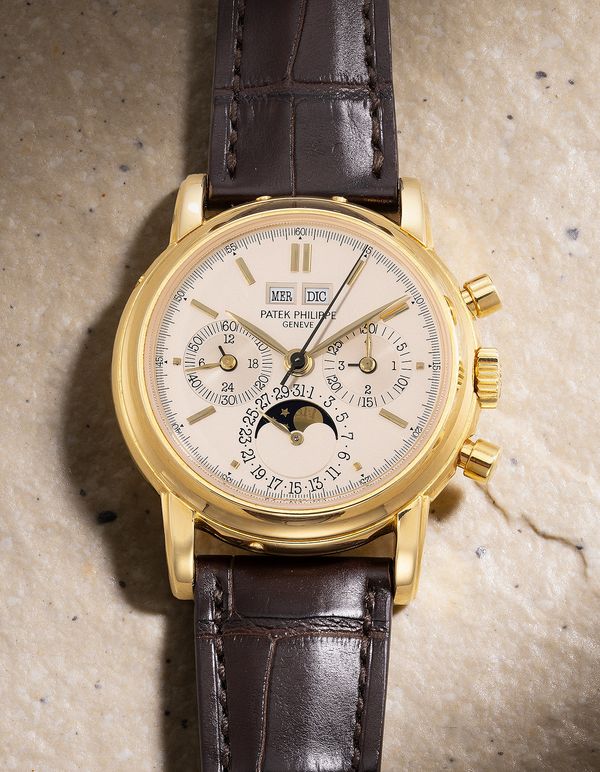
Lot 856: A 1987 first-series Patek Philippe ref. 3971 in 18k yellow gold with Italian calendar that's included in the Phillips Hong Kong Watch Auction: XX. Estimate: HKD $1,500,000 - 3,000,000
Mechanically and aesthetically, aside from the caseback, the 3971 is identical to a first-series 3970: 36mm yellow gold case, leaf hands, stick markers, two-tone silver dial, etc. In fact, the first series of production included both 3970 and 3971 references. Patek made around 100 examples of the 3970J in 1986, and alongside them produced on the order of a few hundred 3971s in the late 1980s. The 3971 was likely offered in yellow gold primarily (matching the 3970’s metal at the time), but it appears that a handful of 3971s in other metals may exist as well during the second series period. In total, fewer than 300 pieces of ref. 3971 were made, making it an exceedingly rare bird.
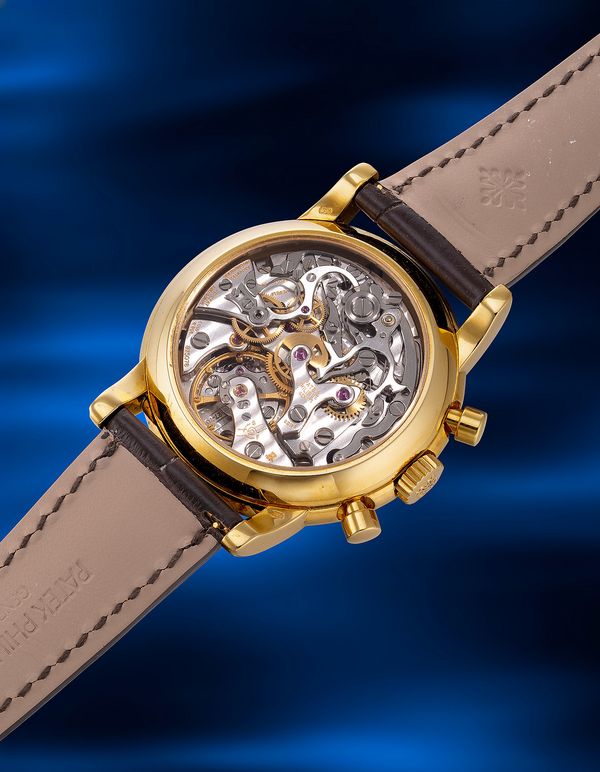
Lot 856: A 1987 first-series Patek Philippe ref. 3971 in 18k yellow gold with Italian calendar that's included in the Phillips Hong Kong Watch Auction: XX. Estimate: HKD $1,500,000 - 3,000,000
It’s worth noting that after the early years, Patek phased out the separate 3971 reference. By the 1990s, with the third series, they chose to package the 3970 with both backs (solid and display) under the single ref. 3970. Thus, the need for a distinct number went away. This makes the 3971 a quirky footnote in Patek’s cataloging – essentially a display-back 3970E before display backs became mainstream. For collectors today, a 3971 is a prize: it has all the first-series traits (and the vintage charm that comes with them) plus the exhibition caseback which lets you enjoy the movement.
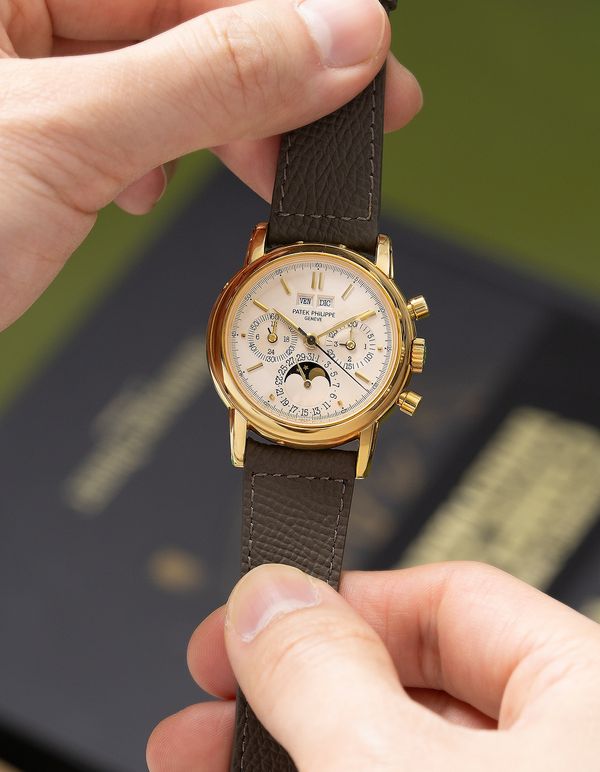
Lot 856: A 1987 first-series Patek Philippe ref. 3971 in 18k yellow gold with Italian calendar that's included in the Phillips Hong Kong Watch Auction: XX. Estimate: HKD $1,500,000 - 3,000,000
Visually, identifying a 3971 vs. 3970 can be subtle – the sapphire back on a 3971 is a snap-on type (like the first series snap back, just transparent), whereas a second-series 3970 has a screw-down back (and any display back on those would be screw-fit). If you see a first-series style 3970 with a sapphire back, it’s almost certainly carrying the 3971 reference. Given their low production (<300 units), these don’t surface often. But when they do, savvy collectors pay attention – the 3971 combines the romance of 1980s Patek with the practicality of being able to admire the movement.
Collectability
Over its two decades, the 3970 was produced in greater numbers than its predecessors, meaning it does not automatically command the stratospheric prices of a 1518 or 2499. However, within the 3970 family, there is a clear hierarchy of desirability. Certain configurations and eras of production are considered the cream of the crop, and these have been increasingly sought-after as collectors reassess the 3970’s importance. Let’s highlight which versions of the 3970 collectors find most desirable (without diving into specific dollar values):
Unique and Special-Order Pieces: At the very top of the pyramid are the unique dial versions – the watches made for VIP clients or as special editions. These include pieces like Eric Clapton’s salmon-dial 3970 and other Breguet numeral examples, the black-dial platinum one-offs, the luminous dial, and so on. By virtue of being one-of-a-kind or “possibly unique,” these watches ignite serious excitement whenever they appear. Collectors will pay multiples of the price of a normal 3970 to obtain a unique dial example, especially if it has celebrity provenance or a storied background. In short, unusual dials trump all else in the eyes of many high-end collectors, making this category the apex of 3970 collecting.
First Series 3970 and Reference 3971: Next in desirability are the earliest production pieces – those rare first-series watches from 1986 and the display-back 3971s. With only ~100 made of the 3970 first series and under 300 of the 3971, these are legitimately scarce. They also have the appeal of being the “original” version of the watch, with traits like the two-tone dial and snap back that were quickly phased out. Collectors who value vintage Patek aesthetics love the first series for its clear link to the 2499 (feuille hands, etc.), and for the romantic notion that these were produced under the stewardship of Philippe Stern as he navigated Patek through the 1980s. While a yellow gold first-series 3970 might not reach the price of a unique-dial piece, it’s still considered a trophy – especially if it’s in top condition and complete. This underlines a truth of the 3970 market: historically, collectors placed slightly less value on a plain first-series gold piece than on something like a platinum with exotic dial. But nonetheless, owning a first-series or a 3971 is owning a piece of horological history. For many, that makes them enormously appealing.
White Metal Rarities (especially Second Series WG & Pt): Patek collectors often gravitate to platinum and white gold pieces, and within the 3970 line there are some extremely rare ones. As discussed, in the second series Patek made only a handful in white gold (perhaps 14 known) and an equally scant number in platinum (around 11). These watches combine early production charm with precious metal rarity. Because so few exist, they almost never come up for sale. Collectors who own one tend to hold onto it. Consequently, when these do trade, they command a premium. Later-series platinum 3970s (third or fourth series) are more common by comparison, but are still highly prized – a platinum case is the ultimate expression of Patek’s flagship complication, and those pieces often came with gorgeous black dials (with or without diamonds) that set them apart. In general, platinum 3970s in any series attract strong collector interest, with white gold just behind, since WG was produced in smaller numbers than yellow or rose overall. For the collector who wants the stealth wealth look of a white-metal Patek, a 3970P or 3970G is a grail – and if it happens to be a rare early one, all the better.
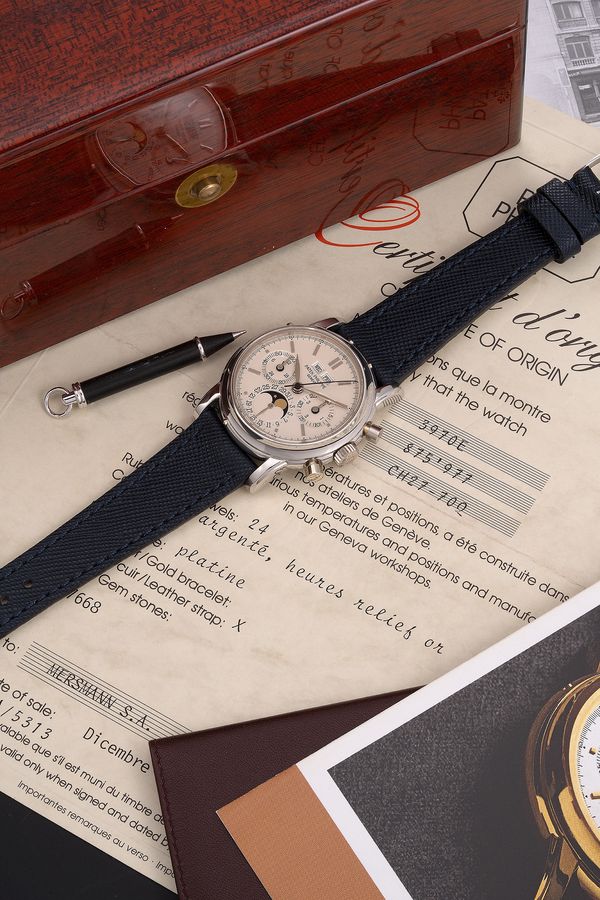
Lot 904: A second-series circa 1991 Patek Philippe ref. 3970 in platinum that's included in the Phillips Hong Kong Watch Auction: XX. Estimate: HKD $800,000 - 1,600,000
Complete Sets and Unique Combos: There are also collectors who love to assemble complete sets or hunt down unusual combinations. For example, acquiring one 3970 in each metal is a fun (if ambitious) project. Additionally, variants like the 3970/2 with integrated bracelet (a rare version that came with a fixed “beads of rice” style gold bracelet from the factory) have their own sub-collector following, as do watches with unusual hallmarks (some second series cases have oversized “big 750” gold hallmarks on the lug, which collectors find quirky and cool). While these aspects might not drive the highest prices, they add to the rich tapestry of 3970 collecting.
At the end of the day, any 3970 is a significant Patek Philippe – this is a perpetual calendar and a chronograph, after all, two of the most revered complications in one watch. Even a “standard” late-series 3970J or 3970R (yellow or rose gold, fourth series, silver dial) is a breathtaking piece of haute horlogerie. These more common configurations have historically been the entry point for collectors into the world of Patek high complications – relatively accessible (in context) yet still undeniably important watches. They might not appreciate as dramatically in value as the rare versions, but they still hold their own allure. Some collectors actually prefer the understated look of a yellow gold 3970 with silver dial, enjoying it as a wearer’s watch rather than a safe queen. And indeed, compared to its successors (the 5970 grew to 40mm, and the 5270 to 41mm), the 36mm 3970 is often cited as a more elegant, versatile size for regular wear.
In summary, the most desirable 3970s to collectors tend to be the ones that either have historical significance (earliest series), material rarity (white metal), or unique aesthetic flourishes (special dials or known provenance). But regardless of variant, the ref. 3970’s reputation has been on a steady rise. The market has been “gaining steam” in recent years as folks realize that this reference offers tremendous value relative to other Pateks. The days when nobody cared about the 3970 are over – it’s now very much on the radar of collectors worldwide.
The Enduring Legacy of the 3970
Why does the Patek Philippe 3970 hold such an enduring place in collectors’ hearts? Perhaps because it represents the perfect balance of many things. It’s complicated yet wearable, historically important yet not ostentatious. It has pedigree – tracing its lineage to two of the most revered references in Patek’s history – yet it was forward-looking, introducing new features and ushering Patek’s complications into a modern era. In the 3970, one finds the soul of a vintage watch wrapped in the reliability and finish of a modern one. It is, as many have come to realize, the last “classic” Patek perpetual chrono before case sizes swelled and aesthetics shifted in the 21st century.
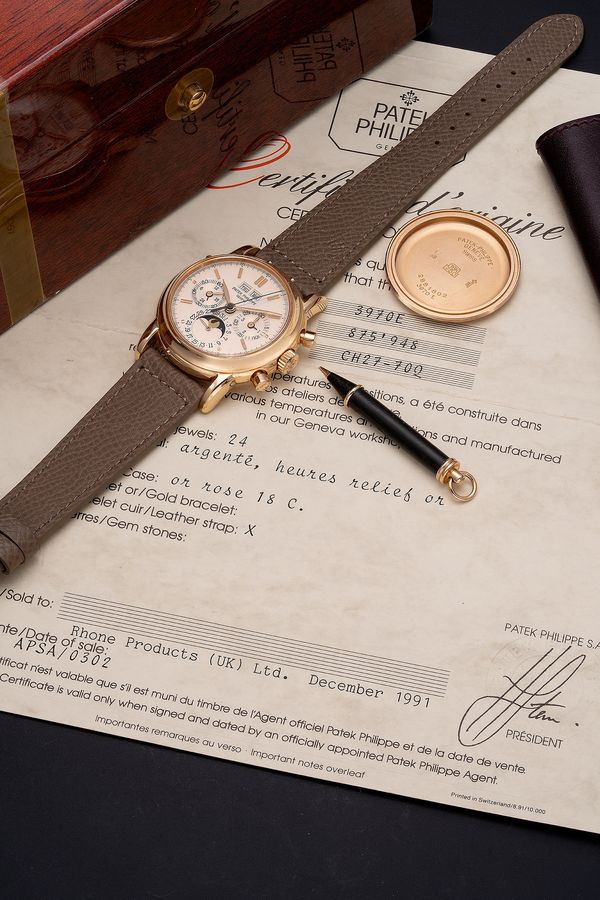
Lot 1046: A second series circa 1991 Patek Philippe ref. 3970 in 18k pink gold that's included in the Phillips Hong Kong Watch Auction: XX. Estimate: HKD $640,000 - 1,280,000
The 3970’s long production run also means it has stories to tell. It’s not a one-note watch – it evolved subtly, it was customized for the few who asked, and it quietly witnessed the renaissance of mechanical watchmaking from the 1980s into the 2000s. As collectors study it, they keep uncovering new fascinations: a rare dial here, a curious hallmark there, an exceptional set made years after it was discontinued. It’s a reference that rewards knowledge and connoisseurship. To own a 3970, especially a noteworthy example, is to participate in that ongoing story.
In the end, the Patek Philippe ref. 3970 occupies a sweet spot in collecting. It’s exclusive enough to be special (you certainly don’t see one every day, and some variants you might never see except in books), yet it’s not so unobtainable that it lives only in auction catalogues and dreams. It’s a watch you can, with effort, acquire, wear, and enjoy – all while knowing you have on your wrist a direct descendant of those seven-figure legends.
You can learn more, place a bid, and view the entire Phillips Hong Kong Watch Auction: XX catalogue right here.