Article | In Depth Patek 3448
In-Depth: Patek Philippe’s Perpetual Calendar Ref. 3448 Was the First of Its Kind
Everything you need to know about the first automatic perpetual calendar, from dial variations to design evolution — and why it remains one of the all-time greats.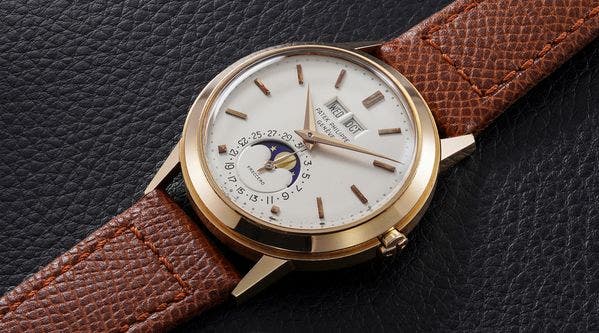
Our first live auction of 2025, the PHILLIPS Geneva Watch Auction: XXI, takes place on 10 - 11 May, at the Hotel President, at Quai Wilson 47, in central Geneva. The auction includes nearly 200 of the world's finest watches – and though we are loath to boast, we truly think it's one of the best catalogs we've ever put together. We'll be highlighting a number of the most interesting lots and stories featured in the sale over the next month, including all the watches detailed below.
– By Logan Baker
Few references inspire as much reverence in the realm of complicated vintage watches as Patek Philippe ref. 3448. Nicknamed the “Padellone” (Italian for “frying pan”) for its broad, straightforward case, the ref. 3448 holds a special place in watchmaking history.
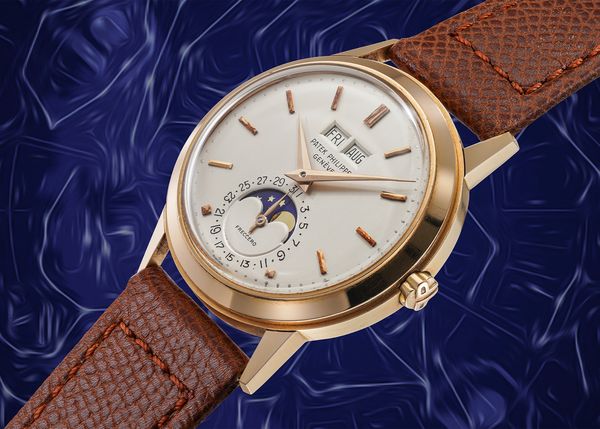
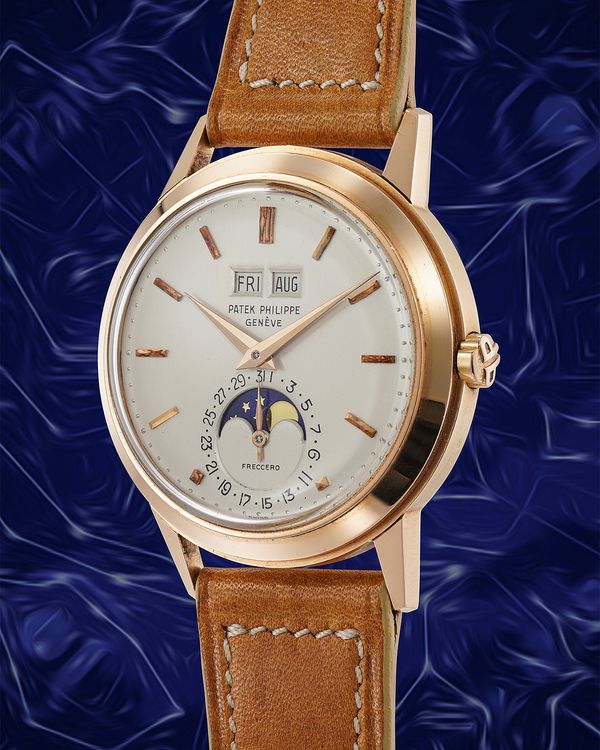
Lot 74: The only known Patek Philippe ref. 3448 in 18k pink gold. Included in the upcoming Phillips Geneva Watch Auction: XXI. Estimate: CHF 2,000,000 - 4,000,000
Debuting in 1962, it was the world’s first serially produced automatic perpetual calendar wristwatch – a groundbreaking union of convenience and complexity that set a new benchmark for fine watchmaking.
Collectors adore the ref. 3448 for its clean and symmetrical dial, its formidable presence on the wrist, and its significance as a bridge between classic and contemporary Patek Philippe design.
A Brief History
The Patek Philippe ref. 3448 was introduced in 1962, arriving on the scene as the successor to Patek’s earlier perpetual calendars like the refs. 1526 and 2497. This was the height of the post-war watchmaking renaissance, and Patek Philippe was determined to push the envelope.
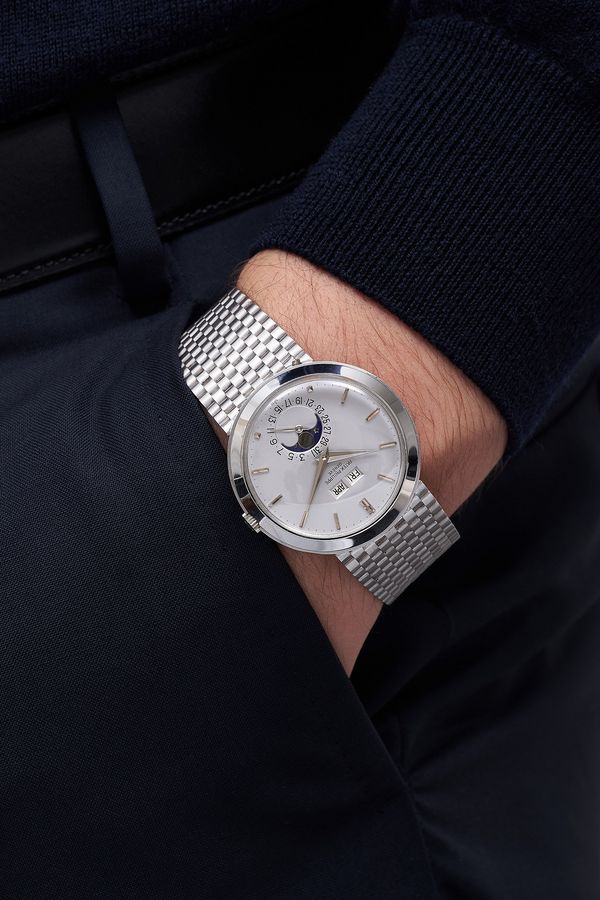
A 1977 Patek Philippe ref. 3448/17 in 18k white gold with integrated bracelet that sold for CHF 441,000 at the Phillips Geneva Watch Auction: XIII, in May 2021.
With the ref. 3448, they did exactly that – for the first time ever, a perpetual calendar watch wound itself. Up until then, perpetual calendars were manually wound affairs. The ref. 3448 changed the game by adding an automatic winding mechanism to keep the calendar ticking without daily manual winding. In fact, Patek can claim that the ref. 3448 was the first automatic perpetual calendar wristwatch made by any brand.
Beyond its technical first, the ref. 3448 also marked a shift in design language. It replaced the baroque 1950s-style cases of its predecessors (such as the ref. 1526 and ref. 2497) with something altogether more simple and modern. The legendary case maker Antoine Gerlach is credited with the design, and what a design it was: a 37.5 mm precious metal disc of a watch with strong, angular lugs and a clean dial layout.
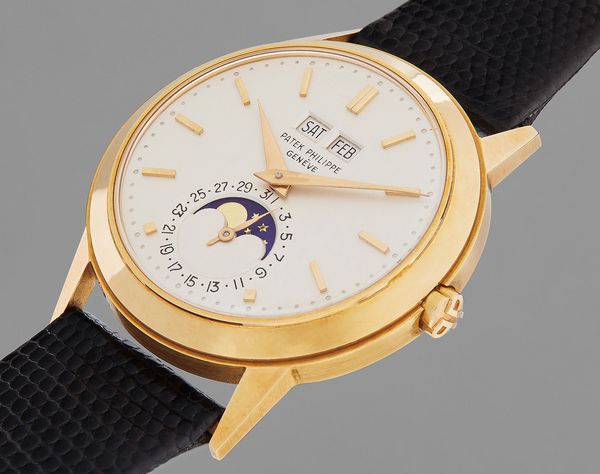
A 1966 Patek Philippe ref. 3448 in 18k yellow gold that sold for USD $529,200 at Phillips Racing Pulse in New York in December 2020.
Importantly, Patek Philippe produced the ref. 3448 for just about 20 years (1962–1982), and in very small numbers by today’s standards. It’s estimated that only around 586 pieces were made in total. For context, that’s roughly two watches per month on average – truly a drop in the bucket, even in mid-century Switzerland.
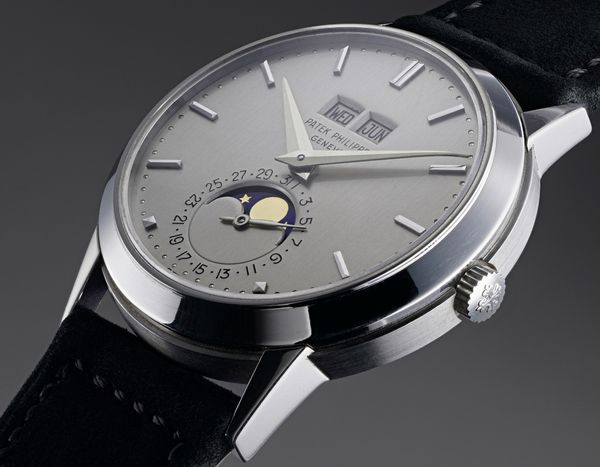
This rarity only adds to the allure for collectors. Most of those 586 were cased in 18k yellow gold, but Patek also offered a scarce few in white gold, and there are exceedingly rare examples in rose gold (only one publicly known) and platinum (two known).
The Case Design
One cannot discuss the ref. 3448 without mentioning its case design. When you first pick up a ref. 3448, you’re struck by its geometric elegance. The case is a perfect circle when viewed head-on, with a broad bezel and taut lines that give it a monolithic appearance – like a coin or a flying saucer on the wrist. The lugs jut out sharply with crisp facets, almost brutish in their straight-edged form, yet proportioned so well that the watch still feels dressy and refined.
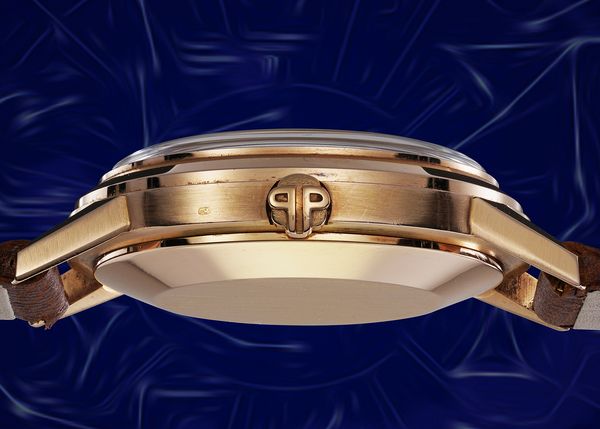
Lot 74: The only known Patek Philippe ref. 3448 in 18k pink gold. Included in the upcoming Phillips Geneva Watch Auction: XXI. Estimate: CHF 2,000,000 - 4,000,000
At 37.5mm in diameter and around 9mm thick, the ref. 3448 was considered large for its time. But Patek balanced the size with beautiful details. Note the subtle slanted bezel profile – it slopes outwardly just slightly, adding visual interest and reducing mass. The real party trick, however, is the crown integration. The winding crown is partially recessed into the case flank, sitting about halfway sunk in when pushed in. This not only protects the crown but also preserves the case’s clean silhouette. Early examples of the ref. 3448 have been observed with "PP"-signed crowns, while most examples feature the Calatrava cross.
Finally, let’s touch on the case metals and rarity, as this is key for collectors. As noted, the majority of ref. 3448s were cased in yellow gold. A look at auction records over the decades reveals that 218 yellow gold examples have appeared compared to just 82 in white gold.
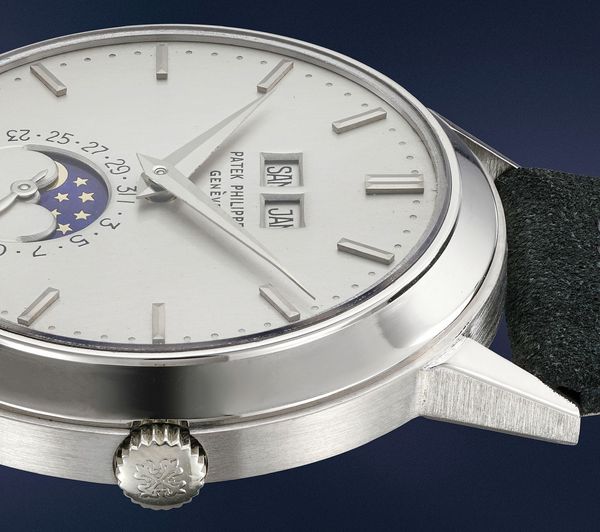
A 1970 Patek Philippe ref. 3448 in 18k white gold that sold for CHF 644,000 at the Phillips Geneva Watch Auction: XI, in June 2020.
But even those pale in rarity next to the unicorns: Patek is believed to have produced just one or two examples in pink gold, and for decades collectors weren’t even sure they existed. One finally surfaced, with a Freccero co-signed dial, in 2011 to much fanfare. It’s the same example we have included in the upcoming Phillips Geneva Watch Auction: XXI (lot 74).
And what about platinum? Interestingly, no platinum ref. 3448 that we know of left the factory in the 1960s or ‘70s, but Patek did sanction two special platinum-cased conversions for existing owners in the 1990s. So in summary: yellow gold is classic, white gold is rare and highly sought, rose gold is virtually one-of-a-kind, and platinum is a modern post-script to the story.
The Dial
If the case of the ref. 3448 is bold, the dial is the picture of restraint. Patek Philippe took a less-is-more approach to the dial layout, achieving a look that is harmonious and balanced despite the complexity underneath. The perpetual calendar displays are arranged in what’s known as a “twin in-line” aperture format: two rectangular windows sit side-by-side at 12 o’clock, showing the day of the week and month. Crucially, the ref. 3448 omits a seconds hand entirely, a deliberate choice that keeps the dial uncluttered.
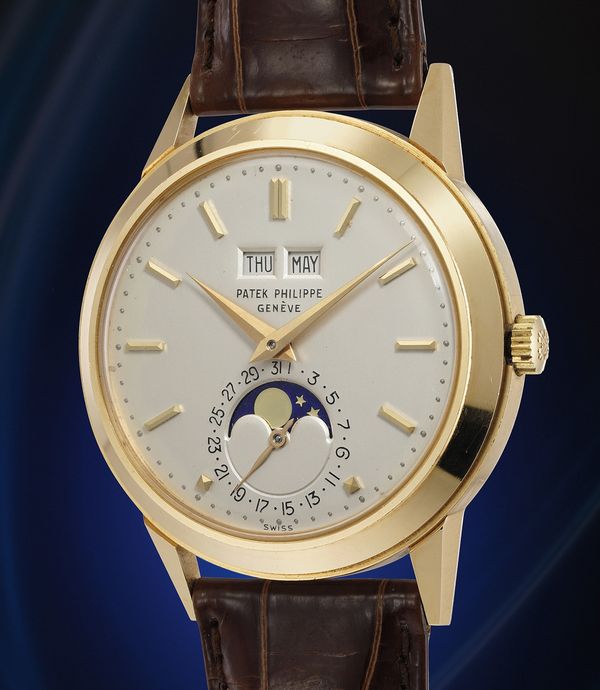
A 1968 Patek Philippe ref. 3488 in 18k yellow gold that sold for CHF 378,000 at the Phillips Geneva Watch Auction: XV, in May 2020.
At 6 o’clock, a circular sub-dial hosts two functions – the date (via a hand pointing to the days 1–31 around the sub-dial’s perimeter) and the moon phase display in its upper half. A small number of ref. 3448 variations have been produced without the moon-phase display. These so-called “Senza Luna” variations are shrouded in mystery and won’t be covered in this article.
The dial itself is usually an opaline silvery-white (sometimes described as ivory or eggshell white) that contrasts beautifully with the applied hour markers and hands. Patek went with faceted baton indices at each hour, and either batons or small pearls for the minutes (at least on some versions – as we’ll see, this evolved). Paired with dauphine-style hands for the hours and minutes, the dial furniture is classic 1960s Patek.
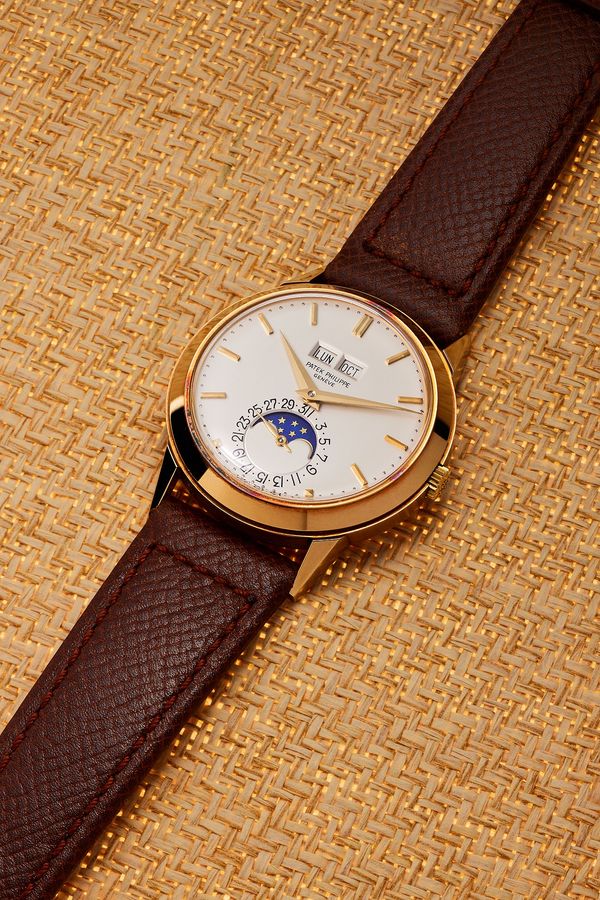
A 1972 Patek Philippe ref. 3448 in 18k yellow gold that sold for USD $273,050 at the Phillips New York Watch Auction: Eight, in June 2023.
There’s a subtle seconds/minute track around the outer edge in the form of minute markers. The only text on the dial is the PATEK PHILIPPE / GENÈVE autograph below the day-month windows, and on most examples, a small “Swiss” signature at 6 o’clock, tucked under the date sub-dial.
The beauty of the ref. 3448’s dial is in what it doesn’t have: no extra scales, no luminous plots (most of the time), and no busy graphics.
Dial Variations
While the dial design remained fundamentally consistent through the ref. 3448’s long production run, Patek did implement several subtle changes over the years, resulting in what collectors classify as four series or dial variations. These variations are a hot topic for ref. 3448 connoisseurs, as the earliest versions have certain traits that are highly coveted. Here’s a breakdown of the known dial variations of the ref. 3448, as commonly defined:
First Series (1962–circa 1965): Features hard enamel printing for the details – the minute markers (thin “baton” indices or ticks) and the signatures are actually engraved and filled with enamel, giving a slightly raised, glossy look under a loupe. First-series dials feature smaller/thinner date numerals, often referred to as the “small date ring.” A small number of early examples have been observed with different hands and hour markers than the standard, including those with slim baton hands and slimmer indexes.
Second Series (circa 1965–circa 1973): Moves to “beady” or “pearled” minute divisions – meaning the minute markers are little dot markers (also called pearl minutes) instead of lines. The printing may still be done in enamel up until the late ’60s, though there is some debate on exactly when Patek switched from enamel to printed; both enamel and printed signatures can be found in this range. Second series dials still have the smaller date numerals on the sub-dial. Some second-series dials produced between 1966 and 1968 incorporate a pearled five-minute marker with the hour indices adjusted slightly inward on the dial, but most known examples feature no five-minute marker and incorporate the applied hour index as flush with the minute track.
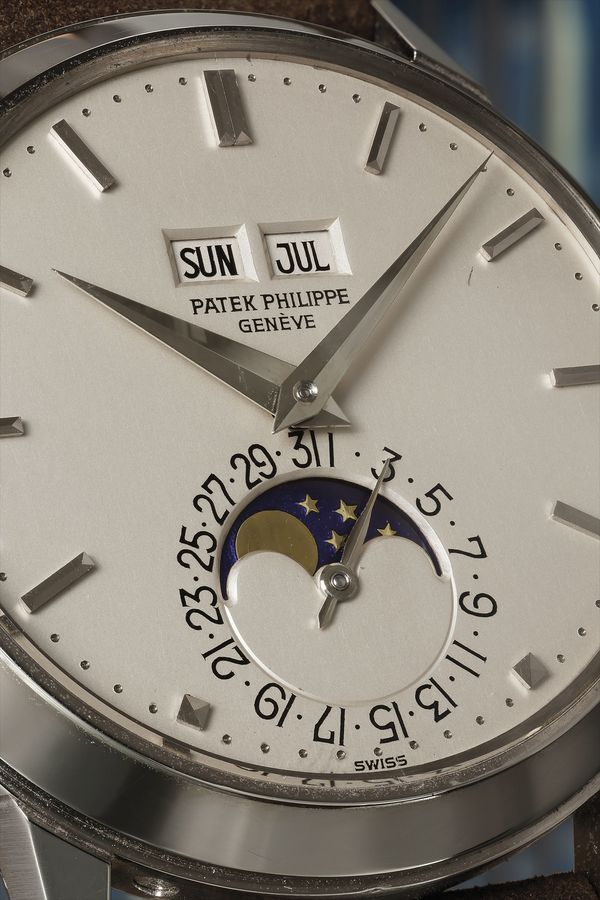
A 1972 Patek Philippe ref. 3448 in 18k white gold with second series dial that sold for USD $471,000 at the Phillips Winning Icons sale in New York in October 2017. This example features bead minute markers, hard raised enamel printing, and inverse date display.
Third Series (circa 1971–circa 1978): This era saw a transition. The date ring was enlarged – larger date numerals for improved legibility on the 6 o’clock sub-dial. The minute markers on third series dials continue to use the beady pearls. The printing by this time was likely done by standard pad printing (the industry had largely moved away from hard enamel by the ’70s). Many third series dials also feature the “Sigma” (Aprior) marks flanking the “Swiss” at 6 o’clock (displayed as “Σ Swiss Σ”), denoting that the hour markers and hands are made of gold. This was a sign of the times in the 1970s, as the Swiss watch industry collaboratively promoted the use of gold components. Certain third-series dials are also known for a slight peculiarity: the lower half of the date ring is inverted, presenting upside-down numerals. It can be found on a few pieces made around 1971 to 1973.
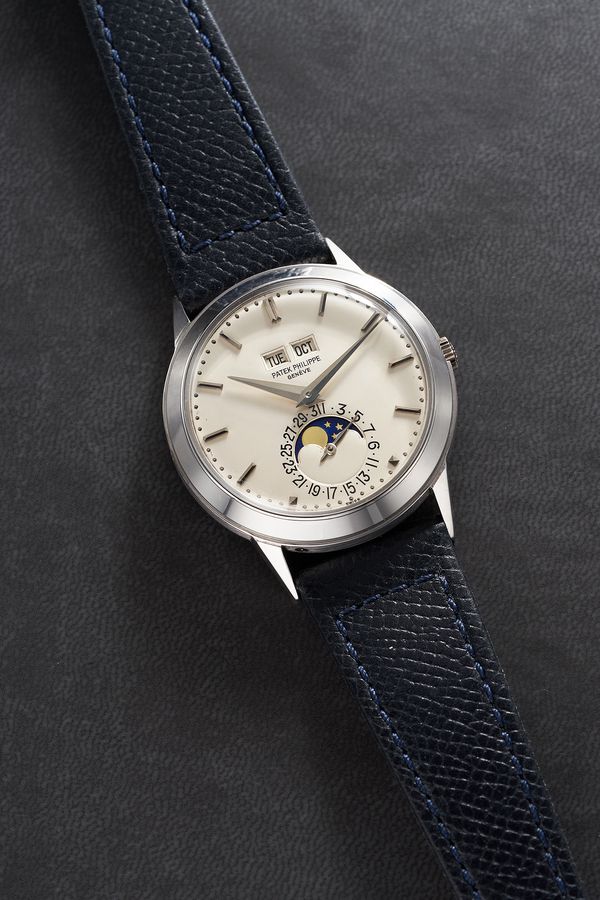
A 1973 Patek Philippe ref. 3448 in 18k white gold with third-series dial that sold for CHF 567,000 at the Phillips Geneva Watch Auction: XVI, in November 2022.
Fourth Series (circa 1978–1982): The final iteration of the ref. 3448’s dial saw a return to small baton minute indices (like the first series) but notably printed, not enameled. Everything on these late dials is pad-printed, with a slightly bolder font for the signatures and a very crisp, industrial look. The date ring is the larger style. Essentially, by the fourth series, the 3448’s dial had evolved to be a bit more modern in production method, if not in appearance. These late pieces often have a “Sigma” marking as well, since we’re still in the late ’70s. One small quirk found on only a small selection of fourth-series ref. 3448s (less than 10 known examples) is the presence of a sapphire crystal. The bezel on these sapphire crystal examples has slightly different proportions than the conventional ref. 3448, closer in style to the successor ref. 3450.
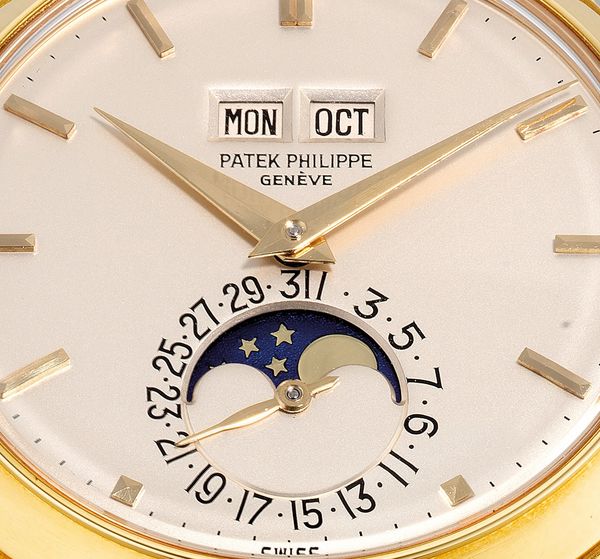
A Patek Philippe ref. 3448 in 18k yellow gold with fourth-series dial that sold for HKD $2,142,000 at the Phillips Hong Kong Watch Auction: XI, in November 2020.
Outside the conventional four dial series, there are a number of other dial variations within the ref. 3448’s production that can be identified.
While the classic silver-opaline dial is almost uniform for the reference across the series, three yellow gold examples have been identified with champagne-yellow dials (Movement numbers 1’119’149, 1’119’173, 1’119’130), one white gold example is known with a grey dial (Movement no. 1'119'494), and one yellow gold example is known with a very unusual blue dial (Movement no. 1'119'531).
There are also a few known ref. 3448 examples out there fitted with gems for the hour markers. Ruby hour markers can be found in two known yellow gold examples, with either baguette-cut rubies (Movement no. 1’119’038) or brilliant-cut rubies (Movement no. 1’119’187). Baguette-cut diamond hour markers are known on three examples, two in yellow gold (Movement nos. 1’119’369, 1’119’088) and one in white gold (Movement no. 1’119’366). And brilliant-cut sapphires can only be found in one platinum example (Movement No. 1’119’323), the legendary Blue Royale.
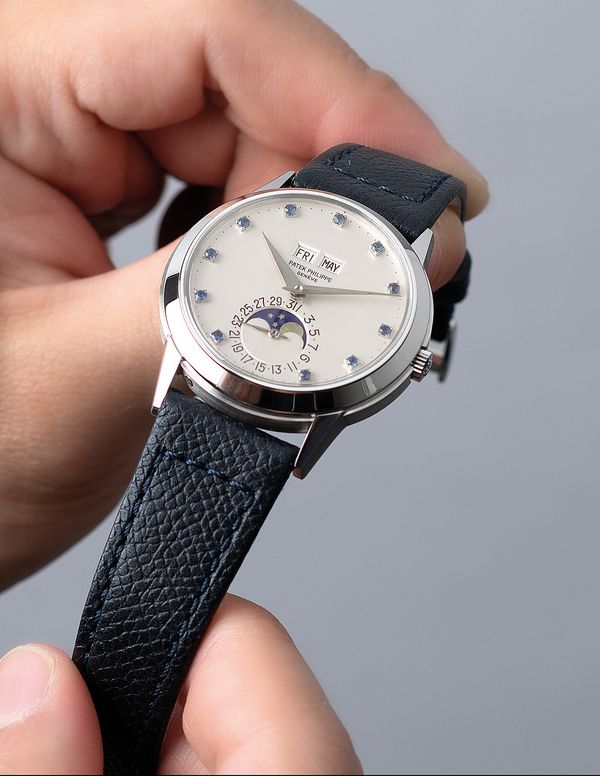
The platinum Patek Philippe ref. 3448 'The Blue Royale' that sold for HKD $17,795,000 at the Hong Kong Watch Auction: XIII, in November 2021.
Of course, a small number of ref. 3448 dials were also outfitted with retailer signatures, with known examples including Asprey, Beyer, Cartier, Freccero, Gübelin, and Tiffany & Co.
Another known dial variation to be aware of are the very few ref. 3448s featuring luminous hands and five-minute markets. Currently, two luminous ref. 3448s are known in white gold and feature an adjusted dial configuration with the hour markers moved slightly toward the center of the dial in order to accommodate the luminous dots. A small handful of yellow gold variations with luminous hands, but no luminous five-minute markers, have also appeared over the years.
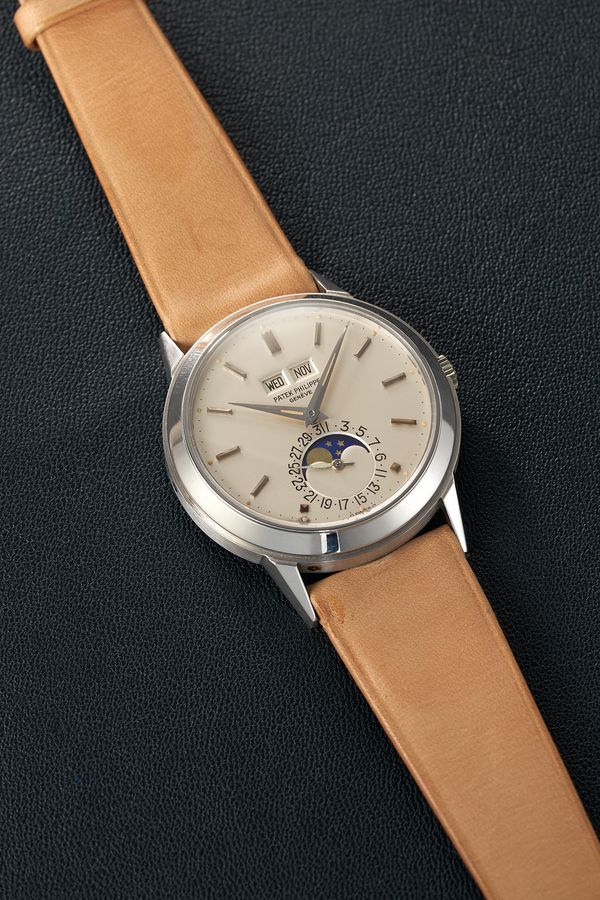
A 1974 Patek Philippe ref. 3448 in 18k white gold with luminous dial that sold for CHF 655,200 at the Phillips Geneva Watch Auction: XV, in May 2022.
Interestingly, a small number of ref. 3448s near the end of the reference’s lifespan have appeared on the market with a surprising addition: a leap-year indicator. While the leap-year display was officially added to Patek’s self-winding perpetual calendar with the release of the successor ref. 3450 in 1981, these few examples of the ref. 3448 with leap-year display were an early proof of concept that the updated caliber 27-460 QB was functional and attractive. The leap-year display is depicted the same as it would appear on the ref. 3450, with a circular aperture using a red disc to indicate the leap year and Roman numerals to depict the three common years. A very small number of examples are known in both white gold and yellow gold. One unique example in white gold features Arabic numerals on the leap-year disc and a black varnish applied to the hour markers and hands.
Finally, although I said I wouldn't cover the “Senza Luna” variation of the ref. 3448 in detail in this article, there is one additional unique dial variation to discuss: the one-of-a-kind “Alan Banbery.” This ref. 3448 was custom-made for Alan Banbery, a longtime head of sales at Patek Philippe who helped build the brand’s museum collection and coauthored its reference books with Martin Huber. It replaced the conventional moon-phase with a quadrant leap-year display in red text. Scholarship states that Banbery proposed the removal of the moon-phase display to Patek Philippe watchmaker Max Berney, who modified the standard ref. 3448 accordingly. Henri Stern, then company president and father of Philippe Stern, later gifted Banbery the watch.
Despite all these differences, every ref. 3448 dial is fundamentally of the same design (besides the Senza Luna/Banbery examples): twin windows, a moon-phase/date sub-dial, and that wonderfully uncluttered layout.
The dial is a huge part of why this reference is considered one of Patek’s most beautiful perpetual calendars – it achieves a perfect balance of complexity and clarity, something even contemporary perpetual calendars struggle with.
The Bracelet Variations
On rare occasions, Patek Philippe also outfitted the ref. 3448 with a variety of integrated or fitted bracelet designs. Many of these bracelets were produced for Patek by the specialist bracelet maker Jean-Pierre Ecoffey (identifiable by the “JPE” stamp on the bracelet clasp). It’s also common for examples of the ref. 3448 born with an integrated bracelet to have been produced without lugs, although this wasn’t always the case.
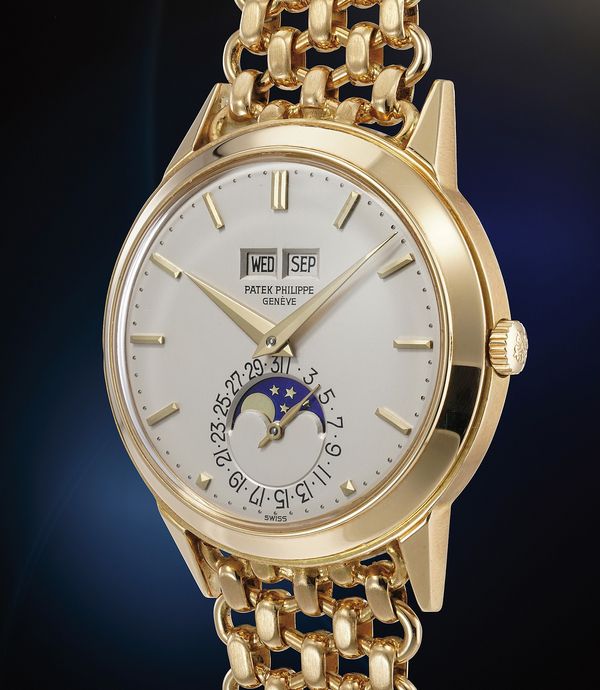
A 1972 Patek Philippe ref. 3448/4 in 18k yellow gold with fitted chain-link bracelet by Jean-Pierre Ecoffey that sold for CHF 239,400 at the Phillips Geneva Watch Auction: XVI, in November 2022.
Bracelet-equipped versions of the ref. 3448 were never produced in series, and often only on request of special clients, as such they were typically assigned a unique reference number. For example, a white gold example Phillips sold in July 2020 that was fitted with a unique woven bracelet was given ref. 3448/14. A yellow gold example sold by Phillips in November 2022 with a chain-link bracelet was assigned ref. 3448/4.
Some of the known original bracelet variations that can be found paired with the ref. 3448 include woven, beads-of-rice, chain link, Swiss cheese, Milanese, and articulating.
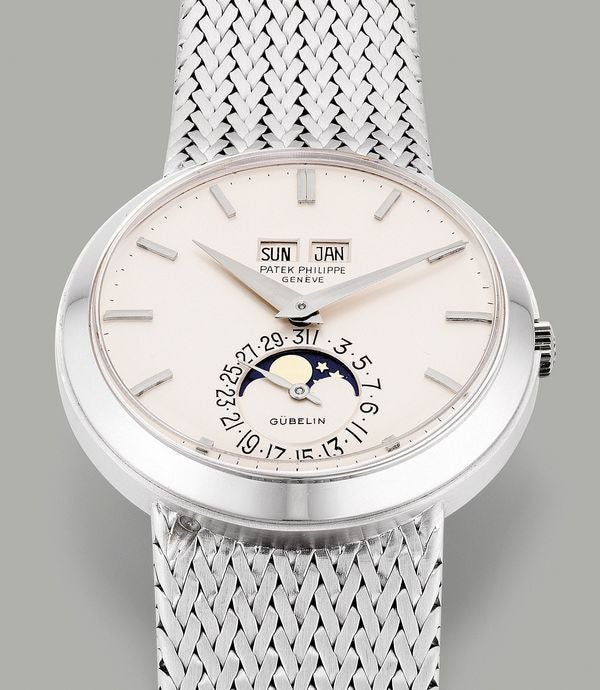
A 1975 Patek Philippe ref. 3448/14 in 18k white gold with integrated bracelet and Gübelin signature that sold for HKD $3,750,000 at the Phillips Hong Kong Watch Auction: X, in July 2020.
It's worth noting that the moon-phase corrector is hidden between the bottom pair of lugs near the six o'clock marker. On ref. 3448 examples with integrated bracelets, a small opening is placed in the bracelet to allow continued access to the moon-phase adjustment pusher.
Under the Hood: The Caliber 27-460 Q
Inside the Patek Philippe ref. 3448 beats a movement that is as impressive as the dial and case that surround it. The watch is powered by Patek’s caliber 27-460 Q (the “Q” stands for Quantième, or calendar).
To understand the significance, we need a little background. Patek’s first automatic movement was the cal. 12’’’600 AT from 1953 (found in the legendary ref. 2526). By the early 1960s, Patek had refined that design into the 27-460. This movement was seen in watches like the ref. 3445 (a simple date model) in the early ’60s and is widely regarded as one of the finest automatic movements of all time. For the ref. 3448, Patek took the 27-460 and added a perpetual calendar module on top, creating the 27-460 Q.
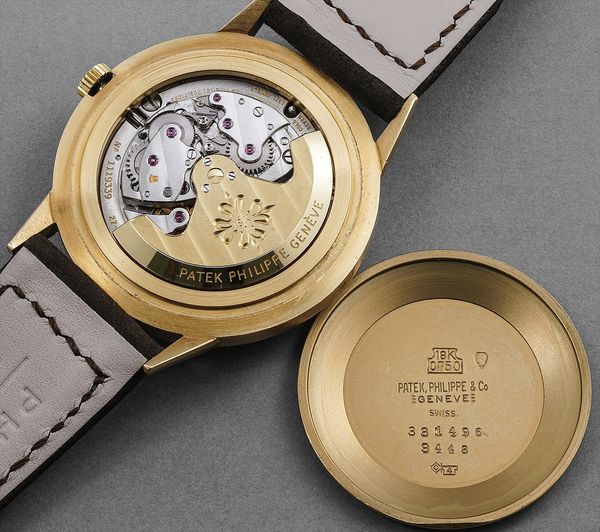
A 1974 Patek Philippe ref. 3448 in 18k yellow gold that sold for CHF 187,500 at the Phillips Geneva Watch Auction: Nine, in May 2019.
It’s a 37-jewel movement, stamped with the Geneva Seal. It features Patek’s famed Gyromax balance and a free-sprung regulator, beating at a traditional 19,800 vph. The rotor is made of 18k yellow gold and is bidirectionally winding. What’s remarkable is that even with the perpetual calendar module, the movement isn’t excessively thick. It sits inside the case with room for the snap-on solid caseback.
One lovely detail: if you were to pop the dial off (not that we recommend doing so!), you’d find that the movement number is hand-engraved on the back side of the dial on many ref. 3448s. This was Patek’s way of keeping the pieces matched during assembly and servicing.
There are also six known examples of the ref. 3448 that include sapphire crystal exhibition casebacks, possibly a result of specific requests from the original owners to admire the movement.
Collectability
The Patek Philippe ref. 3448 is a watch that ticks all the boxes for a collector of vintage high-end watches. Its horological significance is unquestionable – being the first of its kind in so many ways, and representing a key chapter in Patek’s grand history of complicated watchmaking.
Lot 74: The only known Patek Philippe ref. 3448 in 18k pink gold. Included in the upcoming Phillips Geneva Watch Auction: XXI. Estimate: CHF 2,000,000 - 4,000,000
Its design is singular: few other watches look like the ref. 3448, with that bold case and perfectly laid-out dial. It manages to be both of its time (1960s modernism) and ahead of its time (many design elements still feel fresh today). The fact that it was made in such limited numbers over two decades means that owning one puts you in an exclusive club. And within that club, there’s endless nuance to appreciate: which series dial, which metal, which year, perhaps even which retailer signature.
Generally, the earlier dials (first and second series) are the most coveted. The hard-enamel text of the first series, in particular, gives a lustrous depth that later dials lack.
One of two known platinum Patek Philippe ref. 3448s, this example sold for CHF 1,092,500 at the Phillips Geneva Watch Auction: Seven, in May 2018.
Importantly, unlike some vintage complications that are perhaps more revered for their movements than their looks, the ref. 3448 is often hailed as one of the most beautiful watches Patek has ever made.
The Patek Philippe ref. 3448 encapsulates the best of what vintage watch collecting is about: history, design, technical prowess, and rarity wrapped into one exquisite object.
Yet the ref. 3448 stands apart as the genesis of the automatic perpetual calendar, a watchmaking trailblazer that also happens to be drop-dead gorgeous on the wrist.
You can learn more, place a bid, and view the entire Geneva Watch Auction: XXI catalogue right here.
About Phillips In Association With Bacs & Russo
The team of specialists at PHILLIPS Watches is dedicated to an uncompromised approach to quality, transparency, and client service. Phillips in Association with Bacs & Russo holds the world record for the most successful watch auction, with its Geneva Watch Auction: XIV having realized $74.5 million in 2021. Over the course of 2021 and 2022, the company sold 100% of the watches offered, a first in the industry, resulting in the highest annual total in history across all the auction houses at $227 million.
About Logan Baker
Logan has spent the past decade reporting on every aspect of the watch business. He joined Phillips in Association with Bacs & Russo at the start of 2023 as the department's Senior Editorial Manager. He splits his time between New York and Geneva.
Recommended Reading
How Independent Watchmakers Are Rethinking the Escapement
Why Collectors Are Falling Back in Love With Time-Only Vintage Watches
Inside The Philippe and Elisabeth Dufour Foundation