Article | Why Modernism Is More Important Than Ever New York Art Auction
Why Modernism Is More Important Than Ever
History illuminates the present with a selection of our favorite works from Phillips’ upcoming MODERNISM 1880–1960: Editions & Works on Paper auction.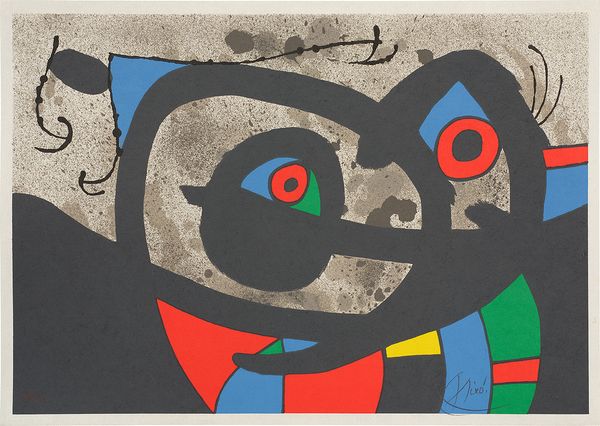
Joan Miró, Le Lézard aux plumes d'or (The Lizard with Golden Feathers), 1971. MODERNISM 1880–1960: Editions & Works on Paper.
For better or worse, change seems to come faster than ever these days. But take a break from it all to visit an art gallery, and you might find that the core themes surrounding Modern Art — from industrialization to cultural experimentation, new technologies, a focus on the individual, and the rejection of established norms — still define how we navigate the world today. We might give them new terms — last century’s urbanization becomes this century’s gentrification and so on — but the fact remains: it’s easy to argue that modernism never ended, maybe it just got faster.
With this in mind, art lovers and collectors discover that today, Modern works can be seen with new, rich layers of meaning.
It’s in this cultural light that Phillips presents a new session in our spring auctions of Editions & Works on Paper in New York. MODERNISM 1880–1990 will be held live just before the Editions & Works on Paper Evening Sale taking place 16 April. The inaugural session includes 103 lots of master prints by key Modernist European, American, and South American artists that represent the pivotal movements of the period, from Cubism to Dada, Surrealism, Expressionism, Constructivism, Orphism, and more.
Here, we trace a chronological line through key works that showcase these ideas. View these works and more in person at our 432 Park Avenue gallery from 9–15 April.
Paul Gauguin and the breakthrough into modernity
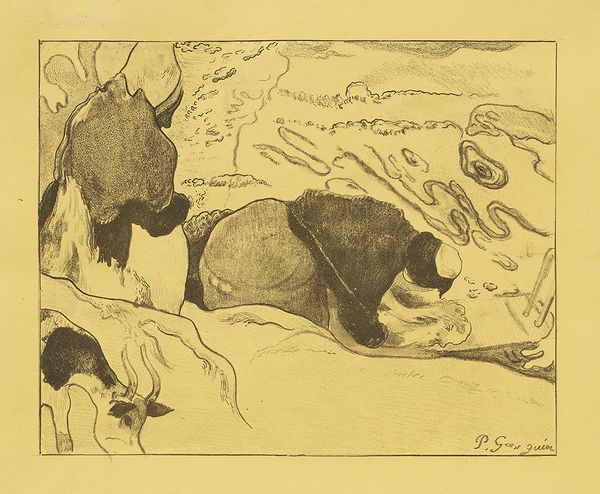
Paul Gauguin, Les Laveuses, from La Suite Volpini (The Washer Women, from the Volpini Suite), 1889. MODERNISM 1880–1960: Editions & Works on Paper.
Not only representing Gauguin’s earliest experiments with printmaking, works from the Volpini series also serve as a reference point for the breakthrough into Modernism itself and the unique role printmaking holds as a beneficiary of emerging technologies. In these prints, Gauguin developed aspects of his signature style that he would go on to explore throughout his career, establishing some of his most familiar motifs, from the mourning Eve to fruit bearers, and the woman in the waves. All told, this work calls to mind the negotiations taking place at the forefront of culture during a time when rapid industrialization was pitted against the ideals of rural life. Looking back, we can see that Gauguin was as fearless in exploring these rapid cultural shifts as he was in questioning them — and what could be more relevant today?
Juliette Nichols and the birth of American Modernism in Provincetown
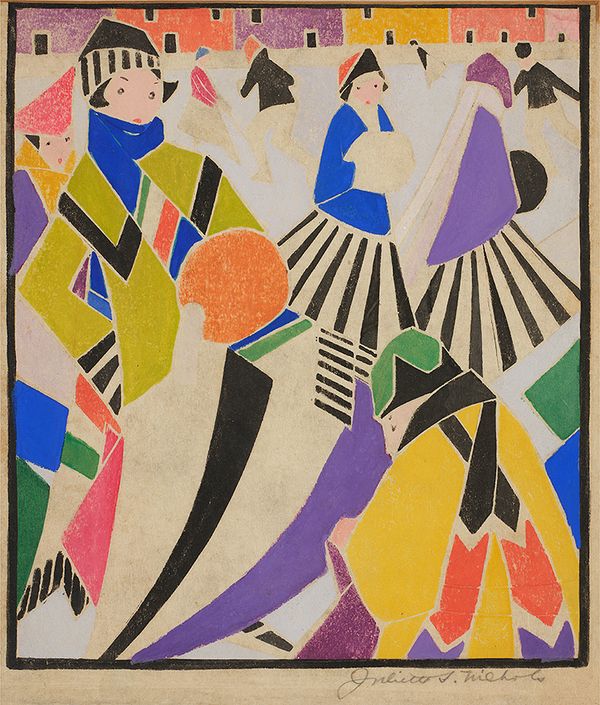
Juliette Nichols, Skating, 1916. MODERNISM 1880–1960: Editions & Works on Paper.
On the heels of Phillips’ groundbreaking offering of Provincetown Prints, an exciting group of works by Juliette Nichols has emerged and will be the first group to appear at auction. Nichols, who was among the group of printmakers who settled in the small Cape Cod village in the winter of 1915–1916, went on to exhibit throughout the Northeast, bringing the group’s trailblazing approach to white-line woodcut to a wider audience. Her penchant for vibrantly hued scenes of bathers, landscapes, seascapes, and more encapsulated the innovations of the group as pioneers of American Modernism.
Paul Klee’s Surrealist premonition
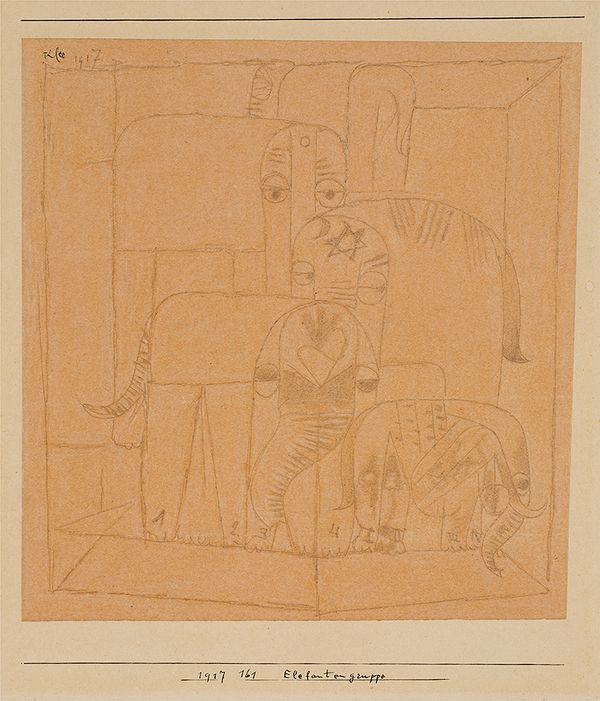
Paul Klee, Elefantengruppe (Group of Elephants), 1917. MODERNISM 1880–1960: Editions & Works on Paper.
Viewing the above drawing by Paul Klee, we can now tell that the 20th century has fully arrived. It’s 1917, the world is at war, and Klee is experimenting with his hallmark thin and energetic lines in a whimsical depiction of elephants. With a closer look, we can see multicultural symbols of spirituality on these animals’ heads — a subtle and poignant revelation of Klee’s peaceful sentiments amid years of global turmoil. In the fantastical and symbolic world this work depicts, we can also tell that Surrealism will arrive before we can say Elefantengruppe three times fast.
Ernst Ludwig Kirchner: Voted 'most expressive' senior year
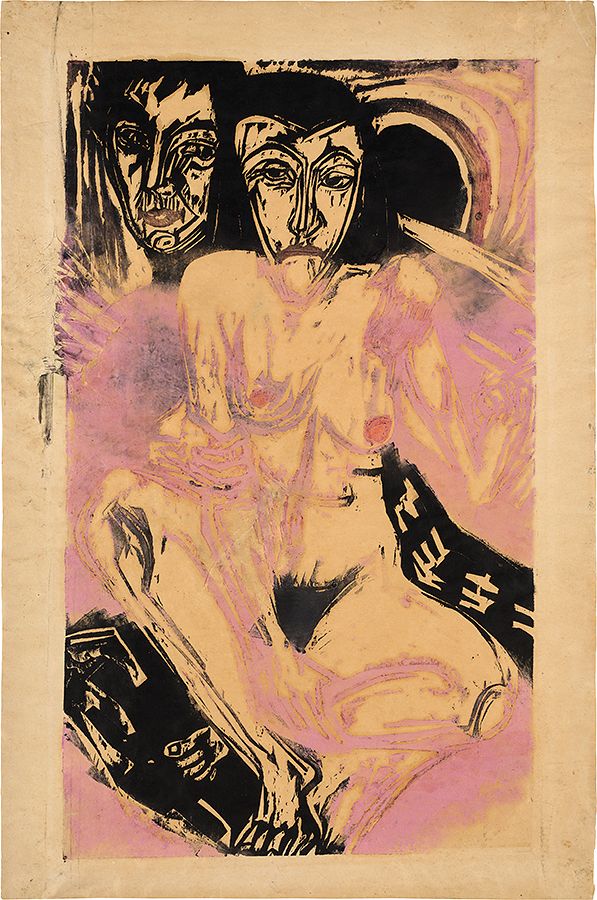
Ernst Ludwig Kirchner, Melancholy. - Naked Woman. - Self-Portrait with Erna, 1922. MODERNISM 1880–1960: Editions & Works on Paper.
This unique trial proof woodcut by Ernst Ludwig Kirchner offers a compelling lens through which to discover the hallmarks of German Expressionism. We’re now looking at works from just about a century ago and can feel the increased focus on the personal expressivity of psychological depth, here rendered through figural distortion, bold color, and stylized line.
The rare work depicts Kirchner embracing his longtime lover and artistic partner, Erna Schilling, showcasing their shared inner turmoil in their life together in Davos, Switzerland — an alpine retreat that eased Kircher’s depression but heightened Schilling’s. Their tragic story is set against the backdrop of important Germanic art historical events, from Schilling’s affiliation with Weimar-era cabaret to Kirchner’s founding of Die Brücke and the group’s rejection of academic norms and embrace of woodcut as a medium. There’s perhaps no better work to showcase what this time and place can mean for us today. Plus, their life story plays out like a devastating romantic blockbuster. It’s well worth a read.
Keeping it real with Edward Hopper
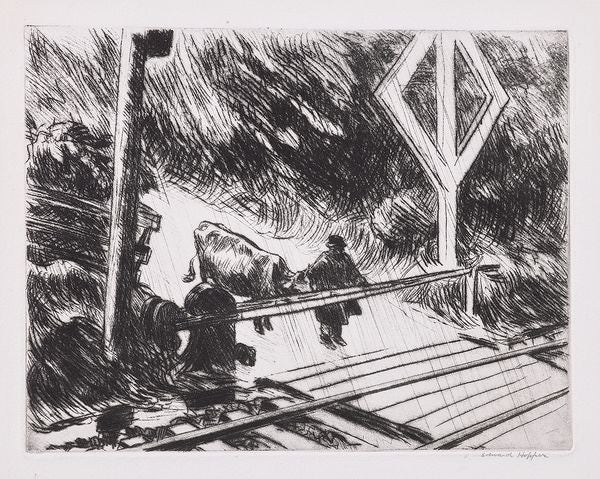
Edward Hopper, Railroad Crossing, 1923. MODERNISM 1880–1960: Editions & Works on Paper.
Trains — the self-driving electric cars of 1923 — were bound to show up here at some point. But in the hands of American Realist Edward Hopper, our gaze is turned toward their ramifications as we witness a solitary farmer with a single cow being stopped in a rainstorm by the modernization of rural America. Hopper first explored etching after having little early commercial success as a painter, and these works mark important early experimentations with his most notable themes and subjects. Here, the rich emotional undertones of isolated figures that characterize his lauded paintings are rendered with a pure immediacy that stops us in our tracks — ourselves mirroring the farmer and his cow.
El Lissitzky: Out with the old, in with the nü
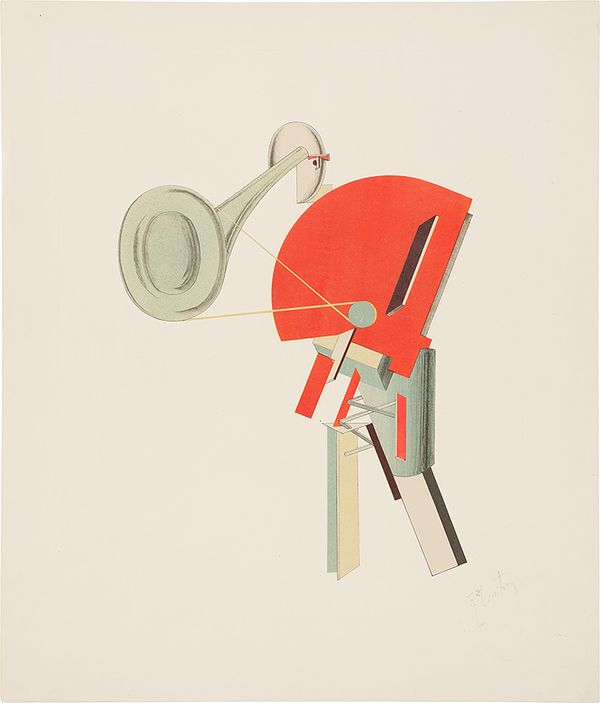
El Lissitzky, Announcer, plate 2 from The Three-Dimensional Design of the Electro-Mechanical Show 'Victory over the Sun', 1923. MODERNISM 1880–1960: Editions & Works on Paper.
Constructivist El Lissitzky, who floated in Marc Chagall’s circle and was initially trained as an architect, fully embraced modern printing and photographic technologies. Focused on the fundamentals of geometry and a limited range of colors, this series explores and emphasizes the triumph of human invention over nature. These notions are seen clearly in the lithograph on offer, titled Announcer, which depicts a human role as played by an imagined machine. The portfolio was based on drawings Lissitzky made of a 1920 performance in Saint Petersburg of the groundbreaking Cubo-Futurist opera Victory over the Sun, in which the protagonist attempts to capture the sun and replace it with a new, man-made source of energy and light as a coup over both time and reason. Why does this all sound so familiar?
Juan Gris: A Dadaist’s play and a connoisseur’s Cubist
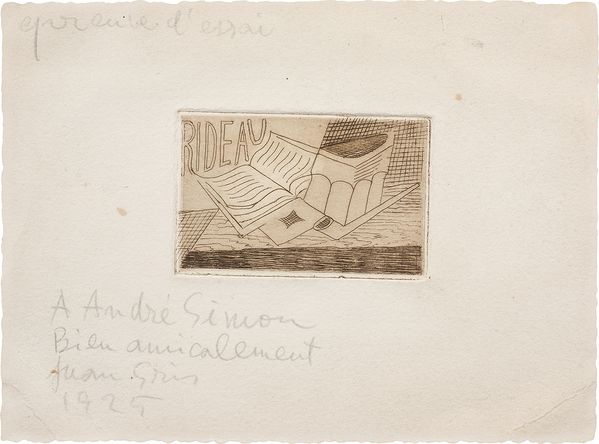
Juan Gris, Rideau, from Mouchoir de Nuages (Curtain, from Cloud Handkerchief), 1925. MODERNISM 1880–1960: Editions & Works on Paper.
This rare proof comes from a set of nine etchings that Juan Gris used to illustrate the French-language Dadaist play Mouchoir de Nuages (Cloud Handkerchief), written by Romanian-born author Tristan Tzara. In the play, a love triangle between a poet, a banker, and the banker’s wife unfolds over 15 short acts, with commentary from characters named A, B, C, D, and E, in true Dada style. While the other etchings in the book depict the characters in the play, Rideau (Curtain) brings our attention to the play’s peculiar set. Because Tzara directed the action to take place within a closed space from which the actors cannot leave, the curtain is perhaps the most crucial element, as it blocks the actors from the audience’s view. This impression is dedicated to André Simon, friend and business partner of gallerist Daniel-Henry Kahnweiler. Gris was among the many now household names on Kahnweiler’s roster, which included George Braque, Fernand Léger, and Pablo Picasso.
Joan Miró’s early experimental printmaking
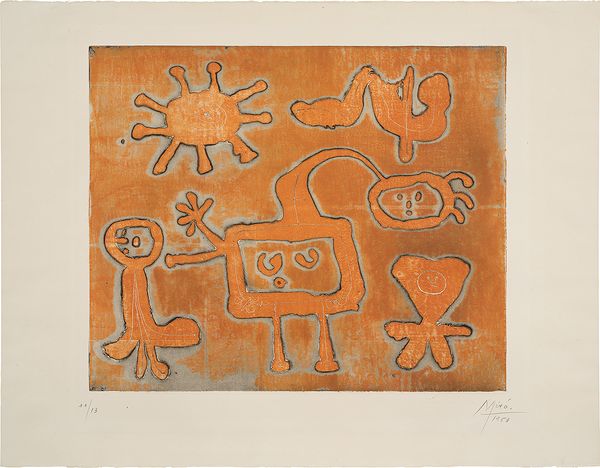
Joan Miró, Série I: plate 4, 1952–53. MODERNISM 1880–1960: Editions & Works on Paper.
Joan Miró is widely celebrated as one of the great printmakers of the 20th century, and this work is a fantastic example of his early experiments in intaglio. Etched in New York at Stanley Hayter’s Atelier 17 and printed in Paris by master printer Robert Lacourière, it truly illustrates an amazing collaboration amongst greats, but also reflects the level of cultural exchange afforded by modern technologies. Across the Sèrie I and II prints, we discover Miró’s passion for experimenting with the differences in the pressure of the press and inking with different colors, which in this stunning work results in the enchanting, halo-like glow surrounding the figures.
Yves Klein: Artist, promoter, postman
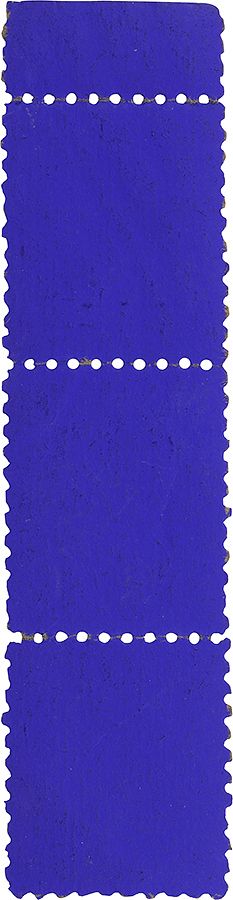
Yves Klein, Timbre Bleu, 1957–59. MODERNISM 1880–1960: Editions & Works on Paper.
Yves Klein, working at the dawn of the advertising age, may be one of the first artists to harness the power of branding. He is now almost synonymous with International Klein Blue (IKB) — the purest form of blue possible that causes his works to pop in any room. Understanding that advertising is an art, Klein developed these applied pigment postage stamps to be used in exhibition invitations for his dual 1957 shows in Milan and Paris. The striking color of the stamps not only beckoned people to experience the most cutting-edge modern art, but the events themselves presaged today’s notions of a gallery opening as a star-studded social occasion.
Picasso in the last act
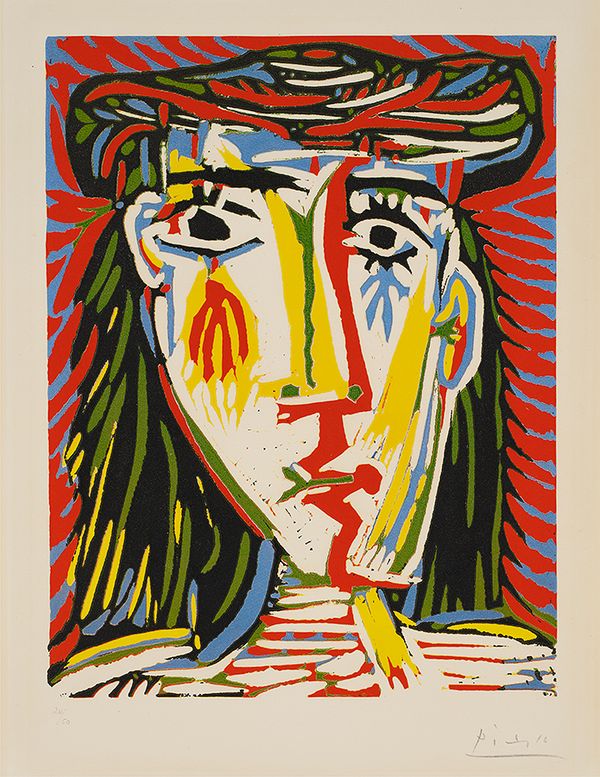
Pablo Picasso, Jacqueline au chapeau de paille (Jacqueline with the Straw Hat), 1962. MODERNISM 1880–1960: Editions & Works on Paper.
Always at the forefront of printmaking possibilities, Picasso turned to linocut in the early 1950s, sixty years after publishing his first etching. Around this same time, he met Jacquline Roque, who would become his wife and muse until his death in 1973. He was drawn to linocut’s immediacy and used the medium to revisit several of his iconic themes and visual motifs as a mature artist — most notably Jacqueline in 1962. In this tender and colorful work, the linocut process perfectly captures the exuberance of Picasso’s line and evokes the warmth of southern France.
Sonia Delaunay: Orphism in a far-out world
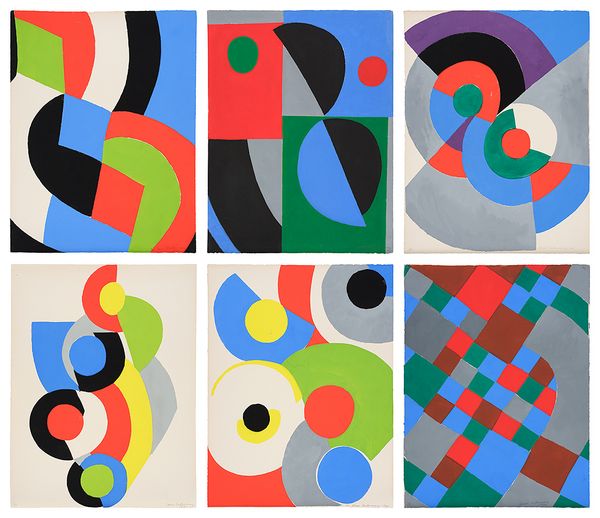
Sonia Delaunay, Poésie de mots, poésie de couleurs (The Poetry of Words, The Poetry of Colors), 1962. MODERNISM 1880–1960: Editions & Works on Paper.
When looking at the six works together, we can almost hear the din of the impending swinging ‘60s. Sonia Delaunay’s style, along with her husband Robert’s and the artist František Kupta’s, was first described as “Orphism” by the French poet and art critic Guillaume Apollinaire in 1912, referencing the Greek bard. It grew out of Cubism, but focused on pure abstraction and bright colors, borrowing ideas from both Fauvism and the theoretical musings of Paul Signac. This complete set of six gouache pochoirs is uniquely striking. The details of the thickly brushed gouache paint are a joy to discover across the suite, each inspired and accompanied by a poem by the avant-garde poets Rimbaud, Mallarmé, Cendrars, Delteil, Soupault, and Tzara.
International Surrealism Club
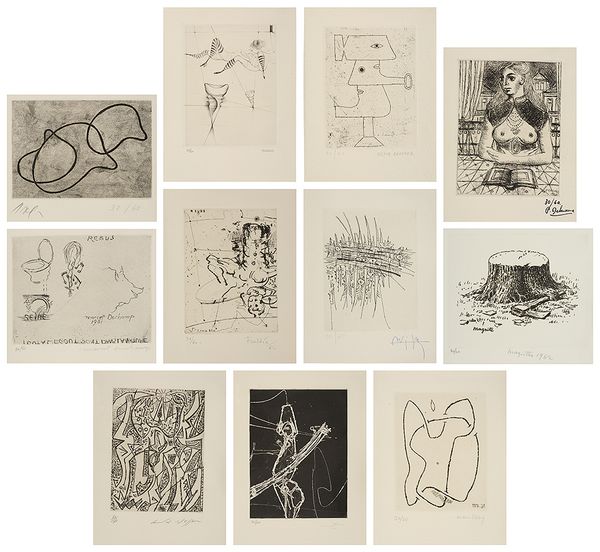
Various Artists, Surrealism Between the Two Wars, from The Forerunners of the Avant Garde (Volume II), from International Anthology of Contemporary Engraving, 1966. MODERNISM 1880–1960: Editions & Works on Paper.
Spanning iconic names such as Marcel Duchamp, René Magritte, and Man Ray, this set of 11 etchings, each mounted and bound as a deluxe collection, does just what it says on the tin. Also including works by Chilean artist Roberto Matta and the German Hans Bellmer, Surrealism Between the Two Wars is a museum in itself. It showcases the significance of each artist individually and together, illuminating how the interchange of ideas across borders was crucial to Surrealism’s artistic revolution.
Jean Dubuffet, or how to change the art world in four decades
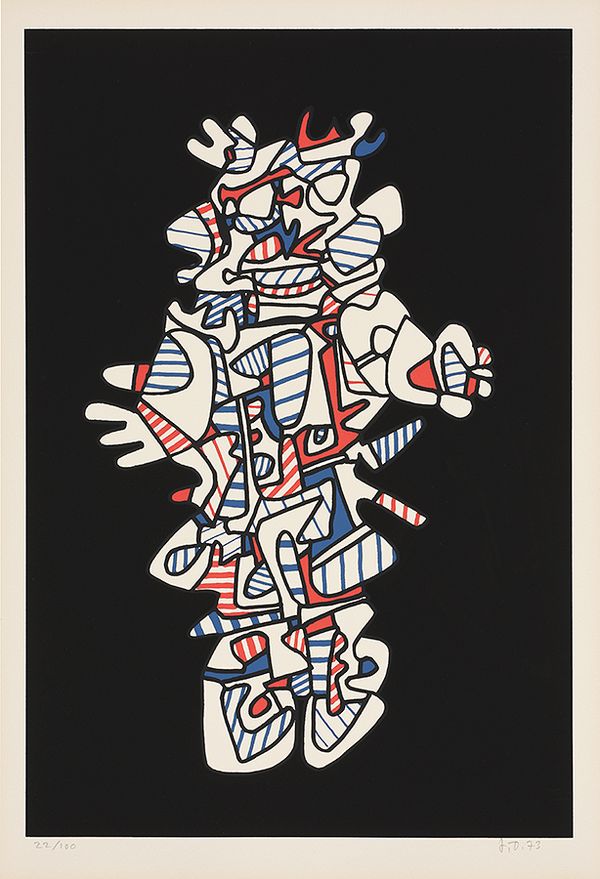
Jean Dubuffet, Epiphanor, from Présences fugaces (Epiphanor, from Fleeting Presences), 1973. MODERNISM 1880–1960: Editions & Works on Paper.
The founding father of Art Brut, or outsider art, Jean Dubuffet looked beyond the traditional art world for inspiration. His love of Parisian street life, bustling with outcasts, led him to take influence from street art and those on the fringes of society. He pushed the limits of representation and the craft of painting itself, incorporating found materials and chemicals in his practice. This experimentation is also seen in his printmaking, where he explored many techniques throughout his career, in this case a screenprint with Pace Editions. His wide-reaching influence can be seen as far as in works by Jean-Michel Basquiat and Keith Haring to contemporary streetwear. In this sense, he bridged the gap from early Modernism to wherever we are now.
Recommended