Article | Perspectives An Afternoon With Phillip Lim Art Collecting New York
PERSPECTIVES: An Afternoon with Phillip Lim
The lauded designer talks to Phillips about how he collects and what he'd love to own from our upcoming Modern & Contemporary Art auctions in New York.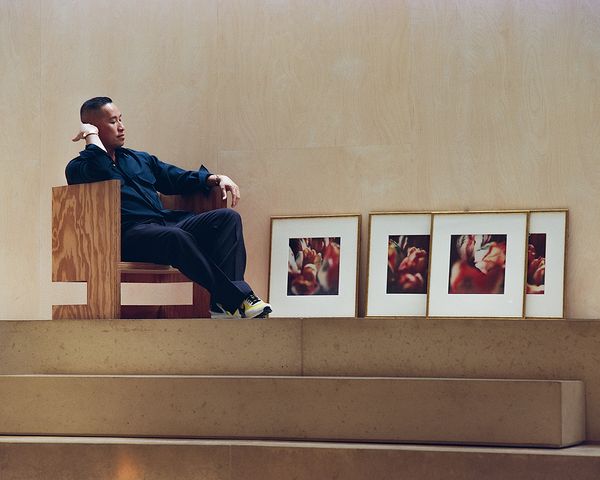
Fashion designer Phillip Lim with Cy Twombly’s Tulips I, no. 2–5, 1985. Image credit: Rasaan Wyzard.
“My taste! I don’t even know what taste means. It’s all about the ongoing exploration, right?” begins Phillip Lim.
His approachability defies the depth and spirituality of both his art collection and his own creative success. Earlier this month, we spent an afternoon in conversation with the fashion designer, inviting him to share some of his favorites from our upcoming Modern & Contemporary Art auctions in New York. He also invited us to glimpse his unique approach to collecting through the works he displays in his New York City home.
“You have to live with it”
To Lim, art’s ability to transport us to a divine dimension is his guiding light as a collector. He’s particularly excited about photographs from Cy Twombly’s Tulips series that he recently acquired, and they give him the freedom to unpack his approach.
“What I love is high and low. What I love is sharp and imperfect. What I love is masculine and feminine,” Lim explains. “And these tulips, they remind me of just simple bodega flowers. But seen through the lens of Twombly’s genius, they become something almost static but also very ethereal.”
When Phillip Lim first moved to New York, he loved art but hadn’t spent much time around the art scene, which can seem intimidating. Finding what resonated with him was a process of letting go of what he felt would be expected of a collector. Early on, he met the art advisor BJ Topol by chance in his New York boutique, and she gave him the liberty to find his voice as a collector. He tells us, “She’s the one who actually brought me into this world of looking at art and giving me the time, the space, and the guidance to really just trust my own taste.”
Lim loves Cy Twombly and longs to own a painting by the artist one day. Knowing this, Topol pointed him in the direction of the Tulips series. “She’s like a muse to me,” Lim says of her.
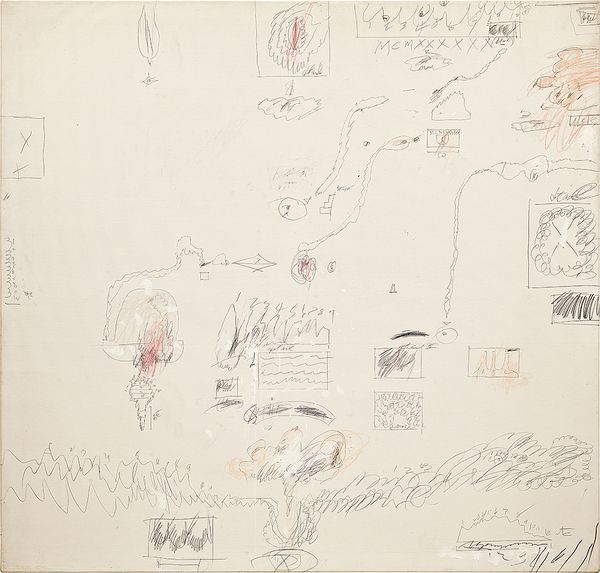
Cy Twombly, Crimes of Passion I, 1960. Modern & Contemporary Art New York Evening Sale.
With several years of collecting now under his belt, Lim can sum up the approach he’s developed with Topol as his partner.
“For me, the way I choose to collect is to ask myself, do I love to look at it every single day? Does it inspire me? Is it a vehicle that allows a more spiritual experience? With the artists I’m attracted to, what they put out there is a corridor so that I can connect with or go back to a time, a space, or a place that I want to arrive at.”
How work is presented in his home is as important to Lim as the works he chooses. As tempting as it can be to buy everything he likes, he explains that a certain amount of space is required to give works the respect they deserve. “When I’m walking through galleries or auction previews with BJ, it’s like I want everything. I walk around like, ‘Oh my god, that’s a dream,’ or ‘That’s my vision board.’ But then you start to realize that if you take it out of that context and you don’t give it the space it requires to vibrate, it can become home decoration, and that’s what I try to avoid.”
As an example, he turns our attention toward a work by Hiroshi Sugimoto displayed in his dining room, explaining, “We eat and everyone gets to see it. It’s the backdrop and it’s a bit nonchalant, but at the same time, I allow it the space that it deserves.”
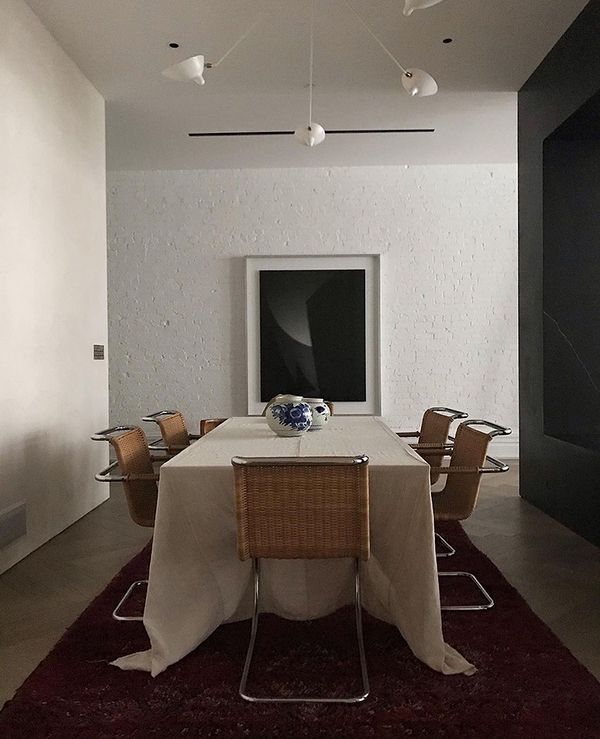
Hiroshi Sugimoto’s, Joe 2065, 2005–2006, hangs in the dining room of Phillip Lim’s New York City home. Image credit: Phillip Lim.
As he explored the art world, Lim was drawn to works by Richard Serra, which led Topol to suggest this Sugimoto photograph that depicts Serra’s sculpture Joe. “I was like, ‘I have got to have this. I have to have this,’” Lim recounts. “It’s two of my favorite artists coming together.”
The Sugimoto expresses much of what Lim loves about art. He explains, “The art in my collection, there’s always a void, or a personal memory attached to it, or the physical bodily gesture of the artist, because I’m a maker too, so I appreciate that.”
Lim also chooses to live with art that allows for a kind of participation as a viewer: “There’s always an unfinished sentence that we as viewers must inject into it. That’s the collaboration, I think, between the artist and the viewer.”
These ideas of personal memories and transcendence lead us to Lim’s Helmut Lang sculpture. “Helmut Lang is a fashion hero to me. In my first years in the fashion industry, Helmut Lang was the designer, and when he transformed himself into an artist, I stumbled upon this at a gallery on the Bowery,” he notes.
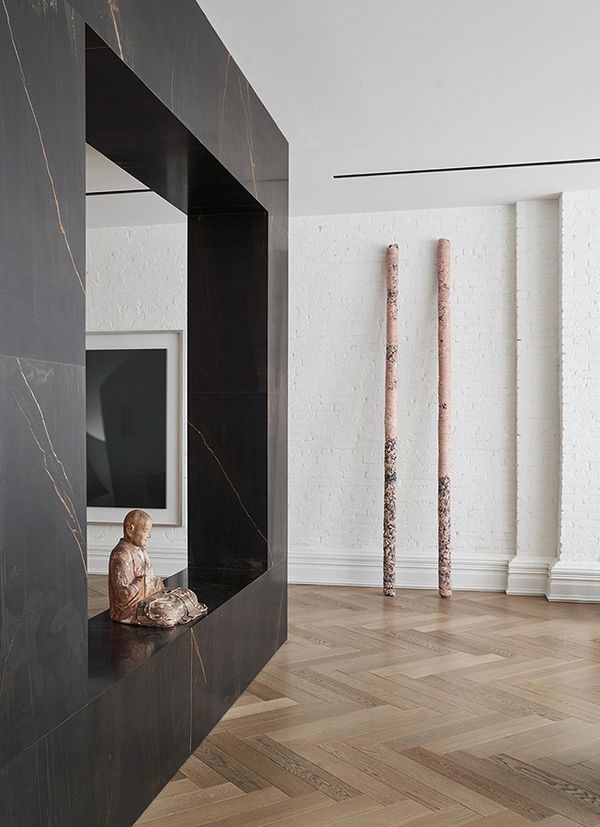
Helmut Lang’s Untitled, 2010–2013, rests against the wall in Phillip Lim’s home in conversation with the Buddha statue and the work by Hiroshi Sugimoto. Image credit: Phillip Lim.
Of his first encounter with the Lang work, Lim recalls, “When you walked into the gallery, you saw all the colors, but they were reimagining sculptural forms, and what we’re looking at here is a nod to his good friend Louise Bourgeois — because that’s the pink of hers. It’s that beautiful pink that, in fashion, we always call ‘sickly pink.’”
Lim is quick to point out that there is more than initially meets the eye in this work: “You can see that he took his archives and melted them down with resin. So, in these polls exist the last remnants of his archives. To me, it is a metamorphosis from a former life, and I fell in love right away.”
He goes on, “It’s so inspiring to see someone have the courage to transform and find a new life, to have a ceremonial process that’s so personal to take that former life and transform it as the materials for the new life.”
At a certain point, there is art that you love immediately, and then there’s art that you invest in — that you love no matter what. It’s not about the trend, it’s about what resonates with you, what moves you, because at the end of the day, you have to live with it. —Phillip Lim
In the gallery at Phillips
Turning our attention to the works on view at Phillips, Lim shares that he loves to browse auction previews, taking in all there is to see in New York this time of year.
“God, I mean there are so many beautiful pieces, but I love this Isamu. Talk about goals, right?” Lim says with a hopeful smile.
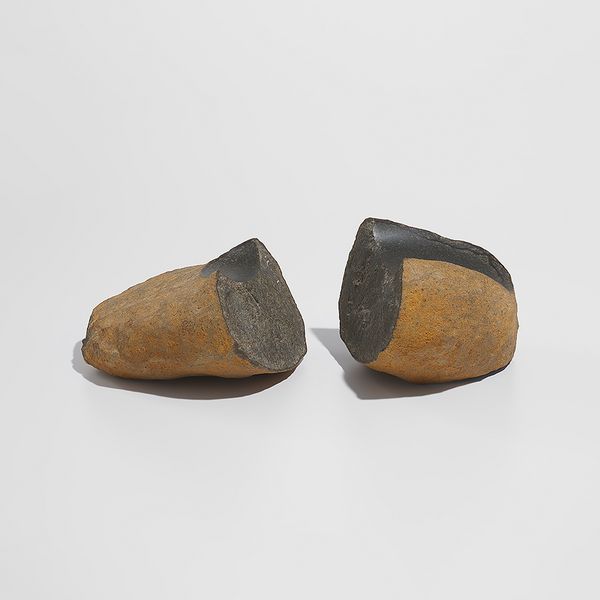
Isamu Noguchi, To Split and Carve, 1979. Modern & Contemporary Art New York Day Sale, Morning Session.
It makes sense that Noguchi’s work would resonate so strongly with a fashion designer like Lim. He sees a kindred spirit in it, comparing the work to his own creative approach.
“It’s just so beautiful, and what I love about this is the contradiction, the rough texture on the outside and the smooth inside. To the eye, it’s just like, ‘What is this? Two pieces of broken rock or something?’ But I love the tension. I love that there is another meaning to what you see. This relates to what I do, bringing very contrasting textures into fashion, building collections out of that through materiality and polishing or tailoring something that might be so rough.”
He pauses for a moment, looking at the work. “I feel that here. I feel his hand.”
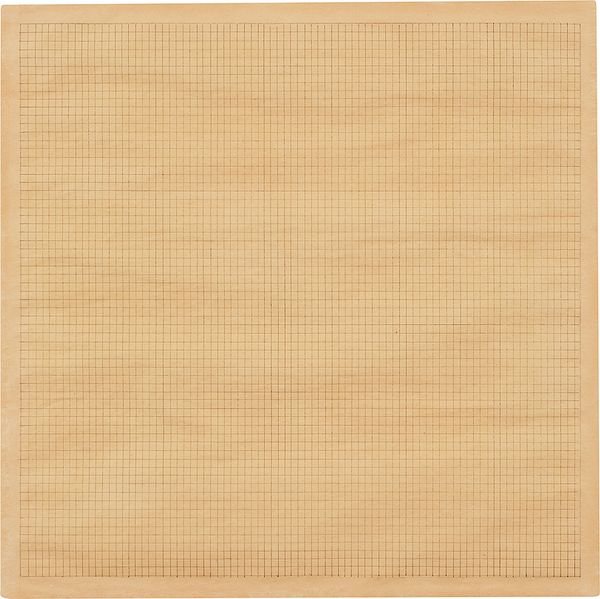
Agnes Martin, Untitled, 1966. Modern & Contemporary Art New York Day Sale, Morning Session.
Lim is similarly struck by a personal connection to works on view by Agnes Martin.
“It’s the meditative quality here,” he explains. “For me, art is the spiritual experience, and seeing this brings me back to my childhood, my upbringing. In grade school, we learn this double idea that’s especially strong with the political climate right now. We’re taught to stay within the lines, we’re taught to be so careful, and to not be bolder than who we are. But growing up in America, you realize that’s not always the path you take, because at a certain point you rebel,” he says. “You end up in this state where you find that balance between who you really are, but at the same time, how much you stay in the lines.”
“I know that’s such a weird resonance on me, but that’s my story in this piece,” says Lim.
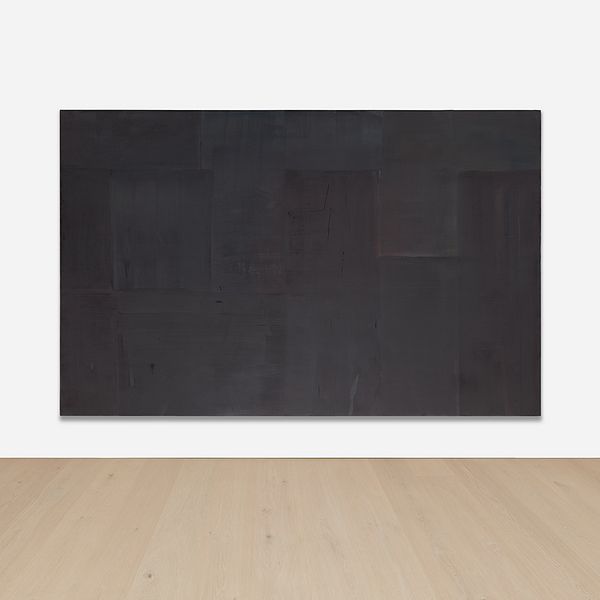
Louise Fishman, Kaddish, 1988. Modern & Contemporary Art New York Day Sale, Morning Session.
Throughout our conversation, it becomes clear that themes of transcendence abound in Lim’s collection, and to that end, Louise Fishman’s Kaddish catches his eye.
“I like it because it’s a black void, and it’s subliminal,” he says. “You see what you see, and I think over time, this type of art actually becomes more powerful when you live with it. It’s just like a spiritual experience.”
Then, as they tend to do, a work by Yoshitomo Nara stops us.
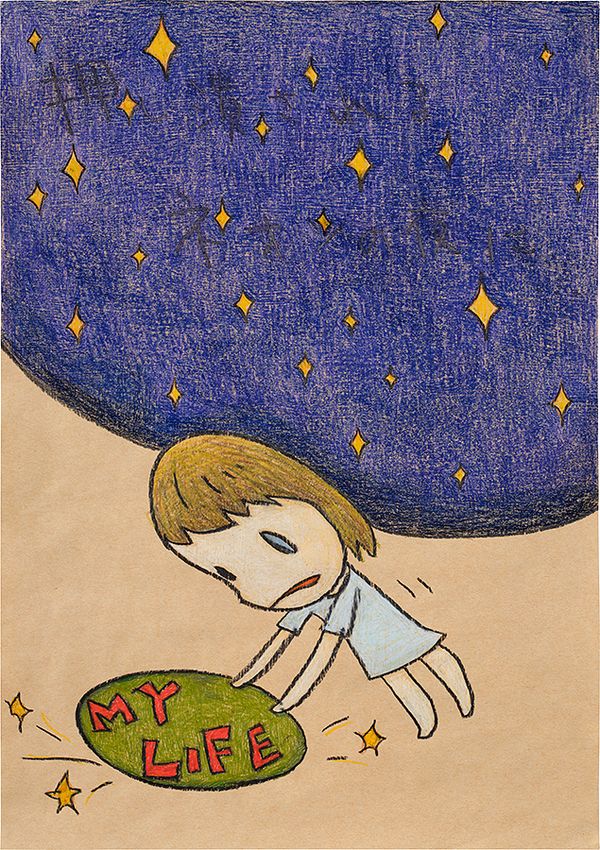
Yoshitomo Nara, My Life, 2006. Modern & Contemporary Art New York Day Sale, Afternoon Session.
“I wouldn’t mind this Nara either,” Lim jokes. “And basically, it is a perfect summation of what’s happening right now. That’s the thing about art and artists, they have this superpower of just encapsulating the zeitgeist in their work. And right now, it’s like my life is being crushed,” he says, now laughing.
On building relationships and community
Lim also enjoys collecting for the relationships that can form with artists. As he’s drawn to artists whose works have a throughline over time, a style you can recognize but that isn’t static, he appreciates collecting multiple works from living artists to see their approach evolve. He’s particularly fond of the American artist N. Dash.
“I met N. Dash through BJ — my friend, my muse,” he recalls. “She brought me to her studio when she was at Columbia. I walked in and met this powerhouse of a woman. She has a tiny, petite stature, but her spirit is so powerful. I saw these two nude photographs on the wall behind her in the dark room, and I immediately asked to buy them.”
As the years have passed, Lim has collected works from her various exhibitions, forming a personal collection that showcases her development, hoping one day to loan works from his collection to a retrospective exhibition of Dash’s work.
He explains, “In her work, there’s a throughline with the materials used, the narration, the tactility, and the methodology, and it always comes back to her using art as a way to manage her anxiety. And I love that because I can relate to that and it’s such an impressive body of work. To me, she’s a true artist. She embodies what an artist is.”
Another artist Lim has come to know well is Bill Jacobson. He tells us it is “one of those fortunate relationships where I started collecting his work, and then I had the privilege to meet him. We collaborated on a book project when we opened the store on Great Jones. He documented the building of it through his lens and his genius, and it really goes back to this idea of just impermanence and that void.”
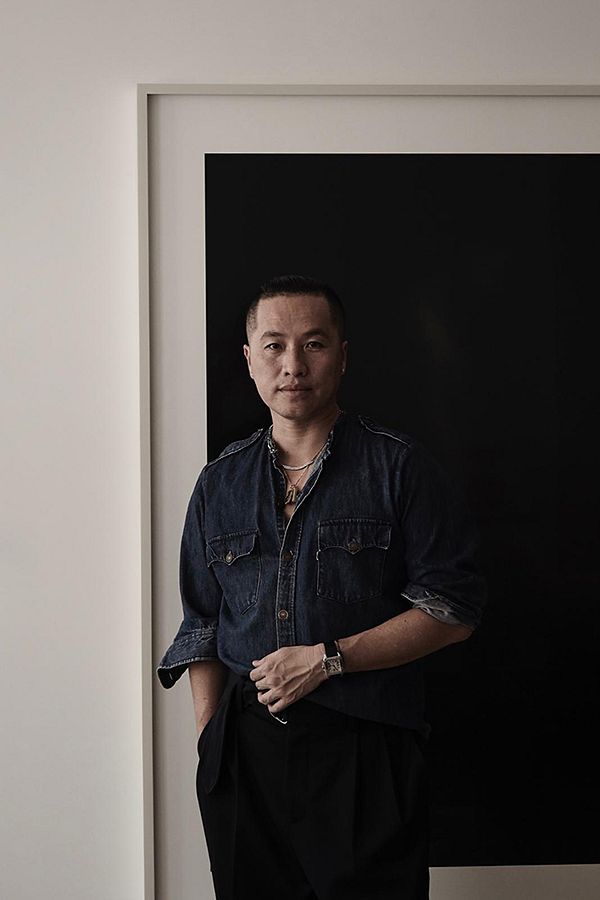
Phillip Lim at home with Bill Jacobson’s New Year’s Day #5801, 2003. Image credit: Ark Journal.
Lim has also supported female artists and makers from the AAPI community, and we ask him how this influences his approach to collecting and his creative work.
“I think for so long, Asian female artists haven’t been seen. They’re not heard. You don’t even know who exists. And there are so many talented ones!” he says. “Supporting this group is a fun way to engage and build community because, at the end of the day, art, fashion, film, media, it’s all related. So, we’re always asking how we can champion each other and how do we celebrate each other?”
In terms of how this might impact his own creative vision, Lim’s answer is nuanced: “When people ask me this question of how my heritage influences my work, it is a difficult one,” he says. “Asian culture is not a showy, in-your-face, obvious thing. It inherently goes back to the value of integrity, the grit of establishing and appreciating beauty in all forms. So, in my work, I always say to people that you’ll never see my Asianness — you’ll just feel it.”
We point out that these themes are also felt when viewing his collection. Though you may not necessarily see overt Eastern aesthetics in the works, you can feel his profound personal reverence, respect, and intention flowing through the collection.
“Yes, that’s it, there you go. End of the interview!” he replies with a knowing grin.
Discover More from Modern & Contemporary Art >
Recommended Reading