Article | History Japanese Watchmaking Seiko Citizen Casio
Three Distinct Brands That Made History in Japanese Watchmaking
Seiko. Citizen. Casio.
– By HODINKEE Japan
Japanese watchmaking, a relatively new industry and culture compared to the West, but it has passed a history of over 100 years since the launch of the first Japanese-made wristwatch, the Seiko Laurel. This significant milestone paved the way for the three domestic watchmakers, who have continued to exert their unique presence in the watchmaking industry, which had already thrived with bristling brands. As we look back on their history, we aim to explore their distinct ways of perceiving "time" and the process of progress.
SEIKO: Unremitting Pursuit for Precision and Expression of Japanese Beauty
In 1913, Seikosha, the predecessor of the current Seiko, produced Japan's first wristwatch, the "Laurel." This watch was a significant leap forward in the Japanese watch industry, which had lagged far behind the rest of the world. Despite the crisis caused by the Great Kanto Earthquake of 1923, which destroyed its company building and factory, Seikosha didn't give up. The following year, it released its first wristwatch under the Seiko brand, a testament to its resilience and unwavering commitment to Seikosha's philosophy of "Success in producing precision timepieces."
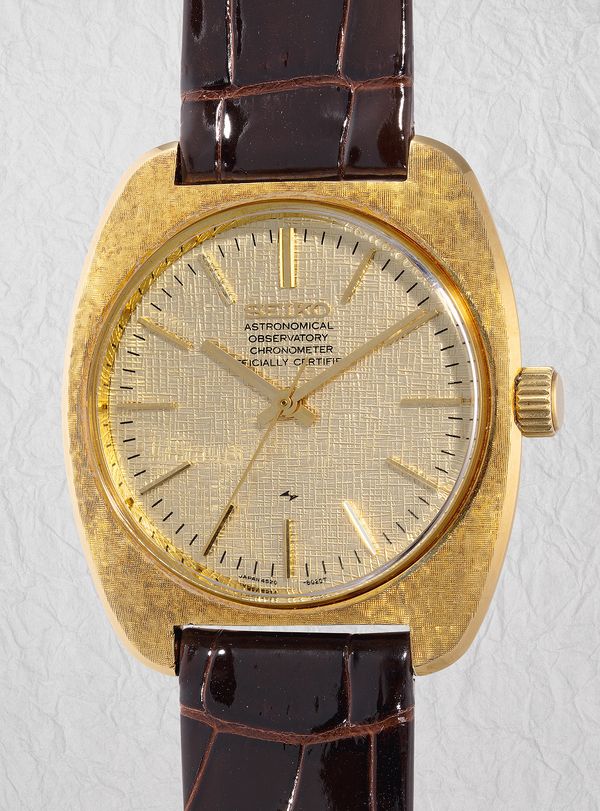
Lot 40: A circa 1970 Seiko Astronomical Observatory Chronometer ref. 4520-8020 in 18k yellow gold. Estimate: HKD $160,000 - 310,000
Seiko's history can be described as a history of challenges to bring to fruition the quest for precision, beauty based on practicality, and the Japanese "beauty of usage" in watches and clocks. Seiko completed the Tokyo landmark, the present Ginza Wako main building and clock tower, in 1932. In the 1950s, the company introduced a series of high-quality movements, including self-winding watches, and in 1960, Seiko launched the "Grand Seiko," which conformed to Swiss chronometer standards. And in 1961, Seiko won a prize in the Neuchâtel Observatory Competition, a technical achievement.
In 1964, Seiko served as the Official Timekeeper of the Olympic Games in 1969 and launched the first quartz wristwatch, the Quartz Astron. Four years later, Seiko introduced a digital watch with an LCD, pioneering a revolution in watchmaking technology. At the same time, the company also launched a series of watches that would later become Credor, and after developing multi-functional watches and kinetic watches in the 1980s, Grand Seiko revived the mechanical Grand Seiko in 1998. Seiko continues to challenge the pinnacle of practical watches and has become a representative of Japanese luxury wristwatches through its sobriety, refined beauty, and expression of Japanese sensibilities.
CITIZEN: A 'World-First' Technology in a Design Reflecting the Era
Shokosha Watch Research Institute, the predecessor of Citizen, was founded in 1918 to produce pocket watches domestically. In 1924, the first pocket watch was named "CITIZEN" to ensure that citizens would broadly love it for a long time. In 1931, the company shifted to producing wristwatches, introducing women's rectangular models. It excelled at making contemporary watches that were ahead of the time.
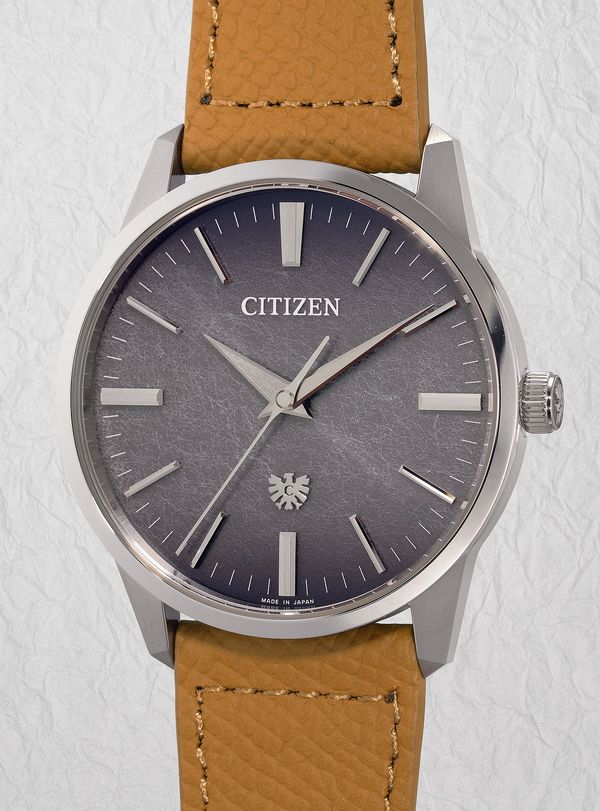
Lot 48: A circa 2022 Citizen Eco-Drive “Washi” in titanium. Estimate: HKD $16,000 - 24,000
In 1949, the company launched the "New Citizen," the first Japanese-made watch adopting a direct second with a co-axial center. A few years later, the company launched a series of ambitious original mechanisms, such as the "Para Shock," a full-fledged shock-resistant watch, and the "Para Water," a waterproof watch. In the 1960s, the company introduced the "Jet," the thinnest automatic three-hand watch ever made in Japan, followed" by the "Diamond Flake," also the world's thinnest three-hand watch at the time, the "Crystal Seven," a self-winding model with a calendar, and the world's thinnest movement size, was released rapidly. The company has demonstrated its technological capabilities in domestic and international precision machining.
In 1970, Citizen launched the world's first pure titanium watch, showcasing its pioneering spirit. Six years later, the company introduced the world's first analog quartz wristwatch recharged by solar cells, the "Crystlon Solar Cell." This model was the forerunner of what became known as Eco-Drive, an environmentally friendly watch that did not require periodic battery changes. In 1993, Citizen introduced the world's first multi-band radio-controlled watch, further solidifying its reputation as an innovator in the industry. Citizen's uniqueness lies in its pursuit of precision and new styles and the incorporation of new materials and technologies into its watches, transcending the boundaries of traditional mindset.
CASIO: Pioneering an Independent Path Based on 'Adding Every Second'
Kashio Seisakujo, the predecessor of Casio Computer, was founded in 1946 in Mitaka, Tokyo. The company started as a manufacturer of electric mechanical calculators and eventually became a manufacturer of advanced office equipment such as electronic tabletop calculators. In 1974, CASIO launched the CASIOTRON, the world's first digital watch with an automatic calendar, based on a unique idea and approach to timekeeping that accumulated zeros and ones like a calculator. CASIO continued introducing ambitious mechanisms in its wristwatches, including a function calculation, a touch sensor, and the first digital watch with water resistance to 20ATM.
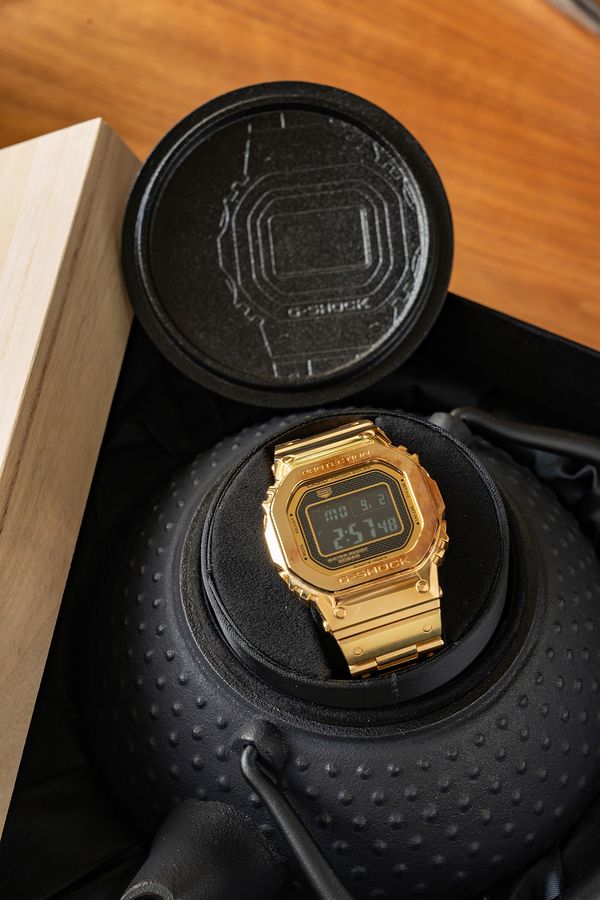
Lot 49: A circa 2021 Casio G-SHOCK ref. G-D5000-9JR in 18k yellow gold, one of 35 pieces. Estimate: HKD $200,000 - 400,000
CASIO's development approach, an outsider in watchmaking, came to fruition in 1983 with the release of the "G-SHOCK." The G-SHOCK hit a phenomenal sales record, and in the nine years and nine months since the CASIOTRON was introduced, CASIO has shipped more than 100 million wristwatches.
In the 1990s, CASIO launched the "MASTER OF G" series for professional use. The company combined its proprietary sensor technologies, including "ProTrek" and the world's first built-in GPS functionality, "Satellite Navi," into wristwatches. In the 2000s, Casio continued to develop playful items in the watch field, such as wristwatch-type MP3 players and digital cameras, during the dramatic digitalization era. In 2018, the company released its first full-metal G-SHOCK based on the DW-5000C, the first G-SHOCK, and four years later, the MRG-B5000B, a high-end version of the first G-SHOCK in the context of the MR-G. The company continues to take unique approaches that are not bound by the norms of watch manufacturers.