Article | Rise Mechanical Watch Collecting In Japan Toshio Masui
The Rise of Mechanical Watch Collecting in Japan
How the market was shaped.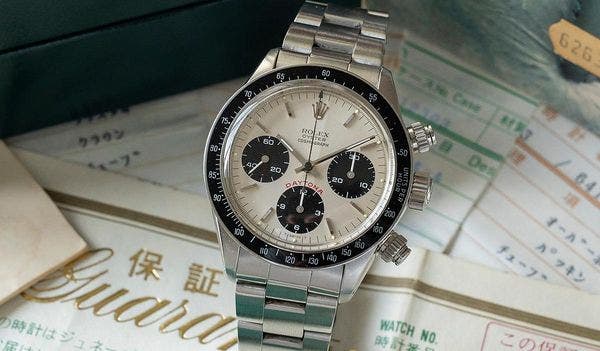
– By HODINKEE Japan
How did watch collecting take root in Japan, eventually forming a market that is now highly regarded worldwide? This article delves into the history of the watch boom in Japan during the 1990s and the pivotal role played by watch dealers in shaping this phenomenon.
In the 1990s, following the burst of Japan's economic bubble, various cultural phenomena emerged, many of which would later influence the world. Among these was a fervent interest in wristwatches. With an enthusiasm rivaling that for Swatch and G-SHOCK, mechanical watches garnered significant attention, leading enthusiasts to frequent watch shops regularly. This era marked the beginning of the maturation of watch collecting in Japan.
A Decade of Trial and Error Leading to the Revival of Mechanical Watches
In 1969, the Swiss watch industry was dealt a severe blow with the advent of Seiko's quartz wristwatch, the Astron, sparking what became known as the Quartz Revolution. However, by the mid-1980s, the industry began its comeback. The 1990s, a period when the revival of mechanical watches started to gain momentum, can be described as an era of trial and error. Naoya Hida, CEO of NH WATCH, who is well-acquainted with the watch industry of that time, reflects on the era from a brand's perspective:
"I entered this industry in 1990 and spent five years working in sales at Japan Desco, an agency that handled brands such as Audemars Piguet, Jaeger-LeCoultre, Eterna, Maurice Lacroix, as well as high-end clocks. The clientele and sales methods for luxury watches were very different from today. It was rare to see watches priced over one million yen on display in stores; most were sold through department store sales agents. The image of luxury watches at that time, shared by both sellers and buyers, was likely one of 18-karat gold watches encrusted with diamonds. As for the Royal Oak, the preferred model in Japan was a smaller quartz version made of stainless steel and yellow gold."
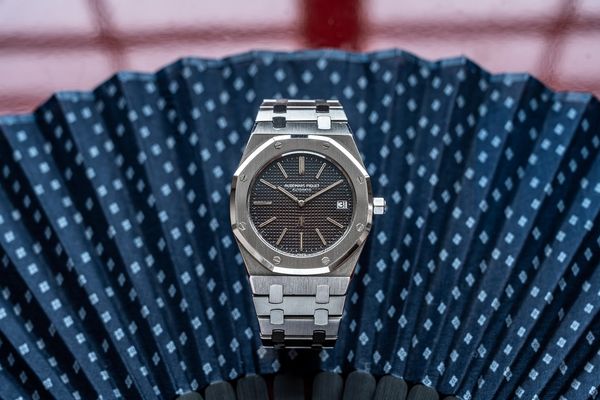
Lot 84: A circa 1975 Audemars Piguet Royal Oak “Jumbo No Series” in stainless steel. Estimate: HKD $390,000 - 650,000. Image by HODINKEE Japan.
Many manufacturers realized that preserving the culture of watchmaking required more than just diligent craftsmanship. As a result, companies began to seriously pursue new management styles and marketing strategies. Central to this narrative are figures like Günter Blümlein, who revitalized IWC and Jaeger-LeCoultre and led the rebirth of A. Lange & Söhne, and Jean-Claude Biver, later hailed as a marketing genius. These charismatic leaders, who had an unwavering passion for watches, brought about a transformation in the business strategies within the luxury watch industry. In parallel, Japan’s luxury watch market also saw significant growth, establishing itself as one of the most prominent markets globally.
"When I joined Nihon SiberHegner K.K. (now DKSH Japan) in 1994, the Swiss watch industry could no longer ignore the Japanese market, and hit products that resonate even today were emerging one after another. For instance, when I saw the stainless steel Breguet Type XX Aeronavale model at Baselworld in 1995, I was immediately convinced it would be a success. Around this time, several watches emerged that would break away from the traditional norms of luxury watches, becoming the forerunners of what we now call 'big and bold' watches. Looking back, the 1990s can be described as a 'period of awakening,' and I realize now that the various events of that era laid the groundwork for today’s luxury watch boom."
The Remarkable Growth of Japan's Vintage Watch Market
Behind Japan’s emergence as one of the world’s leading watch markets lies the vintage watch boom that took place from the late 1980s through the 1990s. Before founding Carese in 1989, Tomokazu Kawase, now Chairman of the company, was actively traveling across the United States as a vintage watch dealer.
"Back then, I couldn't speak English, and there was very little information about watches, so it was all about trial and error. In California, whether at Cypress, Rose Bowl, Newport Beach, or even flea markets at racetracks and universities, there were always watches for sale. Collecting watches had already become a popular hobby in America, with active trading among dealers, collectors, and brokers. Unfortunately, as Japanese, we were a minority, and there were times when we were simply ignored even if there were good watches available. But we enjoyed buying what we could. It was a culture shock to visit Bunmeikan in the Kanda area (later moved to Killer Street in Aoyama) and see watches of a completely different level than what I had encountered before while looking for stores to supply, guided by the magazine Time Spec."
"Meeting Jim Klaus was a turning point that allowed us to leap into handling high-end watches. He had special connections that enabled us to acquire models that were impossible to find in Japan. In the early 1990s, what sold well in Japanese vintage specialty shops were gold-plated square watches, known as 'kakukin,' which had been popular in post-war America. As the market grew, demand concentrated on models like the Omega Seamaster and the Tudor 'Big Rose' logo models. Even though there were countless redialed dials, they still sold incredibly well."
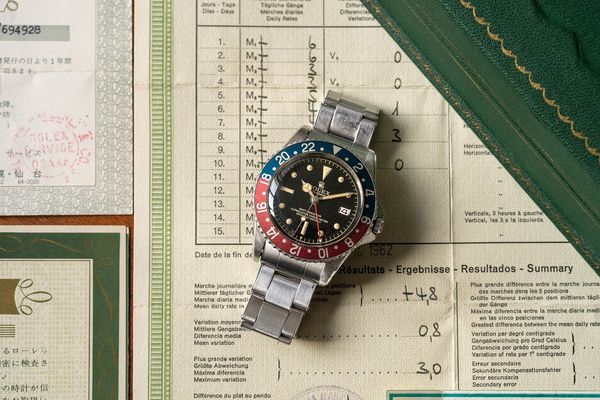
Lot 76: A circa 1961 Rolex GMT-Master ref. 1675 with "exclamation mark" dial. Estimate: HKD $240,000 - 480,000. Image by HODINKEE Japan
Naoto Nakayama, founder of Jack Road, who, like Kawase, supported the early days of vintage watch collecting in Japan, also reflects on those times, recalling memorable watches.
"In the early days (around 1987 when the shop opened), our main focus was on gold-plated square watches from brands like Bulova. We could acquire them cheaply in America, so we could offer them at significantly lower prices than the market rate. Gradually, the focus shifted more towards Rolex, and we began offering a wider range of models. Overall, they all sold well, but I believe we sold a significant number of the manual-winding Oysterdate Ref. 6694. It was a watch I liked so much that I bought several myself."
By the early 1990s, the Paul Newman dial had ignited a growing interest in the Cosmograph Daytona, leading to increased attention on other professional models as well.
"The talk of the town was the Paul Newman dial. When we first started selling them, they were priced around 1.2 million yen. While that might seem like a bargain compared to today’s prices, you could easily buy a Submariner for around 200,000 yen, making the Paul Newman dial one of the most expensive vintage watches at the time. A bit later, possibly influenced by magazines, the momentum for vintage watches in general subsided, and current models gained popularity instead. Around that time, the market price for the Explorer Ref. 14270 worn by famous actor Takuya Kimura in a drama more than doubled, creating a phenomenon."
In the 1990s, Jack Road’s sales were not only supported by Rolex but also by brands like Omega, TAG Heuer, and Tudor.
"As a business, it was basic to select items that were more likely to sell. Back then, the models and tastes that sold for Omega and TAG Heuer were different from today. For instance, the Speedmaster wasn't as recognized as it is now, and the Seamaster was much more popular. As for Tudor, it didn't have the same premium appeal as some Rolex models, but it consistently sold well. Generally speaking, there was a strong tendency for customers to want to own a watch from a well-known brand, or to enjoy watches as fashion items. I remember suggesting Swatch because it seemed to fit this need. On the other hand, Patek Philippe's Ref. 96, which was popular among older customers seeking more specialized watches, also had a steady following."
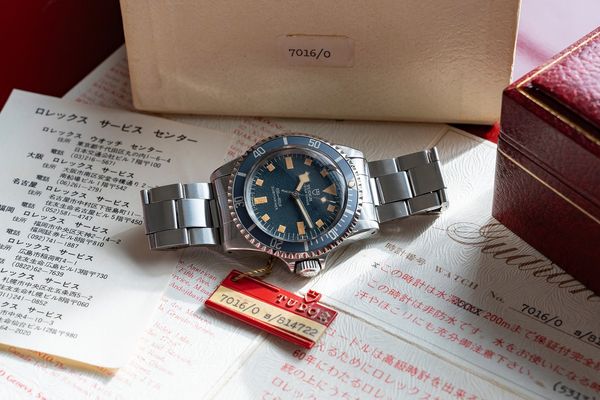
Lot 96: A circa 1974 Tudor Submariner ref. 7016/0 in stainless steel. Estimate: HKD $75,000 - 150,000. Image by HODINKEE Japan.
As the years went by, sourcing vintage watches, which are limited in number, became increasingly difficult. To address this, Nakayama continued searching for the next big hit through a process of trial and error.
"When Panerai, which was revived in 1993, first entered Japan, sales were tough, but by the 2000s, it had gained worldwide recognition and took off before our eyes. Finding the next popular watch is never easy, but that’s what makes it interesting. Looking back, there are several models, like the Rolex Explorer II, that I wish I had bought in the late 1990s to early 2000s when they weren’t as popular as they are today."
New Value Emerges by Revealing Differences in Patina
Looking back at the Japanese market in the 1990s, it is impossible to overlook Rolex’s professional models as iconic timepieces of that era. Starting with the Paul Newman dial of the Cosmograph Daytona, which sparked the boom, the criteria for evaluating watches in the secondary market have changed dramatically from the 1990s to today. Takeshi Kaneko, Executive Officer and Appraiser at Commit Ginza, shares his insights:
"Just a few decades ago, even with vintage Rolex watches, the ones that appeared visually pristine were the most popular. It’s only in the past 10 years that terms like 'tropical dial' have become widely used. References with five-digit numbers that were sold new in the 1990s are now gaining attention as the next generation of vintage watches. Given that nearly 20 to 30 years have passed since their release, you can now find pieces that exhibit patina that wasn’t present at the time. Additionally, models like the Cosmograph Daytona Ref. 16520 are seeing increasingly detailed evaluations as enthusiasts continue to study their nuances."
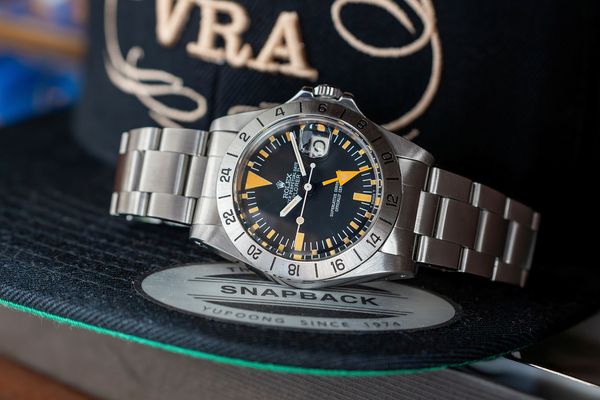
Lot 94: A circa 1978 Rolex Explorer II "Freccione." Estimate: HKD $120,000 - 320,000. Image by HODINKEE Japan
The 1990s, marked by continuous trial and error, also saw the nascent stages of the current global luxury watch boom. The rapid development of the internet dramatically changed the pace of information sharing, leading to an explosion in the market size, fueled by a growing number of affluent new collectors and those purchasing watches for investment purposes. Today, some watches possess a value akin to that of art pieces.
Whether this outcome aligns with the ideal future envisioned by pioneers in the 1980s is uncertain, but one thing is clear: The vintage watch boom that took place in Japan helped cultivate the discerning eye of Japanese collectors, who are now considered among the most stringent in the world. Tomokazu Kawase, mentioned earlier, explains:
"At the beginning of the vintage watch boom, it was possible to purchase practical and affordable timepieces, and the Rolex Oysterdate Ref. 6694 was a best-seller. While American collectors were keen on amassing as many watches as possible, regardless of whether they worked properly, in Japan, vintage watches were primarily seen as practical tools. Consequently, if a watch didn’t function correctly, complaints would arise, leading retailers to start offering warranties. While this might seem like a given today, it wasn’t the case back then."
As the market matured in the late 1990s, the criteria for evaluating vintage watches began to shift, and certain watches started to be weeded out of the market. Kawase comments on this change:
"In the U.S., the originality of individual pieces began to be increasingly valued, leading to a decline in the market for redialed watches, which could be bought for next to nothing. As a result, these watches became difficult to handle in stores in Japan as well. Many watches that have now been forgotten were simply unpopular and fell out of favor. The 1990s was a mixed market of both gems and duds, but because watches weren’t sold at extreme premium prices, it was easier to choose the ones you liked. In that sense, it was a good time for those who wanted to purely enjoy watches. I consider myself one of those fortunate enough to have encountered numerous remarkable watches during that period."
The Legendary Watch Dealers Who Supported Japan’s Vintage Watch Boom
One of the key figures who supported Japan’s vintage watch boom was the late Toshio Masui. While he was a well-known figure within certain circles, even among watch enthusiasts, few are familiar with his name. Masui quietly passed away in February 2022, but by retracing his steps as a watch dealer, we can gain a clearer understanding of the vintage watch boom in Japan.
Born in 1950 in Hamada City, Shimane Prefecture, Masui graduated from a university in Tokyo before working for several companies. However, feeling that corporate life didn’t suit him, he decided to pursue a career in trade and moved to Los Angeles in February 1981. At that time, imported goods were still quite expensive, but Japanese magazines like Popeye were heavily promoting West Coast culture, and there was a strong fascination with American fashion and goods. Masui initially thought of buying and selling old sewing machines and typewriters from flea markets in Japan, but what caught his eye were vintage watches, particularly the “kakukin” (square gold-plated watches) exemplified by brands like Bulova. Flea markets were abundant with such watches, made by American brands in the 1930s to 1960s. Every weekend, Masui would scour various flea markets, collecting these kakukin watches.
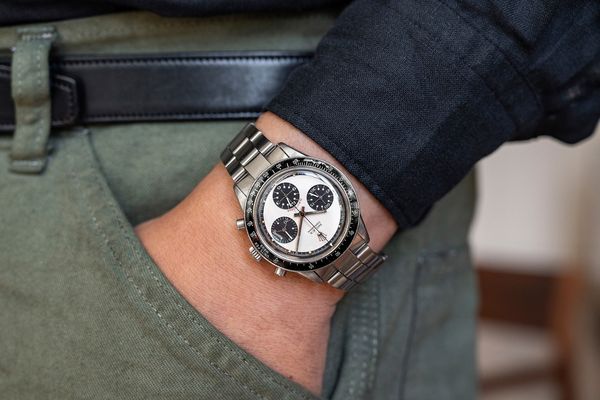
Lot 79: A circa 1970 Rolex Cosmograph Daytona “Paul Newman Panda” ref. 6264 in stainless steel. Estimate: HKD $1,400,000 - 2,800,000
"At the time, it wasn’t uncommon to find unused watches still in their original boxes at flea markets. They were incredibly cheap. I ended up buying over 50 of these old kakukin watches," Masui recounted in an earlier interview. He returned to Japan in 1985, more than three and a half years after his first trip to the U.S. The many kakukin watches he brought back sold out almost immediately. This marked the beginning of his full-fledged career as a watch dealer, based in Los Angeles. He would frequent flea markets like the Rose Bowl Flea Market, the Long Beach Antique Market, and the Pasadena City College Flea Market, buying up kakukin watches. He could purchase them for an average of $30, with an additional $30 for an overhaul, and sell them in Japan for more than double the cost.
While kakukin watches were plentiful, as the business grew, the need for higher-value watches naturally arose. However, high-end watches like Rolex were seldom found at flea markets. The question was, where could one find the desired luxury watches? It was around this time that Japanese watch dealers discovered NAWCC (National Association of Watch & Clock Collectors, Inc.). NAWCC is a non-profit organization founded in 1943 by watchmaker L.D. Stallcup, who initiated the group during a New York Horological Society meeting. Initially, the organization started with 50 chapters, but it has since expanded to 170 chapters in 52 countries, boasting 21,000 members. Japan has three chapters: the 9th Chapter (Tokyo), the 108th Chapter (Central Tokyo), and the 131st Chapter (Osaka). The greatest benefit of NAWCC membership is access to member-only shows. While these shows were not originally intended for business transactions, they attracted collectors and watch dealers from across the United States, offering an array of watches and parts that couldn’t be found at flea markets. The prices were also extremely low, making the trade shows feel like treasure troves. Masui fondly recalled these NAWCC trade shows as a source of great opportunity.
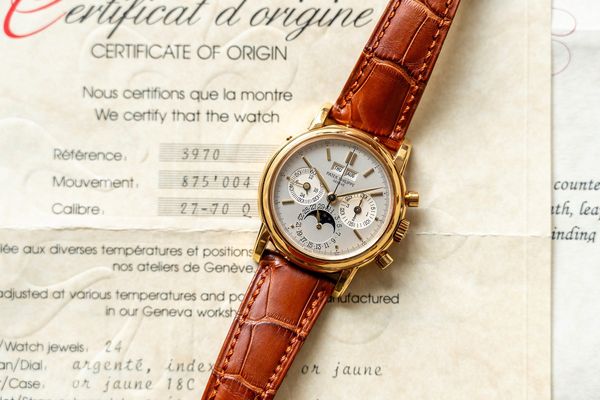
Lot 87: A 1986 Patek Philippe Perpetual Calendar Chronograph ref. 3970, first series, in 18k yellow gold. Estimate: HKD $1,000,000 - 2,000,000
The NAWCC trade shows were held in various states across the U.S., typically lasting three to four days, with two shows each month. Toshio Masui was not the only Japanese participant frequenting these events. Around the same time, Yoshihide Isogai, former president of Shellman, and the late Hiroki Aikawa, known as a pioneer who introduced many rare watches to Japan, were also attending these trade shows. Although they didn’t know each other initially, the presence of Japanese participants at NAWCC was rare, so they quickly became acquainted. The three of them, being the same age, formed a close friendship and often toured flea markets and trade shows together.
Isogai recalls those trade show days:
"I spent a lot of time with Masui and others. Before the show started, we would wait in the hotel lobby, catching dealers as soon as they arrived and asking to see their watches. We often secured the best pieces before the show even began. I remember one time when a show was held near the Walt Disney World Resort in Orlando, Florida. Since it was a tourist spot, there were many families with children around. It must have seemed strange to them that we, along with some tough-looking men, were skipping the tourist attractions to spend all day in the hotel lobby looking at watches. I remember a little kid giving us a puzzled look and asking his mom, 'Mom, what are those men doing?'"
Isogai primarily dealt in Patek Philippe, Aikawa focused on Rolex Bubblebacks, and Masui specialized in chronographs and Rolex professional (sports) models from various brands. Their preferences were different enough that their favorite dealers would show them watches according to their individual tastes. Isogai fondly reminisces about the excitement of discovering a dealer with a great watch or securing a fantastic piece on any given day.
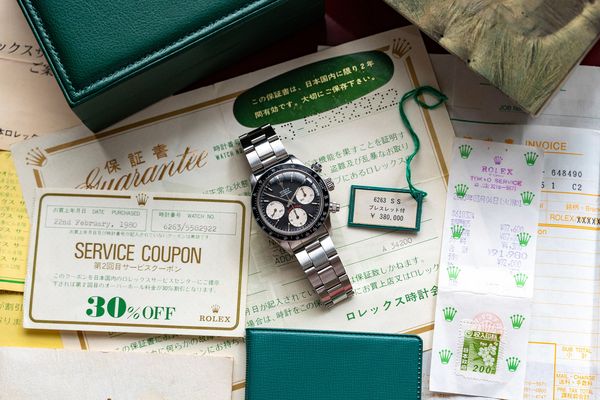
Lot 82: A circa 1978 Rolex Cosmograph Daytona “Big Red” ref. 6263 in stainless steel. Estimate: HKD $620,000 - 1,200,000
Tomokazu Kawase, mentioned earlier, also knew Masui well. Back then, there were no travel agency tours, and even figuring out how to get to the flea markets was a challenge. Kawase recalls relying on a beaten-up rental car and thick maps to navigate his way to flea markets in America.
"In addition to the Rose Bowl, I went to various flea markets like Cypress, Newport Beach, and Barstow. There was always a watch dealer present. I would eagerly approach their stall, but some watches would be flipped over. When I asked why, they would say, 'These are on hold for Kenji.' And it wasn’t just one shop—this happened everywhere I went. 'This one’s for Kenji.' I remember feeling frustrated, thinking, 'Who is Kenji? What kind of person is he?'"
It turned out that "Kenji" was actually Masui. His real name was Toshio, but since it was difficult for Americans to pronounce, he went by Kenji in the U.S. Kawase recalls how Masui, who was consistently ahead of him in securing the best watches, motivated him to work harder to acquire quality pieces and became someone he admired.
During an era when quartz watches dominated, it was dealers like Masui, Isogai, and Kawase who recognized the unique design and beauty of vintage watch movements, bringing them back to Japan. Isogai and Kawase also bought countless watch parts from flea markets and trade shows, offering vintage watches with repair warranties similar to those provided for new watches. This was an unprecedented move globally, but it was through these efforts that vintage watches began to gain acceptance in Japan.
In Japan, from the late 1980s through the early 1990s, the economy was booming. Riding this wave, many vintage watches were imported into the country. As previously mentioned, kakukin watches and Rolex Oysterdate models were initially popular. Other models, like the Datejust and Bubbleback, were also in demand, but dive watches like the Submariner were originally niche, bought by those who genuinely needed them for diving. Back then, the newer models with crown guards were valued more highly, whereas the early Submariners without crown guards—now considered collector's items worth millions—were merely seen as outdated models, and could be purchased for around $800. It was truly a golden era.
The Background Behind Japan Becoming a Hub for Exceptional Vintage Watches
While Yoshihide Isogai and Tomokazu Kawase became well-known to end-users in Japan through their focus on retail, Toshio Masui supported the vintage watch market from behind the scenes, primarily through wholesale. This is why only a select few in the industry knew his name in Japan. In the business of vintage watch wholesaling, where gathering a large number of quality pieces is crucial, the most important asset is the trust one holds as a watch dealer. Masui spared no effort in investing to build this trust. For instance, as mentioned earlier, when he was the first to be shown watches in a hotel lobby, he would purchase them at the seller’s asking price without negotiating.
He also shared the following: "I would place orders with various dealers, telling them, ‘I’m looking for watches from this brand, of this type, please bring them to me. If you bring them, I’ll buy them at this price.’ Sometimes, they’d bring me watches in terrible condition without hesitation. I would buy them because of my promise, but I’d also teach them what to look for next time. By doing so, they began to trust me and would prioritize offering me better watches. In the long run, this approach paid off—it’s the classic strategy of 'lose the battle, win the war.'"
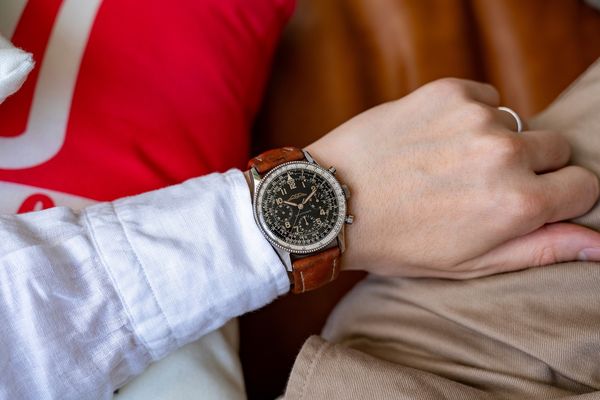
Lot 55: A 1955 Breitling Navitimer ref. 806 in stainless steel. Estimate: HKD $32,000 - 64,000
Starting in the 1990s, thanks to the efforts of dealers like Masui, Japan became one of the world’s leading markets for rare and well-preserved vintage watches. The presence of Japanese collectors, who were always in pursuit of the best, further spurred research and interest in these timepieces. Vintage watches, especially those that had been worn over the years, often underwent overhauls or repairs, resulting in parts being replaced—cases, crowns, hands, and so on—so it was common for them not to be entirely original.
However, as research progressed, both sellers and buyers began to prioritize watches that maintained their original condition, with some even adopting the philosophy that originality is everything. This shift led to watches in original condition commanding higher prices, while those that weren’t original were devalued. By the mid-1990s, when specialty vintage watch shops started proliferating, competition for the best pieces became intense, and it became increasingly difficult to source well-preserved vintage watches. Nevertheless, the relationship between dealers and collectors during this time laid the foundation for Japan’s market to become a place where exceptional condition watches could be found.