Article | Rolex Daytona Mother Of Pearl 116578 Saco
Perpetual Picks: A Pair Of Precious-Metal Rolex Daytonas With Mother-Of-Pearl Dials
Welcome to our series highlighting the exceptional watches that are available through Perpetual, Phillips’ boutique service offering immediate access to the world’s rarest and most desirable timepieces. You can view all currently available watches by visiting our London headquarters at 30 Berkeley S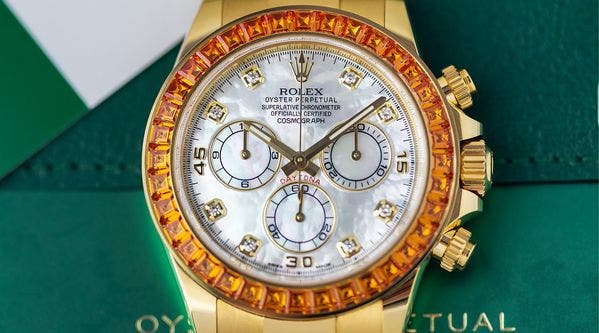
Welcome to our series highlighting the exceptional watches that are available through Perpetual, Phillips’ boutique service offering immediate access to the world’s rarest and most desirable timepieces. You can view all currently available watches by visiting our London headquarters at 30 Berkeley Square, or by visiting Perpetual online.
– By Logan Baker
We recently explored the fascinating – and spectacular – world of gem-set Rolex Daytona watches in the context of the upcoming Geneva Watch Auction: XVII, and it coincidentally lined up with the arrival of a pair of similar, yet different, Daytonas at Perpetual.
These two Daytonas that are now available have the same dial material, the same case metal, were produced within a five-year span of each other, and even the same movement inside, and yet they couldn’t look more different from one another. That’s the beauty of exotic materials like mother-of-pearl and bright-orange sapphires – they change the entire look and feel of the watch.
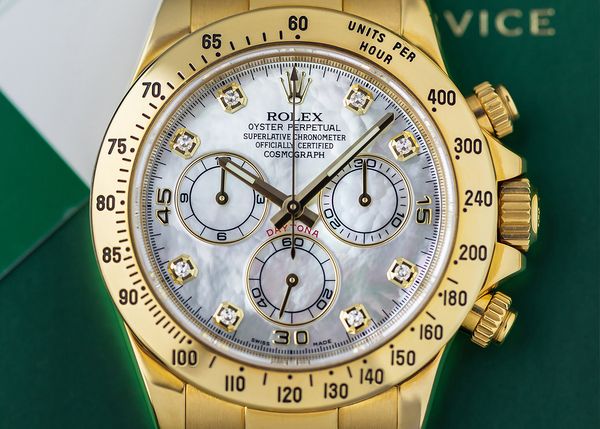
A Rolex Cosmograph Daytona Ref. 116528 in 18k yellow gold with a white mother-of-pearl dial. Available now from Phillips PERPETUAL: Price: £45,000
What Is Mother-Of-Pearl?
Mother of pearl is one of the most common exotic natural materials you’ll find in watchmaking. It’s also one of the most misunderstood. Unfairly stigmatized as solely the province of smaller-diameter ladies’ wristwatches, mother-of-pearl is also known as nacre, a material that occurs naturally inside certain mollusks. Yes, if you happen across a nautilus shell or pearl oyster (careful, these aren’t the edible variety) next time you’re at the beach, go ahead and crack it open – you might discover the iridescent multicolor sheen of nacre inside.
Humans have been using nacre as a decorative material since the Bronze Age. The brilliant rainbow shine of the substance must have seemed like complete magic centuries ago, and scientists still aren’t exactly sure of what causes it to appear inside mollusk shells.
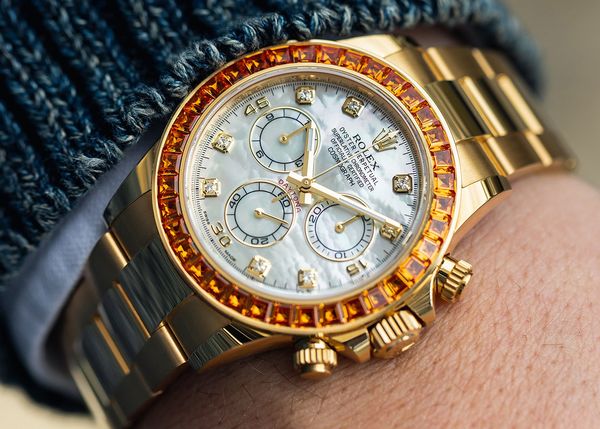
A Rolex Cosmograph Daytona Ref. 116578SACO available from Phillips PERPETUAL. Price: £325,000
In the world of watchmaking, mother-of-pearl is most frequently found as a dial material. Although nacre is actually quite hard and doesn’t shatter easily in its natural form, it has to be trimmed into a disc less than half a millimeter in height before it ends up inside of a watch. True story: While touring a Swiss dialmaking facility in Switzerland a few years ago, I was shown a mother-of-pearl dial with a latticework pattern that measured just 0.16mm in height.
Mollusks are like humans – each one is different, and just like every fingerprint, the specific pattern found on every nacre fragment is completely and entirely unique. Nacre can be found with all sorts of dominant hues – white is the most common, but black, grey, green, purple, red, pink, and orange are all known to appear, among other colors. The quality can also vary wildly between different shells, and the only way to find out is to look inside and check the appearance and condition of each example. For example, I know that at Louis Vuitton, they have to purchase and sort through 200 kilograms of mollusks in order to find 10 mother-of-pearl dials up to their quality standard,
Mother-of-pearl is an attractive and special material, yet it doesn’t carry the same price premium as other potential exotic additions that watchmakers are willing to add to their designs. That combination of beauty and value has made it a popular choice for the countless companies that have introduced new watches with mother-of-pearl dials or sub-dials over the past few decades. F.P. Journe is one maker that I think does a particularly good job, but everyone from A. Lange & Söhne to Patek Philippe has added mother of pearl as a potential dial option for their clients. However, few brands have leaned as hard into the material as Rolex.
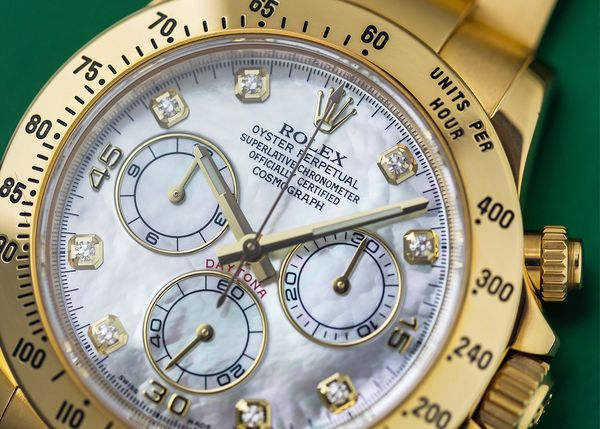
A close-up on the white mother-of-pearl dial of a Rolex Cosmograph Daytona Ref. 116528 in 18k yellow gold. Available now from Phillips PERPETUAL: Price: £45,000
As Arthur discussed in his recent Daytona story, Rolex began to open its brand identity to incorporate concepts of luxury, fashion, and jewelry alongside its historic lineage of reliable tool and sport watches in the 1980s in reaction to the effects the Quartz Revolution had on their business model. Precious-metal cases soon turned up in Rolex catalogs alongside their traditional stainless-steel counterparts. Gems began to creep onto bezels, lugs, and hour markers. And mother-of-pearl dials started to make appearances in various collections, including the Datejust, the Day-Date, and our focus for today: the Cosmograph Daytona.
A Rolex Cosmograph Daytona Ref. 116578SACO
Rolex loves its abbreviations. If you’ve ever heard some watch collector spouting off about BLNRs, LNs, and SARUs, they aren’t speaking in military shorthand, they’re just talking Rolex. Case in point – the bejeweled, mother-of-pearl Daytona seen here that has the four-letter abbreviation “SACO” following its reference number.
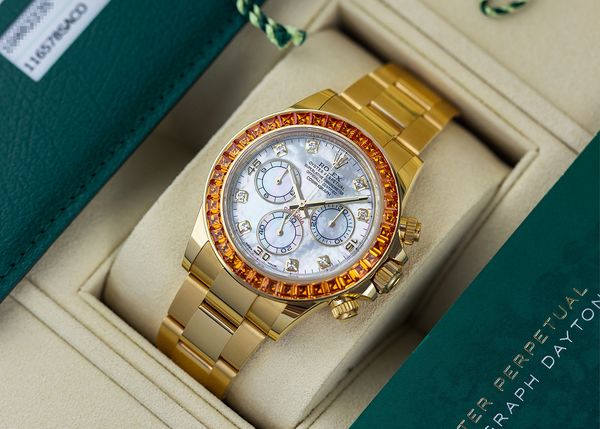
A Rolex Cosmograph Daytona Ref. 116578SACO available from Phillips PERPETUAL. Price: £325,000
Rolex is based in Geneva, so these confusing codes represent a set of French words that describe something specific about the watch. The “LN” I mentioned earlier, for example, stands for Lunette Noir, or black (noir) bezel (lunette). SACO, meanwhile, is Saphirs Cognac, referencing the cognac-colored sapphire stones set on any watch with the label.
Rolex’s first SACO Daytona is a bit on the infamous side: It was the ref. 116598SACO “Leopard” introduced in 2004 and that’s famously owned by Nicolas Cage. However, you might have missed the cognac-tinted sapphires on the bezel of that watch due to the bold leopard-print pattern used on the watch’s dial and strap.
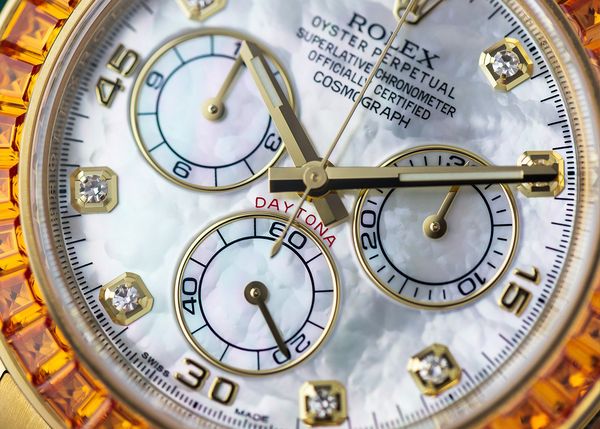
A Rolex Cosmograph Daytona Ref. 116578SACO available from Phillips PERPETUAL. Price: £325,000
Thankfully, in 2019, Rolex went back to the drawing board and brought out the 18k yellow gold Daytona ref. 116578SACO with a perfect mother-of-pearl dial to complement the 36 baguette-cut orange sapphires set on the bezel. Rolex introduced the ref. 116578SACO as an off-catalog variant of its legendary sport chronograph intended for only its very best customers and clients. The currently available example dates to 2020 and comes from a private collector with its original Rolex box, warranty card, and accessories. Price: £325,000
A Rolex Cosmograph Daytona Ref. 116528
Our second Daytona of the day is similar in many ways to the ref. 116578SACO. It has a mother-of-pearl dial. It’s cased in 18k yellow gold. And most importantly, it comes from the same Daytona era, which would be considered the second series of the six-digit generation for the chronograph.
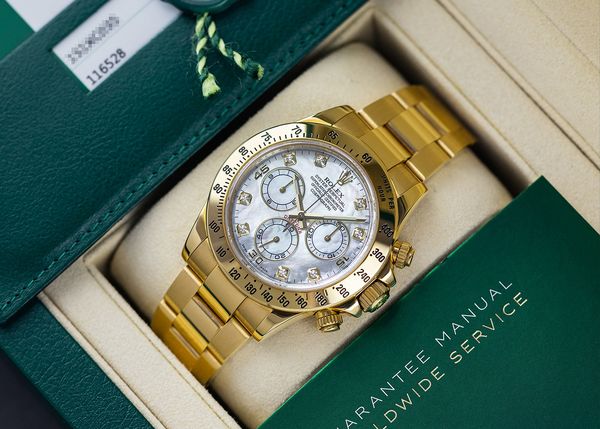
A Rolex Cosmograph Daytona Ref. 116528 in 18k yellow gold with a white mother-of-pearl dial. Available now from Phillips PERPETUAL: Price: £45,000
In fact, the ref. 116528 seen here could be viewed as a milder successor to the wildness of the mid-2000s Daytona “Beach” models, which featured special dials in a number of materials and finishes, including green chrysoprase, blue lacquer, and a pair of mother-of-pearl options, naturally tinted either yellow or pink.
This specific Daytona era was discontinued at Watches & Wonders 2023, with the introduction of the new Daytona series (still in the six-digit generation, but the reference number now starts with 1265XX rather than 1165XX). That said, examples like the ref. 116528 still represent a relative bargain on the market, as they’re less recognizable than a Cerachrom-bezel Daytona and less collectible overall than an older “Zenith” Daytona. If you want a unique precious-metal Daytona and the Beach series is a bit too loud for you, then it’s hard to suggest any model other than the ref. 116528.
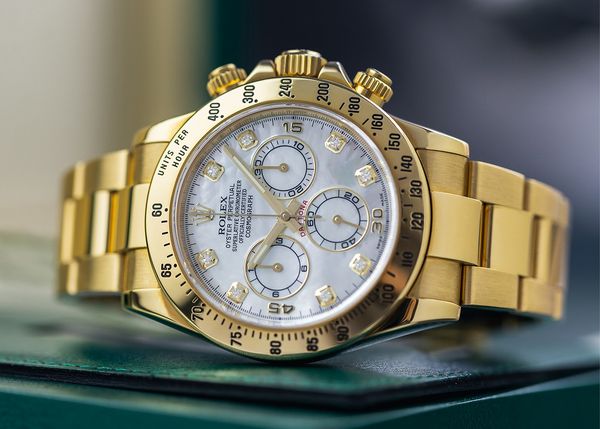
A Rolex Cosmograph Daytona Ref. 116528 in 18k yellow gold with a white mother-of-pearl dial. Available now from Phillips PERPETUAL: Price: £45,000
The example currently available from Perpetual was produced in 2015 and is in excellent overall condition and comes with its full set of accessories, including the International Guarantee and box. Price: £45,000
Phillips PERPETUAL
Phillips PERPETUAL offers a boutique experience to clients for both the sale and purchase of fine and rare watches, in London’s Berkeley Square and the Gstaad Palace, in Switzerland.
About Logan Baker
Logan has spent the past decade reporting on every aspect of the watch business. He joined Phillips in Association with Bacs & Russo at the start of 2023 as the department's Senior Editorial Manager. He splits his time between New York and Geneva.
Visit Phillips PERPETUAL /
30 Berkeley Square, London, United Kingdom, W1J 6EX (map)
Monday through Friday, 10:00 AM – 17:30 PM
Contact & Consignment Enquiries /
00 44 207 901 7916
perpetual@phillips.com
@phillipsperpetual
Discover More from Phillips PERPETUAL >
Recommended Reading
The Spectacular World Of Gem-Set Rolex Daytonas
The Beauty of Natural Hardstone Dials
What Is An ‘Eisenkiesel’ Dial? A Look At Rolex’s Underrated Day-Date Alternative