|
PHILLIPS TO PRESENT MODERN & CONTEMPORARY ART SALES IN HONG KONG ON 29 MARCH DURING HONG KONG ART WEEK
A Curated Dialogue: Evening Sale to Feature Exceptional Works by Pierre-Auguste Renoir, Yayoi Kusama, Tracey Emin, and Liu Dan, Alongside Leading Contemporary Voices Nicolas Party, Adam Pendleton, and Robin F. Williams
Danielle So, Hong Kong Head of Auctions, Modern & Contemporary Art, Phillips, and Rebecca Hu, Head of Sale, Modern & Contemporary Art, Phillips Hong Kong, jointly said: “We are thrilled to present this season’s Modern & Contemporary Art Sales during Hong Kong Art Week— a defining moment in Asia’s cultural calendar. This season, we bring together exceptional works that speak across generations and geographies: from Renoir’s luminous Mediterranean landscapes and Kusama’s poetic late canvases, to Chen Yifei’s nostalgic Water Villages, and Murakami’s vibrant reimagining of Mr. DOB. Anchored by exceptional provenance and presented alongside today’s most dynamic contemporary voices, this sale offers collectors a unique opportunity to acquire works that embody cultural dialogue, market significance, and the enduring power of artistic legacy.”
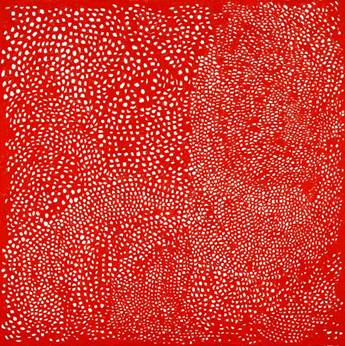
Modern & Contemporary Art Evening Sale: 29 March, 4PM HKT A leading highlight of the Evening Sale is Yayoi Kusama’s Sunset Afterglow Inside My Heart (illustrated page 1), a work of exceptional rarity appearing at auction for the very first time. Acquired directly from Ota Fine Arts, Kusama’s long-standing primary gallery, the painting enters the market with impeccable provenance. Distinguished by its evocative, poetic title—a significant departure from the alphanumeric codes typically associated with her Infinity Nets series—the work occupies a unique space in Kusama’s oeuvre. Executed in her signature red-and-white palette, the canvas reverberates with the history of her practice. It recalls both the stark minimalism of her breakthrough white-on-white nets from the 1960s and the visceral, accumulative energy of her early soft sculptures. Here, the colour red is more than pigment; it is a symbol of vitality, the intensity of the sun, and the artist’s own obsessive creative force. Created in 2020, Sunset Afterglow Inside My Heart resonates deeply with its context of creation. Painted during the global upheaval of the pandemic, when the artist was confined to her studio, the work stands as a powerful testament to resilience. In its confident late style, this painting unites personal narrative, historical moment, and artistic innovation, offering collectors an intimate encounter with a major artist of our time.
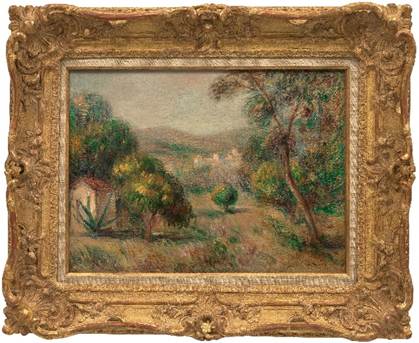
Pierre-Auguste Renoir, a founding master of Impressionism, is widely celebrated for his intimate and tender depictions of the figure. Yet, in the final decades of his career, a profound transformation took place. Seeking respite from the damp climate of northern France, he settled on the radiant Mediterranean coast, where the ancient olive tree—a symbol of resilience and timelessness—emerged as the defining motif of his late period. Around 1901, Renoir reached a pivotal turning point. Moving decisively away from Impressionism’s fascination with modern urban life, he embraced the serene, classical temperament of the southern French landscape. For the artist, landscape was never a secondary genre; rather, it served as the ultimate touchstone for refining his formal and chromatic vision. In Paysage aux oliviers Heart (illustrated page 1), vegetation, light, and atmosphere coalesce into a luminous tapestry of colour, exemplifying the full maturity of his late style. Works devoted explicitly to olive groves by Renoir are exceptionally rare, with only four examples ever appearing at auction. This particular canvas is distinguished not only by its subject but by its impeccable provenance. Acquired in 1953 by the legendary Harry Oppenheimer, it was part of an outstanding collection of Impressionist art assembled by him and his wife—a testament to the work’s enduring quality and historical importance.
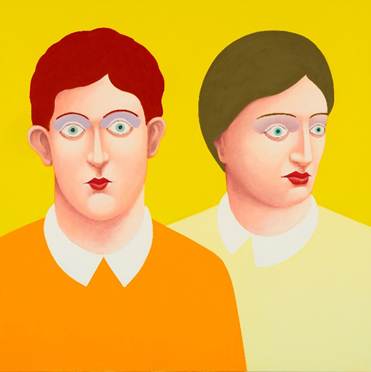
Two Portraits, a standout example from this season’s Evening Sale, showcases Nicolas Party’s virtuosic command of colour and form. Scintillating citrus tones—zest-infused yellows and luminous oranges—animate the composition, amplifying the presence of his enigmatic figures. Rendered with painterly precision, the subjects are devoid of extraneous detail yet rich with psychological ambiguity. Androgynous and anonymous, they occupy a liminal space between familiarity and strangeness, inviting contemplation rather than resolution. In this work, Party underscores his ongoing interrogation of the very building blocks of painting. Colour is not merely descriptive but structural; form is both simplified and charged with meaning. Two Portraits exemplifies the magnetic pull of his practice—a practice that continues to captivate audiences by making the classical feel radically new.
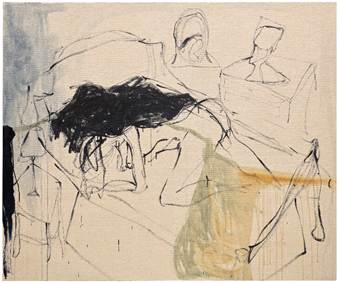
Tracey Emin, stands as one of the most influential figures in contemporary British art, having spent decades redefining the boundaries of confessional practice through work that is at once deeply personal and uncompromisingly honest. Painted in 2022, I See the Mirror emerges from what is widely regarded as her most critically acclaimed period—a profound creative rebirth following her battle with aggressive cancer in 2020. In this new chapter, mortality, vulnerability, and resilience dominate her large-scale canvases, rendered with an urgency that has captivated audiences and critics alike. The painting’s significance is already underscored by its prominent inclusion in You Should Have Saved Me, Emin’s introspective solo exhibition at Galleria Lorcan O’Neill in Rome (2023). Yet its importance extends far beyond that presentation, I See the Mirror arrives at a moment of unprecedented institutional recognition for the artist, culminating in A Second Life, a monumental retrospective at Tate Modern, London (February–September 2026)—the largest exhibition of Emin’s career to date.
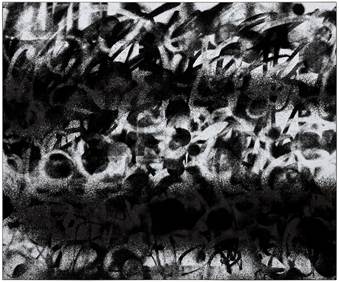
Adam Pendleton, one of the most incisive voices in contemporary American art, brings his conceptual rigor to Untitled (Days), featured in this season’s Evening Sale. Known for his groundbreaking “Black Dada” framework and landmark institutional exhibitions from MoMA to the Venice Biennale, Pendleton interrogates the intersections of language, identity, and abstraction through layered, contrapuntal fields that resist fixed meaning. In Untitled (Days), arching forms dissolve into dense sprays of black, culminating in a near‑void punctuated by drips—an achromatic surface that documents the artist’s daily practice while embodying his refusal of narrative closure. Held in major museum collections worldwide, Pendleton’s work continues to redefine abstraction as a mode of cultural critique and artistic resistance.
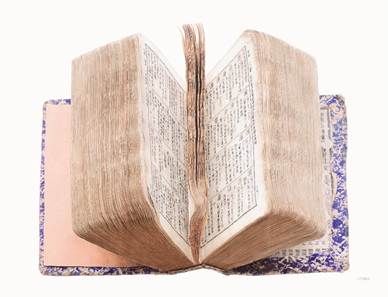
Liu Dan is widely regarded as one of the most influential figures in contemporary Chinese ink painting. With exceptional scholarly depth and a singular artistic vision, he has redefined the possibilities of ink art on the global stage. Dictionary, offered in this season’s Evening Sale, exemplifies the full scope of his transformative power. In this work, Liu masterfully harnesses traditional Chinese ink techniques to challenge conventional perceptions of reality. Its monumental scale is striking: an ordinary pocket dictionary used by elementary school students is dramatically enlarged, overturning familiar modes of viewing and transforming a humble object into a majestic, immersive visual experience. Yet the true brilliance of the piece lies in its synthesis of opposing forces. Liu renders his subject with a precision that approaches photorealism, while every brushstroke remains deeply rooted in the lyrical subtlety and refined spirit of classical Chinese tradition.
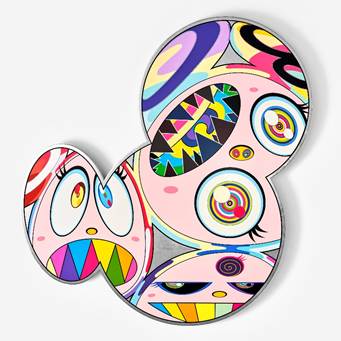
Takashi Murakami’s Untitled exemplifies the artist’s Superflat aesthetic at its most dynamic—a seamless collision of high art and mass culture mediated through his enduring alter ego, Mr. DOB. First introduced in 1993, Mr. DOB has evolved into a cornerstone of Murakami’s practice, embodying the contradictions between playful pop sensibility and unsettling psychological depth. In this large canvas, three kaleidoscopic faces crowd the frame, their vibrant, candy-like hues offset by jagged teeth and manic expressions that disrupt surface exuberance with an undercurrent of tension. The work’s platinum leaf background—a deliberate invocation of traditional Japanese decorative arts—heightens this cultural irony, juxtaposing historic materiality with the deliberate flatness of industrial production. Here, luxury and mass reproduction collide. Exhibited in the landmark Baka show at Galerie Perrotin’s historic Salle de Bal in Paris, Untitled represents a rare and significant reimagining of Murakami’s most recognisable motif.
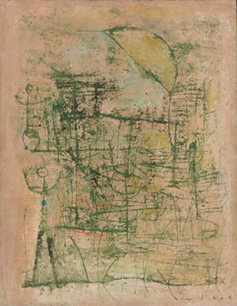
Zao Wou-ki’s Untitled (Paysage et personnages) captures a defining moment in the artist’s journey toward abstraction, created during his celebrated “Grand Tour” of Europe. It was in this period that encounters with Western landscapes and ancient antiquities began reshaping his visual language. In this poetic nocturne, simplified motifs—a pair of figures, clustered dwellings, and a half moon—emerge from layered, textured surfaces that recall ancient Chinese rubbings and bronzes. The brushwork is at once delicate and assured, rooted in Eastern tradition yet responsive to new surroundings. An earthly palette grounds the composition, but it is unexpectedly softened by rosy tints and scattered notes of blue, yellow, red, and green flecks of tenderness and dreamlike fantasy that seem to hover between memory and invention. As a rare early example bridging figuration and abstraction, Untitled (Paysage et personnages) illuminates Zao’s evolving sensibility and the cultural hybridity that would become the hallmark of his signature style. It stands alongside major contemporaneous works in international museums, offering a rare glimpse of an artist in transition—honoring tradition while moving toward the future.
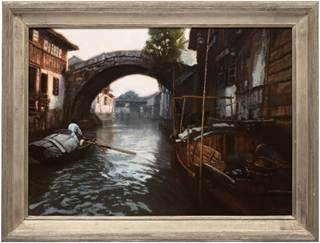
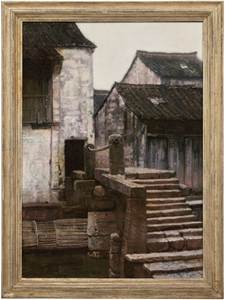
Chen Yifei, one of the most influential figures in modern Chinese art, achieved international acclaim in the 1980s with his Water Village series, works that married nostalgic Jiangnan landscapes with a distinctive soft-focus technique. Created in 1984, Late Afternoon (Suzhou) and The Ancient Stone Bridge (Suzhou) offered in this March’s Hong Kong sale, represent the pinnacle of this period, first unveiled at Hammer Galleries in New York and later exhibited at the Corcoran Gallery of Art. Their debut coincided with Chen’s meteoric rise in the Western art market, underscored in 1985 when Dr. Armand Hammer presented Memory of My Homeland – Double Bridge to Deng Xiaoping as a national gift—cementing his global impact and rarity. These works not only embody Chen’s poetic vision of Jiangnan but also mark a watershed moment when he became the first Chinese artist to ignite a collecting frenzy in the West, making them highly coveted examples of cultural exchange and enduring market prestige.
Additionally, Phillips is delighted to present its first-ever curated collection of “Japan Modern” in this season’s sale, spotlighting five pivotal artists—Ryūzaburō Umehara, Zenzaburō Kojima, Seiji Chōkai, Kazu Wakita, and Saburō Aso—whose works shaped Japan’s modern art history and are housed in major institutions such as The National Museum of Modern Art, Tokyo. Emerging during the Meiji Restoration, “Japan Modern” introduced Western oil painting techniques to Japan while forging a distinctly modern Japanese identity, blending European influences with indigenous traditions like Rinpa and Nanga. This landmark presentation celebrates the profound legacy of these masters, whose innovative approaches laid the foundations for Japan’s vibrant art scene and continue to resonate in contemporary practice.
###
Modern & Contemporary Art Evening Sale: 29 March, 16:00 Modern & Contemporary Art Sale: 29 March, 17:00 Auction Preview: 20-29 March, 11:00-19:00 Location: Phillips Asia Headquarters, GF, WKCDA Tower, West Kowloon Cultural District, No. 8 Austin Road West, Kowloon, Hong Kong
|