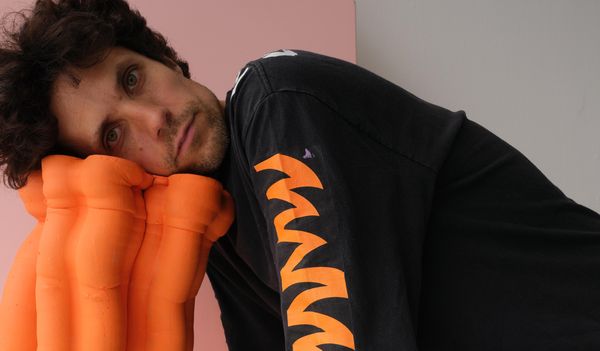
Photo by Erik Wålström
Currently, Stockholm based Swedish-Chilean Anton Alvarez is a 2012 graduate from the Royal College of Art in London. Alvarez originally studied cabinetmaking before completing an Interior Architecture and Furniture Design course at Konstfack. Alvarez’s work focuses on the design of systems and the creation of tools and processes for producing objects and architecture. Alvarez's work has been exhibited internationally including solo shows at Salon94 in New York, Xue Xue institute in Taipei and Gallery Libby Sellers in London.

THE FLAVOUR IS SO STRONG—Larsen Warner (2019). Photo by Carl Kleiner
PHILLIPS: Is there a specific space or object within your home or studio that you draw inspiration from, or return to, when thinking about new ideas for your work?
ANTON ALVAREZ: In my work, I really like the aspect of things looking like they were made by themselves. I have a coral stone that had been washed up by the sea for a very long time that almost looks like a brain. It has these very intricate textures and I think whenever I make a piece with a ceramic process that it should look like something that was made by nature. I try to direct my work a little bit but I also want it to happen by chance. And when it's successful, I feel like the piece looks like it was made by itself rather than by somebody.
I also think that my process is almost like walking on the beach for me. When I'm working in my studio it’s more about me making the decision if I should keep it or not— things go south and then I put it back into the machine and it comes out again, and it's like searching for something. I don't always know what it is, but it's like strolling and having a daily routine, and then suddenly something appears—it's very important for me.

THREAD WRAPPING ARCHITECTURE—Gustavsbergs Konsthall, Stockholm, Sweden (2014). Photo by Märta Thisner
P: When deciding what materials you use in your work, what are the most important factors you consider? Are there any materials you'd like to explore next that you haven't tried yet?
AA: Since graduating from the Royal College of Art in 2012, I've been working with materials that a person can relate to easily. I used to work as a cabinet maker and I’ve found that making furniture out of wood is a material that people can understand. They can see a tree that they have some kind of relationship to, they can understand this object is made out of wood and know what the material is.
I've also worked with the thread wrapping machine—an invention of my own. The machine uses threads and textiles something that we wear every day. It’s awesome material, which is easily relatable to everybody and everyone has their own emotions about these materials. I work with ceramics because these are materials we use every day with plates, in a bathroom, a sink, a toilet, etc.—we interact with these every day. Most people have touched a piece of clay, then it's processed and then it becomes eternal. I like materials that people can relate to in different ways, I think it builds up a very good connection for the audience. They can emotionally and intellectually relate to what they're looking at.

THREAD WRAPPING ARCHITECTURE—Gustavsbergs Konsthall, Stockholm, Sweden (2014). Photo by Katrin Grejling
P: What challenges do you often face in your creative process?
AA: I often don't know what will come out of an initial idea. But I like that because if I try too hard to visualize it in my head, it's almost like it already exists. I like the unexpected aspect of my work. I want to find and encounter new things that I haven't seen and it's a challenge, of course. After a while I might get used to it, I might understand it, I might be able to master the process; that’s when I usually try to add another thing into the process in order to achieve that new unexpected result.
P: Having to step away from your usual day to day schedule, is there a book/film/project you’ll take this opportunity to begin (or return to)?
AA: Right now, I'm building this pizza oven for us to enjoy with family and friends. I'm digging out soil, drying the clay and then I'm going to mix it with water and grass to strengthen it. When I was in Chile, my father's home country, my uncle was building a house out of clay and he mixed a lot of dry grass into the clay to prevent it from cracking and I thought that was a good idea. So, the pizza oven is a smaller, ongoing project.
I also love music. When I draw sometimes, I have music on in the background, but if I’m creating something more complex that I want to understand spatially I can't listen to music, I get too distracted. I want complete silence. But I think music is very important to help you get inspired.

ALPHABET AEROBICS—National Centre for Craft and Design Sleaford, UK (2016).
Photos by Märta Thisner
P: Where is the future of your practice headed?
AA: That’s something that I'm exploring right now and I'm not sure. My first project within this series of works with machines involved a thread wrapping machine, which I loved because I was a craftsperson operating with this machine together. So, I made a machine, a clay extruder, placed it in a museum and the staff used the machine to create work and then I took it back because they looked so fantastic! That's what I did last year. But I think a project that interests me right now excludes the middleman, in this case, me, and see if I can create a process that is totally autonomous from human decisions. As I said before, I really love it when objects look like they were made by themselves. If that's possible to achieve then it’s something that I'd like to try and explore at the moment.