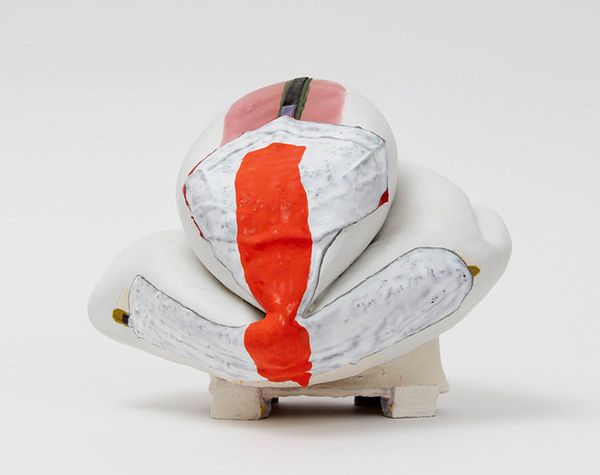
Kathy Butterly “Orange Tilt” clay and glaze.
For over twenty years, ceramist Kathy Butterly has created intimate works—in size and subject—that continually surprise and delight. Her contorted vessel-like pieces often draw references to bodily forms such as lips, necks and mouths, and the intimate scale of her work (often measuring no more than 8 inches in height) draws in the viewer to observe her mesmerizing glazes and complex forms. Butterly typically only creates about a dozen pieces each year due to her trial-and-error working method: she glazes and fires and reshapes each piece dozens of times until she is satisfied with the outcome. This process, though intensive, helps to explain why one critic called her “today’s liveliest master of clay” and why her work continues to stretch the material and conceptual possibilities of the medium. Butterly’s work is in the permanent collections of multiple institutions, including the Museum of Fine Arts, Houston, the Museum of Modern Art, New York, and the Carnegie Museum of Art, Pittsburgh.
With a Los Angeles exhibition on the horizon this fall, Kathy Butterly invited us into her New York City studio for a look at her recent work and a brief conversation about her practice.

Kathy Butterly “Distraction” clay and glaze.
PHILLIPS: Is there a specific space or object within your home or studio that you draw inspiration from, or return to, when thinking about new ideas for your work?
KATHY BUTTERLY: I live and work in the East Village, NYC. I’ve been in this space for just about 25 years now. I am extremely fortunate and grateful, especially now, to be able to walk from my living space to my studio. My studio is my favorite place to be. I spend most of my time here. I’ve made it a space that feels good to be in. I don’t get my ideas from specifics - more from just being alive at this moment and reflecting my feelings and observations. Living in NYC is ultra stimulating. I get to go to the Met, the Whitney, MoMA, etc., whenever I feel the need and to visit galleries to see what is current. Most of my friends are artists, including my husband, so thoughts are being shared. The reason my studio is so important to me is that within this bustling city I have a private space where I can go deep into my psyche, tune out or tune in the world and make the work that I need to make. I listen to public radio most of the time so current affairs and politics are on my mind a lot and strongly influence my work. It is not overt but felt.
P: When deciding which materials you use in your work, what are the most important factors you consider? Are there any materials you’d like to explore next that you haven’t tried yet?
KB: I have limited myself to ceramic materials. I’d like to emphasize that by limiting the materials that I use I get to explore my materials deeply. I have an understanding and a relationship with clay and glaze that has been getting richer and more meaningful to me over time. Each glaze and color has a unique personality and temperament and I really enjoy the challenges they present and the doors they open for me.
I also do works on paper and have chosen to use nail polish as my medium. Nail polish is glaze-like in a way. I can obtain nuances like I do in glazes and I love the fact that I can see the process happen before my eyes and to make a piece in one day. My ceramic pieces take between 6 months to a year and a half to make and I make about 12-15 in a year. I fire them between 15-40 times in the kiln so working on the paper pieces gives me a bit of immediate gratification.

Kathy Butterly “Brink” clay and glaze.
P: What challenges do you often face in your design or creative process?
KB: I think that I have two main challenges: physics and time.
Physics - because of repetitive firings. I have learned how to fire my pieces multiple times to roughly 1800 degrees. With each firing the pieces are put under tremendous stress, many things can go wrong - the biggest worry would be a structural crack. As my work gets larger the physical stress within the works changes so I’ve had to figure out how to make the works evolve to meet this new challenge.
Time - I hand-carve each tiny detail on my works. A strand of ‘beads’ can take 2-3 weeks to complete working 8 hours a day and pretty much 7 days a week - I carve them with a tiny pin. A clean line can take a day or two… I need them to feel right. Why bother making something if it doesn’t speak or feel right? As I mentioned earlier, the works are reflections of ‘now’ so my pieces are getting much more complicated and larger, thus they are taking so much longer to complete. As the world seems to be getting more complicated, more overwhelming, so do the pieces.
P: Having to step away from your usual day to day schedule, is there a book/film/project you’ll take this opportunity to begin (or return to)?
KB: For me, getting out of the day to day is to be in nature, which is a little tough right now. But in my studio, I have plants that I love to watch grow. During the summers my family goes to a small home we have in Maine. I have a tiny studio there in a meadow... I am surrounded by nature and I love every minute of it. My favorite thing to do extracurricular up there is to take long bike rides on isolated country roads. I enjoy taking the same ride almost every day - it’s about a 13-mile trip.
Though it’s familiar, it changes each day; I like to observe the subtle changes that happen. One day the forest smells extra pine-y because it rained the night before and the humidity brought out the smell, or I watch a field of flowers bloom, smell glorious then wilt and ultimately dry out and smell like sweet hay. It makes me feel very connected to a world distant from the city -- and one that I need.
For now, in the city, I am making my way through Ninth Street Women by Mary Gabriel - it’s great.

Kathy Butterly "New Space Place" clay and glaze.
P: Where is the future of your practice headed?
KB: It’s hard to say where it will go. For now, it is getting a little larger and more complicated. One clear observation that I had this past year was a shift in the bases. My current works are involving a cubed base. Past works had very individualized bases, but now I see them being on podiums. I see the square bases representing a podium for the work to stand on and speak.
Kathy Butterly at James Cohan (NY) >
Kathy Butterly at Shoshana Wayne Gallery (LA) >