
Lee Krasner’s Lame Shadow, 1955 belongs to a discrete series of five works, which have been lauded as her “most commanding artistic statements” (Ellen G. Landau, Lee Krasner: A Catalogue Raisonné, New York, 1995, p. 146). Executed on top of paintings from her 1951 exhibition at Betty Parsons Gallery, New York, these works were made on a monumental scale, showcasing the artist’s expert use of materials to create depth in abstraction. In the present work, Krasner collaged heavy black photographic paper and fraying pieces of canvas resulting in a composition that is both gestural and organic. Inspired by Henri Matisse’s late cut-out paper collages as well as the Cubist compositions of her predecessors, Krasner’s 1955 collages were a turning point in her career. Signified by her acclaimed show at the Stable Gallery, New York that same year, her important position in post-war abstraction has solidified with numerous international exhibitions, most recently her celebrated retrospective held at the Barbican Centre, London earlier this year. With two other works from this small series housed in the collections of the Albright-Knox Gallery, Buffalo and University Art Museum, California State University, Long Beach, Lame Shadow is the first of these large-scale 1955 works to come to auction.
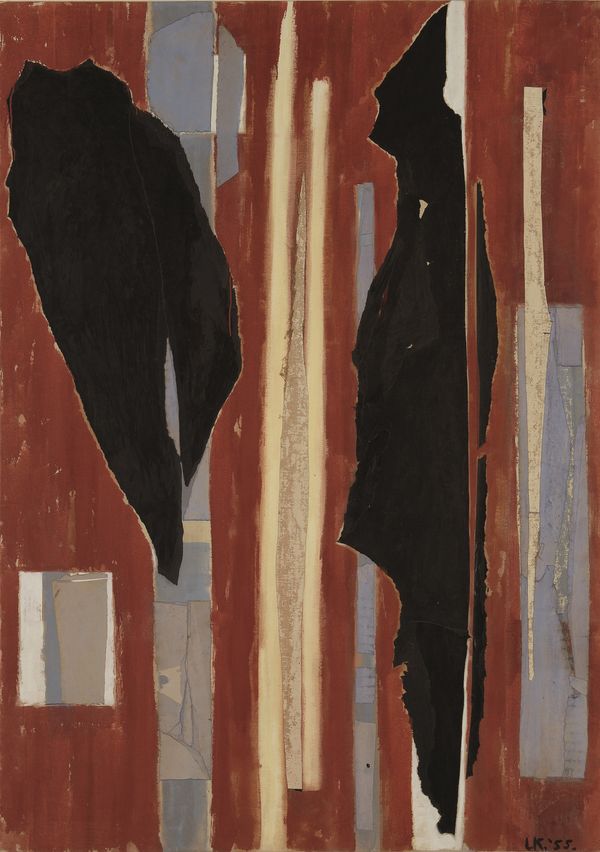
Lee Krasner Lame Shadow, 1955
Of the origin of her process in these works, Krasner said she saw “a lot of things there [her studio] that began to interest me. I began picking up torn pieces of my own drawings and re-gluing them. Then I start cutting up some of my oil paintings. I’ve got something going here and I start pulling out a lot of raw canvases and slashing [them] as well” (Lee Krasner, quoted in Cindy Nemser, “A Conversation with Lee Krasner”, Arts Magazine, April 1973, p. 45). While her collages from earlier in the decade were comprised of fragments of her own drawings and those of paintings by her husband Jackson Pollock on top of blank canvases, Lame Shadow and its four companion works are unique for their support – existing paintings. After mixed reviews from her 1951 show, Krasner retired the paintings exhibited, each vertically oriented and measuring over six feet in height, and left them abandoned in her studio for a few years. Only two of the 14 works shown at Betty Parsons Gallery are extant in their original state, and only one of the five used in the 1955 collages can be matched to its original painting. Through paint and assemblage, Krasner altered their surfaces so much that they were transformed into completely different masterworks. Of their autobiographical nature, Krasner said “If I’m going back on myself, I’d like to think it’s a form of growth” (Lee Krasner, quoted in Barbara Novak, “Lee Krasner Interview”, WGBH, Boston, October 1979).
If I’m going back on myself, I’d like to think it’s a form of growth. – Lee Krasner
The human presence in Lame Shadow is felt not only in the central pseudo-figurative forms, but perhaps even more so in the palpability of its surface, reminding us of Krasner’s own laborious process. This is aptly described by Robertson on the occasion of Robert Miller Gallery’s exhibition of her collages in 1986, including the present work: “It is clear that these grandly composed works marked a decisive break in Krasner’s evolution and led to some of her grandest paintings almost immediately afterward. Both the big collages and the paintings of this period are conspicuous for a new scale in which another kind of physicality is projected into the design through the dimensions and scale of Krasner’s own body” (Bryan Robertson, Lee Krasner: Collages, exh. cat., Robert Miller Gallery, New York, 1986, n.p.). It was these qualities that brought Clement Greenberg to call works like Lame Shadow “a major addition to the art scene of that era,” an influence which has continued to have a lasting impact today (Clement Greenberg, quoted in Lee Krasner, Paintings, Drawings, and Collages, exh. cat., Whitechapel Art Gallery, London, 1965, n.p.).
Inquiries
Amanda Lo Iacono
Head of Evening Sale
aloiacono@phillips.com
+1 212 940 1278
Browse more highlights from our 20th Century & Contemporary Art Evening Sale >