
Richard Meyer, co-author of Phaidon's Art & Queer Culture
Phaidon's Art & Queer Culture is one of the most extensive surveys of LGBT art and artists over the last two centuries. Originally published in 2013, scholars Richard Meyer and Catherine Lord joined a group of new contributors—all themselves gay, lesbian, queer and trans—to re-release an edited and updated second edition earlier this year. We sat down with Richard Meyer to find out more about the book's genesis and its place in the current discourse.
PHILLIPS: When did you decide you wanted to write this book? What was the process of partnering with Catherine Lord on both the original and revised editions?
RICHARD MEYER: The original book was 10 years in the making. It started when Catherine and I were both working on essays for Wack! Art and the Feminist Revolution, a breakthrough exhibition and book organized by Connie Butler that looked at the worldwide power of feminism in shaping art in the late 1960s and 70s. At a break during a meeting of the contributors to the catalogue, Catherine and I fantasized about how great it would be if such a project existed for queer art and culture. We decided that the only way to turn fantasy into reality was to do it ourselves. We began meeting every two weeks or so in her house or mine (we both lived in L.A. at the time) and our project ultimately took the form of a massive exhibition in book form. We called ourselves “curatorially promiscuous” because we included both vanguard and amateur art, canonical and underground work, and everything from abstract paintings to activist posters. The art ranges from the late 19th century to the present because this was the only way to do justice to the historical sweep and influence of queer culture across the world.

Catherine was committed to other projects when the opportunity to do this updated edition of the book to celebrate the 50th anniversary of Stonewall. I knew I could only cover recent work by, once again, collaborating with other queer critics and scholars. So I invited four cutting-edge contributors—Jon Davies, Alexis Bard Johnson, Cyle Metzger, and David Román—to join me in working on the new edition. They brought expertise and insights into contemporary, global, queer, and trans artists that has transformed the book.
P: You and your co-author tackle two distinct time periods separately. Why did you want to explore the earlier half, from 1885-1979?
RM: Catherine and I had different views of what would be the most strikingly “queer” part of the book. I thought that the most historically remote works would be most memorable to readers because of the ways in which queer culture has so often been presented as a post-Stonewall (post-1969) invention. Catherine felt that the more contemporary work would be especially compelling because of the explosion of queer art and artists in the recent past and their global reach. Although I wrote about a much longer chronological period than Catherine, the art reproduced in the book are almost evenly divided between pre- and post-1979. We simply couldn’t find as much work in earlier historical moments. This made the work we did find, to my mind, all the more precious and all the more queer in the sense of flamboyantly non-normative.

P: How did writing a such a broad survey differ from writing a book that focuses on one artist or movement? Was this book something you've always wanted to do?
RM: I never imagined writing a book that would be so wide-ranging and far-reaching, whether in terms of the number of artists discussed, their national origins, or the chronological period covered. Neither Catherine nor I could (or would) have done this book alone. And neither of us felt that it should be written by an individual person—whether male or female, lesbian, gay, trans or otherwise-identified. We strongly believed in the idea that the book—like queer culture itself—should arise out of collaboration, dialogue, and, occasionally, dispute.
P: Was it a challenge deciding which artwork to feature for each artist in the book?
RM: Yes, extremely so. At a certain point we decided the every artist, no matter how famous or influential (e.g. Warhol, Mapplethorpe, Catherine Opie) would be permitted only one work in the book. This allowed us to include over 275 different makers and a much wider range of art—high and low, anonymous and than would have otherwise been possible.
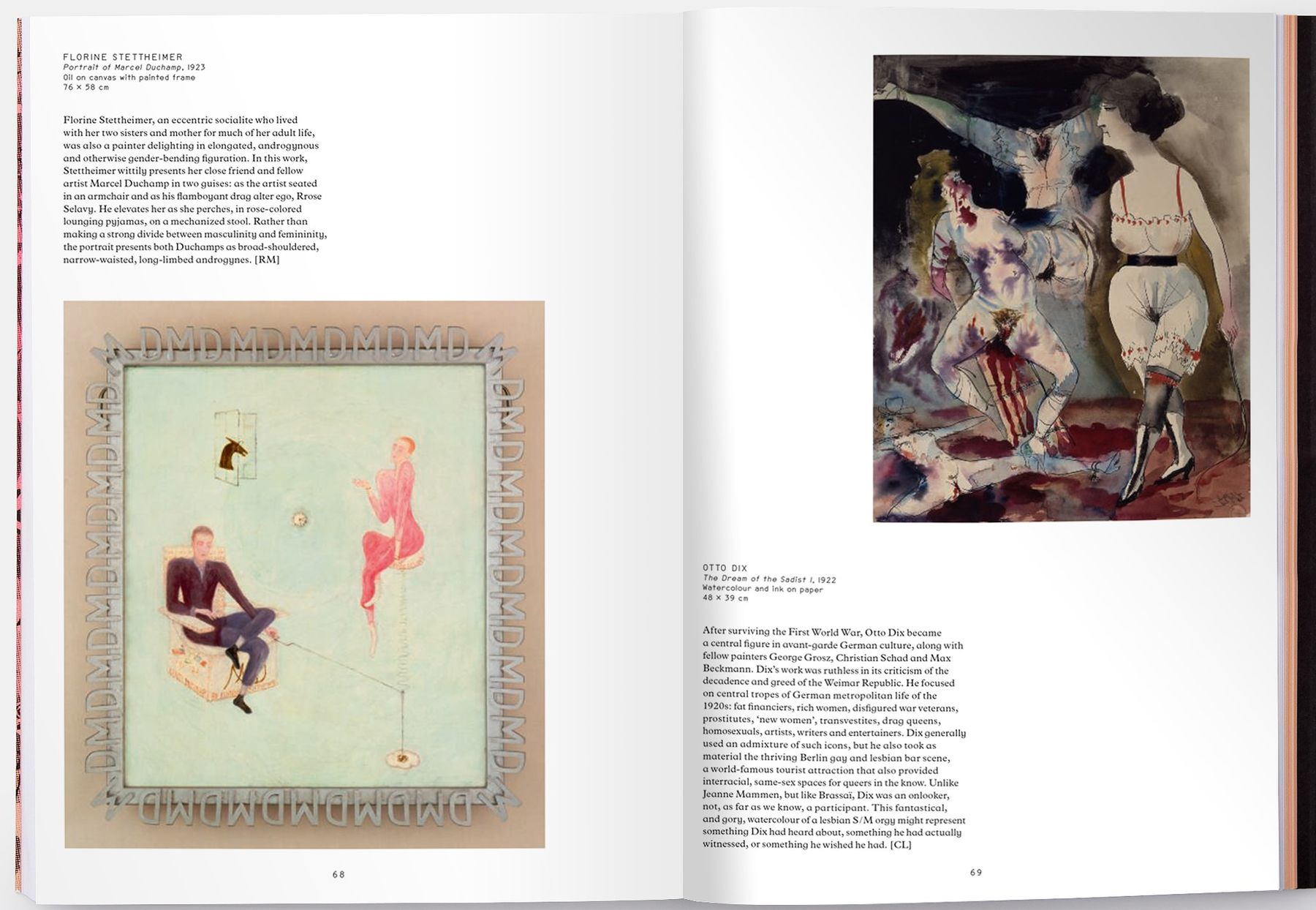
P: Looking across such a wide time frame, what patterns did you notice? How, if at all, does history continue to repeat itself today?
RM: It’s extremely difficult to name a pattern that obtains to more than 130 years of art and queer life. Both Catherine and I noticed, however, how often queer culture appropriated the stigmas and stereotypes imposed on homosexuality to produce counter-representations . In a response to social structures that framed queers as sinful, criminal, sick, or aberrant, artists reworked these terms to their own creative purpose. Rather than trying to assimilate to the norm, queer art has often embraced extravagant difference, including the difference of being outcast from the mainstream. To take but one example discussed in the book, a painting by the artistic duo McDermott and McGough from 1986 titled A Friend of Dorothy, 1943 reworks a litany of phobic epithets—“faggot, fairy, pansy, cocksucker” into a lovingly scripted array of decorative flamboyance. What should be degrading becomes, against the odds, a form of fabulous defiance. And that is what art and queer culture has often achieved over the course of more than a century. And why it continues to inspire us.