Article | First Reveal David Hammons On View At The Box
First Reveal: David Hammons on View at the Box
Each Friday through 19 April, we’re unveiling works from our upcoming 20th Century & Contemporary Art Day & Evening Sales in New York. Next up in the Box @ Phillips, we're highlighting a David Hammons tarp painting that exemplifies his signature critique of the art world.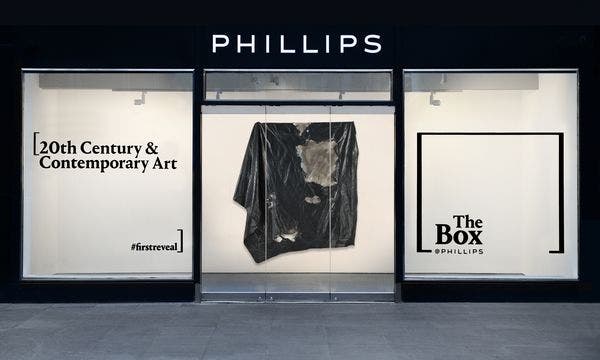
A powerful example of the artist’s acclaimed series of tarp paintings, David Hammons’ Untitled combines a half-painted canvas marked with silvery brushstrokes with a plastic tarp, straddling the line between sculpture and painting, high art and the everyday. One of the most relevant and influential artists working today, David Hammons has spent the past five decades constructing deeply insightful works that reflect on the dynamics of race and power in America, in an enduring critique of institutional elitism and the art world. Shortly after this work was shown in a 2011 exhibition of his tarp paintings at L&M Arts, a work from this series was acquired by the Museum of Modern Art, New York for their permanent collection.
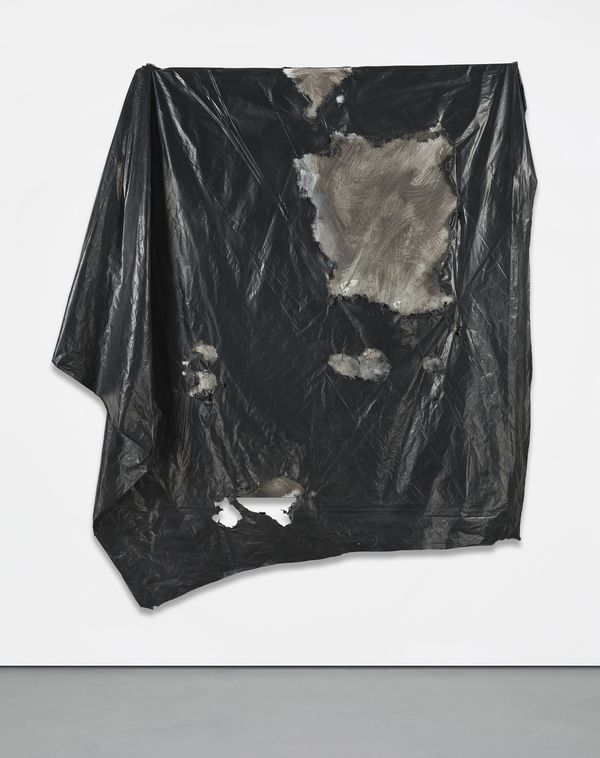
David Hammons Untitled, 2008
“Nearly every one of these works belongs in a museum, in a room of its own. Any other art juxtaposed with it would curl up and die.” – The New Yorker
Though strikingly elegant in form, the work possesses an undeniable rawness achieved through the artist’s characteristic use of found or ephemeral materials through the industrial plastic tarp. By cloaking the canvas, marked in Abstract Expressionist brushstrokes, in this quotidian material, Hammons challenges the established hierarchies of the canvas. The act of draping references Classical Greek sculpture and the female nude, which was traditionally depicted draped in a long robe. In Untitled, the veiled painting is a substitute for the nude form, shrouded in a cloth that both masks and reveals what lies beneath. Through this wrapping, the painting itself becomes a metaphor for the intangibility of the art world. By replacing the immaculate white marble characteristic of Classical sculpture with a black tarp, Hammons calls attention to the centricity of the white Western experience to the art historical canon, and replaces this with his own bold representation of the historically marginalized, black urban experience. Eschewing the conventional norms of the established art world, Untitled is a daring aesthetic and political statement which exemplifies Hammons’ profound creative defiance towards the conventions and inequalities of our cultural landscape.