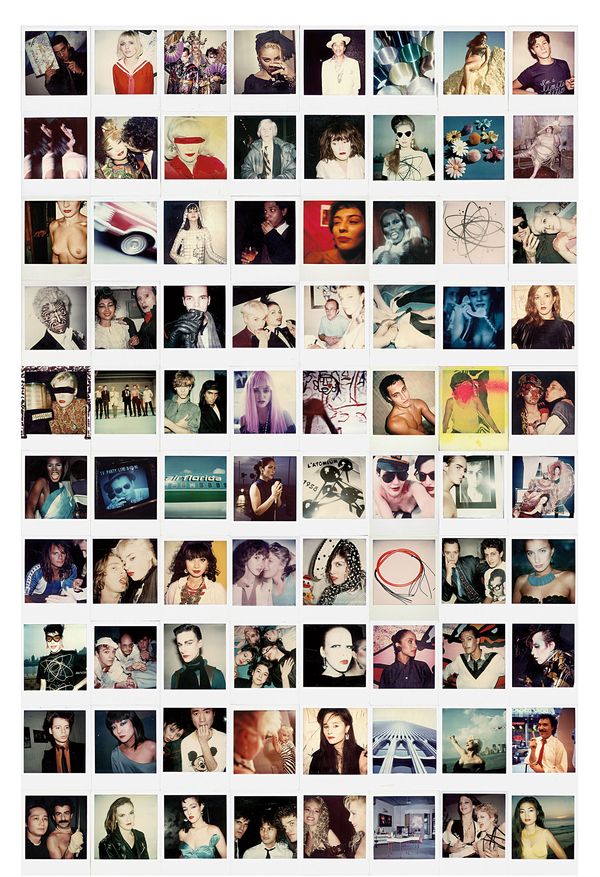
Maripol My 80s, New York, 1977-1989. Archival pigment print of eighty SX-70 Polaroids, flush-mounted, executed 2016.
Maripol, recently described by Vogue as "the Original Club-Kid Selfie Queen", traded Paris for New York in 1976, at the age of 21, and began taking Polaroids a year later, immersing herself in the bright lights of the city and its grimy underground. Working as a stylist and sometimes model, she collaborated with Grace Jones and Blondie and shaped Madonna’s now-iconic look for both her self-titled debut album and it’s follow up Like a Virgin.
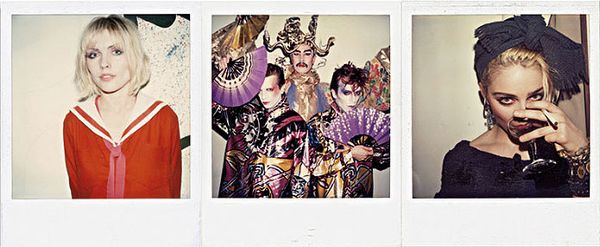
In 1981, Maripol teamed up with her then-boyfriend and photographer Edo Bertoglio, who gave Maripol her frst Polaroid SX-70, to shoot Downtown 81. Written by Glenn O’Brien, the first editor of Interview magazine, and starring a young Jean-Michel Basquiat, the film, only released in 2000, is a day-in-the-life portrait filled with a cast of colorful characters and avant-garde artists of the Lower East Side. Reflecting on the people she knew at the time, Maripol has said, "We were artists but we didn’t really think of that. We were in the moment."
We were artists but we didn’t really think of that. We were in the moment.
—Maripol

Throughout the 1980s, Maripol faithfully carried around her Polaroid camera, shooting her friends, both famous and unknown, and often turning the camera on herself: "I would take Polaroid selfes to express myself—my sorrows, my joys, my sexiness, my love."
She also took pictures of landscapes, interiors and still lifes, ranging from her signature rubber bracelets and other jewellery creations to abstract close-ups of objects. Maripol pushed the boundaries of the Polaroid, experimenting with multiple exposures, and at times scratching the surface of her Polaroids to cross out faces or directly applying ink and paint to them.

Taken during a time when everything seemed to be moving fast, her Polaroids present a world that has become glamorized in our collective imagination. "Certain people make things happen. They see things coming and put this one together with that one," writes Glenn O’Brien for the introduction to her 2005 photobook Maripolarama, "They are secret agents of fate. And that’s what Maripol did and does."