Article | Masahisa Fukase Becoming A Raven
Masahisa Fukase: Becoming a Raven
In the summer of 1976, Masahisa Fukase travelled from Tokyo to his hometown in Hokkaido and began to photograph ravens, an ill omen in Japan. 襟裳岬 [Erimo Misaki] Cape Erimo was taken during this journey that would launch his epic series.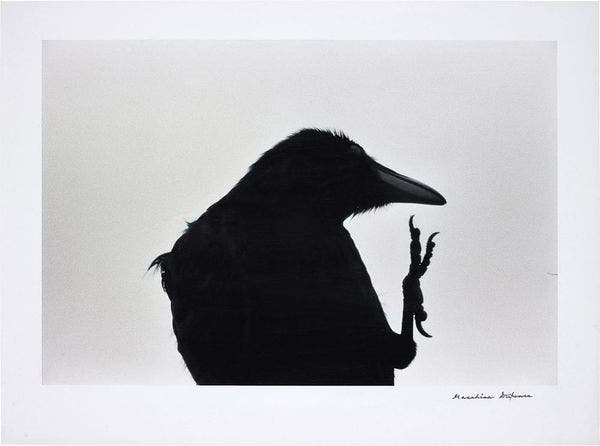
Masahisa Fukase 襟裳岬 [Erimo Misaki] Cape Erimo from 鴉 [Karasu] Ravens, 1976
In the summer of 1976, Masahisa Fukase travelled from Tokyo to his hometown in Hokkaido and began to photograph ravens, an ill omen in Japan. This escape home was precipitated by his divorce from Yoko Wanibe, his muse and wife of 12 tumultuous years. Fukase’s gravitation towards ravens during this period mirrored his own solitude and misfortune. The images of ravens captured by Fukase express the emotions he felt as his personal life collapsed. 襟裳岬 [Erimo Misaki] Cape Erimo, which can be read as a self-portrait, was taken at Cape Erimo in Hokkaido during this journey that would launch his epic Ravens series.
Fukase’s烏 Crows exhibition, the first presentation of his ravens images, opened later that year in October at Nikon Salon in Ginza and then travelled to Nikon Salon in Shinjuku and Osaka. Highly praised in Japan, the exhibition won Fukase the second annual Ina Nobuo Award. Installation shots from the time attest that the image offered here was exhibited only at Ginza Nikon Salon and it is likely that this exhibited print has not survived.
Also in the autumn of 1976, Fukase’s ravens images were published for the first time when they appeared in the monthly magazine Camera Mainichi. Two years later, the influential photobook 洋子 Yohko was produced, publishing the 襟裳岬 [Erimo Misaki] Cape Erimo for the very first time. In this revealing book, the story of Fukase and Yoko’s life together is punctuated by ominous images of ravens. It is unknown whether the actual print of 襟裳岬 [Erimo Misaki] Cape Erimo made for 洋子 Yohko has survived.
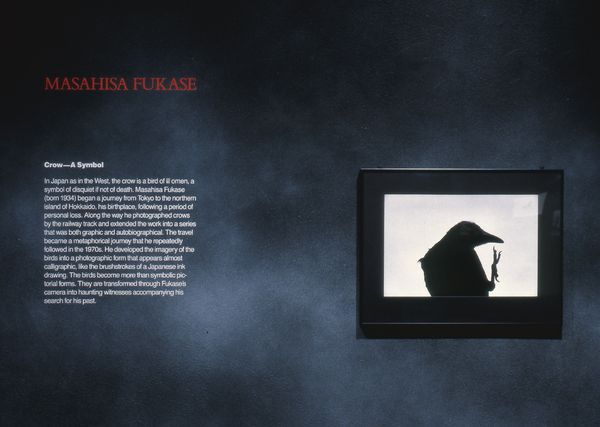
Black Sun: The Eyes of Four Exhibition installation view Philadelphia Museum of Art 1986.
After the 1976 Nikon Salon exhibition and the 1978 publication of 洋子 Yohko, the next opportunity for Fukase to present the image of the lone raven in profle came nearly a decade later for the travelling group exhibition Black Sun: The Eyes of Four, which showcased the work of four masters of Japanese post-war photography: Masahisa Fukase, Eikoh Hosoe, Daido Moriyama and Shomei Tōmatsu.
Opening at the Museum of Modern Art, Oxford in 1985, Black Sun subsequently travelled to four more venues and ended at Baltimore Museum of Art in 1988. For this exhibition, Fukase showed 21 works and made two print sizes: an oversized sheet size of approximately 111.8 x 157.5 cm (44 x 62 in.) and a smaller sheet size of approximately 36.8 x 49.5 cm (14 ½ x 19 ½ in.), which is the same sheet size as the 襟裳岬 [Erimo Misaki] Cape Erimo print offered here. In 1990, following the completion of the exhibition tour, the Philadelphia Museum of Art acquired all 21 of Fukase’s photographs, including a similar-sized print of 襟裳岬 [Erimo Misaki] Cape Erimo. The accompanying book, published by Aperture in 1986, also includes 襟裳岬 [Erimo Misaki] Cape Erimo, however, the current location of the set of prints made for the publication is unknown.
The Ravens themselves weren’t really the point. I myself had become a raven. —Masahisa Fukase
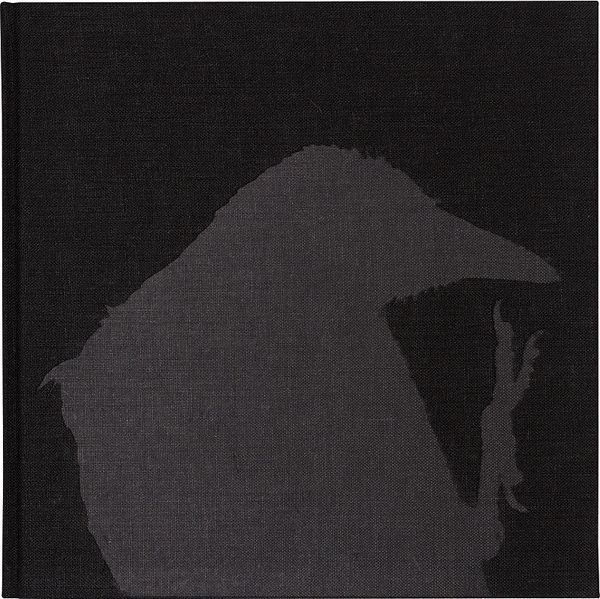
Cover of Masahisa Fukase's photobook 鴉 Ravens, published in 1986.
In December 1986, Fukase published his seminal photobook 鴉 Ravens, cementing this powerfully evocative image of a lone raven in profle, which is blind-stamped on the cover and is the first image reproduced, as an icon of Japanese post-war photography. A set of small prints used for this photobook, including a print of this image, are held privately. The culmination of a six-year obsession with ravens, beginning in 1976 and ending in 1982, 鴉 Ravens was selected as the best photobook published between 1986 and 2009 by the British Journal of Photography.
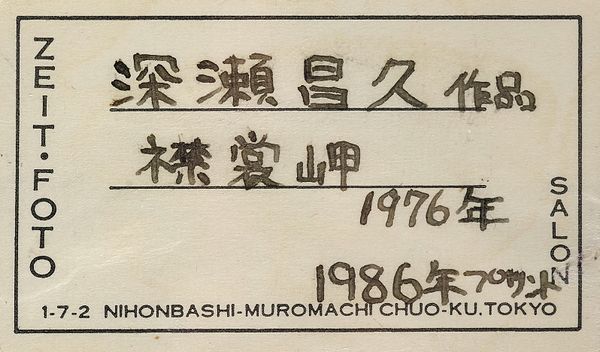
Zeit-Foto Salon gallery label with credit, title, negative and print dates.
To commemorate the launch of 鴉 Ravens, Fukase held a solo show at Zeit-Foto Salon in Tokyo in February 1987. Included in this exhibition was the 襟裳岬 [Erimo Misaki] Cape Erimo offered here, printed in 1986 as indicated by Fukase on the print verso. The accompanying Zeit-Foto Salon gallery label with credit, title, negative and print dates was affixed initially to the reverse of the frame used in the exhibition.
The print offered here was acquired from this show and has been held privately in Japan for nearly 30 years. Appearing at auction for the first time, this photograph is the only known extant large-format exhibition print made by Fukase of this image available for sale.